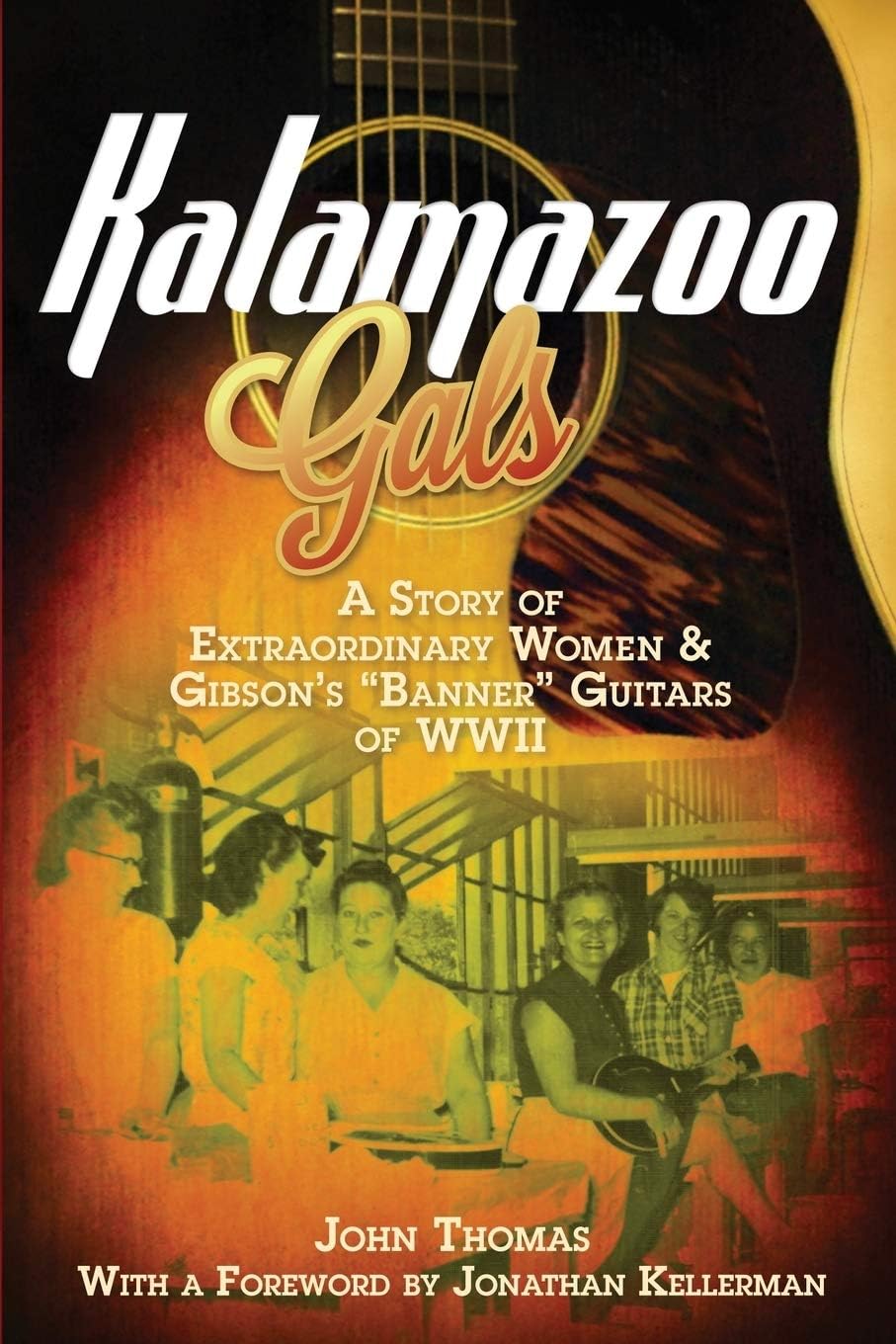
Kalamazoo Gals: A Story of Extraordinary Women & Gibson's "Banner" Guitars of WWII
Product ID: 5351379
Buy anything from 5,000+ international stores. One checkout price. No surprise fees. Join 2M+ shoppers on Desertcart.
Desertcart purchases this item on your behalf and handles shipping, customs, and support to Kyrgyzstan.
Kalamazoo Gals: A Story of Extraordinary Women & Gibson's Banner Guitars of WWII [John Thomas, Jonathan Kellerman] on desertcart.com. *FREE* shipping on qualifying offers. Kalamazoo Gals: A Story of Extraordinary Women & Gibson's Banner Guitars of WWII Review: Fun Vintage Guitar + American History, The Women Behind Gibson’s WWII Banner Guitars - Kalamazoo Gals by John Thomas is a great book for vintage guitar enthusiasts, anyone curious about why folks are so crazy about vintage guitars, anyone generally interested in the Gibson guitar company and its founding, and anyone interested in the culture and society of the U.S. home front during World War II. The author weaves the stories of the 1942 – 1945 Gibson “banner guitars,” the personal stories of the largely female workforce of the time, and the context of the wartime manufacturing regulations. Check out my in-depth YouTube video review ("Guitar Books Review #21: Kalamazoo Gals by John Thomas" by Joe McMurray) in which I objectively go through the book section by section. You can also hear the full review on "Guitar Books the Podcast" - Review #21. For context, I’m a professional player, teacher, author, and recording artist. This book does NOT teach you how to play the guitar - it is non-fiction novel. John Thomas put a tremendous amount of research into this book, making multiple trips to Kalamazoo, MI (where the Gibson factory was located). He presents his findings with a sense of humor, making for an enjoyable read. When many of the male employees at Gibson were sent off to fight in World War II, local women (the “Kalamazoo Gals”) stepped in to fill their shoes at the factory. Despite heavy wartime regulations and an inexperienced, largely female workforce, Gibson built some of its most revered guitars – the “Banner Gibsons.” Mysteriously, the Gibson company denies ever building these guitars! John Thomas sought out the Kalamazoo Gals for their first-hand accounts of working at the Gibson factory during WWII, and along the way he discovered their personal stories. He poured through old shipping ledgers to decode Gibson’s strange serial numbers system (or lack there-of) so that we can more accurately date these vintage guitars. He X-rays a bunch of Banner Gibsons to discover exactly what made these guitars special. Finally, he produced a musical album to capture the sounds of the Banner Gibsons. The early chapters of the book present the history of Orville Gibson and his founding of Gibson guitars in the late 1800s and early 1900s. As a guitar player, I was intrigued by the history of the company and how it is intertwined with American history. I had no idea that Orville Gibson was fond of gaudy pinstriped suits and built interesting instruments like harp guitars and lutes. I have a new respect for the company’s history having learned about how it scraped by during the depression, building both guitars and children’s toys, and how it aided the WWII effort by taking a bunch of contracts to build military weapons. You will gain a much deeper understanding of Gibson’s flattop guitar models and their histories. You will read the stories of several specific guitars that were owned by famous musicians including Buddy Holly and Woodie Guthrie. You may develop an itch to acquire a vintage guitar - the massive, resonant sounds of these guitars and the stories they carry are truly special. However, most importantly, you will hear the personal stories of some 15 or so Kalamazoo Gals. It is touching to follow along as John Thomas clearly develops meaningful relationships with these women throughout the course of his research and interviews. Be sure to check out the album, The Light Still Burns, by Lauren Sheehan and produced by John Thomas, to hear some of the Banner Gibsons in action! Review: Who Knew? - Extremely interesting book. Turns out those "pre-war" banjos and wartime guitars that are so prized were pretty much made by women. During WWII, the work force at Gibson in Kalamazoo, MI became almost entirely female -- the author works with what information there is (turns out Gibson kept very poor records for that period -- almost as if they didn't want the women to get any credit!) to make his case for that conclusion. Makes terrific sense to me, and there's no evidence at all that I can find to contradict it. One note: I am drawing the conclusion about banjos myself --it makes sense to me, and my own interest is in banjos rather than guitars. Mr. Thomas addresses only the famous "banner Gibson" guitars -- those were truly made *during* the war. "Pre-war" banjos generally were made from 38-39 through about '48 -- I've no idea why they are all called "pre-war". One of the things that struck me the most was that the author convinced folks at MI State University to run some tests on the instruments that he could find -- he wanted to find out if there was any basis in reality for a musician's perception that these instruments **really** are different than the instruments made just before and immediately after the war. And, lo and behold, it turns out there is! Frets filed a micro-meter finer, something just a bit thinner, more finely done. Since these instruments were tested by those that were verifiably made by an all-male crew, I found this quite interesting. A good deal of the book is given over to interviews of those women Mr. Thomas could still find to talk with. This makes the women, and what they contributed to the music industry, really come alive. I'm really glad he helped preserve this part of our history, as without a book like this, it would be lost (note above that the Gibson company itself kept very poor records). Before purchasing this book, I read some of the other reviews -- there are some who are critical that Mr. Thomas didn't find more women to interview -- I am not sure how that is his fault though! 50 years after the war, there were only so many left, and only so many who could be located! So he did what he could. There are also some who criticize him for thinking that the Banner Gibsons are/were such a prized instrument -- well that's not something he invented either. Certainly in the banjo world, a banjo made in that era is worth a lot of money -- and I've heard from guitarists that indeed these wartime instruments are quite special. When one of these guitars or banjos can sell for something in the 100's of thousands -- well Mr. Thomas isn't fantasizing. Personally, I would recommend this book. It's an important piece of our history, and the women should be given credit.
| Best Sellers Rank | #850,841 in Books ( See Top 100 in Books ) #1,564 in Guitars (Books) #1,711 in Music History & Criticism (Books) #2,044 in Women in History |
| Customer Reviews | 4.6 out of 5 stars 181 Reviews |
J**Y
Fun Vintage Guitar + American History, The Women Behind Gibson’s WWII Banner Guitars
Kalamazoo Gals by John Thomas is a great book for vintage guitar enthusiasts, anyone curious about why folks are so crazy about vintage guitars, anyone generally interested in the Gibson guitar company and its founding, and anyone interested in the culture and society of the U.S. home front during World War II. The author weaves the stories of the 1942 – 1945 Gibson “banner guitars,” the personal stories of the largely female workforce of the time, and the context of the wartime manufacturing regulations. Check out my in-depth YouTube video review ("Guitar Books Review #21: Kalamazoo Gals by John Thomas" by Joe McMurray) in which I objectively go through the book section by section. You can also hear the full review on "Guitar Books the Podcast" - Review #21. For context, I’m a professional player, teacher, author, and recording artist. This book does NOT teach you how to play the guitar - it is non-fiction novel. John Thomas put a tremendous amount of research into this book, making multiple trips to Kalamazoo, MI (where the Gibson factory was located). He presents his findings with a sense of humor, making for an enjoyable read. When many of the male employees at Gibson were sent off to fight in World War II, local women (the “Kalamazoo Gals”) stepped in to fill their shoes at the factory. Despite heavy wartime regulations and an inexperienced, largely female workforce, Gibson built some of its most revered guitars – the “Banner Gibsons.” Mysteriously, the Gibson company denies ever building these guitars! John Thomas sought out the Kalamazoo Gals for their first-hand accounts of working at the Gibson factory during WWII, and along the way he discovered their personal stories. He poured through old shipping ledgers to decode Gibson’s strange serial numbers system (or lack there-of) so that we can more accurately date these vintage guitars. He X-rays a bunch of Banner Gibsons to discover exactly what made these guitars special. Finally, he produced a musical album to capture the sounds of the Banner Gibsons. The early chapters of the book present the history of Orville Gibson and his founding of Gibson guitars in the late 1800s and early 1900s. As a guitar player, I was intrigued by the history of the company and how it is intertwined with American history. I had no idea that Orville Gibson was fond of gaudy pinstriped suits and built interesting instruments like harp guitars and lutes. I have a new respect for the company’s history having learned about how it scraped by during the depression, building both guitars and children’s toys, and how it aided the WWII effort by taking a bunch of contracts to build military weapons. You will gain a much deeper understanding of Gibson’s flattop guitar models and their histories. You will read the stories of several specific guitars that were owned by famous musicians including Buddy Holly and Woodie Guthrie. You may develop an itch to acquire a vintage guitar - the massive, resonant sounds of these guitars and the stories they carry are truly special. However, most importantly, you will hear the personal stories of some 15 or so Kalamazoo Gals. It is touching to follow along as John Thomas clearly develops meaningful relationships with these women throughout the course of his research and interviews. Be sure to check out the album, The Light Still Burns, by Lauren Sheehan and produced by John Thomas, to hear some of the Banner Gibsons in action!
L**K
Who Knew?
Extremely interesting book. Turns out those "pre-war" banjos and wartime guitars that are so prized were pretty much made by women. During WWII, the work force at Gibson in Kalamazoo, MI became almost entirely female -- the author works with what information there is (turns out Gibson kept very poor records for that period -- almost as if they didn't want the women to get any credit!) to make his case for that conclusion. Makes terrific sense to me, and there's no evidence at all that I can find to contradict it. One note: I am drawing the conclusion about banjos myself --it makes sense to me, and my own interest is in banjos rather than guitars. Mr. Thomas addresses only the famous "banner Gibson" guitars -- those were truly made *during* the war. "Pre-war" banjos generally were made from 38-39 through about '48 -- I've no idea why they are all called "pre-war". One of the things that struck me the most was that the author convinced folks at MI State University to run some tests on the instruments that he could find -- he wanted to find out if there was any basis in reality for a musician's perception that these instruments **really** are different than the instruments made just before and immediately after the war. And, lo and behold, it turns out there is! Frets filed a micro-meter finer, something just a bit thinner, more finely done. Since these instruments were tested by those that were verifiably made by an all-male crew, I found this quite interesting. A good deal of the book is given over to interviews of those women Mr. Thomas could still find to talk with. This makes the women, and what they contributed to the music industry, really come alive. I'm really glad he helped preserve this part of our history, as without a book like this, it would be lost (note above that the Gibson company itself kept very poor records). Before purchasing this book, I read some of the other reviews -- there are some who are critical that Mr. Thomas didn't find more women to interview -- I am not sure how that is his fault though! 50 years after the war, there were only so many left, and only so many who could be located! So he did what he could. There are also some who criticize him for thinking that the Banner Gibsons are/were such a prized instrument -- well that's not something he invented either. Certainly in the banjo world, a banjo made in that era is worth a lot of money -- and I've heard from guitarists that indeed these wartime instruments are quite special. When one of these guitars or banjos can sell for something in the 100's of thousands -- well Mr. Thomas isn't fantasizing. Personally, I would recommend this book. It's an important piece of our history, and the women should be given credit.
P**L
Golden book on the makers of some of the best Gibson acoustic guitars ever made
One of those GOLDEN BOOKS - a must-read for Gibson acoustic guitar lovers! The amazing story of these Kalamazoo Gals in building some of the best of Gibson acoustic guitars during the WWII years. As an empirical social scientist I am also impressed with the qualitative empirical methods skills of lawyer-researcher-author John Thomas. Good social science research! I used it as an example for my doctoral students on qualitative empirical research methods.
G**N
Very Nicely Done - Great for Guitar Aficionados
Truly a labor of love for Mr. Thomas, and glad he shared it with us. Wonderful read, really enjoyed mixture (balance of) human stories with historical perspective and guitar facts. Nicely done.
D**K
Great Book! Just couldn't put it down...
What a fantastic book! I was completely enthralled by it, and as a fellow "guitar geek", I found it simply facinating. The author's tireless research and obvious passion for the subject are so evident, and they really serve to draw you in and personalize this magnificent story! As a recent owner of a 1943 Banner Gibson, I found it especially exciting to have its history unveiled to me in such a detailed way, and to be able to put a face (or more appropriately, faces) to the story of my guitar. I highly recommend this book to anyone interested in American history--whether or not you share a passion for guitars. It's not just about the very special "Banners" that were made at "Gibson's" during WWII, but equally about the sacrifices, unselfishness, & pride of the folks in Kalamazoo, MI during this very crucial & frightening time in our history...
M**E
Great Research and Writing
I love Gibson and have owned/played a bunch, so my initial draw to your book was that. However, Kalamazoo Gals made me think about the times, also. World War II was staggering in its immensity, both abroad and at home. The "Gals", whom I feel like I know because of your descriptions, are heroes to me along with all Americans that preserved our freedom. My favorite parts of the book ended up being your interactions with the Gals themselves, visits to their homes and the teas. The guitar sections, which drew me in the first place, became secondary (although still interesting - -). I think you've done remarkable work with your research and writing -
J**H
A slow starter for an otherwise great story.
The first four chapters of "Kalamazoo Gals" was weighted down with a lot of boring information that really had nothing to do with the role of the women at Gibson,After chapter five , the actual interview with some of the "gals" finally happens.
M**I
Beautiful story
This is an excellent book. I our based it to learn more about my 1943 Gibson. The author intricately details the lives of these incredible women and paints a film-worthy depiction of life at home during the second world war. I left this book with a sense of genuine pride in this guitar of mine, and grateful for having gotten a chance to meet these fascinating women, after a fashion of course. If you're a Gibson fan or a history fan, you'll adore this book.
Trustpilot
3 weeks ago
2 months ago