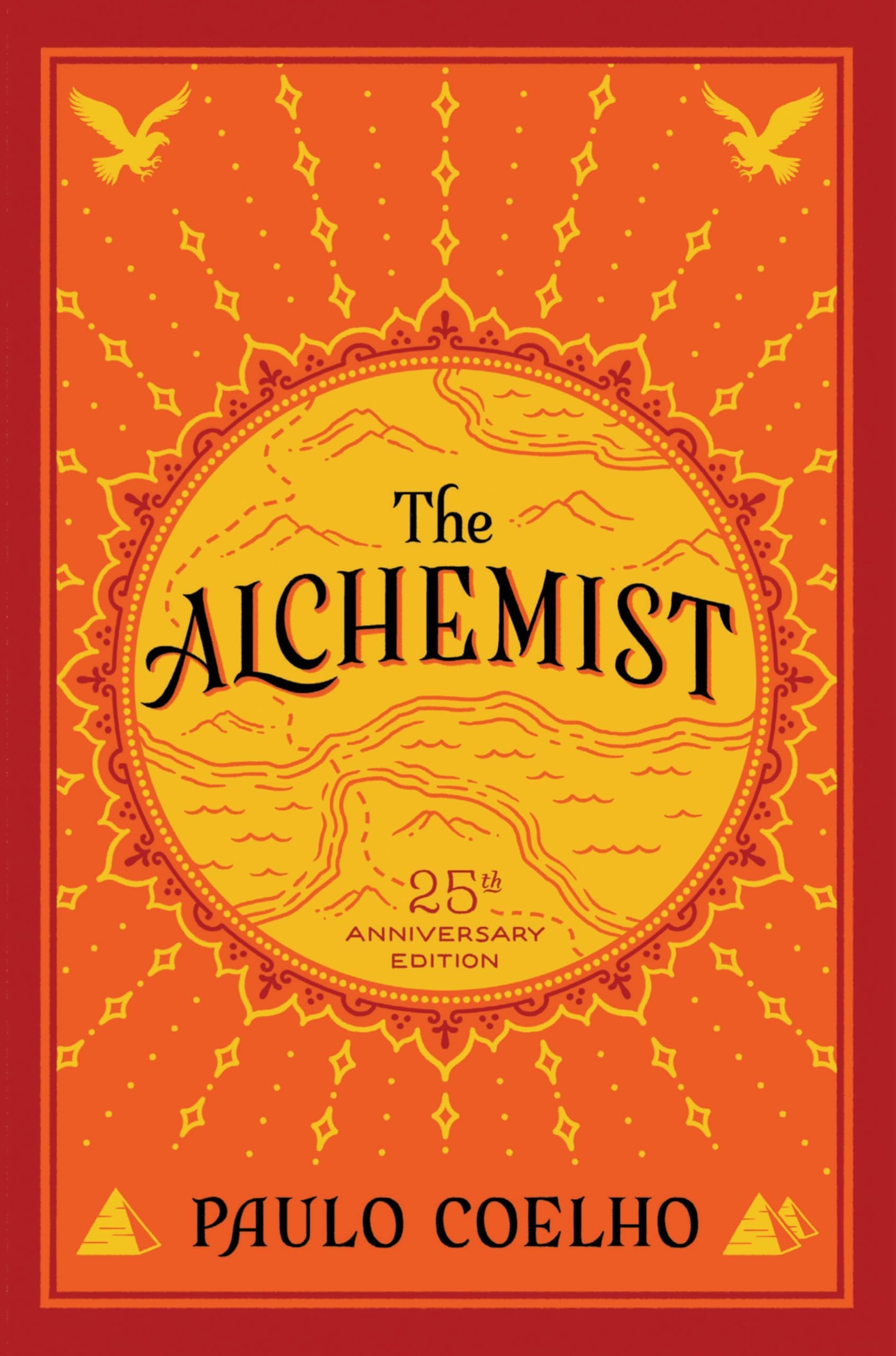
The Alchemist: A Modern Classic Fable of Spiritual Healing, Self-Discovery, and the Power of Dreams
Product ID: 5117586
✨Magic & Mysticism Infused
🎨Visually Stunning Graphic Novel
📚25th Anniversary Edition
Buy anything from 5,000+ international stores. One checkout price. No surprise fees. Join 2M+ shoppers on Desertcart.
Desertcart purchases this item on your behalf and handles shipping, customs, and support to Kyrgyzstan.
✨ Unlock your dreams with the art of storytelling 📖
The Alchemist 25th Anniversary Graphic Novel edition reimagines Paulo Coelho’s international bestseller with stunning visuals and a new Foreword. This collector’s item features intentionally rough-cut edges for a unique tactile experience and has earned top rankings in Metaphysical & Visionary Fiction, backed by over 42,000 glowing reviews.


| Best Sellers Rank | #107 in Books ( See Top 100 in Books ) #1 in Metaphysical & Visionary Fiction (Books) #10 in Classic Literature & Fiction #13 in Literary Fiction (Books) |
| Customer Reviews | 4.6 out of 5 stars 180,783 Reviews |
K**T
Book Review of The Alchemist
In The Alchemist, Paulo Coelho uses diction, syntax, and the hero cycle to keep the pace of the book constant, and keep the reader intrigued. But, he does have a few flaws present in the book. The Alchemist is a book about a boy named Santiago, who goes on an adventure to find his “Personal Legend” or treasure. Coelho uses the hero cycle to add more emphasis on the plot, which overall makes the story more entertaining. In the story, the Old King tells Santiago that “when someone wants to realize his or her Personal Legend,” he will “always [be] nearby.” (67) This is an example of atonement with the father, because the Old King’s closeness creates a father like figure in him, who is there to support Santiago. The hero cycle for me made the story more enjoyable and kept me reading. Also most of the book is him trying to obtain his Personal Legend, which is “what you have always wanted to accomplish.” (23) Compared to other books I have read this year in my English class, this one was easier to follow in terms of diction. The language that Paulo Coelho uses in the novel overall is not too difficult to understand. Word choice is done very well, and lets the reader flow through the book at a constant pace. The diction also makes the book a novel for a wide range of readers. The hero cycle with the clean diction made the story very enjoyable. While reading this book, I found that it was fairly easy to understand the passage, and that it was very inviting. Paulo Coelho structures the syntax of the book in an easy-to-understand format. Throughout the book, the syntax helps the reader understand where they are on the page, and it also positively affects the pace set by the diction in the book. Towards the middle of the novel, the boy says that “An army is coming,” and he knows because he “had a vision.” This dialogue is quickly followed up by a response from a camel driver, saying that “the desert fills men’s hearts with visions.” (104) The quick pace of dialogue keeps the book driving keeps the pace constantly in motion. The syntax made it easier for me to follow the story and follow which character was speaking and what they where feeling or doing. Even though I enjoyed a great bit of the book, there was still another bit that I didn’t fully enjoy. At the beginning of the Alchemist, the book seems to go a slower speed then the rest of it. The first portion of the book has a lot to do with introducing Santiago, the plot, the setting, and more. There is a part in the story where it goes from page 35 to page 38 with very little dialogue, which I felt stopped progress of the story. The first part also has to do a lot with how he discovers his Personal Legend. It took me a little while longer to read the first part of the book then the rest because I was mostly bored while reading it. I also felt that there was more descriptive text than the rest of the book, which really dragged out the first part. In conclusion, the book has lots of great traits and only a few bad ones. I would definitely recommend this book to a friend or anyone who enjoys reading about adventure.
D**L
Love this book. Top 5 favorite
Life changing book, buy it right now. Read it front to back then do it again but slower. If you are maybe in a rut or feeling down and out this book will bring you right back up.
K**K
Interesting story
The Alchemist is an engaging modern fable centered on self-discovery, personal destiny, and following your dreams. It offers interesting life lessons and an easy-to-read story. While its themes draw on various spiritual ideas and may feel unconventional, it still delivers meaningful reflections on purpose and perseverance. Overall, a thought-provoking and enjoyable read.
R**R
A Beautiful Edition of a Timeless Journey
This deluxe edition transforms Coelho's beloved fable into a truly special keepsake. The larger format, quality paper, and thoughtful design details make it feel like the gift it's meant to be—whether you're giving it to someone at a crossroads in their life or treating yourself to an upgrade from a worn paperback copy. The story itself remains as powerful as ever. Santiago's journey across the desert in search of treasure is deceptively simple on the surface, but Coelho's allegory works on multiple levels. Yes, it's about following your dreams, but it's also about learning to read the signs the universe offers, understanding that the journey itself transforms us, and recognizing that what we seek is often closer than we think. I know some readers find the philosophy too simplistic or New Age-y, but I think that misses the point. Coelho isn't trying to be subtle—he's distilling universal truths into their essence. Sometimes we need straightforward wisdom delivered clearly, especially when we're overthinking our own paths. This edition makes a perfect graduation gift, retirement present, or milestone marker for anyone embarking on something new. The story has earned its place as a modern classic, and this deluxe version does it justice. "When you want something, all the universe conspires in helping you to achieve it." Still resonates.
R**S
One Of The Most Important Books Ever Written
The Alchemist by Paulo Coelho is in my opinion, one of the most important books ever written. It's no wonder that it's one of the best-selling books of all time with more than 150 million copies sold. Those numbers are in spite of and defiance to the author's encouragement to file share his now legendary novel. But sales statistics are not the criterion on which I stake this claim. It is the impact on the lives of those that have read it, and the impact on the lives that have not yet been born, that I boldly state the above. The simplicity of its unfoldment may at first belie the depth of its wisdom. But the simplicity is part of the profundity that allows the reader to assimilate the messages without resistance. The first time I read The Alchemist;, I read it cover to cover in one sitting. No bathroom break, no cup of water pause, no telephone distractions. I read it from the first word to the last in what seemed like a single breath. I simply couldn't put it down. I was swept, swung, and swallowed up by this extraordinary narrative. The result was transformation. I was not the same man that began reading the novel by the time I finished it. I would thereafter read it again and again. The messages are so layered that with every new pass comes new understanding and enlightenment. At the core of the novel is the fulfillment of one’s destiny. There is a force in the Soul of the World that wants us all to live out our personal legend. When we truly desire something, the entire Universe conspires to help us achieve it. With love, all things are possible. With love, we can perform miracles. These themes are artfully integrated and clothed within a modern day fable. They come in varying iterations from a string of colorful characters that propel the protagonist towards a profound and satisfying ending. The Alchemist is the story of Santiago, a shepherd boy from Spain that crosses the desert of Africa in search of a hidden treasure. It was revealed to him in a reoccurring dream that the treasure is buried by the Ancient Pyramids in Egypt. What he naively believes will take three weeks to complete becomes a journey that expands nearly three years. After miles of traveling through the desert, the boy arrives at an oasis where he falls in love with a beautiful desert woman named Fatima. The boy is willing to abandon his dream of finding his treasure for the procurement of her love. But one night, beneath the light of a full moon, he meets a man straddled upon a mighty horse. This elusive man is known in legend and folklore as The Alchemist. The Alchemist is a man imbued with profound wisdom and mystical powers. He is reportedly over 300-years-old and can turn lead into gold. He reminds the boy that his destiny is to find the treasure. That he must continue. If it is true love, Fatima will be waiting for him after his destiny is fulfilled. Reluctantly, the boy continues his journey deeper into the desert accompanied by The Alchemist. But the desert is at war, and they are soon captured by Bedouin sentinels and accused of spying for the enemy. For this crime, they are sentenced to death. The Alchemist saves them temporarily by proclaiming that the boy is an Alchemist. He tells the general that if he wanted to, the boy could turn himself into the wind and destroy their entire camp. The general is intrigued! He wants to see this happen. He promises to spare their lives if it is done. He grants them three days. But how does a shepherd boy from Spain turn himself into the wind? Paulo Coelho says that he wrote “The Alchemist” in two weeks. It is almost hard to imagine that something so far-reaching could have been conjured up in two weeks time. He said it was his own journey that he was writing down, parabolically speaking. The impact of “The Alchemist” comes from the realization that Santiago’s journey is Everyman’s journey. His story is our story. If we tap into the Soul of the World and dare to live out our destiny, we will discover that within us all is The Alchemist.
A**A
excellent book; great read
I love this book!! This was a gift to a friend and they loved it
R**S
Great read
Love this book! It’s a great read. I bought it after a friend lent me theirs to read
B**R
Good book, but I think the ending is a betrayal
As I write this I realize that I am talking about a modern classic, one that I must admit I did enjoy reading overall. But that said, I simply didn’t find this book to be as moving a book as I thought I would. The novel tells a simple though interesting tale about a boy’s attempts to search for a treasure revealed to him in multiple dreams. Along the way he encounters many people and situations that enable him to learn and grow spiritually, aided by either his clever and inquisitive mind or the guidance of others who effectively serve as mentors. For the most part, I did like THE ALCHEMIST. I enjoyed the simple style of writing and the stripped-down nature of the tale. We don’t get into the “five senses” kind of environmental description – Coelho’s tale is more of a parable at its heart, and in fact is a story OF the heart and of the mind. I also admired the central character as well: Santiago is not only aptly named, but he is a likable boy full of pleasant good will and a gentle disposition, ready to work and clever when it comes to the things one must do to succeed. He is also brave, and remains positive whether things are going well or they are not, choosing to do the best he can at whatever hand he is dealt by life. Here, however, comes the problem. While I felt that the book worked for a good deal of the story, it weakened a bit toward the end. Part of it was the story’s mumbo-jumbo manner of religiosity; while I understood the author’s decision to tackle his subject in this simple, unadorned manner, it didn’t hold up at times. Certainly, the notion that there is a hidden one-ness at the heart of all matter is a notion that works well through a simplistic style, a la the clean, stripped-down beliefs at the heart of innocents or the way we conceptualize the purity of, say, the Native Americans culture when it came to nature. But when the boy began addressing the wind and other elements (a point I’ll get to further in a moment), it really broke down for me. It stretched credulity, reducing Nature to a kind of repertory theater. I will speak further on this scene in a second. HERE I ONE ASPECT THAT WOULD BE CONSIDERED A SPOILER – SKIP THIS PARAGRAPH. What I particularly disliked about THE ALCHEMIST is that I felt it broke its own rules. Again, I’m discussing the ending here, so beware. It bothered me that the ending should have been a point when the boy’s budding spirituality took its hold upon the lad. I ask: why would a person who is in essence learning so much about what really matters about life still keep seeking money? His interest in gold is not the same as the alchemist’s interest in it: the elder character is a man who can manipulate the elements in a near-magical manner, a process he leaves the boy to discover for himself (like when he fact almost comically abandons him to magically “make like the wind” for men who will otherwise kill him – comical because once the alchemist places the boy IN the situation, he simply goes off to play with his birds. And one more thing: while the twist at the end was clever, it disappointed me for two reasons: the first, for point I made above, but the second is trickier. The boy learns that the truth the material treasure HE sought is NOT there; it is, he learns, where the OTHER character says it is. Clever, sure… but is the author telling us the other character’s “information” is more true? Why is that? Was it that the other boy was favored? OR, which is probably more true, is it because whatever force it is that imparts such “wisdom” does so knowing that one boy WILL follow his heart and the other won’t. Think: if the other boy does follow his quest then Santiago’s info is going to be wrong. But IF things are meant to work out the way they actually do, then is Coelho indeed telling us that these actions were predetermined? This sends, I think, the opposite message the author wants to send. THE ALCHEMIST is a book that people will enjoy for its simple values, and the tale of this young boy’s spiritual quest has satisfied many. While I too enjoyed it and liked the boy, I ultimately felt a bit disappointed in what I felt to be a contrived ending. Though I initially liked the twist at the end, the story could have ended on that exact moment and left me happier. As it is, I felt the final portion of the boy’s quest betrayed his AND the author’s intentions, which hurt the novel for me.
J**N
A small book with the potential to unlock the treasure map within yourself
The Alchemist is one of those rare novels that reads like a fable yet manages to speak directly to the deeper layers of one’s inner life. Coelho’s prose is deceptively simple—clear, uncluttered, almost musical. That simplicity allows the book’s philosophical undercurrent to surface gently rather than forcefully. The story is built on parables, recurring signs and moments of quiet reflection; at its best, it feels like an invitation to pause and reconsider what we think we know about destiny and choice. Whether you read it as a spiritual guide, a modern parable or simply a beautifully told story, The Alchemist earns its place as a contemporary classic. It’s a short book that lingers long after the final page.
A**A
Just order it. One of the best investments ever!
Must read!
J**A
Muy bueno.
Una gran aventura cargada de grandes enseñanzas, aparentemente diseñado para poder encontrar nuestro camino personal, aprendiendo a comunicarnos con nuestros corazones.
A**O
Porque ler em inglês
Para quem quer treinar seu inglês é um ótimo livro para ler. Eu já tinha lido em português mas é sempre um prazer reler melhor ainda em um outro indioma
T**O
Best book so far
Best book ever! Fast delivery and great price
Trustpilot
4 days ago
3 weeks ago