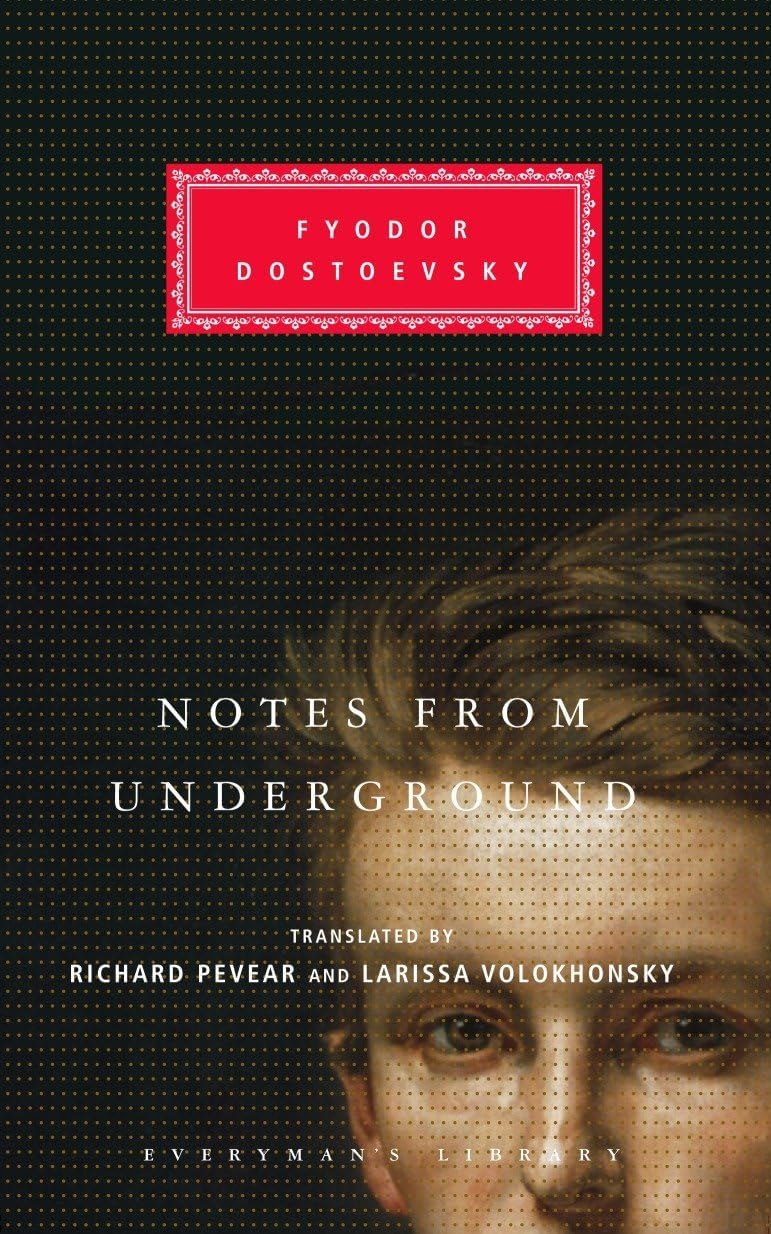


desertcart.com: Notes from Underground (Everyman's Library): 8601404402104: Dostoevsky, Fyodor, Pevear, Richard, Volokhonsky, Larissa: Books Review: Existentialism and God - Dostoyevsky is Dostoyevsky, and if you care about literature you will read his great works if you haven't already. But what makes this edition of one of those great works, Notes from Underground, great is that it is combined with other shorter works from different periods in his life. Dostoyevsky is serious stuff. Living in a time and a place of brutal oppression, he could do nothing else but write about the serious questions of life. And through the writings chosen for this collection, we can see the progression of his thoughts and beliefs as he aged. We start with `White Nights', a story of selflessness in which a young man helps a girl connect with her love even though he loves her too. Though this story has the grave tone common of 19th century Russian literature, it has a tinge of hopefulness in the man's sacrifice. This is the young and idealistic Dostoyevsky, before he was jailed for having `revolutionary ideas' and sentenced to death only to be pardoned moments from being shot. Obviously this had a great impact on his mind and went a long way towards destroying any hopefulness he had. The transition is seen in the three stories selected from The House of the Dead, his first successful work. Written in 1862, or about a decade after his imprisonment, these stories tell of senseless murderers and corporal punishers. Almost entirely devoid of emotion, we can see a Dostoyevsky who has gone inward and narrates simply and pragmatically. Life has become a matter of survival, with no room for the sentimentality of the protagonist in `White Nights'. Then in the main event, Notes from Underground, the emotion is back, but it has been transformed into anger and hatred in the form of the bitter and isolated narrator. There is much existentialist (this work is considered the founding work of existentialism) rambling in the first part, as he debates with us, the reader (even though these are his memoirs, not a two way discussion) about logic and determinism, arguing that man will not always do what's best for himself, as propounded by the utopians of the time, but will often act in direct antagonism towards themselves to display `individualism'. And, as he is an `individual', he cannot act properly in society, which is why he is now isolated and bitter. Then he gets into a proper narrative in Part II, as he demonstrates his ideas to us with stories from his earlier life. There are three parts to this, but the most interesting is the last: his brief encounter with a prostitute, where he shows the inkling of decency and love towards her, but rejects her when she returns it. Despite feeling much revulsion for the narrator to this point, there is a sense of poignancy at this end for him, and perhaps reflects both Dostoyevsky's struggle with society after his imprisonment, and our admiration for him despite his nihilistic views. The collection closes with Dream of a Ridiculous Man, a story written just a few years before his death. In it, a man decides life is meaningless and wants to commit suicide. He chances upon a little girl whose mother needs help, but he brushes the girl away. He then goes home, feels guilty, falls asleep, and has a dream. In the dream he goes to a utopia where everyone is happy until heteaches them to lie and ruins the society. He awakens a changed man who only wants to love others as himself. Near the end of his life, Dostoyevsky had found God. Review: From a Crawl Space - As usual with Dostoevsky, the read is complex, even in this instance with the simplest of storylines - an old man ranting. The complexity comes from Dostoevsky's amazing ability to articulate the waves of thought behind human emotion - the flood and ebb of reasoning, the articulation of the irrational. But complexity extends well beyond style. Dostoevsky counters and buttresses contemporaneous philosophical thought using the rantings of his protagonist, "the underground man", the narrator. For those not familiar with Søren Kierkegaard and Nikolay Chernyshevsky (and here I admit my own ignorance) even a quick read of the short, but well done Wikipedia article on this title will be a very useful primer. Interestingly, the reviewer mentions that 'underground' is a flawed translation of the Russian and that 'crawl space' (my alternative) or something like it, might be more apt, implying; underneath the structure and within the loathsomeness of darkness, rats, snakes, spiders, and evil spirits. Part I "underground" overwhelms, tediously with rant, still, the reader comes away with a sense of the underground man's misery, frustration, and disgust at life. It is a pure rant with minimal structure. In part II "Apropos the wet snow" we are taken on a - years earlier - 'social encounter' of the underground man. It does not go well - in fact, the reader will now feel, compellingly, albeit without sympathy, the narrator's hatefulness. Dostoevsky's novels so overwhelm with depth and seriousness that other authors on the list of '100 greatest books' (which I am reading through) can seem well behind. In order NOT to be that reviewer who ‘gushes’ 5-stars at everything picked-up - and because this isn’t my favorite Dostoyevski novel I’ll give it 4-stars (but if my arm were twisted - even a little - 5! ;-). (translation by Richard Pevear and Larissa Volokhonsky, Publisher: Aegitas April 20, 2017)



| Best Sellers Rank | #75,386 in Books ( See Top 100 in Books ) #28 in Russian & Soviet Literature (Books) #343 in Classic Literature & Fiction #1,043 in Literary Fiction (Books) |
| Customer Reviews | 4.3 4.3 out of 5 stars (5,597) |
| Dimensions | 5.2 x 0.6 x 8.3 inches |
| ISBN-10 | 1400041910 |
| ISBN-13 | 978-1400041916 |
| Item Weight | 9.6 ounces |
| Language | English |
| Print length | 160 pages |
| Publication date | March 23, 2004 |
| Publisher | Everyman's Library |
P**N
Existentialism and God
Dostoyevsky is Dostoyevsky, and if you care about literature you will read his great works if you haven't already. But what makes this edition of one of those great works, Notes from Underground, great is that it is combined with other shorter works from different periods in his life. Dostoyevsky is serious stuff. Living in a time and a place of brutal oppression, he could do nothing else but write about the serious questions of life. And through the writings chosen for this collection, we can see the progression of his thoughts and beliefs as he aged. We start with `White Nights', a story of selflessness in which a young man helps a girl connect with her love even though he loves her too. Though this story has the grave tone common of 19th century Russian literature, it has a tinge of hopefulness in the man's sacrifice. This is the young and idealistic Dostoyevsky, before he was jailed for having `revolutionary ideas' and sentenced to death only to be pardoned moments from being shot. Obviously this had a great impact on his mind and went a long way towards destroying any hopefulness he had. The transition is seen in the three stories selected from The House of the Dead, his first successful work. Written in 1862, or about a decade after his imprisonment, these stories tell of senseless murderers and corporal punishers. Almost entirely devoid of emotion, we can see a Dostoyevsky who has gone inward and narrates simply and pragmatically. Life has become a matter of survival, with no room for the sentimentality of the protagonist in `White Nights'. Then in the main event, Notes from Underground, the emotion is back, but it has been transformed into anger and hatred in the form of the bitter and isolated narrator. There is much existentialist (this work is considered the founding work of existentialism) rambling in the first part, as he debates with us, the reader (even though these are his memoirs, not a two way discussion) about logic and determinism, arguing that man will not always do what's best for himself, as propounded by the utopians of the time, but will often act in direct antagonism towards themselves to display `individualism'. And, as he is an `individual', he cannot act properly in society, which is why he is now isolated and bitter. Then he gets into a proper narrative in Part II, as he demonstrates his ideas to us with stories from his earlier life. There are three parts to this, but the most interesting is the last: his brief encounter with a prostitute, where he shows the inkling of decency and love towards her, but rejects her when she returns it. Despite feeling much revulsion for the narrator to this point, there is a sense of poignancy at this end for him, and perhaps reflects both Dostoyevsky's struggle with society after his imprisonment, and our admiration for him despite his nihilistic views. The collection closes with Dream of a Ridiculous Man, a story written just a few years before his death. In it, a man decides life is meaningless and wants to commit suicide. He chances upon a little girl whose mother needs help, but he brushes the girl away. He then goes home, feels guilty, falls asleep, and has a dream. In the dream he goes to a utopia where everyone is happy until heteaches them to lie and ruins the society. He awakens a changed man who only wants to love others as himself. Near the end of his life, Dostoyevsky had found God.
V**K
From a Crawl Space
As usual with Dostoevsky, the read is complex, even in this instance with the simplest of storylines - an old man ranting. The complexity comes from Dostoevsky's amazing ability to articulate the waves of thought behind human emotion - the flood and ebb of reasoning, the articulation of the irrational. But complexity extends well beyond style. Dostoevsky counters and buttresses contemporaneous philosophical thought using the rantings of his protagonist, "the underground man", the narrator. For those not familiar with Søren Kierkegaard and Nikolay Chernyshevsky (and here I admit my own ignorance) even a quick read of the short, but well done Wikipedia article on this title will be a very useful primer. Interestingly, the reviewer mentions that 'underground' is a flawed translation of the Russian and that 'crawl space' (my alternative) or something like it, might be more apt, implying; underneath the structure and within the loathsomeness of darkness, rats, snakes, spiders, and evil spirits. Part I "underground" overwhelms, tediously with rant, still, the reader comes away with a sense of the underground man's misery, frustration, and disgust at life. It is a pure rant with minimal structure. In part II "Apropos the wet snow" we are taken on a - years earlier - 'social encounter' of the underground man. It does not go well - in fact, the reader will now feel, compellingly, albeit without sympathy, the narrator's hatefulness. Dostoevsky's novels so overwhelm with depth and seriousness that other authors on the list of '100 greatest books' (which I am reading through) can seem well behind. In order NOT to be that reviewer who ‘gushes’ 5-stars at everything picked-up - and because this isn’t my favorite Dostoyevski novel I’ll give it 4-stars (but if my arm were twisted - even a little - 5! ;-). (translation by Richard Pevear and Larissa Volokhonsky, Publisher: Aegitas April 20, 2017)
O**H
Danke
M**A
The spiteful man from the underground was announcing the advent of nihilism and revealing in this book wha are the consequences of a man whose moral values had been lost track over the course of his life. 40 years before the soviet union takes place this man had in advance exposed the faliure of a system which is predicted upon no beliefs (structural one). A man (in the west) who tries to neglect all the belief system upon which our society was predicted on is obviously going to get himself left in miserable because no man can ever create his own values out of nothingness in the short course of his life. Amazing book. Disclaimer: Don't allow yourself to drift your soul into someone akin to the underground man.
A**R
Good page quality and text readability. The content is great ofcourse
P**I
Un libro trasformativo
M**Y
A book talking about a man who isolated himself from society. The book is basically a man that is thinking, and decided to put everything that he was thinking of on paper, anything that came to his mind was written in his notes; the notes are full of contradictions, regrets, ideas and struggles, and you the reader, are reading these notes. Can't say that I understood everything philosophical in the book, but it was a good read, I liked it. If you liked Crime and Punishment you will most probably like this one as well. If you like to hear the thoughts of a person then this is the book for you. :)
Trustpilot
2 months ago
5 days ago