
Buy anything from 5,000+ international stores. One checkout price. No surprise fees. Join 2M+ shoppers on Desertcart.
Desertcart purchases this item on your behalf and handles shipping, customs, and support to Kyrgyzstan.
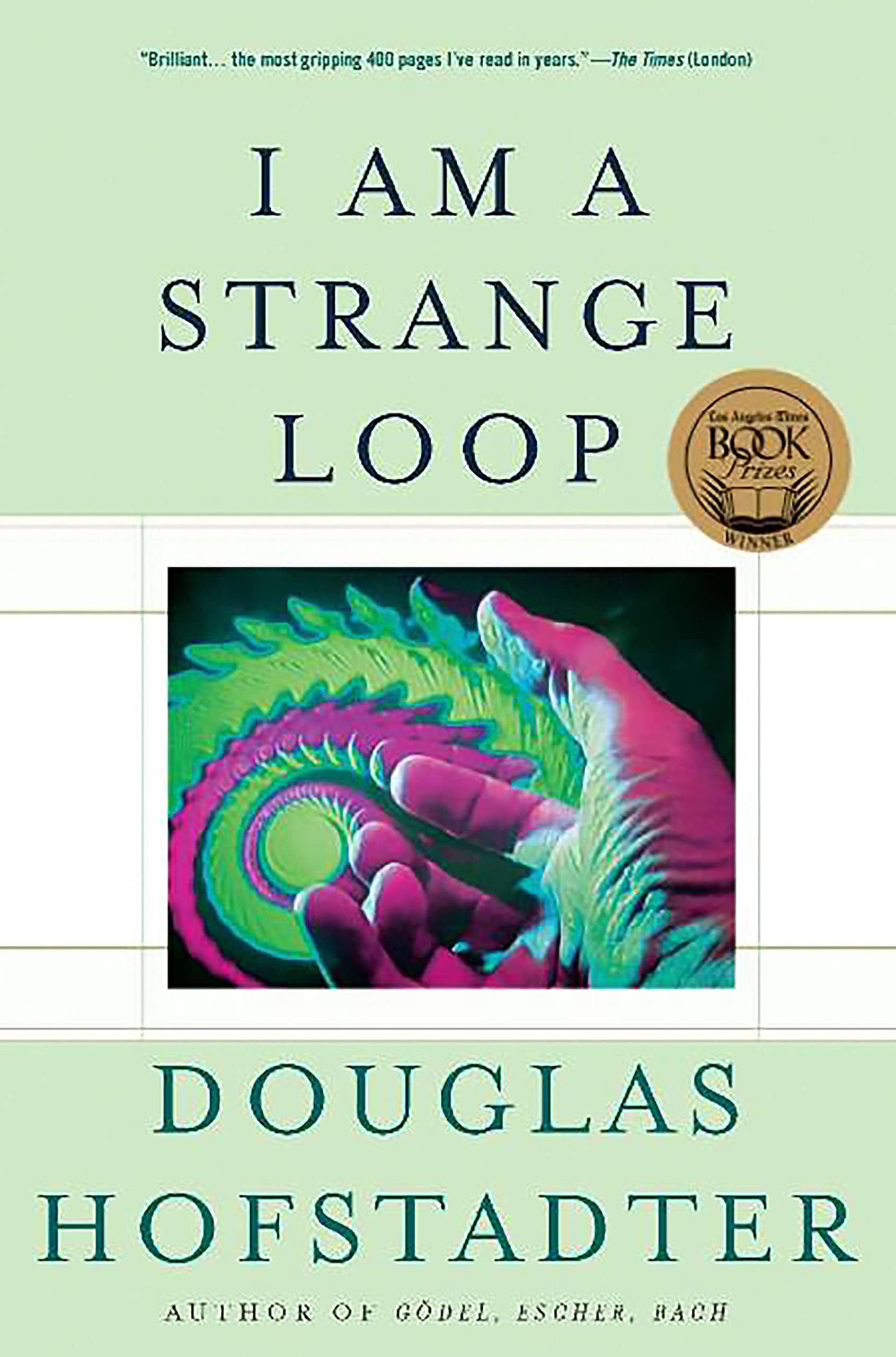
One of our greatest philosophers and scientists of the mind examines where the self comes from – and how our selves can exist in the minds of others. “ I Am a Strange Loop is a work of rigorous thinking, but it’s also an extraordinary tribute to the memory of romantic love: The Year of Magical Thinking for mathematicians.” ― Time Deep down, your brain is a chaotic seething soup of particles. On a higher level it is a jungle of neurons, and on a yet higher level it is a network of abstractions that we call “symbols.” The most central and complex symbol is the one you call “I.” An “I” is a strange loop where the brain’s symbolic and physical levels feed back into each other and flip causality upside down so that symbols seem to have gained the paradoxical ability to push particles around, rather than the reverse. To each human being, this “I” is the realest thing in the world. But how can such a mysterious abstraction be real? Is our “I” merely a convenient fiction? Does “I” exert genuine power over the particles in our brain, or is it helplessly pushed around by the all-powerful laws of physics? These are among the mysteries tackled in I Am a Strange Loop , Douglas Hofstadter’s first book-length journey into philosophy since his Pulitzer Prize-winning Gödel, Escher, Bach. It is a tale crisply told, rife with anecdotes, analogies, and metaphors – cutting-edge philosophy that any strange loop can understand. Review: Forget the Physicalist Functionalism - I came to this book looking for a digital version of GEB, that doesn't exist at the time of this writing. Looking at some of the reviews I thought I might be getting a rehash of the concepts covered in GEB. Fortunately, that is not the case. Douglas Hofstadter starts the book with some reflections on things that influenced him in his early years. I found these stories a nice bit of insight into the mind of Douglas Hofstadter. About a quarter of the way into the book he states: "The thesis of this book is that in a non-embryonic, non-infantile human brain, there is a special type of abstract structure or pattern that plays the same role as does that precise alignment of layers of paper and glue -- an abstract pattern that gives rise to what *feels* like a self". To add a little context, the precise alignment of layers of papers and glue he is referring to is a stack of envelopes that felt like there was a marble in them..., an illusion. So, in other words, Douglas Hofstadter wants to set about to convincing us that the "self-ness" we experience as humans is an illusion. The next hundred or so pages sets forth in describing how no mathematical system is totally complete. I am not sure why Douglas went in that direction, as I took the obligatory re-read of that section when Douglas suggests, and another read for this review, yet I still can not see the reason. That is not to say it is poorly written. I felt as if I was in the hands of an expert as Douglas walked through the proof of Euclid's theorem for those who have no exposure to number theory before embarking on explaining what exactly it was that Godel did. Despite my not fully understanding the purpose of the mathematics, Douglas Hofstadter was able to convey to me that consciousness is a strange loop and it got there by self-reference. This aligns well with at least one theory I've heard before, found in Ken Wilber's "Spectrum of Consciousness", but I think goes a bit beyond that when Douglas says that in his model the "I" can be in more than one body. Later in the book he expresses with a good amount of certainty that in the future this proves to be true, just as he is certain that we will eventually refer to machines with pronoun's like "who" as they become more conscious. And they will eventually become conscious, as Douglas believes that past a certain point in neural complexity, consciousness gets thrown in as a bonus. I'm not sure how close all this is to Physical Functionalism but the research I did failed to find "Physical", "Functionalism" and "strange loops" or "self-reference" mentioned in the same paragraph anywhere. Some of the philosophers Douglas mentions, including one who was a graduate student of his, however, gets mention with just the "physical"-"functionalism" search. Douglas does mention that he is only discussing some matters at the end of the book for the "consciousness philosophers". I believe that is where the discussion of the Inverted Spectrum and Freewill comes in. My overall assessment of this book is 5 stars because it accomplishes what it sets out to do, and it does so very elegantly giving a nice bit of insight into how the author came upon his thoughts along the way. Review: Incredible - One of the best books I’ve ever read.


| Best Sellers Rank | #21,436 in Books ( See Top 100 in Books ) #12 in Consciousness & Thought Philosophy #51 in History & Philosophy of Science (Books) #81 in Cognitive Psychology (Books) |
| Customer Reviews | 4.4 out of 5 stars 1,039 Reviews |
C**N
Forget the Physicalist Functionalism
I came to this book looking for a digital version of GEB, that doesn't exist at the time of this writing. Looking at some of the reviews I thought I might be getting a rehash of the concepts covered in GEB. Fortunately, that is not the case. Douglas Hofstadter starts the book with some reflections on things that influenced him in his early years. I found these stories a nice bit of insight into the mind of Douglas Hofstadter. About a quarter of the way into the book he states: "The thesis of this book is that in a non-embryonic, non-infantile human brain, there is a special type of abstract structure or pattern that plays the same role as does that precise alignment of layers of paper and glue -- an abstract pattern that gives rise to what *feels* like a self". To add a little context, the precise alignment of layers of papers and glue he is referring to is a stack of envelopes that felt like there was a marble in them..., an illusion. So, in other words, Douglas Hofstadter wants to set about to convincing us that the "self-ness" we experience as humans is an illusion. The next hundred or so pages sets forth in describing how no mathematical system is totally complete. I am not sure why Douglas went in that direction, as I took the obligatory re-read of that section when Douglas suggests, and another read for this review, yet I still can not see the reason. That is not to say it is poorly written. I felt as if I was in the hands of an expert as Douglas walked through the proof of Euclid's theorem for those who have no exposure to number theory before embarking on explaining what exactly it was that Godel did. Despite my not fully understanding the purpose of the mathematics, Douglas Hofstadter was able to convey to me that consciousness is a strange loop and it got there by self-reference. This aligns well with at least one theory I've heard before, found in Ken Wilber's "Spectrum of Consciousness", but I think goes a bit beyond that when Douglas says that in his model the "I" can be in more than one body. Later in the book he expresses with a good amount of certainty that in the future this proves to be true, just as he is certain that we will eventually refer to machines with pronoun's like "who" as they become more conscious. And they will eventually become conscious, as Douglas believes that past a certain point in neural complexity, consciousness gets thrown in as a bonus. I'm not sure how close all this is to Physical Functionalism but the research I did failed to find "Physical", "Functionalism" and "strange loops" or "self-reference" mentioned in the same paragraph anywhere. Some of the philosophers Douglas mentions, including one who was a graduate student of his, however, gets mention with just the "physical"-"functionalism" search. Douglas does mention that he is only discussing some matters at the end of the book for the "consciousness philosophers". I believe that is where the discussion of the Inverted Spectrum and Freewill comes in. My overall assessment of this book is 5 stars because it accomplishes what it sets out to do, and it does so very elegantly giving a nice bit of insight into how the author came upon his thoughts along the way.
J**Y
Incredible
One of the best books I’ve ever read.
K**N
Recursion and the Over-Unification of the Self
I Am a Strange Loop is often described as a theory of consciousness. It is more accurate to say that it changes how we look at the self. Douglas Hofstadter does not defend a soul or a hidden mental substance. His proposal is simpler: the “I” is a pattern. More specifically, it is a self-referential pattern — what he calls a strange loop. When a system can represent itself, feed that representation back into its own activity, and stabilize the cycle, a strange loop forms. Consciousness, in this view, is identified with such stabilized self-reference. It is what self-reference feels like from the inside. The book relies heavily on analogy, and Gödel’s work on formal systems plays a central role. Gödel showed that purely mechanical symbol systems can encode statements about themselves. Through Gödel numbering, a system can generate sentences that refer to their own provability. In that sense, self-reference does not require intention, meaning, or subjectivity. It can arise from formal structure alone. Hofstadter’s suggestion is that if mathematics can turn inward in this way, perhaps the brain can too. If a sufficiently complex symbolic system can model itself, feed that model back into its operations, and stabilize the cycle, then something like an “I” might emerge. The appeal of this move is clear: it rejects dualism and avoids positing any mysterious mental substance. However, the analogy establishes formal self-reference, not phenomenological presence. Gödel’s constructions demonstrate that a system can refer to itself; they do not show why self-reference should feel like anything from the inside. The step from structural recursion to lived experience remains an assumption rather than a demonstrated consequence. Up to this point, the argument is conceptually neat. Whether it genuinely bridges the gap between formal self-reference and subjective awareness is another matter. The real issue is not whether recursive loops exist. Neuroscience makes it clear that they do. The brain is full of feedback circuits, top-down signals, and re-entrant processing. Recursion is normal, not rare. The question is different: does the existence of many recursive circuits mean that they form one unified strange loop? Biologically, the brain looks less like a single loop and more like a federation of semi-autonomous systems. The enteric nervous system regulates digestion through local feedback loops. The immune system evaluates threats and adjusts responses. Hormonal systems shape mood and motivation. Cortical networks integrate perception and planning. Each system has its own inputs, internal processing, outputs, and feedback cycles — effectively operating in its own functional “world.” These systems interact. But interaction does not require a single governing self. Traffic has global flow without a central will. Markets coordinate without a single mind. In the same way, neural integration does not automatically imply one unified subject. What we call the “I” may be a practical formatting solution — a way of keeping multiple internal evaluative systems from conflicting too strongly. Seen this way, the strange loop may be an aggressive compression. It redescribes many distributed recursive processes as one self-referential structure. The metaphor unifies, but it may simplify too much. Hofstadter implicitly leans toward the view that higher-level patterns (beliefs, meanings, selves) have real causal power over lower-level physical processes. This idea, sometimes called downward causality, is useful for explanation. We predict behavior more easily by talking about goals than about neurons. But explanatory convenience is not the same as ontological proof. A high-level description can be useful without representing a separate layer of reality. The strength of the book lies in how it reshapes intuition. Through repeated metaphors, the reader begins to experience the self as loop-like. By the end, the strange loop feels natural. But feeling natural is not the same as providing a testable model. The theory does not clearly explain why recursive processes should converge into a single loop rather than remain distributed across semi-autonomous systems. This does not render the book trivial. It rejects naïve views of the self as a hidden substance. It insists that identity is a pattern, not a thing. That move is important. The concern is about unity. Even if self-reference stabilizes, why must it stabilize into one loop rather than a coalition of partially independent loops? Why assume convergence instead of plural structure? In the end, I Am a Strange Loop succeeds as a philosophical reframing. It teaches us to see the self as emergent and recursive. What it does not fully provide is a biologically grounded account of how many heterogeneous systems are edited into one narrative voice. The strange loop persuades. Whether it fully explains remains open.
T**L
Why do we build societies? What is consciousness?
I Am a Strangel Loop is a scientific discussion on the immortality of the soul. Or perhaps it's a poetic discourse on the physiology of the brain. It floats between a diverse array of ideas that readers will either find fascinating or infuriating. This book admittedly starts out slow, as many readers have pointed out, so I recommend to start reading on pg. 147, and referring to Index the as needed. For the mathematically inclined, pgs. 125-142 give an amazingly good explanation of Godel's Incompleteness Theorem. But pg. 147 is where the big picture ideas that I cared most about really started to start flowing. Here's my attempt at a condensed summary of his message: Our ancestors created stories that placed humans in the middle, in between the animals on one side, and the angels on the other. This picture illustrates our dual nature [...] our biological needs and impulses and our less fixed, but potentially stronger social nature. Our biological nature is relatively fixed and unchanging, but our social nature, being relatively new on the scene, is currently much more varied and dynamic. What is our social nature? What exactly do we want from society? (Of course, we want the needs of our biological nature to be satisfied, but that tells us nothing about the ultimate goals and desires of the social part of our being.) While we've learned much about our biological nature (thanks to Darwin and evolutionary theory), our understanding of our social nature is still largely mystical, based largely on the accumulated wisdom passed on through religion and literature. I Am a Strange Loop takes the first steps toward formulating a well-defined understanding of our social nature. That's the ultimate purpose of the book. The specific purpose of the book though is to spell out, in grand fashion, Hofstadter's theory of consciousness: what it is and how it develops. Think of man 10,000 years ago compared to where he is today. It would have taken biological evolution 10,000,000 years to achieve as much progress. Don't think that I'm talking primarily about technology. Although technological innovation has greatly increased the average individual's capacity for self-expression, technology is only a means to an end, not an end itself. Near universal literacy, the ease of travel, and political freedoms have greatly increased the life possibilities for the modern individual. Shakespeare, Muhammad Ali, J.K. Rowling and countless other lives are the shining achievements of our civilization. Humanity's greatest achievement has always been man himself. (`Man' in the gender-neutral sense of the word, of course.) What is the source of this relatively rapid progress? What forces are behind this social evolution? Hofstadter has built a framework for exploring our ever-still-emerging self-consciousness, ultimately the starting point of our social nature, in well-defined terms. -----Hofstadter's theory of consciousness----------------------------- A basic definition of `consciousness' is `awareness of one's desires'. Hofstadter believes that our desires ultimately are caused by the interaction of neurons obeying the probabilistic laws of quantum mechanics. The catch is that our consciousness, our "I", by its very nature is required to view things differently. Our "I" automatically sees itself as the cause of desires. "I" decides it wants something (say a peanut butter and jelly sandwich), our bodies move about in certain ways, and often that desire is fulfilled (if we have access to a pantry and a refrigerator at least). The cause and effect relationship couldn't be more obvious! And yet, in Hofstadter's view, that first assumption, that "I" decides what it wants, is basically illusory. "I" automatically views things in terms of higher level symbols, in terms of billiard balls and pressure fronts, rather than particles and molecules. But "I" is no more the cause of our desires than a pressure front determines the behavior of individual air molecules (rather than the other way around). "I" automatically turns causality upside down with regards to itself in the world. So we are left with the question: Does causality start on the small level or the large level? Does the interaction of particles--particles, electrons, and molecules--determine the behavior of our billiard balls, computers, and pressure systems, as science claims they do? Or is science wrong about causation--does causation ultimately start on the symbolic, large level, the level of billiard balls, pressure systems, and "I"s? Judging from the fact that I'm trusting the technology of laptops, wireless radio signals, and the internet to communicate this review, it's hard to claim that science is wrong. And Hofstadter, as one would expect form the son of a Nobel prize winning physicist, sees no choice but to choose the scientific, particle level as the ultimate source of causation, and claim that "I"ness is ultimately illusory--an extremely convincing, extremely necessary hallucination. We are tempted to say: "Well maybe it can be both: maybe for non-conscious objects, like billiard balls and pressure systems, causation starts on the small level, but once consciousness kicks in, it is endowed with a causal ability of its own." But this goes against Hofstadter's whole conception of what consciousness is. Consciousness is not made out of some separate, "specially-endowed" material; it is made out of astoundingly complex patterns of the same particles, neurons, and molecules as everything else. The last two paragraphs of the book, he says: Pg. 363 - "In the end, we self-perceiving, self-inventing, locked-in mirages are little miracles of self-reference... Our very nature is such as to prevent us from fully understanding its very nature. Poised midway between the unvisualizable cosmic vastness of curved spacetime and the dubious, shadowy flickerings of charged quanta, we human beings, more like rainbows and mirages than like raindrops or boulders, are unpredictable self-writing poems--vague, metaphorical, ambiguous, and sometimes exceedingly beautiful. "To see ourselves this way is probably not as comforting as believing in ineffable other-worldly wisps endowed with eternal existence, but it has its compensations. What one gives up on is a childlike sense that things are exactly as they appear, and that our solid-seeming, marble-like `I' is the realest things in the world; what one acquires is an appreciation of how tenuous we are at our cores, and how wildly different we are from what we seem to be. As Kurt Gödel with his unexpected strange loops gave us a deeper and subtler vision of what mathematics is all about, so the strange-loop characterization of our essences gives us a deeper and subtler vision of what it is to be human. And to my mind, the loss is worth the gain." I won't try to go any further into Hofstadter's explanation of consciousness for now. (It involves a brilliant analogy to a mathematical proof written by Kurt Gödel in 1931. If you're at all mathematically inclined, he gives an excellent, understandable explanation of Gödel's Incompleteness Theorem, which by itself makes the book worth a look.) But here are some of Hofstadter's more interesting, possibly controversial conclusions: 1. He provides reasoning behind claiming that birds, mammals, and possibly some fish or reptiles have a self-consciousness that is qualitatively similar to human consciousness. Although even for these animals, he explains their consciousness is clearly limited compared to ours. (pp. 83-84) 2. He claims that human embryos and even probably human infants are not self-conscious as their minds have not taken in enough perceptions in order to construct the mental symbols necessary for a sense of "I"ness. He does however, also point out the potential that lies within a human embryo. (pg. 209) (The obvious conclusions being that abortion is not equivalent to murder, but is nevertheless wiping out a huge amount of potential and is therefore still a tragic occurrence.) 3. We are immortal to the extent that we live on within those that love us and to the extent that our life's achievements continue to impact future generations. As Hofstadter explains in this interview [...] "I would also say that I think that music comes much closer to capturing the essence of a composer's soul than do a writer's ideas capture the writer's soul." A prominent example Hofstadter uses in the book is how the thoughts, and therefore pieces of the soul (which he terms "soul shards"), of long-dead composers are preserved on sheets of music through which they sometimes are kept alive in other minds. And: "autobiographical story-telling is not nearly as effective a means of soul-transmission as is living with someone you love for many years of your lives, and sharing profound life goals with them -- that's for sure!"
R**Y
The title says it all...
In the "strange loop," Douglas Hofstadter has come up with a pretty fertile metaphor. The problem is that the book doesn't do a whole lot to explain it. If you can "dig" or "grok" or "intuit" that consciousness is a strange loop, then you won't need the long portions of this book that attempt to promote this thesis. If you cannot so grok, then reading those same portions will be confusing and unhelpful. This is not Hofstadter's fault. Trying to understand consciousness in this way is like "the art of seeing one's own eye" - it pushes up at the limits of language and reason. Good writing can only get you so far. There are other portions that are quite enjoyable and these are the ones that are less thesis-driven and more literary. Hofstadter's youthful attempt at his own Socratic dialogue is fun and -although he apologizes at length for its immaturity- actually pretty good. I could have read a book-length chat between his "Plato" and "Socrates" (who seem -anachronistically- to be aware of computers and fruit-canning machines). But even these bits could have done with a bit more editorial direction. The main problem with this book is Hofstadter's isolation within the closed-universe of the academic philosophy of mind. He clearly attaches an undue importance to this vanishingly small world. Hofstadter's snipes at John Searle are embarrassingly frank in their personal bitterness. I have never thought Searle was worth taking very seriously, but Hofstadter has little sense of humor about him or his work. The same problem colors Hofstadter's frequent digressions into ethics, since his ethical positions seem to stem more directly from the cultural values of the academy than from his own ideas. He makes clear that he is pro-animal rights and pro-choice, since animals have consciousness and fetuses do not. He proposes that there exists a hierarchy of consciousness, with "small-souled" beings (e.g. fetuses, vegetables, retarded human beings) at or near the bottom and "large-souled" beings (e.g. adult humans) at the top. I happen to agree with him here, but Hofstadter's ethical discussion would be greatly enlivened by a familiarity with mysticism and religion, especially Buddhism and Aristotle. Instead, his horizons seem limited to journal-page arguments with Dennett, Churchland and Searle (ethical geniuses none). Specifically, Hofstadter conflates "degree of consciousness" with "relative right to exist." If he fails to recognize that this is a nonsequitur, he does at least acknowledge that it commits him to a troublesome implication: that 2-year old humans have less right to exist than adult humans. He deals with this as follows: "Even though I sincerely believe there is much more of a soul in a twenty-year-old than in a two-year-old (a view that will no doubt dismay many readers), I nonetheless have enormous respect for the potential of the two-year-old to develop a much larger soul over the course of a dozen or so years." It is entirely obvious that fetuses (not to mention spermatazoa) have this same potential, so to the extent that "potential" is the reason for Hofstadter's pro-choice views, his argument is unsatisfactory. He gives another: cuteness. Perhaps, he suggests, the sensation of cuteness reflects a protective instinct in humans. But this is clearly a positive fact and not a normative one - Badtz Maru is cute, but this alone does not give him rights. Indeed, it seems to me that the OPPOSITE is often true. Babies are precious by virtue of their limited awareness, not in spite of it. (Which is a greater tragedy: the death of child or a highly realized being?) Viewed with a cold eye, the "strange loop" theory of consciousness simply has no necessary ethical implications. Like Dennett, Hofstadter is a terrific thinker but a hamfisted ethicist - an unreflective mouthpiece for the ideology of the academy. By far, the most useful contribution here is Hofstadter's specific discussion of video feedback as a metaphor for consciousness. Again, you either "grok" this or you don't - there is just no explaining something this weird. In the most novel and interesting portion of the book, he uses Marvin Minksy's term "telepresence" to explore the notion that consciousness is not singular, discrete or correlated with a spatial location or any single "body." He suggests, I think rightly, that mind exists wherever there is sufficient feedback of information, and that it spills over from one feedback loop into another, without respect for bodies, matter, or location. However, in my view, the same prejudices that prevent Hofstadter from confronting the ethical implications of his views also commit him to a reductive, ateleological worldview (again, he is here in lockstep with Dennett here), and this forces him over and over again to explain mind as some sort of emergent (and therefore anomalous) property of information itself. It also forces him to spill gallons of ink unnecessarily in an (unsuccessful) attempt to salvage free will. Finally, it keeps him from exploring the teleological (and much more parsimonious) alternative: that information exists in order to facilitate the emergence of mind. At the end of the day, this is a self-indulgent book-length footnote to Hofstadter's masterpiece, GEB. Rather than pick at these scraps, the reader should take the opportunity to read or re-read that work.
J**N
Strange Loops Rule!!
I read this book after a friend of mine, who shares my interest in neurophilosophy, recommended it, and I am glad that I did. Hofstadter does a nice job of showing how the complex interactions of neurons at the basic level of the brain can lead to large scale structures which are the cause of consciousness. He terms the former "mentalics" and the latter "thinkodynamics". He then proceeds in the monistic manner of his friend Daniel Dennett to show how the material brain can produce an immaterial consciousness by the incredibly complex interactions of 100 billion neurons, which are capable of forming intricate patterns of feedback loops, and from these loops consciousness emerges. Unfortunately, he starts out by making unfair criticisms of John Searle, who has doubts that a computational system can think. In his famous (or infamous in some circles) Chinese room experiment, he merely points out that syntax, which the machine is very good at, is not the same as semantics. In other words, the poor guy in the Chinese room can translate perfectly following the set of rules, but he does not understand a word of what he translates. Searle's point is valid, and nobody, not even Searle himself, has solved this neurophilosophical dilemma. What I find most interesting about Hofstadter's argument is that he uses Gödel's incompleteness theorem as a basis for his solution. On page 110 he says: "...what was really being explored by Gödel, as well as by many people he had inspired, was the mystery of the human mind and the mechanisms of human thinking." Gödel, in a manner which defies my mathematically impoverished mind, takes Russell and Whitehead's Principia Mathematica, which is a set of rigid rules governing logic and arithmetizes it, or, in other words, adds a higher level of meaning and then is able to manipulate this higher level so that self-referential feedback loops can emerge which have the ability to cause further feedback loops. On page 206 Hofstadter summarizes this: "Kurt Gödel .... demonstrated how high-level, emergent, self-referential meanings in a formal mathematical system can have a causal potency just as real as that of the system's rigid, frozen, low-level rules of inference." Even more interesting, at least to me, is that Roger Penrose (The Emperor's New Mind; The Shadows of the Mind; and The Large, the Small and the Human Mind) uses Gödel's theorem to prove the opposite - that no computational system could ever possibly be the basis of thinking. Penrose says that the incompleteness theorem showed that no computational system is complete, and, therefore, cannot be the basis of human thought, which must necessarily be independent and complete in its own world. He stated it this way in The Shadows of the Mind, page vi: "Central to the arguments of Part I, is the famous theorem of Gödel ...... The conclusions are that conscious thinking must indeed involve ingredients that cannot be even simulated adequately by mere computation; still less could computation, of itself alone, evoke any conscious feelings or intentions. Accordingly, the mind must indeed be something that cannot be described in any kind of computational terms." Let me explain the basic problem of consciousness as I see it. While playing a game of kickball I focus on a ball which is "red" and `round". If you stop and think about it, the round, red ball does not exist. In the "real" world that object consists of a gazillion elementary particles, complexly organized, which give off light waves/particles of a specific frequency, which travel into my eye, are focused on the retina, and then excite special neurons that, by way of a complex pathway, travel to our cerebral cortex and set up the complex feedback loops that Hofstadter talked of. Nowhere in this material world does a round, red ball exist. It is an illusion in our mind, but an important one if I want to be able to dodge the ball. Our brain consists of 100 billion neurons, which are connected to each other via multiple synapses (around 3000 synapses per neuron). These neurons can fire in very intricate ways, thereby setting up incredibly complicated patterns, which exist in space and time, both synchronically and diachronically. From these patterns "emerge" consciousness, much as the wetness of water emerges from the combination of hydrogen and oxygen. I cannot fault this explanation, mainly because I can see no other way to explain consciousness without getting mystical. Nevertheless, it seems impossible for our minds to exhibit free will in a closed material system. Hofstadter solves this neatly by denying free will (see pages 339-341). Penrose tries to solve it by getting into the quantum world, which is weird (mystical?) in many ways. For example, I pity poor Schrödinger's cat, whose fate is dependent upon human consciousness somehow interacting with the quantum world. Furthermore, Bell's interconnectedness theorem (refer to Quantum Reality by Nick Herbert, page 211) indicates that we are all connected in some magical way at the micro-level of our existence. There is no doubt that we get away from the strict mechanistic causality of our macro-world when we delve into quantum mechanics. Courtesy of Sir John Eccles, the Nobel prize winning neurophysiologist (see How the Self Controls Its Brain by Eccles). Penrose says that the microtubules of each neuron, which secrete the neurotransmitters essential for synaptic transmission, are so small that they are actually part of the micro-world that operates according to quantum mechanics. Perhaps here lies the spiritual aspect of mind, which completely eludes any explanation based upon the physical laws of our macro-world. In conclusion, I would like to bring up Cartesian dualism, which is the other way we can salvage free will. Ever since Gilbert Ryle in his 1949 book, Concept of Mind, showed how the "ghost in the machine" contradicted Descartes' mind/matter dualism, sophisticated neurophilosophers have ridiculed the spiritual concept of mind. An immaterial mind could not effect changes in material neurons anymore than Caspar, the friendly ghost, could float through a wall and then play catch with the kids. If this is true, then free will goes out the window, or through the wall, if it is an immaterial idea. It seems like a stretch to use microtubules as the means the quantum world, which has immaterial aspects to it, can effect material changes in our brain. Let me end by pointing out that Descartes, in his criticism of Newtonian gravity, was proven right by 20th physics. Descartes ridiculed the idea that gravity, a mysterious force that acted at a distance, could be the cause of planetary motion. He stated that there were "vortices" in space that controlled how celestial objects moved. Einstein showed that material bodies act to transform and curve the space around them, and that the planets move in the channels that such curved space provides. Perhaps Descartes was also right about mind/matter dualism.
N**E
I'm one too!
I am a strange loop, too, and Douglas Hofstadter has written my book! Actually, he has written a much more thorough and comprehensible book than I could, and in such a friendly and personal way that I feel I could call him Doug. Not everyone will feel the same about it as I do. I once worked with a guy who said, "Your brain is like the telephone: you don't have to understand how it works to use it." There are many people like that who have no interest in how this amazing organ gives us our experience of our selves and the world, and they will find nothing of interest here. If scientific explanations of human behavior give you apoplexy, you will probably be unhappy with this book, but maybe it would be good for you anyway. If you believe in "free will," you may find yourself very upset by this book, for as Doug says, "I don't see any room in this complex world for my will to be 'free.'" (p. 340) I don't, either. If you're at all curious about what makes us tick, this book has the answers to some of the most significant questions--not about "wet-ware;" I don't think it mentions "amygdala" even once--but about how it is possible to think, and to think about our thinking. Doug did make me a little nervous in Chapter 3, "The Causal Potency of Patterns." At first I had visions of recipes causing cakes to be made, but in the end he made the point perfectly clear that, "Deep understanding of causality sometimes requires the understanding of very large patterns and their abstract relationships and interactions, not just the understanding of microscopic objects interacting in microscopic time intervals."(p. 41) That was a relief, and from there on it was clear sailing. Even as mathematically challenged as I am, I was able to follow the two chapters on Bertrand Russell and Godel and get the gist of them. I have some niggling little issues here and there, arising, I think, from our cultural differences. While little Dougie's mom was playing Chopin for him in California, little Normie's mom was playing Eddie Arnold for him in Florida, at the opposite end of the intellectual spectrum. While he was practicing piano, my brother and I were making bows and arrows out of sticks and playing Indians. Aside from our similarities in having good brains and sisters whose brains were broken, our lives were vastly different, and I had the feeling while reading the book that he had little appreciation for the impact of his personal history on his values and preferences--he seemed to have little compassion for those whose history might have been less musically and intellectually stimulating. So it's not exactly my book, but it makes ideas that I have struggled with wonderfully clear, and in the process manages to be personable and even entertaining--I laughed out loud more than once. I hope that millions of readers find it equally gratifying and enjoyable.
J**A
The illusion of the I
What is a strange loop? First of all, what is a loop? Hofstadter gives some examples. One is the infinite regression of yourself looking at a mirror in a room where there is another mirror on your back. Or a video camera filming the TV screen to which is connected. What about a "strange" loop? One of the author's examples is Gödel's theorem. Russell and Whitehead designed their theory of types in Principia Mathematica (PM)to avoid the self-referring paradoxes of mathematics such as the set of sets that do not contain themselves or in a more digestible version the barber who in a village shaves those and only those that do not shave themselves. Who shaves the barber? What Gödel discovered through an ingenious code system is that the (in principle meaningless formal) formulas of PM could be mirrored in statements of arithmetic and in this way he managed that PM talked about itself and proved that in PM there are true propositions which are not provable. This means that any axiomatic system rich enough so that it contains the elementary arithmetic (positive integers with addition and multiplication) is not complete. In a similar fashion, when an animal brain grows in complexity such as an adult human brain, the system is capable of self-referral. Hofstadter tells us that this is what self-awareness is about. When you apply reductionist methods in your analysis of the brain and you go down to brain zones, neurons, DNA, atoms, protons and quarks, you don't find any inmaterial essence, no "élan mental". Consciousness is an emergent property that appears in a sufficiently complex system, the way that if you touch the envelopes in a box it feels that in ht middle there is a marble. So, the "I" according to the author, is our more precious hallucination. The book is also a memoir of his personal suffering due to the unexpected death of his wife and his reflections about souls of dead people living, albeit in fragmentary and coarse form, in the brains of other people. "A la Turing", Hofstadter tells us that the human brain is a universal brain, capable of modelling other brains. I must say that I was delighted to read a book about this difficult subject that I could finish and understand. However, there are parts in the book that perhaps need more discussion, as when the author makes a rough ranking of human souls. Apparently he is most interested in two dimensions: the love of music and the generosity (magnanimity means great soul). I do not know how Picasso ranked in music and he certainly was not a very generous person, rather, as many top people in their fields, he was an egocentric. However, for me he ranked high in the soul classification. Another interesting aspect of the book is the references to AI. The self-driving automobiles that crossed the Mojave dessert should have some symbols inside. Hofstadter tells us that intelligence is about patterns. We have symbols, we categorize them and our brain activity is a constant dance of these symbols. You can envision a day, perhaps in the XXI century, when machines will be capable of self-representation and when the patterns in a human brain can be transported to either machines (like the novel "2001, a Space Odyssey" predicted) or other brains. Our century will be the century of the brain like the first half XXth century was the century of physics and the second part the (half) century of biology and computer science. We are, with regard to the brain, as we were regarding quantum mechanics in the 1920's. So expect fascinating years.
A**ー
再帰(recursion)の再帰的理解のためのインスピレーション集
Touretzky, D.S. "COMMOM LISP: A Gentle Introduction to Symbolic Computation." で演習的学習を進めていたところ,Chapter 8: Recursionの8.15の項で,再帰的プログラミングの理解を促進するための参考資料として,Hofstadter, D. R.の "Gödel, Escher, Bach: An Eternal Golden Braid." が紹介されており,Amazonで検索したところ,近作である本書もあることを知り,両方を購入して,Lisp の再帰的プログラミングの学習を進める際の参考資料として,面白そうなところをチラチラと眺めるような形で利用している。そんな皮層を撫で回すような利用法ではあるのだが,再帰(recursion)とは,Lisp のみならず,音楽,絵画・美術,数学,さらにはさまざまな日常場面において,それらの根底に,類似のあるいは相似の構造性を秘めている「精神活動枠組み」なのだ,という著者の主張に触れ,その「間口」と「奥行き」の深さに,改めて気付かされたように感じる。ただし,著者の記述展開は,筆者の読み取りの不十分さに起因するものかもしれないが,「間口」の広さの強調の方にかなり偏しているような印象を持った。それでも,あまり哲学的に深いことを考えないで,紹介されているトピックスや,さまざまなジャンルの図や画像を眺めるだけでも,Lispにおける再帰的プログラミングの理解の深化には有用であるように感じている。ただし,以上は,門外漢による斜め読みの途中報告であるということをお断りしておく。念の為。
C**N
Boas discussões sobre o conceito de eu.
Um bom livro com questões interessantes sobre o funcionamento da mente e simbolos mentais. Discussões filosóficas interessantes, utilizando argumentos científicos em alguns pontos. Trata de maneira mais fácil de ler algumas questões levantadas no GEB e outras também interessntes. Capa texturizada e imagens coloridas dão ao livro uma boa finalização.
T**S
As mind-bending as the title suggests
Having enjoyed the author’s ‘Godel, Escher Bach’ some years ago, and spurred on by a deepening interest in human nature, I opened this book with a sense of expectation. I wasn’t disappointed, and found the ideas both deeply thought-provoking and highly satisfying. If you are interested in the enigma of ‘consciousness’, and are open to exploring concepts from multiple viewpoints, this book will intrigue and entertain you. Somewhat like riding an intellectual roller-coaster.
D**.
Five Stars
Excellent
J**R
I'm a Strange Loop, by Douglas Hoffstadter
Hoffstadter revient près de 35 ans après Gödel, Escher, Bach: an Eternal Golden Braid avec un autre livre sur un sujet très voisin. C'est une sorte de livre de fin de carrière (ou même de retraité) qui traite des mêmes problèmes que GEB. En substance, Hoffstadter regrette que les gens qui ont lu GEB se soient intéressés à tous les exemples dont il a parlé, mais sans forcément s'intéresser de très près au fond de son propos. Son sujet (noyé dans un feu d'artifice de considérations souvent brillantes) c'était la conscience en tant que mécanisme auto-référentiel, en tant que boucle capable de s'analyser elle-même de manière récursive, en tant que système de perception qui se perçoit lui même, ou que système de modélisation qui se modélise lui-même. Il regrette que ses lecteurs se soient plus préoccupés des illustration de ses idées que de ses idées elles-mêmes: i.e. qu'ils se soient plus intéressés à sa démonstration du théorème de Gödel, à l'auto-référence en mathématiques, au codage et au stockage de l'information sémantique avec auto-référence [ainsi que des détails de la façon dont ces mêmes principes sont implémentés dans le vivant avec le code génétique, qui est si bien expliqué dans GEB]. Là, c'est un texte de retraité, avec un ton plus intimiste, parsemés d'histoires de sa vie. Un bilan de sa carrière passée sur le sujet (à l'ombre du succès de GEB), avec plein d’anecdotes personnelles, et d'impressions personnelles sur divers sujets qui lui semblent importants. Il réfléchit sur la conscience et l'esprit humain. Quoique sa réflexion soit souvent pleine de mathématiques, il s'agit plus de philosophie que de science, puisqu'elle est en dehors de l'expérimentation et des sciences dures. Il a lu les neuro-scientifiques, attentivement même, mais son propos est ailleurs. Il traite de questions qui sont souvent d'un ordre plus élevé que les questions traitées par les sciences cognitives dures. ((Quoique de temps en temps il s'aventure sur les terres où les neuro-scientifiques sont en train de faire des avancées à pas de géant, et là, son approche est parfois un peu moins convaincante, parce qu'un peu plus immatérielle, bref, plus philosophique que scientifique. Mais il faut aussi reconnaître à sa décharge que les grandes avancées des neurosciences n'étaient pas encore vraiment là au moment où il a élaboré ses idées)). Il est très clair, il prend son temps pour expliquer doucement, mais il va assez loin. Au final, il est excellent sur les domaines mathématiques, le codage, la représentation de l'information. On arrive à comprendre assez bien ce qu'il pense de la conscience quand il aborde les implications des représentations capables d'auto-références, de méta-définitions et de méta-méta-définitions (récursives) ; et quand il décrit les systèmes de perception à base de classes et de sous-classes capables d'étendre leur répertoire de catégories de manière arbitrairement étendu. C'est assez bien vu, et assez attirant comme vision des choses... C'est donc un cocktail au départ de mathématiques, de philosophie et de théorie de l'esprit et de la conscience. C'est un peu étrange au début, et puis on s'y habitue, et ça devient de plus en plus passionnant au fil des pages. D'autres aspects de ses idées sont plus "délibérément humanistes" que scientifiques à mon sens: ce sont plus des partis pris philosophiques de voir l'être humain et la vie sous un angle positif, plutôt qu'une position scientifique ; mais ça reste intéressant à lire, quoique pour d'autres raisons. C'est bien amené, le personnage est intéressant, je me sens proche de ses valeurs positives, humanistes et rationnelles et de son approche de la conscience. J'aime bien Hoffstadter -depuis l'époque des Methamagical Themas de Scientific American... Il mélange pas mal de naïveté et de fraîcheur, avec une grande vivacité d'esprit et une énorme puissance d'analyse, un côté humaniste et empathique, un esprit mathématique qui se fascine pour les choses imbriquées, intriquées, récursives, complexes et tordues (et de préférence quand elles ont des conséquences bizarroïdes) ... Il ne se laisse pas enfermer par des frontières, il passe sans effort des mathématiques à la psychologie cognitive puis à la philosophie avant de retourner à la science... Il en tire des conséquences parfois improbables -parfois moins que scientifiques- mais qui donnent du carburant pour la pensée et qui restent toujours intéressantes et que j'ai toujours lu avidement. On n'arrive pas à une certitude expérimentale sur la plupart des questions fondamentales qui sont posées et auxquelles il donne des réponses partielles (d'ailleurs la conscience et les autres grandes questions soulevées ne sont pas vraiment des questions expérimentales, la conscience n'est pas très définissable scientifiquement et sa présence ou son absence n'est pas une question qui se prête à une démonstration expérimentale, c'est tout au plus quelque chose qu'on ressent en notre for intérieur). D'autres sources récentes semblent confirmer à posteriori certaines intuitions de Hoffstadter. e.g.: l'article tout récent de "Cerveau et Psycho" intitulé "crises d'épilepsie et troubles de la conscience" de Stéphane Charpier (Jan 2013): certaines crises d'épilepsie partielle complexe ("le petit mal") se manifestent par un effondrement de la conscience sans autre manifestation physique; voire une poursuite des activités de l'individu, mécaniquement, comme un zombi, mais sans la conscience. L'étude du moment où la conscience disparaît (et réapparaît) permet d'en savoir plus sur la nature du phénomène. Les aires corticales associatives qui font le post-traitement des entrées sensorielles semblent centrales (les aires associatives font le traitement secondaire des données sensorielles et effectuent ainsi la perception, c'est à dire la mise en catégories, classes, et sous-classes des objets détectés à partir des données sensorielles brutes, c'est la différence par exemple entre voir et percevoir). C'est bien ces aires qui sont responsables de la perception de sa propre perception, et donc de la "boucle étrange" qu'Hoffstadter considère comme la conscience. Bref, "I am a strange loop" a une approche étonnante, pleine d'esprit, pleine de rebondissement dans tous les domaines de la connaissance, et que j'ai trouvée rafraîchissante. Un livre qui aère l'esprit.
Trustpilot
1 day ago
2 weeks ago