
Desertcart purchases this item on your behalf and handles shipping, customs, and support to Kyrgyzstan.
🛠️ Desolder smarter, not harder — the braid that keeps you ahead of the curve!
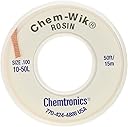
Chemtronics Chem-Wik Rosin desoldering braid is an ultra-thin, pure copper wick engineered for 50% faster solder removal with superior thermal conductivity. Its advanced geometric weave and rosin flux coating ensure efficient, oxidation-resistant performance while minimizing heat exposure to sensitive components. Trusted by aerospace and electronics pros, it delivers precision and speed in a lightweight, easy-to-use format.
| Manufacturer | CHEMTRONICS |
| Part Number | 10-50L |
| Item Weight | 0.01 ounces |
| Product Dimensions | 3 x 3 x 3 inches |
| Item model number | 10-50L |
| Is Discontinued By Manufacturer | No |
| Color | Multicolor |
| Material | copper |
| Item Package Quantity | 1 |
| Included Components | Bra |
| Batteries Required? | No |
A**R
A lifetime worth of solder-hungry braid! Great value and performance.
This has 50 feet of desoldering braid, which is more than most hobbyists or perhaps even some professionals will ever need in their lifetime. Most other desoldering braids sold here are only 10 feet. The braid comes in a 2-part plastic container. The two parts combine to become the round container pictured. You can easily pop open the parts just by pressing on the middle with your thumb. It's not necessary to open it, but it's the easiest way to get braid out of the roll. Sure, you can pull out more braid while the container is snapped closed, but that may cause the braid to get bent out of shape. I prefer the braid to be perfectly flat with no creases, so I open the container to get more braid as needed. This braid is quite hungry for solder. It glides smoothly across the PCB surface to "mop up" any excess solder. It can hold thick amounts of solder in a small segment of braid, and the solder naturally spreads to other parts of the braid as you heat it with the iron. The braid may leave behind a brown, sticky flux residue. This is especially likely to happen if you heat the braid for too long in a spot without much solder for it to absorb. The flux residue is more difficult to clean than the Amtech flux I am used to. The residue loosens once isopropyl alcohol is used, but I need to rub it with a cotton swab or toothbrush to effectively remove it. My understanding is that the thick, stubborn nature of this flux is what gives the desoldering braid its desirable solder-hungry performance. Just don't use the braid in the same place for too long and the flux residue won't be a problem. A mistake I made when learning how to desolder was using temperatures that are too high or too low. I normally have the soldering iron set to 300 degrees Celsius. When I need to desolder, I set the temperature to 350 degrees Celsius. The increase in temperature is necessary for effective desoldering, because the iron will not have direct contact with the PCB and the braid will spread and dissipate heat. Obviously, the temperature needed will vary depending on your soldering iron and other factors. If the braid is not sucking up solder, then you probably need to increase the temperature. Another mistake I made was removing the iron before removing the braid; if you do this, the braid will get stuck to the PCB, therefore you must remove both the iron and the braid at the same time.
M**L
Best wik I've used in over 30 years of soldering
It only made sense to me, to purchase the 50 ft roll of this Chemtronics desoldering braid, as the price per foot made the most sense. This desoldering wik is the best I've ever used in over 30+ years of soldering. The copper braid is extremely high quality and is FINELY woven in such a way, that it VERY QUICKLY sucks up the solder. It almost looks too pretty to use, but use it you will! I usually cut a piece from the reel, then hold it with pliers to avoid heating up my fingers, and on old solder joints that are oxidized, or when lead free solder is used, I make sure I use flux and I'll put a fresh drop of clean solder on the joint I'm desoldering so that the whole thing melts easily. When I use flux, I dip the wik in flux before I use it so that everything flows nicely. You won't regret this purchase. It is money well spent!
D**.
Just call it Mr. Thirsty... Works well for hand-soldering TSSOPs
Works really really well for hand-soldering TSSOP IC packages. I was a little leery of attempting to hand-solder the tiny little TSSOP ICs, which have a 0.65mm center-to-center pin spacing, especially with my $5 piece of junk 35W soldering iron. But I was pleasantly surprised at just how easy it was to do! However, this solder wick was the secret ingredient! The hard part was lining up the part on the pads, but once you've done that and tacked it down, just solder all the pins without worrying about pin-to-pin shorts. Then use this wick to slurp-up the excess and remove the solder bridges and presto, you can hand solder them in minutes and with minimal "special" equipment (I do recommend a magnifier light/scope and a PCB vice). This solder wick performed flawlessly. I've used other solder wicks in the past that didn't perform so well. And I think the key difference is the Rosin flux in this wick. It has the right balance of flux to wick and did an excellent job. And the 0.10" width of this wick is nearly perfect for doing TSSOP packages. No complaints.
W**R
THIS IS THE RIGHT ONE - LOOK NO FURTHER!
I'm a tech with over 50 years at the bench. Nowadays I specialize in the repair of vintage guitar amplifiers. I also build "boutique" tube guitar amps under the "Lord Valve Custom Amplification" badge. This is the best wick there is, hands down. I buy the 50-foot size these days; I used to get it on 500-foot spools but they don't seem to sell it that way any more. I have a few spools designed for 10-foot lengths, and I just refill them from the large spool when necessary. I've never gotten burned, I just let a few inches hang off the small wheel/spool and use the spool as a handle. And I use a 100-watt iron! I've seen a few people complaining about excess flux being left on PC boards (not that I work on many of those, you understand) and this is also easily dealt with - just keep a can of defluxer handy; spray a small amount into a ramekin (metal type preferred) and dip a wooden-shaft cotton swab in it. Use the swab to remove the excess flux. Piece of cake.
C**.
Great value. Works Great! Best I’ve ever used. Recommended.
I found this wick from the Northridgefix guy’s videos. I’ve been using really junky wick. It would fall apart and would spit solder back out into through hole, holes. It was aggravating. I would use 1 ft or more wick since it would barely suck solder!!! It would fall apart! But this chemtronics works very well. One tiny 1 cm piece is enough to wick all bga pads on an iPhone tristar or touch ic chip. It absorbs plenty of solder,doesn’t spit it back out,has better flux and more of it than many others,and it doesn’t fall apart! The cost being around $19 for 50ft isn’t bad at all. It’s cheaper than some others per foot,and it works better,saving time,and quantity of wick you have to use in one go. So I can basically use like 1 inch of wick from chemtronics,rather than 3 or 4 inches of the other stuff,and I’m less likely to pull bga pads(basically VERY unlikely). I’d recommend this wick! It’s probably comparable to the goot wick Louis Rossmann uses.
T**S
Decent and a good price
Not as good has the MG Chemicals rosin series, but its decent. The price is cheaper and reflects that in performance. I am using this on Vintage audio equipment, and the solder from 40 years ago is pretty poor, so having the best solder wick makes a difference. I'm sure this would work even better with newer electronics.
D**R
Good braid is important
I understand a lot of people haven't had luck with desoldering braid. I've gotten a few hanks of the cheap stuff, and I see why. It's thin, saturates quickly and doesn't suck up solder well. This stuff is good, I think it's easier than a pump because it actually gets a joint clean enough to untwist a lead off a terminal or pull it from a through hole. 50 feet may seem like a lot, but if you're just learning and solder before you think, or are attacking old point to point wiring that was globbed in solder, it will get used up before it ages out. One thing I learned the hard way -- buy a flux pen, and soak traces first. You don't have to do this if it's a fresh booboo you made, but good luck getting really old solder to flow quickly and wick up.
R**B
The Best
If you want reliable, fast acting, efficient wicking action, this is the best. I tried using cheaper stuff (because this isn't exactly cheap) and even other name brands, and it's just not worth it. I've used this brand for over 20 years as weekend diy'er after working along side electronics techs who recommended the best test equipment and chemical brands, and this was the only wick advised. I also think Kester is the best solder but there are cheaper solders that work better than cheap solder wick. Also, I've used this wick where a solder pump could have been used and this wick just sucks all the solder up, better. There is a little technique involved but a little practice is all it takes. This wick won't disappoint.
Trustpilot
1 month ago
1 week ago