
Desertcart purchases this item on your behalf and handles shipping, customs, and support to Kyrgyzstan.
🌌 Unlock the universe’s secrets before everyone else does!
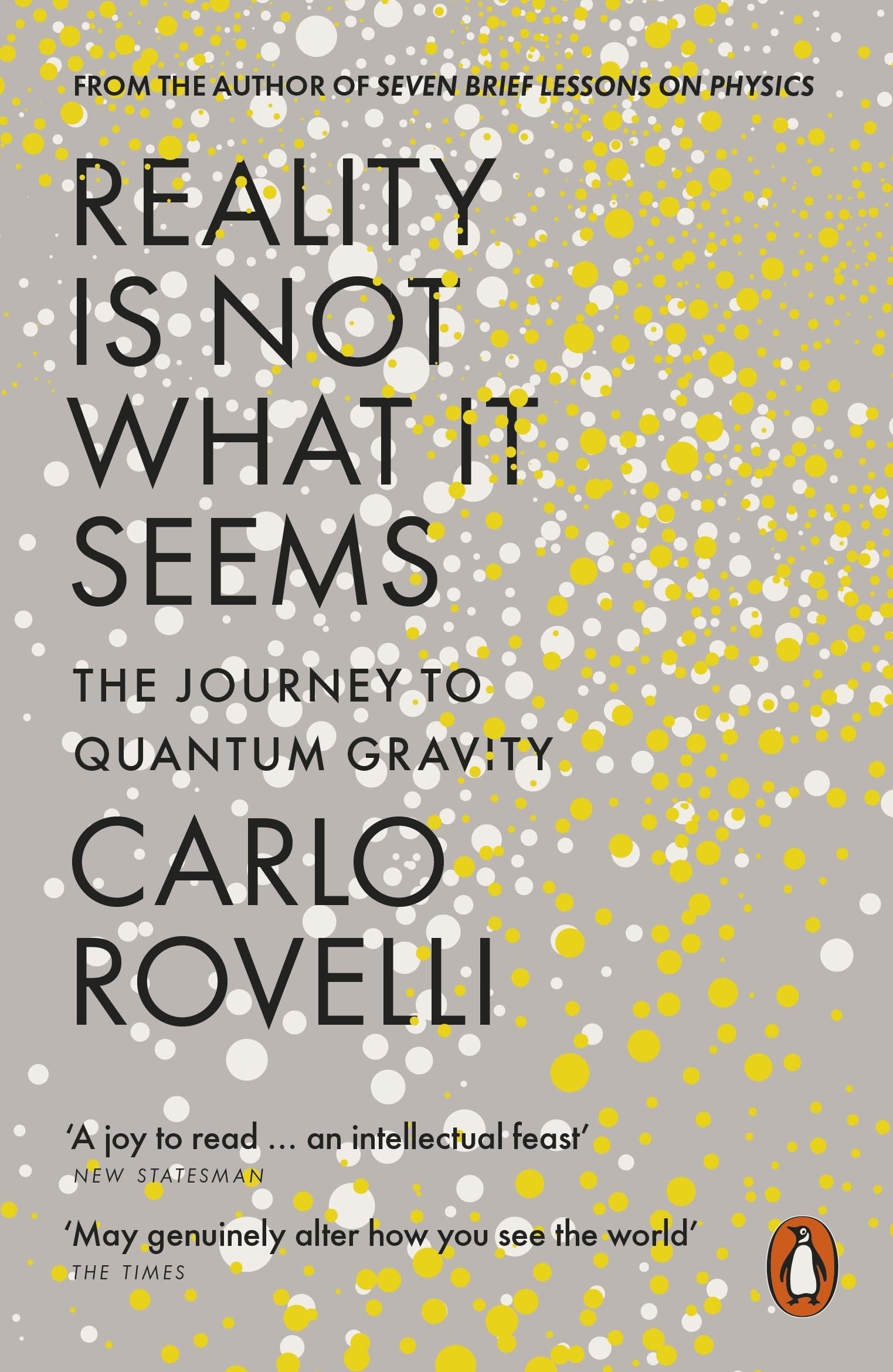
Reality Is Not What It Seems by Carlo Rovelli is a critically acclaimed exploration of the evolution of physics over 2,500 years, culminating in the groundbreaking theory of quantum gravity. This book demystifies complex ideas like spacetime granularity, black holes, and the fusion of quantum mechanics with general relativity, making cutting-edge science accessible to intellectually curious readers. Ranked top in theoretical astronomy and science history, it’s a must-read for professionals eager to stay ahead in understanding the cosmos.
| Best Sellers Rank | 18,489 in Books ( See Top 100 in Books ) 7 in Theoretical & Mathematical Astronomy 14 in Mathematics References 15 in History of Science (Books) |
| Customer Reviews | 4.5 out of 5 stars 4,730 Reviews |
S**T
The evolution of our understanding of physical reality: From Democritus to quantum gravity
The beauty of the writing, the clarity of the exposition, the presentation of cutting edge research on quantum gravity and the nature of physical reality, the creative thinking of things to come along with the enlightened spirit which imbues the text are some of the gratifying characteristics of the book. The author takes us on a fascinating journey spanning 2,500 years of evolution in physics and the human quest for understanding the nature of physical reality from Democritus of Abdera to loop quantum gravity and beyond. Democritus comes something of a hero in the book in anticipating modern thinking on the nature of physical reality overshadowing in this regard Plato and Aristotle. Plato is given due credit, however, in realizing that Mathematics is the language best adapted to understand and describe the world; the fact that Mathematics forms the basis of modern science owes much to Pythagoras and Plato. Mathematics assisted in the evolution of planetary science from classical antiquity through Ptolemy in Alexandria in the second century AD. Ptolemy provided accurate predictions on the movements of the planets with his geocentric system. Then the dark ages ensued. It was in the Renaissance that Nicolaous Copernicus (1473-1543) who made the revolutionary transition from geocentric to heliocentric cosmology but poor mathematics did not improve the accuracy of prediction of planetary movements. It was Johannes Kepler (1571-1630) similarly adopting a heliocentric system and better Mathematics that for the first time humanity finds how to do something better than what was done in Alexandria more than a thousand years earlier. Galileo Galilei (1564-1642) discovered the constancy of pendulum's swing and formulated the law of constant acceleration of falling bodies. And from the earth of Galileo, the genius of Isaac Newton (1642-1727) jumped to heavens and formulated the universal laws of gravity. Then come Michael Faraday and James Clerk Maxwell with the discovery of o electromagnetism and the concept of the field. Electromagnetism is the single force apart from gravity that governs virtually all phenomena we see: this is the force which holds together the matter that forms solid bodies; holds atoms in molecules and electrons in atoms; this is what makes chemistry and living matter work. The two and apparently incompatible pillars of twentieth century physics which radically transformed our ideas about the cosmos were Einstein's general theory of relativity and quantum mechanics: space and time in relativity; matter and energy in quantum mechanics. General relativity provides a simple and coherent vision of gravity, space and time. Einstein appreciated that gravity like electricity must be conveyed by a gravitational field. But his insight of a genius was his visualization that the gravitational field is not diffused through space but is the space itself. Space and time should not be viewed as two distinct entities but as an integrated whole - space-time. The theory provides an enormous simplification of the world. The predictions of the theory of general relativity were verified experimentally with a precision of one part to one hundred billion. The theory describes a world where universes explode, space collapses into black holes, time slows near a planet, interstellar space ripples like the surface of a sea while the space expands. Quantum mechanics, the second pillar, achieves unequaled experimental success and leads to applications which have transformed our every-day life e.g the computers, the advancement of molecular chemistry and biology, lasers and semiconductors. Planck was the first to correctly assume that the energy of the electric field is distributed in quanta (small packets) of energy; the size of the quanta depends on the frequency of the electromagnetic waves. Einstein came to the same conclusion for the energy of the quanta of light (photons). Bohr realized that the fact that the spectra of atoms are discrete and not continuous could be explained if the energy of electrons in atoms (electron orbitals) could only assume certain quantized values - certain specific values as hypothesized by Planck and Einstein. It becomes clear that granularity (distinct and finite as opposed to continuous and infinite) is something widespread in nature. Then comes Heisenberg's audacious theory: a fundamental description of the movements of particles, in which they are described not by their position at every moment but only by their position at particular instants: the instants in which they interact with something else. This is the second cornerstone of quantum mechanics, the relational aspect of things. The strange genius of Paul Dirac provides a final refinement producing the equations of quantum theory of unique abstract beauty. Dirac's equations is a recipe for calculating the spectra (the values) of the variables and a recipe for calculating the the probability that one or another value will appear in the next interaction. What happens between one interaction and another does not appear in the equations. The indeterminacy (the probabilistic character in the equations) is the third cornerstone of quantum mechanics: the discovery that chance operates at the atomic level. Dirac realizes that the theory can be directly applied to fields such as electromagnetic ones and can be made consistent with special relativity (making it consistent with general relativity, a cutting edge research topic in the book, will appear next and conclude this review). Dirac, in the process, discovers an ulterior, profound simplification of the description of nature: the convergence between the notion of particles used by Newton and the notion of fields introduced by Faraday. Einstein understood that space and time are manifestations of a physical field. Bohr, Heisenberg and Dirac understood that physical fields have quantum character: granular, probabilistic, manifesting through interactions. The theory to address the problem of quantum space and time is quantum gravity which reconciles the theories of general relativity and quantum mechanics. The first to intuit the existence of a minimum length in the gravitational field already in the thirties was a young Russian, Matvei Bronstejn who died tragically in the Stalinist regime. Matvei's reasoning was that at a very tiny length, a particle would collapse into a microscopic black hole thus rendering granular the gravitational field. This minimum length (Planck's length) was computed at 10 in the minus 33 centimeters. From this starting point, the Wheeler-Dewitt equation evolved and its solutions had the peculiarity that they depended on closed lines in space; a closed line is a 'loop'. The closed lines that appear in the solutions of the Wheeler-Dewitt equation are Faraday lines of the gravitational field. But now the continuous spiderweb of Faraday's lines become a finite number of distinct lines. The key to understanding the physics of these solutions lies on the points where these lines intersect. These points are called nodes, and the lines between nodes are called links. A set of intersecting lines forms a graph (a combination of nodes connected by links). A calculation demonstrates that without nodes, physical space has no volume. It is in the nodes of the graph, not in the lines, that the volume of space resides. These nodes representing the discrete packets (volumes) can be computed using Dirac's general quantum equation. Each node in the graph has its own volume, one of the numbers which collectively comprise the spectrum of the volume. Similarly the links joining the nodes represent collectively the spectrum of areas adjoining the volumes. What about time? Time no longer exists. The Wheeler-Dewitt equation, the fundamental equation no longer contains the time variable. The absence of the variable time from the fundamental equation does not imply that everything is immobile and that change does not happen. On the contrary, it means that change is ubiquitous. Only; elementary particles cannot be ordered along a rhythm. At the extremely small scale of the quantum space, the dance of nature does not develop to a sequential rhythm: every process dances independently with its neighbors, following its own rhythm. I shall conclude the long review by presenting the progression of our understanding of physical reality from Newton to quantum gravity which constitutes an enormous simplification but at the same time is profoundly counter intuitive: Newton: Space, Time, Particles. Faraday- Maxwell: Space, Time, Fields, Particles. Einstein 1905: Space -time, Fields, Particles. Einstein 1915: Co -variant fields*, Particles Quantum mechanics: Space -time, Quantum fields. Quantum gravity: Co -variant quantum fields. *Co -variant quantum fields are fields that live on themselves, without the need of a space-time to serve as a substratum , and which are capable by themselves of generating space-time.
P**C
Enjoyable if you skip Carlo's ancient Greek (and some 1300's rubbish too)
I was quite impatient with the first 50 pages which were a daft attempt to claim that some Greek in the 5th century BC can be credited for most of the physics we know. Trouble is - no written work by said Greek has been found, with the only reference to it by another Greek who wrote a poem about this. By now I was really worried! This started improving and then - Bang, as I was starting to hope, Carlo is starting to demonstrate his knowledge of Dante Alighieri, assigning to him the discovery of the 3-sphere, ( Divine comedy is about 700 dense pages, he found two sentences which is Delphic in content and is ridiculus as an argument). Apart from some further excursions to Plato's forms, he then mainly starts to deliver. The book proper, without the above nonsense is great, the non scientist will get a flavour and a continuous thread, obviously this isn't the book to teach anyone QM, relativity (either or both), string theory or LQG, but it does have an understandable narrative and it does give you the relevant equations in the footnotes. As someone who understands relativity and QM I liked it, he (justifiably has a go at Schrodinger's methodology, and his preference for Heisenberg's matrix approach is very sound.) What does LQG say about the speed of light? In fact what is velocity in a world without time? Can LQG calculate the fundamental constants: Planck, G, Boltzmann, masses of electron, proton etc? What about Einstein's famous Lambda (the cosmological constant) which has a calculated value of 120 orders of magnitude larger than the measured value? (the largest discrepancy in science, so far). Summary: If you resolutely skip the nonsense and save some time (Ha, ha) the rest is well worth reading.
A**S
Elegantly civilized introduction to a powerfully illuminating view of the cosmos
Carlo Rovelli is a true heir to the legacy of the Renaissance man. Even in translation, his prose is flowery, even poetic, and his exposition is enriched with deeply learned references to artists and philosophers from Anaximander and Democritus to Dante Alighieri. More to the point, his exposition of loop quantum gravity is authoritative and, I am pleased to say, intelligible, so far as it goes, which is admittedly not far in a book of physics for poets. For too long, physicists have struggled to do what they regarded as justice to infinity in their theories of the spacetime continuum and their differential equations. The clear lesson of quantum mechanics is that finite limits bound any physics of small phenomena that we can devise, and a salient lesson of relativity theory is that not only do we face a finite universal speed limit but also the cosmos is quite possibly finite in extent too, even when our curved spacetime now seems to be shooting off to a hyperbolic infinity under the mysterious influence of dark energy. Putting finite bounds on the granularity of spacetime rescues us both from the paradoxes of renormalization in QED and from the singularities at the heart of black holes, not to mention the incalculability of the Big Bang itself. If higher mathematics is the science of grappling with infinity, which is the view that remains when all finite mathematics is consigned to logic and computation, then physicists like Rovelli need to purge physics of its higher mathematics. The paradoxes of measure theory, whereby basic quantum computations lead us to talk of infinitely improbable events, are only the tips of the iceberg. Rovelli is clear that all these paradoxes should be done away with in a decent theory of quantum gravity. Our challenge is to model the granularity of spacetime at the Planck scale in a way that does justice to the observed phenomena, and here we face a massive enterprise for which the definitive equations are not yet in sight. Fro decades now, the fashionable way to work toward a theory of quantum gravity has been via string theory, but that theory is still bogged down in its own mathematical intractability. By contrast, the approaches of such mavericks as Rovelli and Lee Smolin and others are less trodden and less massively developed. This is a shame, because the philosophical advantages of their approaches, not least in banishing infinities, are considerable. Rovelli also mentions approaches to physics via the concept of information, which are even less well trodden and still poorly understood. As pioneers of quantum information theory like David Deutsch take it further, and as the Everett interpretation of quantum branching that Deutsch favors becomes more amenable to reasonable debate, this may change, but meanwhile the reserve on quantum indeterminacy that Rovelli maintains may hold sway. This book is a report on a massive work in progress, where decades could pass before a widely agreed resolution of the outstanding problems comes into view. We are fortunate that Rovelli has entrusted us with his personal thoughts on the story, even though they cannot be final. Sadly, this is a topic that most lay readers will struggle with, but the book is already worth reading for the philosophical perspective on physics and science that Rovelli reveals, where his incomparable Renaissance erudition and wisdom makes for a truly thrilling read.
A**D
Infintesimals are God's way of telling you your math is wrong...
I like Carlo Rovelli's writing, so I'm a bit biased to start with. However, in my defense he does write extremely well and conveys difficult concepts with startling clarity In this book Carlo takes us on the journey to Quantum Loop Gravity, a concept which attempts to join General Relativity with Quantum Electrodynamics, without anybody disappearing in a puff of purple smoke leaving nothing but their boots. It isn't entirely successful. Starting with the Greeks we look and some general philosophical aspects so everybody is nicely grounded in 2,000 years ago, and nothing much changes until Newton. At this point everybody is happy, nice deterministic universe, off to church on Sundays in the sure knowledge it won't make any difference. Then along came Max Planck, Schrödinger (him of the missing pet cat) and Heisenberg, this little gang of trouble makers caused a lot of uncertainty. But after a while a bunch of clever people, notably Julian Schwinger, Richard Feynman and Freeman Dyson, (nothing to do with vacuum cleaners), had a good look and decided we could explain almost everything by looking at the interaction of fields. Carlo runs with this idea, going to back to the by now rather simplistic ideas of Newton (to be fair, he saw the elephant in the room *and* measured it's gravitational force!) and begins to put forward an idea of how these fields could explain gravity without the universe doing a credible impersonation of an Ouzelum bird. The end of the book is quite complicated, but well worth it for the simple reason you are still reading at that point! Also, as a history of physics in a nutshell, it shines for it's brevity but without loosing important detail. Every paragraph is worth reading twice. I digress. It's a damn good read, worth bunging a few groats Carlos way, you won't be sorry. That good enough?
T**T
Reality is much greater than it seems
I previously had not come across this author but the title caught my attention as I have an interest in the philosophy of Kant, Schopenhauer and Ernst Cassirer. Thus I am not a scientist but found this book a dream to read. This man is Educated, he is a scientist yes, but has an understanding how the contribution that philosophy, art, and the other sciences can make to understanding and explication of his subject. He says "(this) is a world that does not exist in space and does not develop in time"; straight out of Schopenhauer! Poetry and paintings can describe some of these wonders he speaks of as well as any equation and he can, and does, avoid using maths. To "read" and understand maths you need to be conversant in the language it is written in as much as any novel needs you to know the language employed to tell the story. I don't denigrate maths, but like many I was taught it so badly in school I developed a dislike of it. You don't need maths for this book, but if for any young person with an inclination to science would read this book then the "point" of learning maths, and its sister subjects, will become exciting and clear. As one reviewer has already noted Carlo Rovelli would make a brilliant teacher. His ability (and that of his translators) to use words to describe this "reality" more than adequately makes it accessible to the general reader with an interest in the world and the texture of its making. Reality is not what it seems; it is far deeper, more vast, "with much still to clarify and explore". Rovelli acknowledges the works of the previous generations' great thinkers, and in humility, he seems to own the Socratic paradox; I know one thing; I know nothing. A brilliant book!
G**E
Clearer Horizions
As a completely untrained and sparsely knowledgable reader I found it accessible and highly informative. I can’t confess to have understood all the concepts or theories but got enough to start making some mental building blocks on which to read more (and probably read this again). The language was clear and the metaphors interesting and useful to make complex ideas relatable. Would certainly recommend.
M**G
Worth it if interested in the esoteric world of space-time
Clear account, and less equation-heavy as some others. Popular account? Depends on your background! Readable by technically educated non-physics specialists. The original Italian title translates as 'Reality is not how it appears to us', if my Italian hasn't let me down.
D**S
Not what it seems
This clearly has been a very popular book on science and, judging from the reviews here, it has proved a very satisfying read for many. I only got half way through the book myself and then gave it to my friend to see if he could understand what the author was going on about in the second half. Having said that I quite enjoyed reading further about Newton, Einstein and so forth in the earlier chapters. However I am non the wiser about reality. The later chapters, which I found inaccessible, largely concern the author's theory about gravity. It is a phenomenon that I think was better explained for the layman by Louis Girifalco in his book "The Universal Force : Gravity - Creator of Worlds".
V**E
Excellente synthese
L'auteur remonte loin (à Démocrite) mais c'est une excellente synthèse. Prose claire, limpide, sans jamais aucune obscurité. Sa gravité quantique à boucle semble soudain très simple et évidente. Très bon livre, bien traduit en anglais, très agréable à lire.
K**Y
Excellent read!
I thought this book was very well written. I still have no clue about quantum physics or gravity but loved reading this book regardless.
R**B
Beautiful summation of the current state of physics and the quantum gravity challenge
I had read rave reviews of this book as well as Rovelli’s other books, but held off reading them for a while. I have read a lot of other popular physics books including several that cover the conundrum of trying to combine quantum mechanics and general relativity (Smolin, Greene, etc) and I had assumed Rovelli was just covering well-trodden ground. I couldn’t have been more wrong. While the majority of content in this book was relatively familiar to me, the way in which the story was told - the prose, the poetic language and the weaving together with history, philosophy and art - was just a pure pleasure to read. It reminded me why I found science interesting in the first place earlier in my life, the sparking of that sense of wonder. That is the feeling you get reading Rovelli, plus learning about a bunch of interesting science in the progress. Highly recommended.
B**.
Quantum gravity.... A subject yet to be evolved to it's fullest
I am an ardent reader of physics subjects, I have read many books on physics ,but only a few of them imparted a satisfactory outlook so that a person with basic awareness of physics can understand it's content, but this one is a amazingly special for the simple reason that a person with general awareness about physics can understand. It covered almost every topics of main theories of classical, relativistic and quantum mechanics with such brevity and simplicity... Thanks to the author who tried his level best to come to the strata of an average physics enthusiast. After reading this book I got immense satisfaction which no other books of the same sort could provide... This is a must read book and I assure that you will get something very special which you will experience later...
L**A
imparare a convivere con l’ignoto
Carlo Rovelli presenta come si è evoluta la visione del mondo per arrivare attraverso la quantum gravity ad un tentativo di coniugare l’indeterminazione della teoria quantistica con la granularità delle cose della relatività generale. Ci si è riusciti? Le due teorie oggi sopravvissute string e loop sono ancora divise pure se quest’ultima sta raccogliendo indizi a suo favore. A fronte della mancanza di certezza rimane lo spirito della scienza che dubita di ogni certezza e che trova il suo valore nel dare le risposte che servono consapevole che domani queste cambieranno. Un libro molto bello da leggere.
Trustpilot
2 weeks ago
1 month ago