We remain fully operational. Our teams are working around the clock to ensure your deliveries continue safely.

DOWNLOAD THE APP


Customer Services
Copyright © 2025 Desertcart Holdings Limited
DOWNLOAD THE APP

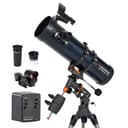
🌌 Own the night sky—track, explore, and discover like a pro!
The Celestron AstroMaster 130EQ-MD is a beginner-friendly Newtonian reflector telescope featuring a 130mm aperture and a motorized German equatorial mount for automatic tracking of celestial objects. It comes with two eyepieces, a red dot finderscope, and downloadable astronomy software, making it an all-in-one starter kit for amateur astronomers eager to master polar alignment, collimation, and night sky navigation. Its battery-powered motor drive ensures smooth tracking without cables, while the sturdy steel tripod offers quick, tool-free setup. Ideal for deep-sky observation and astrophotography with minor modifications, this telescope balances affordability with quality, perfect for millennials seeking a hands-on, educational stargazing experience.


| ASIN | B0013Z42AK |
| Age Range Description | Adults |
| Best Sellers Rank | 7,383 in Electronics & Photo ( See Top 100 in Electronics & Photo ) 16 in Telescopes |
| Box Contents | see descritption |
| Brand Name | Celestron |
| Coating | StarBright XLT |
| Compatible Devices | Smartphone, Camera |
| Country of Origin | China |
| Customer Reviews | 4.0 4.0 out of 5 stars (1,910) |
| Dawes Limit | 0.89 Arc Sec |
| Exit Pupil Diameter | 4 Millimeters |
| Eye Piece Lens Description | 20mm and 10mm eyepiece |
| Field Of View | 1.3 Degrees |
| Finderscope | Built-on StarPointer™ red dot finderscope |
| Focal Length Description | 260 millimeters |
| Focus Type | Manual Focus |
| Global Trade Identification Number | 00050234310512 |
| Item Dimensions D x W x H | 27.9D x 48.3W x 88.9H centimetres |
| Item Type Name | Celestron AstroMaster 130EQ MD Telescope |
| Item Weight | 17 Pounds |
| Manufacturer | Celestron |
| Manufacturer Part Number | 31051 |
| Model Name | AstroMaster 130EQ-MD Newtonian |
| Model Number | 31051 |
| Mount | CG-3 Equatorial |
| Number of Batteries | 1 Lithium Metal batteries required. (included) |
| Objective Lens Diameter | 130 Millimetres |
| Optical-Tube Length | 552 Millimetres |
| Power Source | Battery Powered |
| Product Features | Automatic Celestial Tracking with Adjustable Motor Drive |
| UPC | 050234310512 |
| Unit Count | 1.0 Count |
| Zoom Ratio | 130.0 |
V**3
Very good for the price. Recommended for first telescope. Lots of fun.
This review is based on the cost of this telescope after using it for about a year now. The review is for 130EQ-MD. First, to put things into perspective: * A good eyepiece costs more than half of the price of this telescope * A good mount starts at 4 times the cost of this telescope and exceeds 20 times the price The telescope is an excellent starter telescope. Based on forum review, it is probably not the best, but quote close to that. It has all the bits and pieces that you need to learn about while taking the first steps into amateur astronomy: * Equatorial mount: you'll learn about the types of mounts, how to do polar alignment, what is RA/DE and Hour Angle * It's Newtonian: you'll learn about reflector telescopes and collimation. You don't have to bend to look at the stars, which is important when spending an hour or so * Large focal length (you *do not* need more than that): allows you to toy with eyepieces and discover the limits of the telescope. You will realise the effects of the atmosphere and the limits they impose and you will also realise that in high magnifications the stars move too fast and go out of view in seconds. * Decent aperture: You won't be limited by the ability of the telescope to collect light. You will learn what dark adaptation is and how important it is. * Two eyepieces (20mm erect, 10mm): You'll learn what an erect eyepiece is. You'll get used to seeing things upside down. You'll learn to divide the focal lengths to get the magnification. You'll also inevitably learn about apparent field-of-view, eye relief, multicoating, what plossl is and that there is a variety of eyepieces but that you don't need many of them. * A motor: you'll learn the importance of it at higher magnifications. Eventually you'll also try to take pictures, either with a phone or with a camera, in which case you'll start attaching things to it. It's more trouble than you think but the good thing is that the telescope is very sturdy and can take it. Its pieces: * The telescope itself is of good quality * The mount is a *very* good mount for the price. It's sturdy, accurate to adjust and reasonably stable. I can't stress enough the importance of the mount. It's *the* most important part of a telescope. If you're not convinced, take a look at amateur astronomy forums for advice given to others. * The sky pointer is easy to use and very accurate once adjusted (the first time) * The eyepieces are good for the first days. At some point you will probably replace them with something better and possibly add a barlow lens. Look at forums about recommendations. I had very good results with a celestron omni 15mm. I have a celestron omni 5mm which is not useful 99% of the time and can't recommend because of the high magnification and the bad eye relief. An onni celestron barlow works well too. I also recommend getting a 30-40mm plossl eyepiece with good eye relief. * The motor (for the MD model) is painfully basic. Unfortunately it doesn't allow manual micro-corrections when it's attached, even if it's off. It also limits the rotation of the telescope which creates some blind spots (boooo). I had to remove it in some occasions. Overall , it's lots of fun for the price. IMO, you should not try something more expensive as a first telescope because you won't know what to look for. You'll realize that if you're going to invest then it's better to invest on a mount than a telescope. Expect to be able to see Saturn's rings and Jupiter's moons when they are close to Earth. See attached The bads: * The motor is basic and limits the movement of the telescope when attached. Fortunately, it's easy to remove and reattach. * The included eyepiece are very basic, although a good starting point and expected for the price of the telescope
S**N
Quality scope
Review after six months of using.... Fantastic telescope, really like it. Couple things to keep in mind ( as a respond to some comments and reviews) * Red dot finder I was out of range from the very beginning, I had to place chim to make it able point right ( it was always to high, even adjusted to the lowest position). So it is usable and works with small modification. (Stop working after 5 months, battery replaced but still dead) * Tripod - hmmm Works well, I mean, once polar alligned you can just turn RA knob to track object - great ! Motor Drive - works well as well, I don't understand why people complain about it... Maybe they simply don't know what it does ? Bad things are: when MD attached you can't use RA knob for precise aiming (you need to release a main knob) and there is a dead area / zone - when to motor itself block couple degree of rotation ( Not a big deal really) Tripod is.... Bit wobbly, not the best one in terms of stability, but it's not junk too... Hope you know what I mean. Just avarage one. * Optics Fast telescope (F5), good quality overall, not bad eyepieces included. It's Newtonian so, collimation required. Sound scary ! But is not! Main mirror doesn't have a central mark ( considered as a negative aspect - why celestron ? Why? ) But, I am collimating it without, and i have mastered it ! It's nice and easy . I was thinking about making mark myself, but, what for? YOU CAN COLLIMATE IT WITHOUT! You don't even need laser collimator. Get one if you want, mark mirror if you want - just keep in mind ,it's not must! * Astrophotography Yeah... Newtonian... You get some problems with focus, using DSLR! (Works well with modified webcam) and works well with 2x barlow and DSLR , works well afocal projection with DSLR, and works well with prime focus - if you modify telescope ( move main mirror towards front, about 2 cm) not a big deal, hovewer, once you do it, the observations will required adapter ( all about focus plane) Every method have some advantages and disadvantages - Google them ! I am using Seben zoom eyepiece 8-24 attached to my t adapter and canon DSLR or Barlow X2 with t adapter to the same camera (keep in mind, 2 X Barlow actually quadruple exposure time and doubling FR! ) Anyway, this two methods gives me better results then modified webcam. take reference photos if you want good results ( flats, bias, darks) and experiment. Overall, it's a great scope. You need to learn things in order to obtain full potential ( eq mount, polar alligment, focus, collimation, not to mention night sky !) It's great for observing stars and DSO, not so good for planets (obviously you still can do it) For astrophotography - it required some small modifications. No regrets of buying it ! Imho super cheap and well performing scope. + For observing deep sky objects (nebulas, galaxy's) = For astrophotography DSO, long exposures thanks to motor drive but some mods required (focus) - For planetary observing or photography get Something else - like f12 refractor ;)
S**S
Good first telescope
This is my first Newtonian Telescope.Its not a bad beginner telescope but it needed collimating first which is easy to do also the tripod isn’t the best quality you get a shaky image which settles down after a few seconds. But once collimated the image quality is great
L**A
Mein erstes Teleskop, ich bin voll und ganz zufrieden. Zur Qualität kann ich nichts sagen da mir der Vergleich fehlt. Der Motor ist ein Gimmick, den habe ich als erstes entfernt. Als Anfänger kann ich damit eh nichts anfangen... Der Aufbau war intuitiv und einfach, bis heute habe ich keinen Blick in die Anleitung geworfen. Was auf der beigelegten CD/DVD ist weiß ich nicht, ich habe mir das Programm "Stellarium" runtergeladen und finde so interessante Objekte. Die Okulare im Lieferumfang reichen für einige Monate Spaß, ich bin mittlerweile am überlegen bessere zu kaufen. Ich glaube ein Mondfilter wäre auch nicht verkehrt, der Vollmond ist schon sehr hell. Wer das Geld hat, dem kann ich dieses Teleskop nur empfehlen. Ich glaube aber für den Anfang ist es eine große Investition, da würde auch ein kleines Tisch-Teleskop mehr als ausreichen.
K**.
Fungerade precis som jag hade förväntat mig, bra produkt
K**M
ay, mars, jüpiter ve satürn üzerindeki detaylar, bazı kuyruklu yıldızlar ve bazı meteorlar, yakın çift yıldızlar, sönük yıldızlar, bazı yıldız kümeleri, bazı nebulalar, bazı galaksilerin spiral kolları, bazı yeni genel katalog (ngc) ve indeks kataloğu (ic) nesnelerini gözlemlemek için mükemmel bir başlangıç teleskobu. Kargo çok hızlı geldi.
A**O
Todo inicio requiere aprendizaje. Me costo hacerlo funcionar en un principio y después de adquirir un lente barlow 2x y otros lentes adecuados, comence a realizar oservaciones planetarias, luna y otras estrellas. No he realizaddo observaciones de cielo profundo, después las realizaré. Buena adquisición, buen precio.
P**E
He comprado mi primero instrumento astronomico por curiosidad, sin conocer nada de telescopios, dado el precio bastante barato y el tema que me gusta. Los oculares y el buscador inclusos son un poco débiles, pero se pueden ver facilmente varios planetas. Para ajustar los espejos con precision (el espejo secundario estaba completamente desajustado), he comprado en Amazon un "Cheshire" de Celestron tambien, que facilita la procedura. La montura equatorial necesita un poco de practica, pero parece de buena calidad. Luego he comprado en Amazon.es un ocular Ploss de 4mm y otro buscador de Celestron Firstscope (ver el sitio Web inglés del Astromaster para saber como montarlo) que sea un poco mas potente. En el campo, ademas de los crateres lunarios, he visto Saturno, sus anillos y un satelite, Jupiter, sus bandas y 3 de sus satelites, Venus y Mars. Me queda todavia a utilizar el motor de la montura y a buscar objectos que no se veen sin instrumento.
Trustpilot
3 weeks ago
1 month ago