
Buy anything from 5,000+ international stores. One checkout price. No surprise fees. Join 2M+ shoppers on Desertcart.
Desertcart purchases this item on your behalf and handles shipping, customs, and support to Kyrgyzstan.
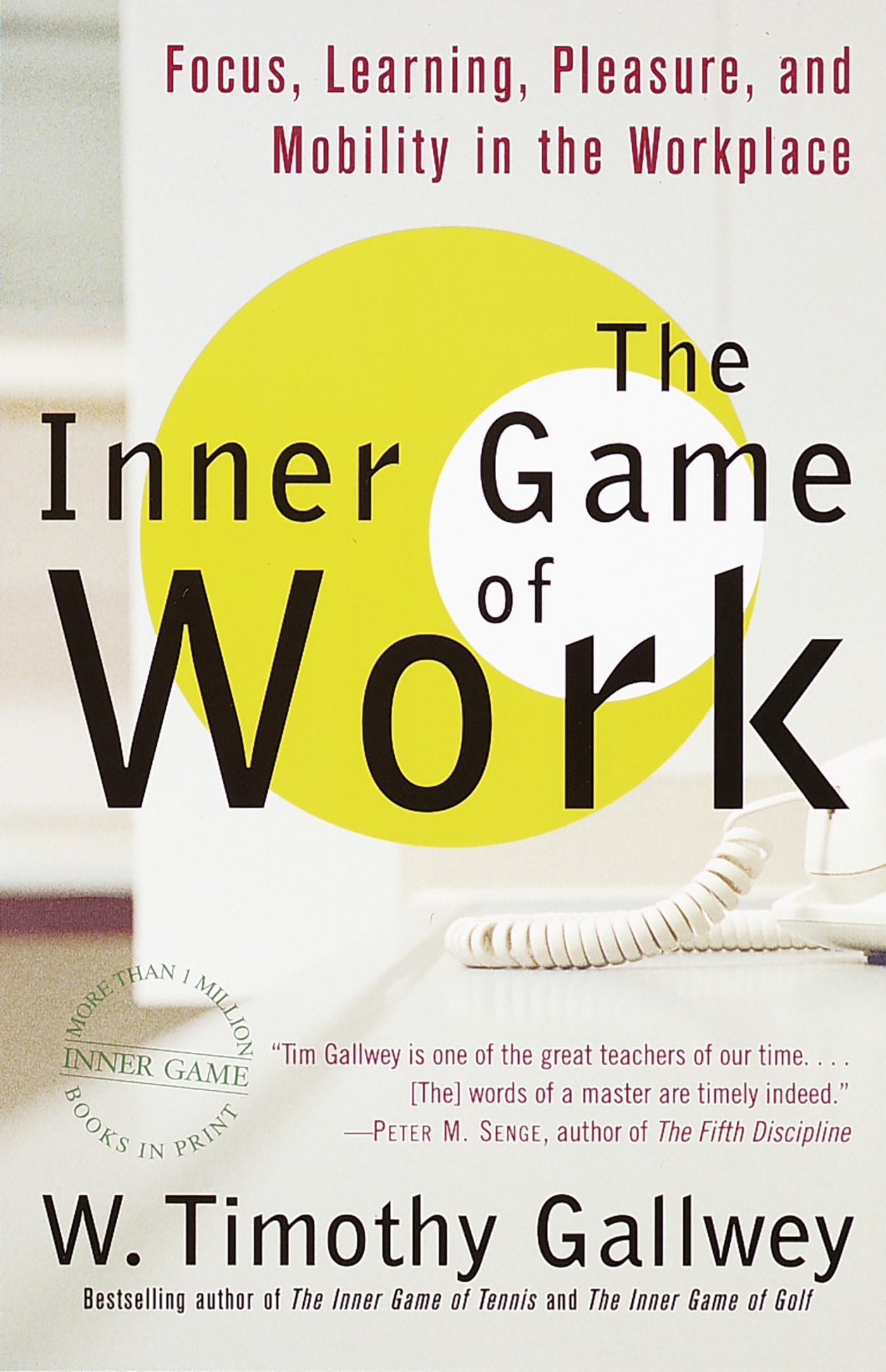
The Inner Game of Work: Focus, Learning, Pleasure, and Mobility in the Workplace [Gallwey, W. Timothy] on desertcart.com. *FREE* shipping on qualifying offers. The Inner Game of Work: Focus, Learning, Pleasure, and Mobility in the Workplace Review: Incredible - I really enjoyed this book. I have a feeling it will take me years to fully appreciate the deep lessons it imparts, even though understanding them was easy. I also liked The Inner Game of Tennis, but this one was more applicable to more people, since so many people work. It isn't full of answers or neat prescriptions, nor claim that it's just a matter of following a patented formula. This book offers tools, ways of finding answers more quickly. Highly recommended for anyone seeking the deeper meaning behind work, which is a worthy pursuit, since it is the single activity we spend the most time doing. Review: Reflects Author's Evolving Thoughts On The Inner Game Of Work (And Everything Else) - I admit have not read the author's classic, The Inner Game of Tennis. Instead, I chose to order TIGOW because I thought the groundbreaking concepts in TIGOT would not only be repeated in the former but that the former would reflect the author's evolving understanding of inner games. After all, many years had gone by since the publication of the later. Having completed TIGOW, I have no reason to believe that I was wrong. Anyway, TIGOW is excellent. Reading it will almost certainly help your inner game. I have nothing to add to what other people have said about the book. Except that the story the author relates concerning the class he took as a Havard undergrad featuring then professor B.F. Skinner demonstrating the power of operant conditioning on a pigeon subject has stayed with me. That story alone might be worth the price of the book for those who understand much of its chilling and not-so-chilling implications. Get the book.


| ASIN | 0375758178 |
| Best Sellers Rank | #141,944 in Books ( See Top 100 in Books ) #29 in Occupational & Organizational Popular Psychology #142 in Workplace Culture (Books) #758 in Business & Investing Skills |
| Customer Reviews | 4.4 4.4 out of 5 stars (344) |
| Dimensions | 5.24 x 0.56 x 7.95 inches |
| Edition | Reprint |
| ISBN-10 | 9780375758171 |
| ISBN-13 | 978-0375758171 |
| Item Weight | 8 ounces |
| Language | English |
| Part of series | The Inner Game |
| Print length | 256 pages |
| Publication date | September 11, 2001 |
| Publisher | Random House Trade Paperbacks |
T**O
Incredible
I really enjoyed this book. I have a feeling it will take me years to fully appreciate the deep lessons it imparts, even though understanding them was easy. I also liked The Inner Game of Tennis, but this one was more applicable to more people, since so many people work. It isn't full of answers or neat prescriptions, nor claim that it's just a matter of following a patented formula. This book offers tools, ways of finding answers more quickly. Highly recommended for anyone seeking the deeper meaning behind work, which is a worthy pursuit, since it is the single activity we spend the most time doing.
B**G
Reflects Author's Evolving Thoughts On The Inner Game Of Work (And Everything Else)
I admit have not read the author's classic, The Inner Game of Tennis. Instead, I chose to order TIGOW because I thought the groundbreaking concepts in TIGOT would not only be repeated in the former but that the former would reflect the author's evolving understanding of inner games. After all, many years had gone by since the publication of the later. Having completed TIGOW, I have no reason to believe that I was wrong. Anyway, TIGOW is excellent. Reading it will almost certainly help your inner game. I have nothing to add to what other people have said about the book. Except that the story the author relates concerning the class he took as a Havard undergrad featuring then professor B.F. Skinner demonstrating the power of operant conditioning on a pigeon subject has stayed with me. That story alone might be worth the price of the book for those who understand much of its chilling and not-so-chilling implications. Get the book.
C**Y
Strong start, slow middle, good advice
Some useful core lessons, though the writer seemed to be spinning his wheels a bit after a few chapters and the end seemed like it would never end. The mindfulness principles are well applied with lots of examples. Even though I'm not in sales, I could relate it to my field because he's so specific. I was a bit baffled by his directly naming for criticism people who gave him access to the inner workings of their (by his analysis) flawed company culture, yet leaving anonymous this one person he praises and credits with near godlike teachings.
J**L
"mobility" - behind the wheel again
In my top 50 (business, productivity). Wonderful overview of the dialogue between the ears. It also discusses how our environment influences us negatively when we're unaware and not focused. The concept of mobility and the analogy of being behind the wheel of a car actually directing our careers was excellent! Definite must read...enjoy Jb
S**T
the book degrades to many steoreotype formulas. focus is no longer important
Disclaimer: by now I have read 63% of the book. so maybe the surprise is in the end. I have to admit i am rather surprised and frankly upset with the second book (the first one is inner game of tennis, which I believe is a masterpiece). The focus state (the key idea of the first book) is blamed for "having no purpose". The author compares focus state with driving with no purpose. He substitutes focus with so-called mobility state which is a conscious awareness. It seems the author is confused with his contradictory approaches. Not comparable with the first book. Not recommend it. PS: pls see the disclaimer in the beg. Best regards, Sergey.
P**E
Everything improves once you change your inner voice
Unlike some books that give you concrete, step by step advice, this is just as the title says....it's the inner game. Gallway observed students of tennis improved more when he stopped telling them what to do and asked them to observe specific things. You have to put on a new pair of glasses so to speak. You step away from worries about performance and put on curiosity, asking yourself new questions about what you are doing. I am not yet through, but reading with a highlighter so I can review it more quickly in subsequent readings, which I would think will be necessary as we tend to slip back to old habits. And not just us. Many athletes and world class performers lose their edge and succumb to pressures about performance. But if we adopt different mindsets, we can get back into the flow where things happen easily and without thought.
J**W
This is a great book for anyone that has a very loud self ...
This is a great book for anyone that has a very loud self talk. My self talk was out of control, I needed to understand by self 1 and self 2, understanding both voices; I was able to quiet my self talk and learn to listen to the voice that I learned to know and trust. Anyone and everyone can learn from this logic, at work and in life.
V**C
nice
nice book, good aplication of the inner game of tennis into work
N**L
Very easy to read and full of insight, it deserves being one of the 'classics' in coaching literature. A must.
M**F
Dieses Buch geht von der zentralen These aus, dass jeder Mensch ein Ich-1 (Self 1) (dass unablässig bewertet - lobt und kritisiert) und ein Ich-2 (Self 2) (das für schöpferische Kreativität und die Einzigartigkeit jedes Menschen steht) in sich hat. Im weiteren Verlaufe des Buches arbeitet Gallwey heraus, welche Aspekte für die größtmögliche Befreiung des Ich-2 zu berücksichtigen sind (Awareness - Bewusstseinsmachung, Choice - Wahl und Vermeidung des Tunnelblicks sowie Trust - auf das Ich-2 vertrauen). Die Verknüpfungen der Aussagen im Buch zum Coaching sind vielfältig. So arbeitet Gallwey sehr gut den Unterschied zwischen Lehren (teaching) und Coaching heraus. Auch belegt er an vielen Beispielen, dass ein nicht-bewertendes Hinterfragen im Coachingprozess oft schon eine sehr heilende Wirkung auf den Coachee haben kann. Im vorletzten Kapitel erläutert Gallwey eine Methode, die in Veränderungsprozessen gut eingesetzt werden kann: den Wechsel der eigenen Perspektive in die Person gegenüber (Transposing). Auch aufgeführt werden in jenem Kapitel einige hilfreiche Fragen, die in den Veränderungsphasen Bewusstwerdung (awareness), Auswahl von Wegen und Methoden (choice) und Vertrauensbildung (trust) sehr gut eingesetzt werden können. Für alle Leser, die sich strategisch mit dem eigenen Arbeitsleben (und dem der Mitmenschen) beschäftigen möchten, kann dieses Buch ein echter Gewinn sein!
A**.
Highly recommended book for those looking to grow their professional status
H**I
It's a pretty deep analysis human interactions in work environment! Beyond that the author goes deep in mental strategies which can take us toward excellence!!!
C**N
Un gran libro de Tim Gallwey, te explica claramente los conceptos de "inner game" aplicable a negocios, pero sobre todo a como crecer uno mismo.
Trustpilot
1 month ago
2 weeks ago