


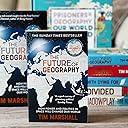


The Future of Geography: How Power and Politics in Space Will Change Our Worl...
Product ID: 473802094
Buy anything from 5,000+ international stores. One checkout price. No surprise fees. Join 2M+ shoppers on Desertcart.
Desertcart purchases this item on your behalf and handles shipping, customs, and support to Kyrgyzstan.
Buy The Future of Geography: How Power and Politics in Space Will Change Our World – THE NO.1 SUNDAY TIMES BESTSELLER* (Tim Marshall on Geopolitics) 2nd by Tim Marshall (ISBN: 9781783967247) from desertcart's Book Store. Everyday low prices and free delivery on eligible orders. Review: Look at maps in a different way - A great read and made me look at maps and geography in a different way. Review: An enjoyable read - Very apt after the recent successful American journey to the Moon and back. An impressive Geopolitical understanding by the author. Very good reading.



| Best Sellers Rank | 4,642 in Books ( See Top 100 in Books ) 19 in Higher Education on Geography 25 in Geography (Books) 185 in Society, Politics & Philosophy |
| Customer reviews | 4.4 4.4 out of 5 stars (2,026) |
| Dimensions | 12.9 x 2.4 x 19.8 cm |
| Edition | 2nd |
| ISBN-10 | 1783967242 |
| ISBN-13 | 978-1783967247 |
| Item weight | 294 g |
| Language | English |
| Part of series | Tim Marshall on Geopolitics |
| Print length | 356 pages |
| Publication date | 1 Oct. 2023 |
| Publisher | Elliott & Thompson |
M**E
Look at maps in a different way
A great read and made me look at maps and geography in a different way.
M**E
An enjoyable read
Very apt after the recent successful American journey to the Moon and back. An impressive Geopolitical understanding by the author. Very good reading.
G**E
Well written and interesting view
Really interesting perspective
A**Y
Timely space race update
Comprehensive, highly-readable and clear overview of the current situation of astropolitics. As someone who as a child was excited by Sputnik (1957) it’s been fascinating watching events unfold in the decades since. In space as on Earth, China, Russia and the US are the Big Three, but many other countries are also staking their claims in space. Big prizes are Moon bases and then Mars and beyond, but a host of countries are aiming for lower but strategically important targets, putting up satellites for various reasons. Therefore, we have to face and meet some challenges - “the arms race, the competition for territory and resources, the lack of laws and many other negative aspects” (page 234). Including the massive amount of debris circling the planet. After potted histories of astronomy and space travel, Marshall launches into a fair and balanced account of current astropolitics. It’s interesting that only China appears to have called for the United Nations to have a central role “in managing outer space affairs.” (page 107). And private companies have also emerged as major players – SpaceX, Virgin Galactic and Blue Origin, and i-Space in China and Arsenal in Russia (page 86). Marshall details threats of violent solar flares and asteroids (pages 92-4) and it’s unsurprising these concerns are also mirrored in the recently published, equally brilliant, The Earth Transformed by Peter Frankopan (pages 649-50). These two books might be read in tandem to give a complete picture of the history and recent escalation of terrestrial and off-Earth geographical challenges. Marshall has done a competent and enlightening job in giving us the facts and background – we see what needs to be done, but will it be done?
M**G
Everyone should read this
Very interesting
B**W
Jumping the shark?
As a concept the future of geography doesn't make a lot sense. How can geography have a future? It feels like he's grasping at straws a bit here. But my wife likes the series.
E**M
“A Brilliant Conclusion to the Geography Trilogy
The Future of Geography brilliantly concludes Tim Marshall’s acclaimed “Geography Trilogy.” With a comprehensive analysis of the often less-discussed field of astropolitics, Marshall expands the conversation beyond Earth to the strategic importance of space.
T**D
Extraordinary achievements
Good synopsis of our achievements in space. In addition explains ongoing research and geopolitical dilemmas. Clearly written and not pompous.
K**R
Very engaging and contemporary, Tim Marshall books are written in a way that once started, it's hard to put them down
I**N
Like the geopolitics of earth, there are places and spaces outside of earth’s atmosphere that are more strategic than others. In Tim Marshall’s “The Future of Geography”, politics on earth will continue to influence the race for strategic space access and exploitation. According to many experts, the globe is in the throes of another space race. But this one is different. In the first race, the Soviet Union and the US spent billions each in national projects, exchanging victories as each nation achieved success “firsts” in space exploration. Russia’s programs extended from scientific giants like Tsiolkovsky who’s calculations in rocket launching fuel-weight ratios still represent the prime hurdle to economical and sustainable space exploration. The Apollo program may have won the moon race but in the 1960s, the space race united a global passion and demonstrated a civility in competition that today’s geopolitics lacks. Marshall begins his latest book by recapping the joys and excitement of the first space race and highlighting its geopolitical influence and shared humanity even amidst the potential for nuclear catastrophe. We are in a second space race, Marshall argues, which happens to coincide with another brand of cold war. This new race has more players, more targets, more investors and even more-so than the first race, is in desperate need of space rules and norms to ensure the peaceful use of space. Peaceful, space, rules, norms, are all words that sadly have differing definitions between today’s biggest space competitors. Today’s space race is a competition for strategic orbits in cislunar space and promising real-estate on the moon’s surface. There is more to orbital dynamics than Low Earth Orbit (LEO), Geosynchronous Orbit and Geostationary Orbit (GEO). Lagrange orbit points represent strategic locations in relation to the sun, moon and earth’s gravity that allow for the most sustainable orbit in most conducive to space development potential. LEO is congested orbit space made worse by increasing space debris. GEO is perhaps a little less congested but requires a more expensive transportation service. In between, MEO, is an orbital expanse where with the right technology, all space players may get a little more elbow room. On earth, the most strategic launch pads are a combination of proximity to the equator, smaller populations with limited radio frequency zones and the presence of an east facing sea of empty space for safe rocket launches in the direction of our spinning orb for greatest thrust out of the atmosphere’s proverbial net. In a way, every corner of the earth can provide some advantage to space explorers and its accompanying technology. For instance, China took advantage of Djibouti’s proximity to the equator and its government’s strategy of hosting competing country outposts at lucrative prices to lease a small plot of Djiboutian land for Africa’s first space port. Australia, Namibia and South Africa are important space places due to their open skies and minimal radio frequency interference. South Africa is soon to host the world’s largest satellite receiving complex (SKA), a multibillion and multinational project. Unlike Sputnik and Apollo, today’s biggest space exploration programs require funding and collaboration from multiple contributors. Marshall digs in to the specifics of the US-led Artemis Project and accompanying Accords comparing it to the European Space Agency’s approach and China and Russia’s space aspirations. Each space program requires the economic, research and technology contributions of as many nations as possible. To be expected, the new space race also requests the political support of its contributors to influence the development of space norms, laws and expectations. While there have been attempts at developing space treaties, as Marshall explains, none has caught on or been fully ratified by all the space faring nations. Instead, the Artemis Accords is one effort to ensure the peaceful use of space in addition to existing space law from individual nations. As a matter of fact, China has yet to produce its own space law despite thousands of rocket launches, hundreds of satellites and its aggressive efforts to provide space launch services and satellite production for other countries. In contrast, Taiwan’s newly named Aerospace Agency (TASA), ensured that mere sounding rocket operations spurred Taiwan’s lawmakers to pass comprehensive space regulations just last year. China’s space technology is advanced, but its reticence to formalize its own space regulations is another data point in comparing not only government systems but development and safety norms. The new space race cold war borders may be less malleable between the US and China but countries like France and their space agency (CNES) claim to be able to de risk continued cooperation with China while signing on to the Artemis Accords. It gives France two paths to the moon and maybe even Mars. Marshall’s work is significant for its fair description of other space programs in India, Japan and the UK and their cooperation calculus. The constant across the spectrum is the increased contributions and funding from private companies like Space-X (US) and ispace (Japan). Space-X provided more than just communication terminals to Ukraine post Russian invasion. Space-X also became the indispensable alternative to Russian Soyuz-supported launches. Yet another example of how this new space race involves a diverse set of players and unexpected geopolitical impacts. The book ends where it begins, restating the need for global space norms and rules. The author engages the reader in an exercise envisioning the many ways in which the current race for space could trigger conflict inside and outside the earth’s atmosphere. Disrupting satellite operations not only spells disaster for economic output dependent on internet connectivity but disrupting early warning satellite feeds to any nuclear power directly impedes nuclear deterrence which makes nuclear conflict more likely. I enjoyed Marshall’s journey through ancient space enthusiasts from the Greeks and Romans to the Chinese and golden age of Islam. The heavens to most are a reflection of Someone’s handiwork. Giants of science like Isaac Newton overcame religious dogma to consider science as a celebration of creation. The vastness of the universe and the minuteness of matter each contain the clues to both space exploration and the pleasure of its Author. In this new space age, we can hope for the best (cooperation) but every nation appears to be planning for the worst which includes ensuring the defense of their space systems and coming up with some impressive laser weapons and satellite robots with claw arms in the process. Also, as many experts have noted, almost any space-related technology can be dual use which makes the need for rules and norms more prescient.
G**L
Análise super atual sobre como a ciência está determinando o jogo do poder no mundo.
D**N
Best book to learn about the future of warfare and space' s importance , illustrates revolutionary envisioned by great powers.
G**R
Siero ottimo
Trustpilot
1 month ago
5 days ago