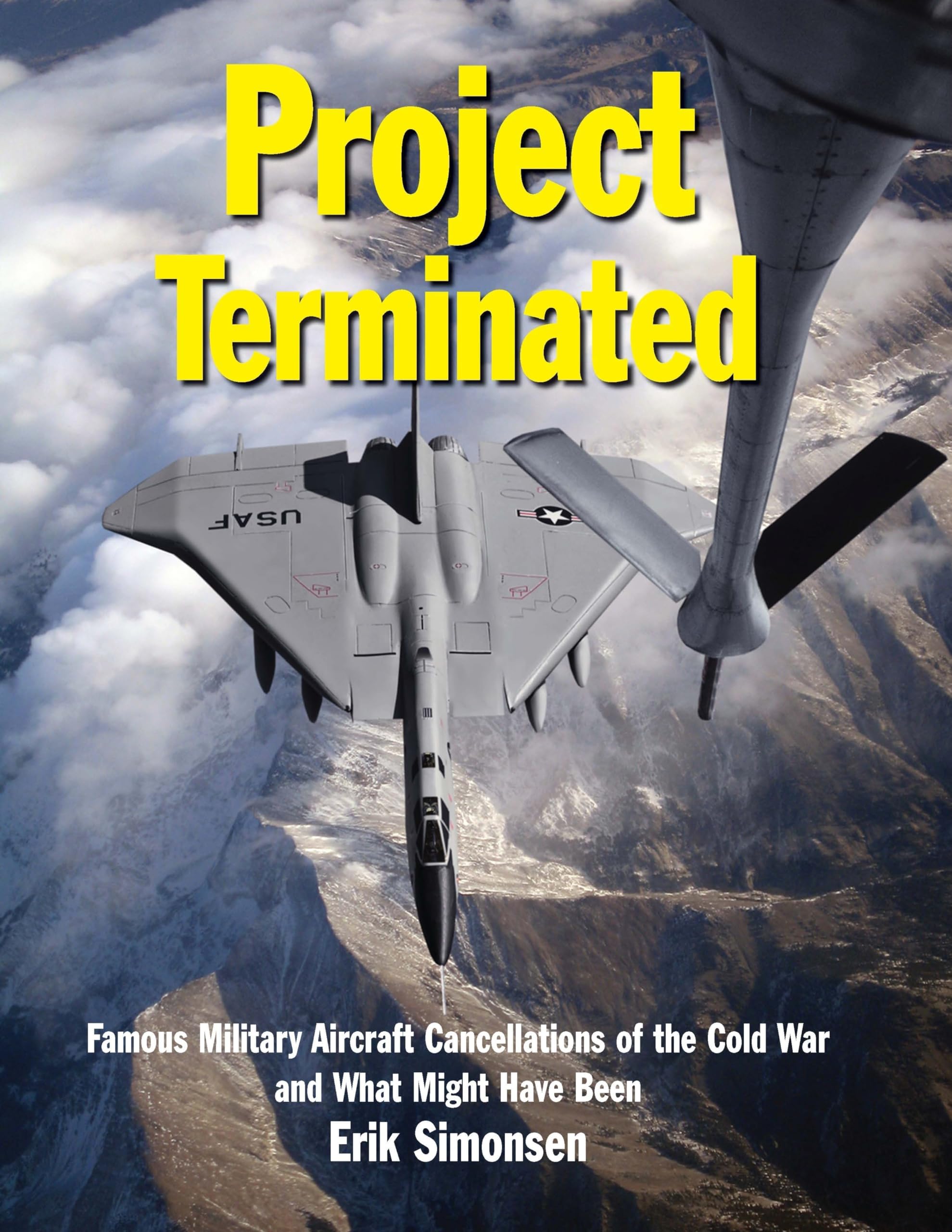


Project Terminated: Famous Military Aircraft Cancellations of the Cold War and What Might Have Been
Product ID: 4674794
Buy anything from 5,000+ international stores. One checkout price. No surprise fees. Join 2M+ shoppers on Desertcart.
Desertcart purchases this item on your behalf and handles shipping, customs, and support to Kyrgyzstan.
Project Terminated: Famous Military Aircraft Cancellations of the Cold War and What Might Have Been [Simonsen, Erik] on desertcart.com. *FREE* shipping on qualifying offers. Project Terminated: Famous Military Aircraft Cancellations of the Cold War and What Might Have Been Review: Bench Racing Cold War Could-Have-Beens - The first thing you'll notice when flipping through the pages of this book are the gorgeous images. And they are numerous. One could spend hours just taking in the fantastic sights of Mach 3 interceptors and bombers on training missions, space planes on orbit and agile fighters scrambling at high alpha. Mr. Simonsen is an accomplished aviation photographer and a superb illustrator; this book is worth the price for the images alone. The introductory quote from British aircraft designer Sir Sydney Camm sets the tone for much that follows: "All modern airplanes have four dimensions, span, length, height and politics". For the aircraft covered, Mr. Simonsen provides tables with the first three dimensions and the text aptly covers the fourth. Project Terminated has the goods on the planes I expected: Lockheed's Blackbirds, North American's XB-70 and Boeing's X-20 but also covers some with which I wasn't all that familiar: Avro's CF-105 and British Aerospace's TSR.2. The technical details for each are covered, supported with photos from the author's collection and the aforementioned imagery. Each chapter also has insets that further shed light on the particular project or show how similar technology is currently applied. For instance, the X-20 Dyna-Soar project is bolstered by the inclusion of Boeing's X-37B, the focus of much speculation. Also, the chapter on the XB-70 includes the Soviet Sukhoi T-4, a plane with supposedly similar characteristics, as context. I sincerely hope the cautionary theme of this book registers with those who make and will be making decisions regarding approval and funding of future envelope-pushing projects; that envisioning and considering what might have been instills big picture, down the road thinking. Personally, I will enjoy this book for years to come. Not only do I now know more about some of my favorite aircraft, I have 'seen' them as if they were put into service and used in ways I'd only imagined. Highly recommended. Review: You can't buy everything - The reason to buy this book is for all of the pretty pictures of airplanes that never were, and to imagine what might have been. The production standards are top-notch: high quality paper, binding, color on every page. It is a pleasure to hold and read. That said, there is a current that runs through popular aviation books where the heroine subject aircraft was the greatest thing ever, and any effort to limit her numbers, retire her after 50 years, etc., can only be the result of wrong-headedness or criminality. This book reads a lot like that, except that there are 11+ heroines, and most of them got cut off far earlier, so the rhetoric about the wrong-headed criminality gets ramped up even higher, and with no real understanding of why "evil" politicians, military officials, and budget makers do what they have to do. The bottom line is that you can't buy everything. There is a finite amount of time, effort, and money, and you must prioritize it where it will do the most good. Those decisions are made by fallible people, and can be wrong, and there are some cases in this book, especially the CF-105 Arrow and F-20 Tigershark, that are famous blunders. (But let me point out that the CF-105 cancellation resulted in the Canadian aerospace industry moving south en masse and taking jobs with NASA, so a Really Bad Day in Canada turned into a Really Good Day in the Sea of Tranquility.) And yes, sometimes fighter guys sabotage bombers or vice versa, and it's unsightly, and yes, Robert Strange McNamara's failures are legendary (only recently eclipsed by Rumsfeld's in the Pantheon of Bad SecDefs), but it's all because you can't buy everything. And this book's analysis is so thin that it doesn't get at any of that. What would we have had to do without that we DID buy instead? Three examples: In one chapter the author argues that if we had built the B-70, it might have shortened the Cold War. Really? But if we'd bought the B-70 instead of 1000 Minuteman ICBMs, maybe we would have lost the Cold War. But we won the thing without the B-70, and without blowing up the world, so I say we take the win. Would B-70s have been cool? Sure, but they would have sure been expensive to operate. What other things would we have had to do without? In two chapters, he complains that it was short-sighted that we didn't build the F-108, F-12B, and F-106X Super Dart interceptors (he even advocates that it would have been a good idea to have both the F-108 and F-12B at the same time, duplicating each other's missions), because what IF the Soviets had built a large supersonic bomber fleet that required us to have Mach 3 interceptors? But the Soviets didn't, not until they were going broke and collapsing, so we didn't need Mach 3 interceptors after all, and we won the Cold War without them. So the people who cancelled them made the right call, not a short-sighted blunder after all. Finally, and this is the insidious part of the book, the author confuses his alternative timelines with reality, by assuming that breakthrough technologies needed for some of these projects would have magically worked out if we just hadn't cancelled them. In a caption for an F-103A fantasy picture he remarks, "The unique dual-cycle (turbo-ramjet) engine would have allowed for economical cruise flight until high Mach speed was required." That's a lot like saying that if we'd only given Ponce de Leon more time and funding we'd have a Fountain of Youth by now. (We still don't have dual-cycle turbo-ramjets because turbofans helped with fuel economy and we found out that high-Mach wasn't all that useful for most things.) The author never mentions that the Wright J67 engine (American version of British Olympus) that was supposed to power the XF-103 ran into development delays and was eventually cancelled. This was very common in the 1950s, when engines could not live up to their promised goals, and they and the planes built around them were dropped, redesigned and delayed (more money), or in some cases the planes limped on, never living up to their intended potential (F-102A, F3H, F7U, F11F, even the F-14A), and these engine problems were not really solved until the 1980s. The author does admit that the Air Force said the technology was not mature enough. Well, if the Air Force, which is generally not shy about spending taxpayer money, says it's not mature enough, they're probably right, notwithstanding the author's claim, "their [XF-103] innovative design work was awesome." But I suppose we could have thrown a whole lot more money at it and done without F-4s and B-52s or something. Interestingly, the author cites the F-35B JSF as evidence of why we should have built the XFV-12. So why if the JSF can't be made to work on time and on budget, the FV-12 program would have gone perfectly? Just like, "You can't buy everything," "You can't make everything that you can imagine work out on time and on budget." So this is not an aviation history book. It is an aviation enthusiast fantasy wishbook, and there's nothing wrong with that. The opportunity to see very well-done CGI action shots of operational F-103s, CF-105s, TSR.2s, B-49s, F-108s, B-70s, F-106C/Ds, F-12Bs, etc., is a great deal of fun, and well worth the price of this well-made book. This does lead to one strange short-coming, however. Since we are talking about CGI, where once the model work is done all you have to do is create additional skins/drapes to lay over it, I am struck by how few paint schemes these fantasy aircraft appear in. The four shots of F-108s are all in the same 5th FIS markings, the three F-103 shots are all in the same 94th FIS markings, four of the F-12B shots are all in the same 49th FIS markings, etc. I would have liked to see a little more variation in color schemes and markings in the fantasy shots. My suggestion for the author is that for his next book he do a full-on "What If" book where he goes ahead and posits an alternate future where the Soviets did build lots of supersonic bombers earlier, and where the skies are populated with these airplanes that "might have been cancelled in another world" and spread out his CGI palette even farther. I will buy that book as well.
| Best Sellers Rank | #3,147,500 in Books ( See Top 100 in Books ) #4,863 in Military Aviation History (Books) |
| Customer Reviews | 4.2 4.2 out of 5 stars (67) |
| Dimensions | 8.88 x 0.75 x 11.25 inches |
| Edition | First Edition |
| ISBN-10 | 0859791734 |
| ISBN-13 | 978-0859791731 |
| Item Weight | 2.4 pounds |
| Language | English |
| Print length | 224 pages |
| Publication date | February 15, 2013 |
| Publisher | Crecy Publishing |
S**Z
Bench Racing Cold War Could-Have-Beens
The first thing you'll notice when flipping through the pages of this book are the gorgeous images. And they are numerous. One could spend hours just taking in the fantastic sights of Mach 3 interceptors and bombers on training missions, space planes on orbit and agile fighters scrambling at high alpha. Mr. Simonsen is an accomplished aviation photographer and a superb illustrator; this book is worth the price for the images alone. The introductory quote from British aircraft designer Sir Sydney Camm sets the tone for much that follows: "All modern airplanes have four dimensions, span, length, height and politics". For the aircraft covered, Mr. Simonsen provides tables with the first three dimensions and the text aptly covers the fourth. Project Terminated has the goods on the planes I expected: Lockheed's Blackbirds, North American's XB-70 and Boeing's X-20 but also covers some with which I wasn't all that familiar: Avro's CF-105 and British Aerospace's TSR.2. The technical details for each are covered, supported with photos from the author's collection and the aforementioned imagery. Each chapter also has insets that further shed light on the particular project or show how similar technology is currently applied. For instance, the X-20 Dyna-Soar project is bolstered by the inclusion of Boeing's X-37B, the focus of much speculation. Also, the chapter on the XB-70 includes the Soviet Sukhoi T-4, a plane with supposedly similar characteristics, as context. I sincerely hope the cautionary theme of this book registers with those who make and will be making decisions regarding approval and funding of future envelope-pushing projects; that envisioning and considering what might have been instills big picture, down the road thinking. Personally, I will enjoy this book for years to come. Not only do I now know more about some of my favorite aircraft, I have 'seen' them as if they were put into service and used in ways I'd only imagined. Highly recommended.
D**N
You can't buy everything
The reason to buy this book is for all of the pretty pictures of airplanes that never were, and to imagine what might have been. The production standards are top-notch: high quality paper, binding, color on every page. It is a pleasure to hold and read. That said, there is a current that runs through popular aviation books where the heroine subject aircraft was the greatest thing ever, and any effort to limit her numbers, retire her after 50 years, etc., can only be the result of wrong-headedness or criminality. This book reads a lot like that, except that there are 11+ heroines, and most of them got cut off far earlier, so the rhetoric about the wrong-headed criminality gets ramped up even higher, and with no real understanding of why "evil" politicians, military officials, and budget makers do what they have to do. The bottom line is that you can't buy everything. There is a finite amount of time, effort, and money, and you must prioritize it where it will do the most good. Those decisions are made by fallible people, and can be wrong, and there are some cases in this book, especially the CF-105 Arrow and F-20 Tigershark, that are famous blunders. (But let me point out that the CF-105 cancellation resulted in the Canadian aerospace industry moving south en masse and taking jobs with NASA, so a Really Bad Day in Canada turned into a Really Good Day in the Sea of Tranquility.) And yes, sometimes fighter guys sabotage bombers or vice versa, and it's unsightly, and yes, Robert Strange McNamara's failures are legendary (only recently eclipsed by Rumsfeld's in the Pantheon of Bad SecDefs), but it's all because you can't buy everything. And this book's analysis is so thin that it doesn't get at any of that. What would we have had to do without that we DID buy instead? Three examples: In one chapter the author argues that if we had built the B-70, it might have shortened the Cold War. Really? But if we'd bought the B-70 instead of 1000 Minuteman ICBMs, maybe we would have lost the Cold War. But we won the thing without the B-70, and without blowing up the world, so I say we take the win. Would B-70s have been cool? Sure, but they would have sure been expensive to operate. What other things would we have had to do without? In two chapters, he complains that it was short-sighted that we didn't build the F-108, F-12B, and F-106X Super Dart interceptors (he even advocates that it would have been a good idea to have both the F-108 and F-12B at the same time, duplicating each other's missions), because what IF the Soviets had built a large supersonic bomber fleet that required us to have Mach 3 interceptors? But the Soviets didn't, not until they were going broke and collapsing, so we didn't need Mach 3 interceptors after all, and we won the Cold War without them. So the people who cancelled them made the right call, not a short-sighted blunder after all. Finally, and this is the insidious part of the book, the author confuses his alternative timelines with reality, by assuming that breakthrough technologies needed for some of these projects would have magically worked out if we just hadn't cancelled them. In a caption for an F-103A fantasy picture he remarks, "The unique dual-cycle (turbo-ramjet) engine would have allowed for economical cruise flight until high Mach speed was required." That's a lot like saying that if we'd only given Ponce de Leon more time and funding we'd have a Fountain of Youth by now. (We still don't have dual-cycle turbo-ramjets because turbofans helped with fuel economy and we found out that high-Mach wasn't all that useful for most things.) The author never mentions that the Wright J67 engine (American version of British Olympus) that was supposed to power the XF-103 ran into development delays and was eventually cancelled. This was very common in the 1950s, when engines could not live up to their promised goals, and they and the planes built around them were dropped, redesigned and delayed (more money), or in some cases the planes limped on, never living up to their intended potential (F-102A, F3H, F7U, F11F, even the F-14A), and these engine problems were not really solved until the 1980s. The author does admit that the Air Force said the technology was not mature enough. Well, if the Air Force, which is generally not shy about spending taxpayer money, says it's not mature enough, they're probably right, notwithstanding the author's claim, "their [XF-103] innovative design work was awesome." But I suppose we could have thrown a whole lot more money at it and done without F-4s and B-52s or something. Interestingly, the author cites the F-35B JSF as evidence of why we should have built the XFV-12. So why if the JSF can't be made to work on time and on budget, the FV-12 program would have gone perfectly? Just like, "You can't buy everything," "You can't make everything that you can imagine work out on time and on budget." So this is not an aviation history book. It is an aviation enthusiast fantasy wishbook, and there's nothing wrong with that. The opportunity to see very well-done CGI action shots of operational F-103s, CF-105s, TSR.2s, B-49s, F-108s, B-70s, F-106C/Ds, F-12Bs, etc., is a great deal of fun, and well worth the price of this well-made book. This does lead to one strange short-coming, however. Since we are talking about CGI, where once the model work is done all you have to do is create additional skins/drapes to lay over it, I am struck by how few paint schemes these fantasy aircraft appear in. The four shots of F-108s are all in the same 5th FIS markings, the three F-103 shots are all in the same 94th FIS markings, four of the F-12B shots are all in the same 49th FIS markings, etc. I would have liked to see a little more variation in color schemes and markings in the fantasy shots. My suggestion for the author is that for his next book he do a full-on "What If" book where he goes ahead and posits an alternate future where the Soviets did build lots of supersonic bombers earlier, and where the skies are populated with these airplanes that "might have been cancelled in another world" and spread out his CGI palette even farther. I will buy that book as well.
S**N
Great book, lot's of information and terrific photography. Interesting and informative. Definately recommended. Just wish the delivery had been more timely; had ordered in October and did not receive the book until end of May. The book was worth the wait but the wait was unacceptable when it originally stated it was in stock.
D**D
Plenty of those nearly happened moments. It's a good overall ,cover all so to speak. If you have a keen interest in aviation;you'll no doubt have read about most if not all the projects within. I've noted what other reviews have pointed out about some of the narrative,which is fair comment. The good news if you want to know more about the golden age of jets. It's still an excellent read.The computer rendered images are good and there some good original photos also.Good value for an hardcover book.
L**S
Sehr schönes Buch, mit sehr viel Infos.
K**R
A quality book, fine artwork, good details on many very interesting designs and their potential rivals & contemporaries. Definite recommendation for those interested in the subject area. There is a but... Any readers used to the more nuanced and mature informed commentary of the Secret Projects series and other books by the likes of Chris Gibson and Tony Butler may be be put off by the writers at best simplistic and at times ill informed comments and commentary. The position appears to be these aircraft were all perfect and who shouldn't have been cancelled and lets not worry about unimportant aspects like not being able to afford them or associated requirements being overtaken by critical events and developments. The worst examples of this is the particularly flawed logic used to imply that (1) cancelling the B-70 directly lead to the Cuban missile crisis and (2) cancelling the B-1A directly lead to the Soviet invasion of Afghanistan when anyone even slightly familiar with the Soviet perspective of these events knows that absolutely no such link existed. Don't want to be too negative, generally a fine book as long as you can stomach it when the writer briefly goes off on a mad tangent.
F**H
Top Buch mit vielen Details und schönen Grafiken. Leider war die Verpackung nicht perfekt für so ein schweres Buch, so dass es kleine Transportschäden gibt - schade - daher nur 4 Sterne.
Trustpilot
2 weeks ago
2 months ago