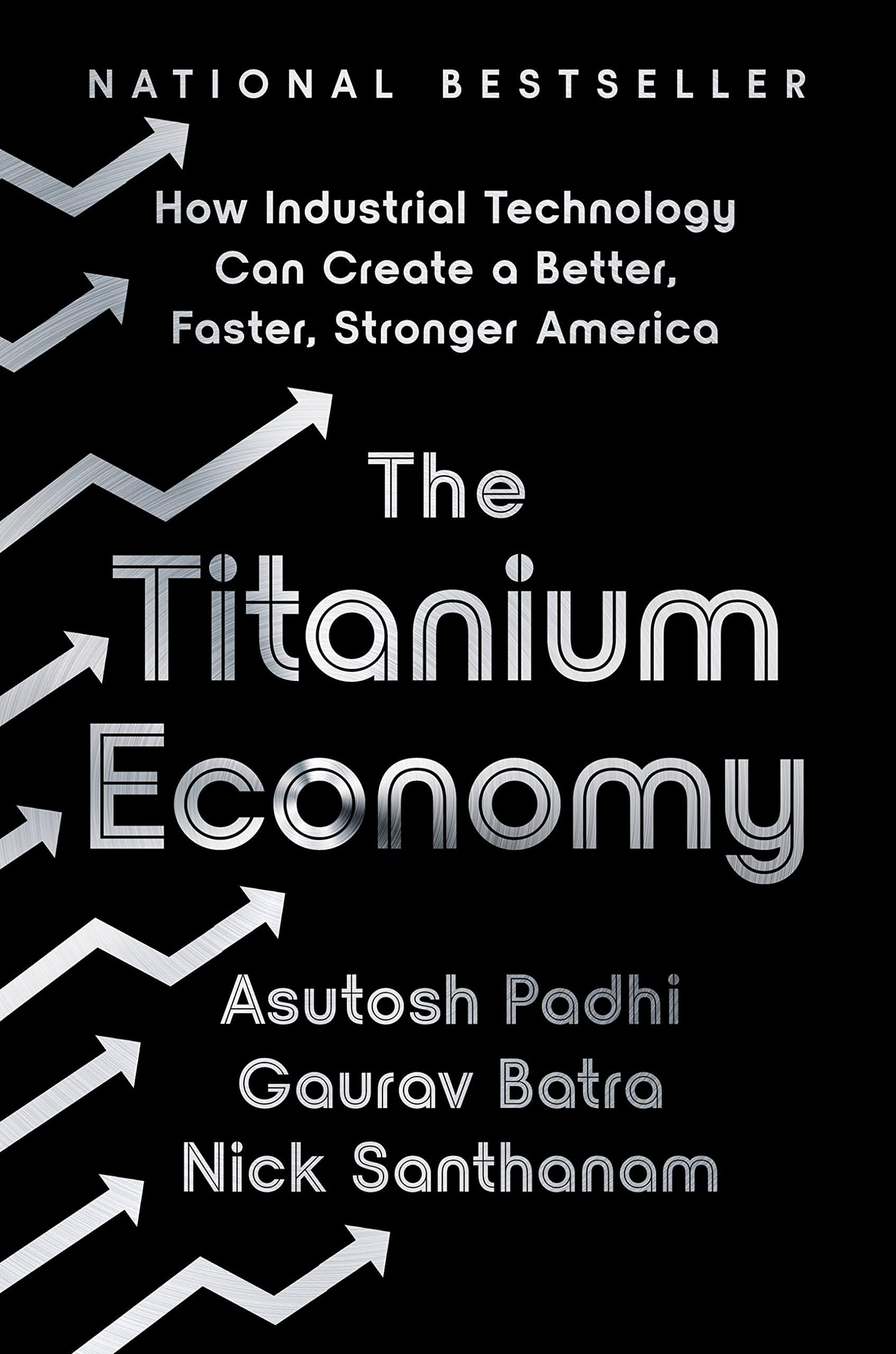
The Titanium Economy: How Industrial Technology Can Create a Better, Faster, Stronger America
Product ID: 459687540
Desertcart purchases this item on your behalf and handles shipping, customs, and support to Kyrgyzstan.
A Wall Street Journal bestseller The future of the American economy is hiding in an unlikely place: the manufacturing sector While Silicon Valley titans dominate headlines, many of the fastest-growing, most profitable companies in the United States are firms you’ve likely never heard of, such as HEICO, Trex, and Casella. These booming companies belong to a burgeoning sector—industrial tech—that offers surprising hope to workers, consumers, and investors alike. Their role: to make a range of products—aerospace parts, for example, or recycled plastic lumber—that quietly form the backbone of America’s biggest industries. In an age of instability, industrial tech is a cornerstone of our economic future. In this book, McKinsey veterans Asutosh Padhi, Gaurav Batra, and Nick Santhanam reveal the “titanium economy,” a modern, reinvented industrial sector complete with high-paying, domestic jobs;, soaring stock prices;, and critical infrastructure. They dispel the myth that the best of American manufacturing is behind us and illuminate an opportunity for a brighter future—if we can seize it. Review: Very insightful and skillful handling of a complex topic - ‘Chip technology and hi-tech manufacturing is the oil of the future’. Gaurav, Asutosh and Nick have done a great job of taking a complex topic, which on the surface may seem somewhat dry and trite, and created a very usable framework to think about how to start, build, and scale in this area. Very relevant in the times we are living in - with the recent CHIPS act signed into law, there will be a rush of new investment flowing into building and scaling hi-tech chip manufacturing and this book provides a playbook. Review: Punchy, highly readable take on US manufacturing (a little "Gladwellian") - I'm a fan of non-fiction but didn't expect myself to be so interested in a book focused on US manufacturing. Pleasantly surprised by the "readability" of this book - really effective use of case studies and human storytelling. I found the style to be somewhat "Gladwellian" in nature (which I quite love). Super compelling storytelling, and conveys an important message about how and why we should be paying attention to these companies that make up such an important part of our economy. Highly recommend!


| Best Sellers Rank | #1,135,519 in Books ( See Top 100 in Books ) #98 in Industrial Relations Business #106 in Manufacturing Industry (Books) #111 in Industrial Technology (Books) |
| Customer Reviews | 4.5 out of 5 stars 110 Reviews |
D**S
Very insightful and skillful handling of a complex topic
‘Chip technology and hi-tech manufacturing is the oil of the future’. Gaurav, Asutosh and Nick have done a great job of taking a complex topic, which on the surface may seem somewhat dry and trite, and created a very usable framework to think about how to start, build, and scale in this area. Very relevant in the times we are living in - with the recent CHIPS act signed into law, there will be a rush of new investment flowing into building and scaling hi-tech chip manufacturing and this book provides a playbook.
R**K
Punchy, highly readable take on US manufacturing (a little "Gladwellian")
I'm a fan of non-fiction but didn't expect myself to be so interested in a book focused on US manufacturing. Pleasantly surprised by the "readability" of this book - really effective use of case studies and human storytelling. I found the style to be somewhat "Gladwellian" in nature (which I quite love). Super compelling storytelling, and conveys an important message about how and why we should be paying attention to these companies that make up such an important part of our economy. Highly recommend!
S**A
USA Manufacturing Alive and Well
Fascinating review of innovative start-ups and midsize manufacturing companies that are revolutionizing micro-market manufacturing markets across the USA using digital sensors and data mining.
R**I
What future of American manufacturing might really look like
What I loved about this book is the vivid and real examples of so many companies--most of which many of us would have never heard of--spread across the US, that have been delivering jobs, innovative products and technologies, returns (to the entrepreneurs and also shareholders, if they are public). If America is looking for an industrial policy to create jobs across the country, Titanium Economy has some interesting approaches in that is looking like the onset of an interesting post-global globalization world.
C**B
Look behind the headlines
Manufacturing has suffered in the U.S. but there's a pocket of companies creating really cool, innovative stuff that does not get noticed by many. It's materials that help run all the mundane things in your life that many take for granted. And much of it is manufactured in North America in factories that don't look like the factories of old. Some really great examples and a few ways for people to get involved.
J**N
McKinsey seek to jump-start an industrrial economy
America's dirty little secret, according to this intriguing book, is that it's industrial sector is thriving, in sharp contrast to the national narrative, “brimming with innovation, offering high quality jobs with good paying benefits, and producing strong financial returns” and can't find enough workers to fill the jobs on offer. There are at least 4,500 such domestic companies in the sector, they say, boasting returns by some that are exceeding those of the Silicon Valley tech stars. Two of the three authors are top McKinsey officials and the third formerly led McKinsey’s North American Industrial Practice as a senior partner. They published this book at a time of national ferment over whether the United States should develop an industrial policy such as the one that has put China at the forefront of global manufacturing and export. It is a call to arms for the US to rebuild its industrial manufacturing prowess. American economic growth in the 21st century, they say, must be manufacturing-led, which is contrary to the common wisdom that says that economies mature, they become service-oriented, and that even China is maturing and turning more to services. Given McKinsey’s Washington clout, it is a proposition meant to be heard in congressional and governmental circles. As McKinsey analysts often are, they are relentlessly upbeat, calling the sector the “Titanium Economy” because titanium “shares a great many characteristics with the companies we identified. Titanium is extremely durable and corrosion resistant. It is incredibly strong relative to its weight. Perhaps most importantly…it's all around us, in our cars, our mobile phones our jewelry, sports equipment surgical tools and more.” It is also an adjective that the authors beat us over the head with until we never want to hear the word titanium again. Nonetheless, the companies described in this book as typical are a hidden world. They don’t make cars or televisions, but they make a lot of necessary stuff, and in fact it was the departure of the car industry for Asia that led to the impression that manufacturing in the United States is in irreversible decline although it’s hard to argue that it isn’t. Actual figures show manufacturing has been receding as a component of US GDP since even before Deng Xiaoping opened China’s industrial sector in the 1980s, falling from more than 30 percent in the 1960s to 12 percent in 2022 Still, the authors say many of these new industrial tech companies are at the center of geographical hubs across the country that are revitalizing communities in the Rust Belt and even Appalachia. The nature of factories has changed, the authors say, with strong workplace protections and high-tech equipment transforming them into clean, safe and extraordinarily productive operations. In fact, the idea of working in manufacturing is so foreign to students today that some have had to have the word factory explain to them. Whether the authors’ optimism is justified, and they provide plenty of examples to say it is, their book also plays to a growing problem in the United States, and that is whether the average cost of college education, which is now roughly US$140,000 over the course of four years in public schools, and far higher at top-line ones, makes education worth it. Among those who borrow, the average debt at graduation is $25,921 — or $6,480 for each year of a four-year degree at a public university. For those in private school, especially those who go for a master’s or doctorate degree, the cost can soar far above US$100,000. Some students will be paying off college debt when they retire. By contrast, the authors say, a motivated high school dropout could earn a general education degree equivalent to a high school diploma via on-the-job training and move right into a job with decent benefits in the manufacturing economy. A line manager without a college degree can earn enough to support a family of four while socking away a surplus for their child's college fund. Meanwhile, with jobs going begging, in 2009 the McKinsey global institute published an analysis on labor disparities that concluded that 71 percent of US workers are in jobs for which there is weak employer demand, and oversupply of eligible workers, or both. Manufacturing now accounts for 20 percent or more of employment in 460 of the US’s 3,142 counties and equivalent governments across the US. Industrial employment increased from 11.6 million from January 2011 to 12.5 million in October 2021 and has continued to increase, as shown by the chart below, which says that the percentage increase growth in manufacturing has outpointed every other sector since the onset of Covid-19. But, the authors say, the persistent talent gap for jobs at all levels has led to devastating results, with 2.4 million industrial jobs going unfilled over the past decade and with seven of every 10 companies falling behind in scheduled production add a cost to the economy of US$2.5 trillion. The authors call for a national effort to revitalize a manufacturing industry whose green shoots are already there. China, they say, invests up to 200 times the level of US funding, providing grants and support to a large an emerging network of research centers. Germany supports 76 tech centers are focused on applied innovation. South Korea boasts the highest share of researchers moving between academia and industry, stimulating industry innovation. That may be a bit alarmist. According to the American Association of community colleges, there are 1167 junior colleges in the United States, many of them providing a solid foundation in vocational skills. Private US research remains formidable, and is growing more so, studies say. Nonetheless, they argue, “the United States is not keeping pace in sponsoring university and federal laboratories and partnerships. The US needs a robust national strategy for advancing industrial tech beginning with nurturing stronger collaboration between academia and industry, as these other countries are doing.” The attention paid to Silicon Valley innovation and the money invested in it, they argue. are disproportionate, neglecting the current and potential future value of the industrial tech sector. “Making and moving things is still the foundation of a thriving economy, as the supply chain disruptions of the Covid-19 pandemic have shown.” At the end of the book, the authors present a series of prescriptions to leverage the “titanium playbook” to move the US back into contention in a world with the Asian manufacturing ones. US innovation in quantum computing, cloud computing, artificial intelligence, machine learning, advanced materials and 3D printing, they say, are making the manufacturing sector more competitive, more efficient and better at serving the needs of customers. A national effort is needed, they say, to get the US back to where it belongs as a manufacturing powerhouse. It is an uphill battle. But the McKinsey mavens make a persuasive case.
R**H
A genuine page-turner for folks interested in the U.S. Economy
Titanium Economy was wonderful - I greatly enjoyed all of the vignettes that show how manufacturing in the U.S. really never died but is instead alive in small towns and cities all across the country...for anyone who loves thinking about the future of the american economy, U.S. Manufacturing, or how to create high-paying jobs here in America, this is a really great book! I flew through it in an afternoon.
J**S
Understanding the new economic warfare facing America today
The Authors explain the dilemma Americans face from manpower shortages to funding technology sufficiently to avoid Chinese dominating the future of technology. Every Country is increasing the funding of research and technology. America is behind in funding the leading technologies of the future.
C**U
Beaucoup de pages pour peu d’idées
Beaucoup de récits d’entreprises industrielles US méconnues qui réussissent, mais peu d’enseignements à en tirer. Derrière le titre accrocheur un article aurait suffit.
Trustpilot
2 months ago
3 days ago