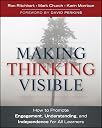
Making Thinking Visible: How to Promote Engagement, Understanding, and Independence for All Learners (Jossey-Bass Teacher)
Product ID: 4198900
Desertcart purchases this item on your behalf and handles shipping, customs, and support to Kyrgyzstan.
A proven program for enhancing students' thinking and comprehension abilities Visible Thinking is a research-based approach to teaching thinking, begun at Harvard's Project Zero, that develops students' thinking dispositions, while at the same time deepening their understanding of the topics they study. Rather than a set of fixed lessons, Visible Thinking is a varied collection of practices, including thinking routines?small sets of questions or a short sequence of steps?as well as the documentation of student thinking. Using this process thinking becomes visible as the students' different viewpoints are expressed, documented, discussed and reflected upon. Helps direct student thinking and structure classroom discussion Can be applied with students at all grade levels and in all content areas Includes easy-to-implement classroom strategies The book also directs readers to online videos that demonstrate how Visible Thinking works in real classrooms. Review: Excellent resource for my students' biggest learning blocker! - **SHORT VERSION** This book provides two things every busy teacher needs: 1. A deeper understanding of how to make the invisible parts of thinking more visible -to both students and teachers. 2. Actionable student activities, grouped for different phases of learning: introduction, processing, and digging deeper into content. I wouldn't recommend this book for the teacher who is simply looking for quick tools for lesson planning… the activities are not complicated, but a deeper explanation is needed to learn them and to make optimal use of them. However, if you are an educator that wants to better understand how to build better THINKERS, this book is a must! **CONTEXT OF MY USE** I've spent the last four years volunteering as a curriculum coordinator for a hybrid (online/in person) learning program (well before Covid). The director and teachers could see a lot of gaps in their pre-existing curriculum, so they asked for my assistance in finding better options. To my surprise, the task was much harder than expected because nearly every curriculum program (regardless of subject) has a major flaw… one that this book addresses in great depth and with great utility! Most programs (regardless of whether they are software or text-based) follow the same pattern: 1) Deliver new information 2) Give writing assignments (or, for math, assign problems) Yet, over and over (and over…) again, students smash into the same brick wall… they freeze at the writing assignments because they are still trying to *process* the new information. We started coaching students to understand, "Writing happens in two phases, first you must determine WHAT you want to say, then you must determine HOW you want to say it." The problem is… they don't really understand the difference between these two phases… until we give them a graphic organizer. Then, one-by-one, their faces light up as they see how the graphic organizer helps them sort through new information… with zero burdens of grammar, punctuation, spelling, and minimal burden on language. Instead, they are free to focus mostly on ideas before transferring those ideas into language. So, we've been supplementing our curriculum with graphic organizers. But, we've long known that there is room here for deeper instruction. (SIDENOTE: For math, we've seen significant improvement from using graphic organizers to help students learn the terminology/vocabulary for each unit!) "Make Thinking Visible" caught my attention because I had been using this phrase with my students, "We have to make the invisible, visible." And, as noted above, it has delivered with comprehensive insights into how to provide more explicit guidance on how to think about thinking. Review: Seeing Inside Students' Minds - How many times have you wished you could open up a child's head to see what he's thinking and how well he understands content you're working with in class? Visible thinking strategies can help you with that, providing a window into a students' thinking so that other students and you can better follow their reasoning and explanations. Visible thinking can be used with virtually any age of student or any subject matter, making these strategies extremely useful and worthy of use in your classroom. The book is well written and easy to read, with clear explanations and examples of how strategies have been used in a wide variety of classrooms. These strategies can be immediately employed in your classroom, no matter when in the school year you begin, so you won't need to wait for a new term in order to get started. If you want to have a better understanding of what goes on in students' heads, I recommend this book. It would be a great book for your professional learning community's focus, too.

| Best Sellers Rank | #46,572 in Books ( See Top 100 in Books ) #32 in Educational Psychology (Books) #218 in Education (Books) #366 in Instruction Methods |
| Customer Reviews | 4.6 out of 5 stars 748 Reviews |
S**S
Excellent resource for my students' biggest learning blocker!
**SHORT VERSION** This book provides two things every busy teacher needs: 1. A deeper understanding of how to make the invisible parts of thinking more visible -to both students and teachers. 2. Actionable student activities, grouped for different phases of learning: introduction, processing, and digging deeper into content. I wouldn't recommend this book for the teacher who is simply looking for quick tools for lesson planning… the activities are not complicated, but a deeper explanation is needed to learn them and to make optimal use of them. However, if you are an educator that wants to better understand how to build better THINKERS, this book is a must! **CONTEXT OF MY USE** I've spent the last four years volunteering as a curriculum coordinator for a hybrid (online/in person) learning program (well before Covid). The director and teachers could see a lot of gaps in their pre-existing curriculum, so they asked for my assistance in finding better options. To my surprise, the task was much harder than expected because nearly every curriculum program (regardless of subject) has a major flaw… one that this book addresses in great depth and with great utility! Most programs (regardless of whether they are software or text-based) follow the same pattern: 1) Deliver new information 2) Give writing assignments (or, for math, assign problems) Yet, over and over (and over…) again, students smash into the same brick wall… they freeze at the writing assignments because they are still trying to *process* the new information. We started coaching students to understand, "Writing happens in two phases, first you must determine WHAT you want to say, then you must determine HOW you want to say it." The problem is… they don't really understand the difference between these two phases… until we give them a graphic organizer. Then, one-by-one, their faces light up as they see how the graphic organizer helps them sort through new information… with zero burdens of grammar, punctuation, spelling, and minimal burden on language. Instead, they are free to focus mostly on ideas before transferring those ideas into language. So, we've been supplementing our curriculum with graphic organizers. But, we've long known that there is room here for deeper instruction. (SIDENOTE: For math, we've seen significant improvement from using graphic organizers to help students learn the terminology/vocabulary for each unit!) "Make Thinking Visible" caught my attention because I had been using this phrase with my students, "We have to make the invisible, visible." And, as noted above, it has delivered with comprehensive insights into how to provide more explicit guidance on how to think about thinking.
M**S
Seeing Inside Students' Minds
How many times have you wished you could open up a child's head to see what he's thinking and how well he understands content you're working with in class? Visible thinking strategies can help you with that, providing a window into a students' thinking so that other students and you can better follow their reasoning and explanations. Visible thinking can be used with virtually any age of student or any subject matter, making these strategies extremely useful and worthy of use in your classroom. The book is well written and easy to read, with clear explanations and examples of how strategies have been used in a wide variety of classrooms. These strategies can be immediately employed in your classroom, no matter when in the school year you begin, so you won't need to wait for a new term in order to get started. If you want to have a better understanding of what goes on in students' heads, I recommend this book. It would be a great book for your professional learning community's focus, too.
T**D
Powerful and the Kindle version needs one more thing
This work is the continuation of the Harvard Project Zero which is all about teacher children to think and make them aware of their own thinking. More importantly, classroom instruction changes in a significant way. The thinking routines force the teacher out of the telling mode and places the highest value on understanding students. Absorption of information is not king any longer. Whether intentional or not, this work goes hand in glove with the work of adaptive schools. Completely changes the classroom! Now the Kindle edition has a major problem. The authors constantly refer to the companion DVD and there isn't one. There should be a link to videos on-line so all versions of this book have the same content. It's like the publishers need to read the book and think some more!
E**A
Very useful
I have found that the suggested approach, promoting a constructivist view of learning, is very suitable for students of art history, who normally start with visual material. It helps them develop their own thinking aloud and gradually become more sensitive to various theories of art and to speculating/theorising in general. The authors provide lots of examples from teaching practice so you can compare how effectively you as a teacher can use and modify the principles and routines. (Personally, I have made all the funny mistakes.) The authors' witty tone makes an experience of using the book even more rewarding.
V**N
Excellent book for teachers
Excellent book for teachers. Although the examples are all from primary education, I feel that this book is equally useful for higher ed too. As a longtime teacher in higher ed, I have seen how hard it is to get student engagement. This book provides many ways in which we can achieve this. I find that many teachers complain bitterly about how students have become dumber over the years and how uninterested they are in learning -- I have been guilty of this too. We do this without thinking about how we are presenting the material. From what I have seen, the bulk of students come to class with a reasonable amount of keenness to learn; taking care to engage them using creative means can be very helpful. What we teachers often tend to forget is that most of us had a knack for learning and did not face the barriers that many students do. Often, especially in higher ed, the thinking among teachers is that they are experts in their subject matter and that their job is to present the material and it is the students' job to pay attention and understand. In truth, we need to be experts in our subject areas and also have special expertise in teaching the material. I think this book can help us to fill in this second aspect that we in higher ed often neglect.
S**E
Beautiful Book and DVD
It is quite easy to recommend any product with Ron Ritchhart's involvement, and David Perkins endorsements. It you like to think about thinking, and like to think of way how to reach out to students and make learning a deeper activity - I think you will enjoy this book. Not only is it a book, but it comes with a wonderful DVD of some methods and tactics for generating thoughtful discussion with students. I know it is aimed at K-12 education, but I have used the videos for Professional Development sessions within Higher Education, and the ideas stuck. A lot of the ideas we got from Project Zero Summer Conferences and WIDE World courses which are connected to these books. I recommend these and the following books that fall in the same genre of thought: Intellectual Character: What It Is, Why It Matters, and How to Get It (Jossey-Bass Education) , Smart Schools , The Teaching for Understanding Guide (Jossey Bass Education Series) . I would add a few to the cart at once, and sit back and enjoy.
K**K
Making Thinking Visible
. Yes to this book! "Making Thinking Visible" unintentionally answers some of the questions posed by educator and psycholinguist Frank Smith who fretted in 1990 about the then-new bureaucratic craze for "critical thinking." Written by three education specialists, "Making Thinking Visible" gives practical advice on how one can actually encourage critical thinking on the part of both students and teachers by encouraging imaginative and creative hands-on learning. Using examples from a variety of both American and European classrooms, "Making Thinking Visible" offers teachers hands-on activities, thought-provoking questions to ask your students, and insights into the use and misuse of these techniques. This a useful, interesting, and inspiring classroom tool. Kim Burdick Stanton, Delaware
S**K
A Must Have Book for Teachers
This is a must have handbook for teachers. As educators we want our students to be independent thinkers and take the time to understand the intrinsic value in continued exploration and learning. This book is a blueprint in how to become teacher as facilitor for their students. I have participated in Cultures of Thinking seminars with Ron Ritchart for the past three years. It has totally changed the way I teach and what my priorities are as an educator. The thinking routines give you a foundation to build lessons with clear objectives with amazing results!!! You will can insight into who your students are as thinkers, especially those students who usually sit quietly by the sidelines. Be prepared for wonderful and rewarding surprises! This book applies to all age groups and subjects. This should be required reading for all new teachers.
S**N
Making students think - excellent ideas for teachers
This book is full of excellent advice for teachers teaching on all different levels. I bought this book years ago and keep reading it again and again. I always find a new idea to stimulate my students to think deeper and deeper. "See - think - wonder" has become a standard routine in my lessons. Thank you.
R**A
Wow
Simply Wow
T**B
An invaluable follow-up to Intellectual Character
All teachers need to read this - and all educators. This concept is an essential addition to the material those of us who wish to transform education can use to create a new education system globally. Focusing on the thinking part of developing learners, a lot of the advice and examples given also apply to developing the learner in general - in fact the book could be called 'Making Learning Visible' (I did suggest this once at a talk by the author). It is an inspiration and has wonderful examples and case studies for the working teacher. Robert Thorn Director Developing Real Learners
J**D
Essential if you’re an educator
It a very interesting book, useful to understand thinking routines and how to bring them to your classroom.
S**E
A must read for any educator
Visible thinking is a buzzword in education circles. Having trialled and refined what works well for my students and for me, I strongly believe this is a must read to help your students develop the art of thinking.
Trustpilot
2 weeks ago
5 days ago