We remain fully operational. Our teams are working around the clock to ensure your deliveries continue safely.

DOWNLOAD THE APP


Customer Services
Copyright © 2025 Desertcart Holdings Limited
DOWNLOAD THE APP
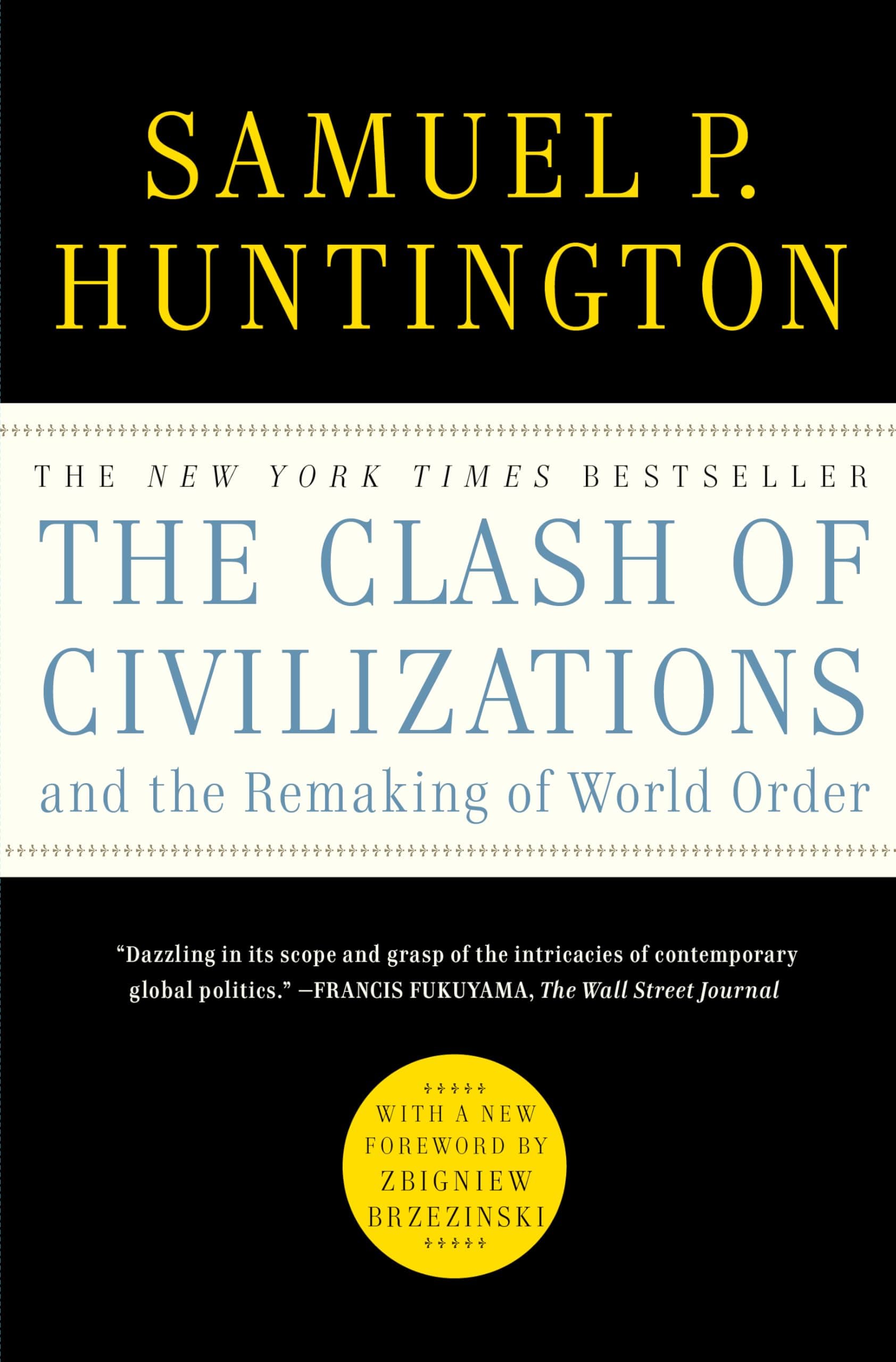

Buy Simon & Schuster The Clash of Civilizations and the Remaking of World Order by Huntington, Albert J Weatherhead III University Professor Samuel P online on desertcart.ae at best prices. ✓ Fast and free shipping ✓ free returns ✓ cash on delivery available on eligible purchase. Review: Scary. A Must read in 2013 . Please sent it to all Présidents of this world. My father asked me to read this book. He had just put down his own copy and called me, saying he could'nt sleep after reading it. Since I value my father opinion, I ordered myself a copy, took a deep breath to read what I though would be a tedious political read. How wrong I was!! It read like a thriller. I could not put it down, and as I read more and more, I realize how important this book is. Even though it was written in the 1990's, it is even more scary to read it now, in light of the latest political crisis. Please someone, make it a higher school mandatory read. Please give a copy to all politicians, and Wake up everybody, for the world as we know it, already does not exist anymore. Review: Fast delivery and good quality of book itself
| Best Sellers Rank | #16 in Political Science #1,073 in Textbooks & Study Guides |
| Customer reviews | 4.6 4.6 out of 5 stars (1,238) |
| Dimensions | 15.54 x 2.34 x 23.5 cm |
| Edition | Illustrated |
| ISBN-10 | 1451628978 |
| ISBN-13 | 978-1451628975 |
| Item weight | 408 g |
| Language | English |
| Print length | 368 pages |
| Publication date | 2 August 2011 |
| Publisher | Simon & Schuster |
A**8
Scary. A Must read in 2013 . Please sent it to all Présidents of this world. My father asked me to read this book. He had just put down his own copy and called me, saying he could'nt sleep after reading it. Since I value my father opinion, I ordered myself a copy, took a deep breath to read what I though would be a tedious political read. How wrong I was!! It read like a thriller. I could not put it down, and as I read more and more, I realize how important this book is. Even though it was written in the 1990's, it is even more scary to read it now, in light of the latest political crisis. Please someone, make it a higher school mandatory read. Please give a copy to all politicians, and Wake up everybody, for the world as we know it, already does not exist anymore.
B**R
Fast delivery and good quality of book itself
A**R
All that's happening in the world today was predicted in this book. Impressive.
R**R
El libro es excelente; llegó en perfectas condiciones y mucho antes de lo que se indicaba originalmente. Sin duda, Huntington fue un visionario y se adelantó a muchas cosas que fueron ocurriendo y que confirmaron sus hipótesis. Lo único malo del autor es que me parece demasiado anglosajón en su forma de plantear las cosas, y se nota una cierta actitud racista hacia los latinoamericanos. En fin, con ello confirma que la lucha de civilizaciones es más real de lo que se plantea en el papel. Es un libro obligado para quien quiera ahondar en el mundo de la geopolítica.
M**Y
As pundits reference THE CLASH OF CIVILIZATIONS regularly (or at least frequently recycle the phrase "clash of civilizations"), I half-expected the book to be a neocon apologist's version of why the U.S. must wage war in the Middle East and Central Asia. It is not. Actually, the book provides an incredibly thoughtful and provocative examination of the world we live in today. Huntington writes: "[C]lashes of civilizations are the greatest threat to world peace, and an international order based on civilizations is the surest safeguard against world war" (13). As he clearly states in the preface, it is intended as a paradigm for viewing global politics. Huntington's thesis is based on his belief that "the most important distinctions among people are not ideological, political, or economic. They are cultural" (21). Thus, the most important and dangerous conflicts will be between people from different cultures (28). Huntington sees the world "divided between a Western one and non-Western many" (36). He states that "[c]ulture is the common theme in virtually every civilization," and that the most important element which defines culture is religion (42). At this point, one might assume that Huntington is setting the reader up for justification as to why the U.S. must go to war with ________ (insert Muslim country here). He is not. Some concepts that Huntington elaborates upon are that of 'fault lines' and 'core states,' as well as 'indigenization,' which would be defined as the reassertion of indigenous cultures and beliefs. Indigenization serves to explain why many countries in the world are not on the same page as that of the U.S. And his idea of core states is especially significant. To simplify, basically each civilization has a core state. For example, in the West it is (and must remain) the U.S. In East Asia, it is China. But in the Muslim civilization, there is no core state, and this, according to Huntington, helps explain why there is so much conflict and unrest in this part of the world. Incredibly, this book very much holds up after 9/11, and I'd say that recent history could serve to validate much of Huntington's thesis thus far. This is not to say that I agree with everything he espouses. For example, I think he unfairly paints the Muslim world with a broad stroke, and I would argue that many people in the Muslim civilization are actually motivated by reasons that are political and economic (not religious), yet his argument merits serious contemplation. Huntington also focuses significantly on China/Sinic civilization, Russian/Orthodox civilization, as well as examines the Bosnian War as a case study in fault line wars. Huntington makes two points that especially stood out to me. One is addressing the issue of weapons proliferation. Huntington writes, "The hold-down efforts of the West may slow the weapons build up of other societies, but they will not stop it" (190). He explains this in further detail, but I can't help think of the U.S.'s position on Iran and those who advocate another pre-emptive attack. Secondly, in his conclusion, Huntington encourages that civilizations focus on what they have in common in order to get along peacefully. This makes perfect sense to me, and I wish we would hear this more often. He writes: "[T]he world's major religions - Western Christianity, Orthodoxy, Hinduism, Buddhism, Islam, Confucianism, Taoism, Judaism - also share key values in common. If humans are ever to develop a universal civilization, it will emerge gradually through the exploration and expansion of these commonalities" (320). Reading this book is well worth your time. I recommend it.
Trustpilot
2 months ago
1 month ago