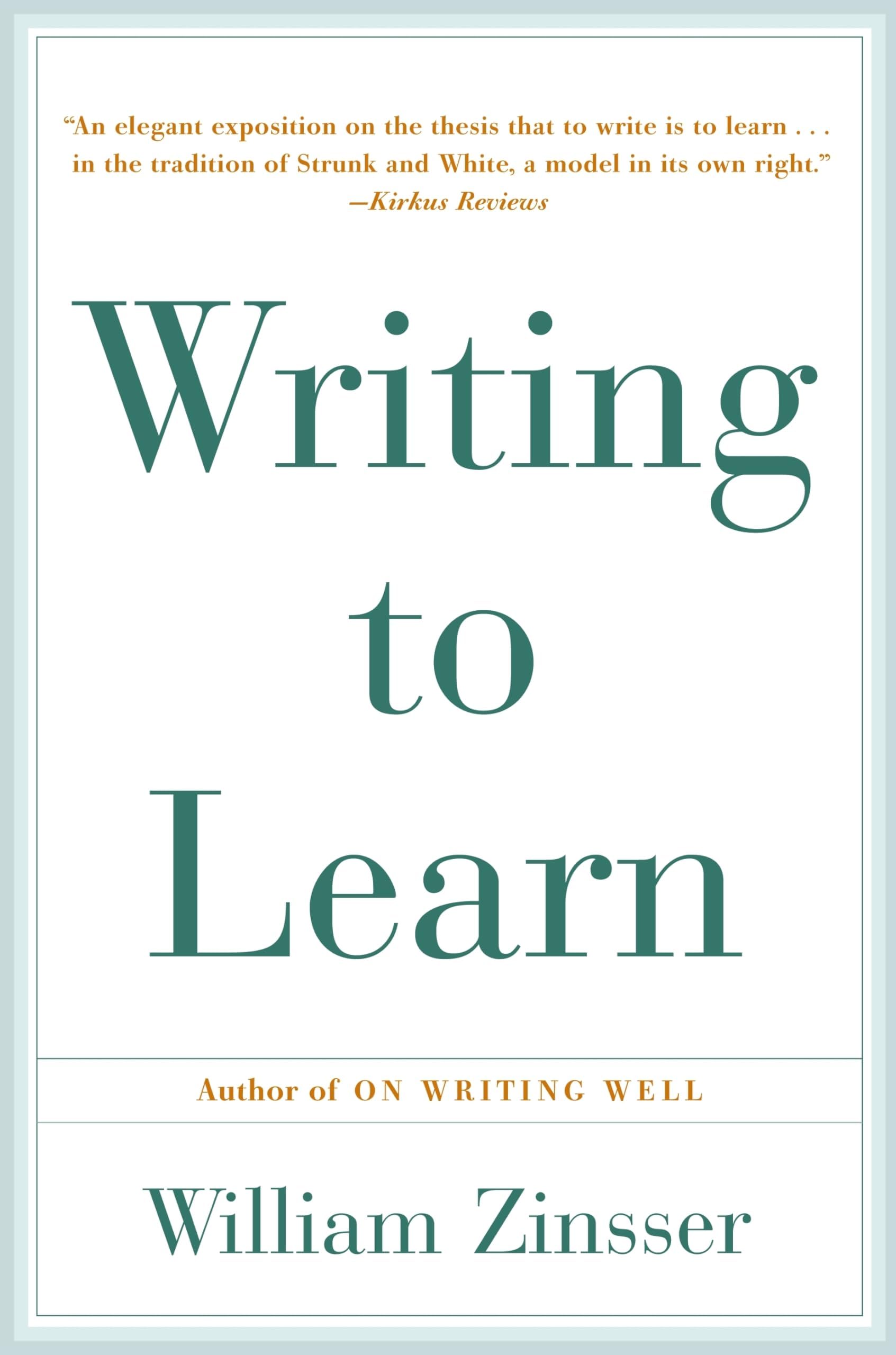
Writing To Learn
Product ID: 4106526
Buy anything from 5,000+ international stores. One checkout price. No surprise fees. Join 2M+ shoppers on Desertcart.
Desertcart purchases this item on your behalf and handles shipping, customs, and support to Kyrgyzstan.
This is an essential book for everyone who wants to write clearly about any subject and use writing as a means of learning. Review: Terrific Homeschool Approach - In the heart of every homeschooling journey lies the quest for methods that not only educate but inspire. William Zinsser's "Writing to Learn" emerges as a beacon of guidance for families navigating this voyage. With a gentle yet persuasive voice, Zinsser introduces us to a teaching approach that goes beyond mere knowledge acquisition. It's about embarking on an adventure with our children, guiding them to express their thoughts, questions, and discoveries through the written word. At its core, "Writing to Learn" illuminates the profound connection between writing and understanding. Like a skilled gardener tending to seedlings, Zinsser teaches us how to nurture our children's ideas, allowing them to blossom into rich insights and knowledge. This book stands not just as a manual but as a companion, walking alongside homeschooling parents and their children, inspiring them to see writing not as a chore but as an exhilarating exploration. What makes this book resonate with homeschooling families is its alignment with the heart and soul of home education: the freedom to tailor learning to each child's unique curiosity and pace. Zinsser's approach, rich in encouragement and practical wisdom, fits seamlessly into the homeschooling ethos. It speaks directly to the heart, urging us to foster an environment where writing is a joyful journey of discovery, not a daunting destination. Beyond academic achievement, "Writing to Learn" gifts students with a skill for life. It teaches them to articulate their understanding and emotions, equipping them with the power to navigate the world with confidence and clarity. As homeschoolers, we cherish not just the academic growth of our children but their development as thoughtful, articulate individuals. Zinsser's masterpiece serves as a key tool in this noble endeavor. William Zinsser's "Writing to Learn" is more than a book; it's a treasure trove of inspiration for homeschooling families dedicated to cultivating lifelong learners. It encourages us to view writing as a natural extension of thinking and learning, beautifully woven into the fabric of our daily educational adventures. Embracing Zinsser's teachings, we can guide our children toward a love for writing that enriches their learning and lights up their paths to understanding. For those seeking to inspire a deeper connection with learning in their homeschool, Zinsser's wisdom is a guiding star. Review: It's a good book, but you can skip most of the content. - The author notes at the end of Ch 5, "Only two chapters--9 and 11--specifically demonstrate writing as a method of learning." Almost all the other chapters are essentially examples of good writing. I believe many people get bored by reading the writing examples before they get to the helpful content of the book. Here is how you should read this book if you are trying to gain the most important bits: Chapter 4, Writing to Learn, discusses the relationship between clear thinking and writing. It's helpful to review as it notes other important books in the field that discuss the topic of thinking and writing. Chapter 5, Crotchets and Convictions, is one of the most important chapters in the book. This chapter gives the reader a crash course in writing, and is one of the most helpful things I've read in my life. Chapter 9 & Chapter 10. These two chapters discuss the idea of using writing to learn things. Once you do those chapters, consider reading the other chapters for examples of strong writing. I'm a lawyer and avid reader, but even I got bored around page 100 and decided to skip directly to chapters 9 and 11. I just got tired of reading all the writing examples over and over and over again. It fatigues you.
| Best Sellers Rank | #27,254 in Books ( See Top 100 in Books ) #10 in Rhetoric (Books) #31 in Linguistics Reference #36 in Fiction Writing Reference (Books) |
| Customer Reviews | 4.2 out of 5 stars 1,153 Reviews |
R**N
Terrific Homeschool Approach
In the heart of every homeschooling journey lies the quest for methods that not only educate but inspire. William Zinsser's "Writing to Learn" emerges as a beacon of guidance for families navigating this voyage. With a gentle yet persuasive voice, Zinsser introduces us to a teaching approach that goes beyond mere knowledge acquisition. It's about embarking on an adventure with our children, guiding them to express their thoughts, questions, and discoveries through the written word. At its core, "Writing to Learn" illuminates the profound connection between writing and understanding. Like a skilled gardener tending to seedlings, Zinsser teaches us how to nurture our children's ideas, allowing them to blossom into rich insights and knowledge. This book stands not just as a manual but as a companion, walking alongside homeschooling parents and their children, inspiring them to see writing not as a chore but as an exhilarating exploration. What makes this book resonate with homeschooling families is its alignment with the heart and soul of home education: the freedom to tailor learning to each child's unique curiosity and pace. Zinsser's approach, rich in encouragement and practical wisdom, fits seamlessly into the homeschooling ethos. It speaks directly to the heart, urging us to foster an environment where writing is a joyful journey of discovery, not a daunting destination. Beyond academic achievement, "Writing to Learn" gifts students with a skill for life. It teaches them to articulate their understanding and emotions, equipping them with the power to navigate the world with confidence and clarity. As homeschoolers, we cherish not just the academic growth of our children but their development as thoughtful, articulate individuals. Zinsser's masterpiece serves as a key tool in this noble endeavor. William Zinsser's "Writing to Learn" is more than a book; it's a treasure trove of inspiration for homeschooling families dedicated to cultivating lifelong learners. It encourages us to view writing as a natural extension of thinking and learning, beautifully woven into the fabric of our daily educational adventures. Embracing Zinsser's teachings, we can guide our children toward a love for writing that enriches their learning and lights up their paths to understanding. For those seeking to inspire a deeper connection with learning in their homeschool, Zinsser's wisdom is a guiding star.
P**S
It's a good book, but you can skip most of the content.
The author notes at the end of Ch 5, "Only two chapters--9 and 11--specifically demonstrate writing as a method of learning." Almost all the other chapters are essentially examples of good writing. I believe many people get bored by reading the writing examples before they get to the helpful content of the book. Here is how you should read this book if you are trying to gain the most important bits: Chapter 4, Writing to Learn, discusses the relationship between clear thinking and writing. It's helpful to review as it notes other important books in the field that discuss the topic of thinking and writing. Chapter 5, Crotchets and Convictions, is one of the most important chapters in the book. This chapter gives the reader a crash course in writing, and is one of the most helpful things I've read in my life. Chapter 9 & Chapter 10. These two chapters discuss the idea of using writing to learn things. Once you do those chapters, consider reading the other chapters for examples of strong writing. I'm a lawyer and avid reader, but even I got bored around page 100 and decided to skip directly to chapters 9 and 11. I just got tired of reading all the writing examples over and over and over again. It fatigues you.
D**N
A text for thinkers
Among the useful things I took away from this Zinsser text are the following: • “Writing is a form of thinking, whatever the subject…” • “Every discipline has a literature…” • “Clear writing is the logical arrangement of thought; a scientist who thinks clearly can write as well as the best writer…” • “Writing and thinking and learning were the same process..” • “Learning, he seemed to be saying, takes a multitude of forms; expect to find them in places where you least expect them…” • “Along the way I’ve also discovered that knowledge is not as compartmentalized as I thought it was. Hermes and the periodic table are equally its household gods, and writing is the key that opens the door…” • “Motivation is crucial to writing – students will write far more willingly if they write about subjects that interest them and that they have an aptitude for…” • “Writing is learned by imitation…” • “…the essence of writing is rewriting…” • “A piece of writing must be viewed as a constantly evolving organism…” • “Writing organizes and clarifies our thoughts…” • “ Probably every subject is interesting if an avenue into it can be found that has humanity and that an ordinary person can follow…” • “… writing is linear and sequential…” • “Freedom, inefficiency, and prosperity are not infrequently found together and it is seldom easy to distinguish between the first two…” I find this observation that Zinsser took from The Birth of the Republic particularly reassuring in light of our contemporary ‘hair-on-fire’ news wherein everything is unprecedented and worse than we have ever known! • “Writing is a tool that enables people in every discipline to wrestle with facts and ideas. It’s a physical activity, unlike reading…” • “…the act of writing will summon from the buried past exactly what we need exactly when we need it. Memory intuition and chance associations will always generate a certain percentage of what any writer writes. The remainder is generated by reason.” • “…there are two kinds of writing: explanatory writing that transmits existing information or ideas… and exploratory writing that enables us to discover what we want to say…” Zinsser provides separate chapters with examples of clear, concise, and illuminating writing from a variety of different disciplines. His specific examples were not as important, to me, as the generic notion that good writing can explore and explain every discipline of thinking. I recommend this book to thinkers, whether they choose to become writers, or not.
M**H
Writing to Learn [Any?] Subject
William Zinsser starts his book by admitting something – he’s never understood chemistry. I read his book under the misguided assumption that it would teach me how to write and think clearly in any subject, including chemistry. I believe that if Zinsser was made to read a chemistry textbook written using his principles, he would not learn chemistry. To be sure, he would learn of chemistry. He would relish in the passion the author had in describing elements and compounds, but he would be unable to use the formulas and apply the rules correctly. Having read Doug Buehl’s Developing Readers in the Academic Disciplines, I imagined that this book would serve as a comparable supplementary guide to writing effectively in academic disciplines. It did not. For those of you who do not know, Buehl’s book teaches strategies for how to become literate in different academic fields. How you read a physics textbook is not the same as how you read a chemistry textbook, and how you read a chemistry textbook is not the same as how you’d read a novel. Every discipline has a different approach that readers should use to maximize their understanding of the information in the text. Different academic disciplines have different approaches to make their readers understand their theories. For example, to teach chemistry effectively, a chemistry textbook would take a formula, explain its components and apply it to a reaction commonly found in nature. Then it would model how to perform the formula, and then have the reader attempt to use it. Only by gaining practice with using the formula in different contexts will the reader truly begin to understand it. In his book, Zinsser does not explicitly acknowledge this; however, he does state that by writing problems out, students will gain a deeper understanding of the formulas they are using (in the math chapter), but that is among the only real suggestion he has for students. Zinsser disagrees with the thought that different styles of writing are required for writing about different subjects. He views all subjects as being under the same umbrella of knowledge. It is likely that his perception was shaped by both gaining a working knowledge of various intellectual and artistic pursuits as a journalist, and by working with Yale intellectuals who could easily find common ground with academics and artists who seemed to hold polar opposite interests. What these experiences did not show him was common knowledge: being able to hold a conversation with an intellectual about their field, and gaining the skills to be an intellectual in the field, are two totally different things. Writing to Learn: How to Write - and Think - Clearly About Any Subject at All offers one chapter that I feel really encapsulates the heart of what its title implies – the mathematics chapter. The math chapter is the only chapter which a teacher describes how she integrates writing in her curriculum. It is also the only chapter which provides insight into the student reception of the integration of writing into the curriculum. Readers are only left with an implication that writing to learn has been successfully implemented in other academic disciplines – otherwise, why would they be mentioned in the book? Zinsser ends his book the same way he started his book, still not knowing chemistry. If he had tried to learn chemistry, or math, or physics, during the course of his book he might have been able to describe pedagogical methods that should be included in writing a book to teach these disciplines. He may have been able to describe the kinds of examples that should be included to ensure that the principles taught generalize to situations outside of the examples given. What he has written is a general guide to write newspaper articles and memoirs in any subject. I give the book three stars. William Zinsser is a talented writer to be sure; I feel a little dirty for giving such an enjoyable, witty, aesthetic book a mediocre score. However, the material is clearly lacking in what it purports to convey.
A**S
Learning with purpose thru writing
True to the title the writing in this book is organized, crafted with skill, and understandable to the point of learning. Specifically, this pertains to non fiction writing in the general topics. If you have read an article nicely titled but poorly executed then this book will give you hope for the next generation of nonfiction writers. Excerpts from several authors in the major fields that are sweet enough to make me want to add to my shelf of want-to reads. As a bonus it's a good read at the end of year or beginning of new year. Also recommended for your emerging writer
M**Z
Very Interesting
This book is a trademark for writing nowadays. The author uses different perspectives to learning via writing in a way that is unique to traditional learning methods, He teaches through stories of other people, as well as, various subjects; how writing consists of how we view the topic at hand. He also introduced the art of writing for complex subjects such as art, chemistry, and mathematics. How interesting that the author encourages its readers to use everyday words, instead of using jargon, just to say something as simple as, "We will have a meeting." Eloquent words are not necessary just to express what we really want to say. Putting words into paper can help break the cycle of continuous misusing words that can powerfully express what we are trying to convey.
J**O
Enjoyable Read For A Teacher Or Serious Student In Life
Who would generally consider using writing to teach courses besides humanities, literature, history, etc? Can it really be helpful when teaching math, chemistry, physics, etc.? Absolutely. This book takes educators and students outside the traditional box related to the value of writing to learn. I enjoy books that broaden perspectives, especially written as well as this book. If you're a teacher, or someone wanting to truly learn anything, consider incorporating writing. This book will give you examples to get you going!
S**N
great book for teachers and students
Easy to read book because it's so well written and it speaks to a real need. The focus is on improving non-fiction writing, the kind that normal people do in their work. Loads of real-life examples of clear writing and writing that is very difficult to read and understand. Whether teacher, student, or adult, you'll learn a lot and you'll write better.
A**S
Schreiben schärft das Denken
Writing to learn machte mich auf einen Aspekt aufmerksam, der in unser schnelllebigen Facebook, Instagram, YouTube Zeit schon gar nicht mehr vorkommt: nämlich die Langsamkeit. Schreiben verlangsamt die Denkarbeit auf natürliche Weise und ermöglicht unserem Hirn, schärfer zu denken. Ganz ähnlich dem Gegensatz fast/slow food.
A**Y
A unique and brilliant insight that is well explained.
A fantastic book. Unique ideas I never came across before and they really helped me understand better a project I was working on. Well written and interesting every step of the way. This book sheds light on the importance of the act of writing and why, in my view, modern education, that relies on kids staring blankly at computer screens, does not compare.
E**I
Eski tarihli bir kitap
Kargo hızlı geldi ancak kitabı beğenemedim, hem eski tarihli bir kitap hem de biraz boş bilgilerle dolu. En azından başlığına bakarak almanızı tavsiye etmem.
C**S
No defrauda
Haberme cruzado con este autor me ha cambiado: al fin tengo la mejor guía que podría desear para adentrarme en el mundo de la escritura.
D**A
Ottimo
Ottimo
Trustpilot
1 month ago
2 weeks ago