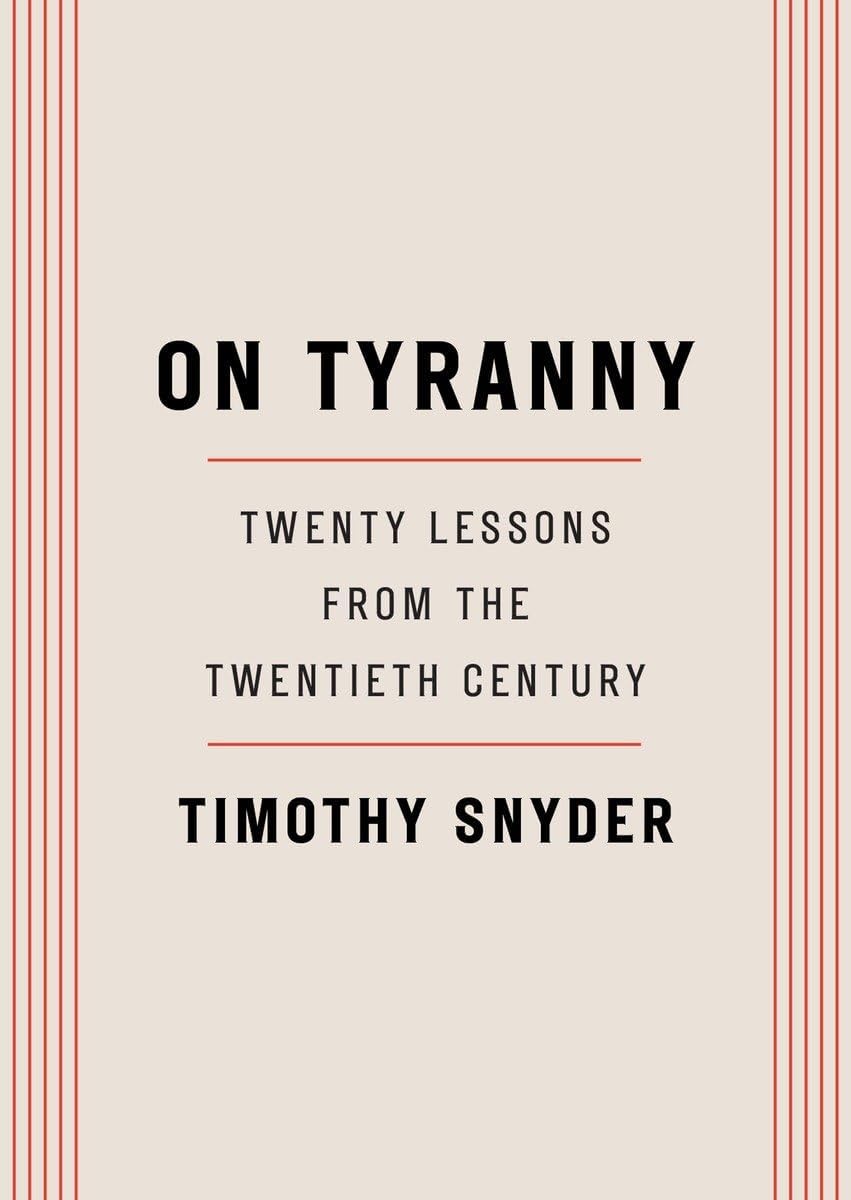
On Tyranny: Twenty Lessons from the Twentieth Century
Product ID: 40216471
Buy anything from 5,000+ international stores. One checkout price. No surprise fees. Join 2M+ shoppers on Desertcart.
Desertcart purchases this item on your behalf and handles shipping, customs, and support to Kyrgyzstan.
#1 NEW YORK TIMES BESTSELLER • A “bracing” ( Vox ) guide for surviving and resisting America’s turn towards authoritarianism, from “a rising public intellectual unafraid to make bold connections between past and present” ( The New York Times ) “Timothy Snyder reasons with unparalleled clarity, throwing the past and future into sharp relief. He has written the rare kind of book that can be read in one sitting but will keep you coming back to help regain your bearings.”—Masha Gessen The Founding Fathers tried to protect us from the threat they knew, the tyranny that overcame ancient democracy. Today, our political order faces new threats, not unlike the totalitarianism of the twentieth century. We are no wiser than the Europeans who saw democracy yield to fascism, Nazism, or communism. Our one advantage is that we might learn from their experience. On Tyranny is a call to arms and a guide to resistance, with invaluable ideas for how we can preserve our freedoms in the uncertain years to come. Review: Real Action - Historical Examples Review: Love ittt - A short but very powerful book. It explains historical lessons about democracy and authoritarianism in a clear and accessible way. Even though it’s a quick read, it gives you a lot to think about. Definitely worth reading if you’re interested in history, politics, or civic responsibility.


| Best Sellers Rank | #1,316 in Books ( See Top 100 in Books ) #2 in Civics & Citizenship (Books) #4 in Democracy (Books) #11 in Sociology Reference |
| Customer Reviews | 4.7 out of 5 stars 35,722 Reviews |
J**N
Real Action - Historical Examples
A**L
Love ittt
A short but very powerful book. It explains historical lessons about democracy and authoritarianism in a clear and accessible way. Even though it’s a quick read, it gives you a lot to think about. Definitely worth reading if you’re interested in history, politics, or civic responsibility.
J**K
We must work hard, very very hard to create a paradise
Make no mistake about it! This is a very important book. I cannot recommend it highly enough. Buy it and read it! "1. Do not obey in advance. Most of the power of authoritarianism is feely given. In times like these, individuals think ahead about what a more repressive government will want, and then offer themselves without being asked. A citizen who adapts this way is teaching power what it can do. "8. Stand Out. Someone has to. It is easy to follow along. It can feel strange to do or say something different. But without that unease, there is no freedom … The moment you set an example, the spell of the status quo is broken, and others will follow. "2. Defend institutions. It is institutions that help us to preserve decency. They need our help as well. Do not speak of “our institutions” unless you make them yours by acting on their behalf. Institutions do not protect themselves. They fall one after the other unless each is defended from the beginning. So choose an institution you care about – a court, a newspaper, a law, a labor union – and take its side." In the first chapter Snyder gives illustrations of people who follow an authority, no matters how heinous the commands of that authority might be. As you know from the quote above, Point Two is about defending institutions. We saw how the Post Office was attacked in the latter part of 2020. Even buying a sheet of stamps was seen as protecting it. We can go further from there: buy and donate books to a public library. Subscribe to a newspaper, even if the editorial page angers you. Patronize local privately owned businesses. The options are endless. 3. Beware the one-party state. “Eternal vigilance is the price of liberty”: “American democracy must be defended against Americans.” There must always be fair elections. Letting moneyed interests interfere is a bad thing. Seriously, our democracy must be constantly safe-guarded. 4. Take responsibility for the face of the world. Politics are played. If you refuse to play, you become its victim. Symbols of hate, such as the Confederate and Nazi flags, are not to be tolerated or ignored. Speak out and take responsibility (indeed) for the world around you. 5. Remember professional ethics. If the professional class – of any profession – maintains the ethics of their craft, then it makes tyranny more difficult. One must not cooperate with a great evil, or more evil will occur. Stand fast and do good! Be strong! 6. Be wary of paramilitaries. Paramilitaries outside of governments are an incredible danger. Mercenaries on the payroll of government are a catastrophe waiting to happen. Private prisons are immoral and anarchic and the beginning of the end. All this privatizes violence! 7. Be reflective if you must be armed. Every single government employee must retain the right to disobey an illegal order. Riot Squads and Special State Police are immoral; do not participate in such atrocities. This applies to local police forces, legal professionals and civil servants. Don’t participate to just not look weak. Don’t be afraid to stand out. As we look at Point Eight, we see that it’s easier to give in and to conform. The real courage is that of people who stand out, who do what is just no matter how difficult it might be. To not conform, do not surrender, do what is right no matter what the cost is. 9. Be kind to our language. Don’t say the same things everyone else is saying. Don’t use the same buzz-words. Don’t start to limit your vocabulary. Don’t participate in the shrinking of our language. Reading a variety of books will help this. If there is still an underground or avant-garde theater in your town go there! 10. Believe in truth. Do not abandon facts. Do not allow authority figures to be hostile to reality. Do not let endless repetition of nonsense disguise the truth. If you think you are hearing nonsense, you probably are. Do not misplace your faith on charlatans. Do not forget that propaganda is bizarre. Fascists create a web of lies to live by. 11. Investigate. Check the sources of the news you consume. Right now, in America in the years 2020-21, reliable sources are CBS, NBC, ABC, PBS, CNN, The New York Times, The Washington Post, The Guardian, Al Jazeera, etc. Do not spread false news that caters to your prejudices. Do not be a conspiracy theorist. Support good journalism if you can. Dedicate yourself to the truth. 12. Make eye contact and small talk. Make friends – real friends – lots of friends. It’s a resource that you might need. 13. Practice corporeal politics. Physically get out and do something of a political nature. Affect the three-dimensional world. One can organize while having “screen time”, but then one must go out and meet these people physically. You cannot only do the former. The latter must eventually happen. 14. Establish a private life. Don’t put everything online. Scrub or delete things that are maybe a little bit too public or personal. When you hear or read news: Is it really news, or is it gossip? Make a distinction. It is fine to publicly have a discussion; that is more real. Delete gossip from your thought processes. Don’t feed the rumor machine! 15. Contribute to good causes. It is up to you to create – or co-create – a civil society. Donate money to something that does good. Share in an undertaking. This will make life seem less chaotic and mysterious. 16. Learn from peers in other countries. It is important to be in touch with people in other countries, even moreso to travel there. Like it or not, trends are international. The more we know about the world, the more we can spot things beginning to happen at home – to challenge and fight things happening at home. 17. Listen for dangerous words. Fascists will attach phony meanings to words such as extremism, terrorism, emergency and exception. Don’t let them do this. If someone is using a “patriotic vocabulary” they are probably seeking to manipulate you. This is why the Patriot Act must be dispelled; it violates the Bill of Rights in many areas. Be bold! Be strong! 18. Be clam when the unthinkable arrives. Do not sacrifice you freedoms when terrorism occurs. I am reminded that wartime presidents always get reelected. When the government perverts what is “normal”, you will give it any power to return to what you think is normal – but it’s not normal, it’s just an authoritarian dictatorship in disguise. Beware of faux terror attacks engineered by your government or some other government. 19. Be a patriot. Be an ideal American. Live by high standards, and teach those same standards. Serve your own country. A patriot fights against tyranny in his or her homeland. 20. Be as courageous as you can. “If none of us is prepared to die for freedom, then all of us will die under tyranny.” Epilogue: History and Liberty. Fascism, Nazism, and other forms of Authoritarian Dictatorships are not gone forever. Unless we are on guard, they will return. In order to move from the Dark Ages to a better and brighter future, we cannot sit on our behinds. We must work hard, very very hard to create a paradise. One will not automatically happen. All right?
D**E
Excellent Pocket Book and a Decent Lesson on General Civility.
"On Tyranny" is an excellent little pocket book. This book was recommended to me by a well-respected attorney who recently led a legal delegation to Colombia (the country, with an 'o') that I was honored to be a part of. Enjoyable, easy read, and good guidance on general civility for both sides of the political aisle. Especially good for those of us who feel trapped by a relatively bizarre, "if you're not with me you're against me", and arguably failing, two-party system that appears hell-bent on punishing moderates and silencing debate. Regardless if you identify as a Republican, a Democrat, a conservative, a liberal...or even if you identify as a cat...this book is a good guide on basic civility and reason. There are a few passages that could have been written a bit less conclusory and with a bit more of a moderate slant. Also, there are a few chapters that I don't agree with because of my own personal opinions. But authors are people too, and I have yet to read any ideological book that does not, at some point, attempt to convey the author's personal opinions on certain matters. Sometimes those opinions take the form of not including counter-arguments, employing one-sided examples, general tone, or using too few words to convey complex positions or concepts. This book is no exception, but it appears as though the author was focusing more on ease-of-read than writing a defensible dissertation. Given how easy this book was to read and digest, I will give the author a mulligan for not expanding more on certain conclusory statements, not spending more time on the importance of established grammar as a tool for open communication, or by failing to use more examples that properly place blame on both sides of the political aisle. This is not a bible, nor is it a "little white book" to be waived around at political rallies. Its just a short, easy to read essay that appears intended to encourage a person use their head for something more than a hat-rack. A good addition to any civics or political science course, and a good "pick your topic" source for an introductory course on debate. A must-read for any moderate who feels disenfranchised by the "pick-the-least-repulsive-greedy-pandering-fool" two-party system that continues to be forced upon American citizens by click-bait media and gold-bricking career politicians.
T**N
The Dangers of Creeping Fascism
This is not an academic book, although it is written by an outstanding academician. There are no footnotes, no index. The explanations are simple and compelling. It offers wise advice about democracy at a time when certain racist and neo-fascist elements are threatening our democratic form of government. The lessons enumerated here give substance to Santayana's famous aphorism: Those who do not remember the past are condemned to repeat it. This short book can be read in two or three hours. It offers sage advice on how to defend our democracy. Ten years ago most people--even political theorists--would have considered this a solution to a nonexistent problem. But the Trump cult of personality and its total disregard for the rule of law has made most intelligent people reconsider our political future. The authoritarian left (Communism) has never gained a serious foothold in American politics, although the extreme right and the late J. Edgar Hoover tried for many years to convince us otherwise. Nobody in their right mind would want to live under tyranny. Communism, fascism, Nazism, all forms of tyranny, repressed human freedom. The rule of law, so vital for our democratic values, was not respected under these regimes. Justice became an unknown quality. These political forces existed solely to further the interests of a small ruling elite (Communism) or those of a single egomaniacal individual (e.g., Hitler, Stalin, Mussolini). Americans are used to democracy. We think it will last forever. This is the good news. "The bad news is that the history of modern democracy is also one of decline and fall" (p. 10). European history reflects the rise of democratic sentiments at three crucial points in the 20th century: (1) In 1918, after World War One. (2) In 1945, at the end of World War Two. (3) After the end of communism in 1989 (p. 11). Many of the democracies founded during these periods failed. And the failures had much in common with our current circumstances (ibid.). Professor Snyder, an eminent scholar of 20th century European history, thinks we need to learn from this history lest we lose our democratic freedoms and slide into tyranny. He outlines 20 short lessons we need to take with the utmost seriousness. I will briefly list several of my favorites. LESSON 2---Defend institutions. Institutions do not protect themselves. Choose an institution you care about--a court, a newspaper, a law, a labor union--and take its side (p. 22). LESSON 3---Beware the one-party state. American democracy must be defended FROM AMERICANS who would exploit its freedoms to bring about its end (p. 27). LESSON 10---Believe in truth. To abandon facts is to abandon freedom. If nothing is true, then no one can criticize power (p. 65). I will now use these lessons to update our present situation (June 2021). (I) We need to get rid of the Senate filibuster to save our democracy. The tyranny of the minority is ANTIDEMOCRATIC. Democracy means one person, one vote. A simple majority reflects the will of the people. (II) The Republican Party, under the total control of the demagogue Trump, wants to restrict voting to mainly white people. They don't think any election is fair unless they win. This will lead to a ONE-PARTY STATE. (III) The facts are in. The 2020 election has been counted, recounted, litigated, and certified. BELIEVE IN TRUTH.
A**R
Must-read you can finish in an afternoon
From Yale professor & historian Dr. Timothy Snyder (who specializes in the history of central & Eastern Europe, the Soviet Union & the Holocaust), 20 key lessons for regular Americans to learn on tyranny from the 20th Century, digest, and hopefully remember when they matter most. Short, sweet, and to the point, On Tyranny is such for good reasons. For one, my twitter-fried brain has difficulty sitting still long enough to read long books the way I once did. I believe Snyder understands that has happened to many of my generation— those who use social media 24/7 & otherwise can’t be still. Second, accessibility. This is short enough to read during a long wait for a medical appointment, and any high school student should be able to understand it. No real background knowledge is necessary. Anyone could pick it up and go. And **busy, hardworking, everyday Americans need the opportunity to clearly see WHAT HAPPENED IN THE 20th CENTURY TO ALLOW TYRANNY so they can IDENTIFY RED FLAGS IN THE PRESENT DAY**—all without needing to keep up with the details of daily news or the ginned-up partisan bs of the cable entertainment news nighttime soap operas. Last, in the age of 24-hr news cycles and short attention spans, Snyder has managed to succinctly write 20 vital historical lessons in such a way that they are easy to remember. He does not appear concerned for his own ego, about appearing to be some superior intellectual. I don’t believe he wrote this $9.99 book (I got it for $7) for clout or money. He wrote it for us, for Americans. If I had the money, I’d buy copies to put in waiting rooms and hotel dressers alongside the Gideon Bible. So, yes. Timely and important… when it was published in 2017. You’ll read the occasional passage and think “well, that ship has sailed”—but this (larger) pocket-sized book is not about defeatism. There is still much to be learned. Still timely & highly relevant.
S**F
Vital Advice from One Who Knows
This is a short, quick book to read, perhaps 30-45 minutes of your time. And at only $2.99 (on Kindle) you can't afford not to buy it. For those who found his list of 20 points elsewhere on the web for free, don't let that suffice. The book adds commentary to his list, and it's worth the small cost. For those of you not acquainted with Snyder, he's a historian of Eastern Europe and has written extensively on the turmoil--the killing fields--of Eastern Europe in the 20th century. He knows whereof he speaks. I will offer you a couple of his thoughts from his concluding remarks. In addressing what he terms "the politics of inevitability," he notes Until recently, we Americans had convinced ourselves that there was nothing in the future but more of the same. The seemingly distant traumas of fascism, Nazism, and communism seemed to be receding into irrelevance. We allowed ourselves to accept the politics of inevitability, the sense that history could move in only one direction: toward liberal democracy. After communism in eastern Europe came to an end in 1989–91, we imbibed the myth of an “end of history.” In doing so, we lowered our defenses, constrained our imagination, and opened the way for precisely the kinds of regimes we told ourselves could never return. Snyder, Timothy. On Tyranny: Twenty Lessons from the Twentieth Century (Kindle Locations 765-769). Crown/Archetype. Kindle Edition. But he then addresses the converse attitude, what he calls "the politics of eternity." About this attitude, he states In the politics of eternity, the seduction by a mythicized past prevents us from thinking about possible futures. The habit of dwelling on victimhood dulls the impulse of self-correction. Since the nation is defined by its inherent virtue rather than by its future potential, politics becomes a discussion of good and evil rather than a discussion of possible solutions to real problems. Since the crisis is permanent, the sense of emergency is always present; planning for the future seems impossible or even disloyal. How can we even think of reform when the enemy is always at the gate? Id. at 810-815 In contrast to both of these attitudes, he places history (an encomium with which I could not agree more): Both of these positions, inevitability and eternity, are antihistorical. The only thing that stands between them is history itself. History allows us to see patterns and make judgments. It sketches for us the structures within which we can seek freedom. It reveals moments, each one of them different, none entirely unique. To understand one moment is to see the possibility of being the cocreator of another. History permits us to be responsible: not for everything, but for something. The Polish poet Czesław Miłosz thought that such a notion of responsibility worked against loneliness and indifference. History gives us the company of those who have done and suffered more than we have. Id. at 822-827 In his peroration, he exhorts young people especially (although it applies to all of us) One thing is certain: If young people do not begin to make history, politicians of eternity and inevitability will destroy it. And to make history, young Americans will have to know some. This is not the end, but a beginning. “The time is out of joint. O cursed spite,/That ever I was born to set it right!” Thus Hamlet. Yet he concludes: “Nay, come, let’s go together.” Id. at 830-834 Buy this book and read it!
M**H
Quick but informative
I didn’t expect to get such a vast amount of information from such a small text. I found it very helpful, as it provided information and background the back up the points made by the author. I definitely think it is a book to consider reading, if you want food for thought and something to chew on later.
S**H
Prescient
We'll see in 6 months.
J**R
Atual e extremamente relevante reflexão sobre o nosso tempo e seus perigos.
Um livro curto, que consegue condensar estratégias de manipulação de líderes inescrupulosos e racionais existentes nas populações que podem facilitar o sucesso de tais líderes. Um certo dia, tudo mudou, e mudou porque não estávamos atentos e caímos nas armadilhas que foram colocadas no caminho, com o nosso apoio. Armadilhas antigas, mas testadas e efetivas, sob as condições certas. Este livro pode ajudar-nos a reconhecê-las e evitá-las, não apenas nos EUA (a cujo público se destina) mas em qualquer lugar no qual autoritarismo e redução de liberdades esteja na agenda de grupos de poder.
M**A
Relevant
Such a well written book. A must read!
S**N
Wonderful- showcasing how history can shed light on the present
This book is a quick exploration of lessons learnt from 20th-century history and how they help us make sense of the present. Lots to reflect on and digest here. The take home message for me is that courage matters and that going with the flow is more dangerous than standing up and standing out. I always found that Tim Snyder's perspectives on Eastern European history made me reconsider what I thought I understood about the story of the 20th century. He delivers yet again, this time reframing the present and urging the reader to recognise that tyranny is enabled by personal choices and behaviours. Recommend.
M**R
Knowledge is power
An excellent book...well written and explains the political dynamics in a clear way...and the signs we need to be aware of creeping tyranny before it's too late. An effective pocket book and tool of resistance for us all.
Trustpilot
1 week ago
5 days ago