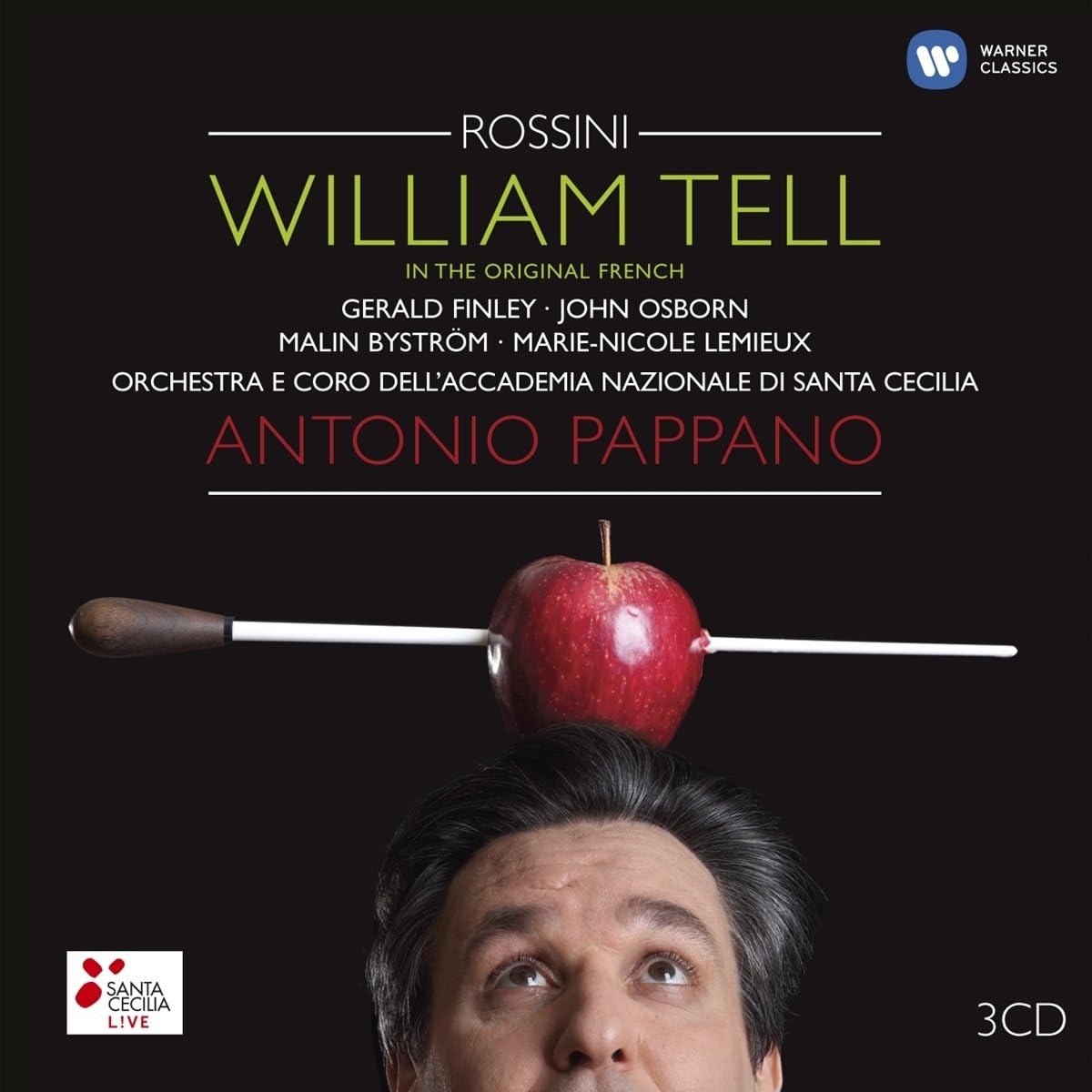

Rossini: William Tell French Version
Product ID: 37817871
In Rome this past autumn, Antonio Pappano and the choir and orchestra of the Accademia Nazionale Di Santa Cecilia launched the present season with complete performances of Rossini's final French opera seria, William Tell. Canadian baritone Gerald Finley led a stellar international cast boasting tenor John Osborn, mezzo Marie-Nicole Lemieux, and sopranos Elena Xanthoudakis and Malin Byström in the story of Switzerland's legendary founding fathers and the courageous folk hero forced to shoot an apple from his son's head. The results were by all accounts sensational. It is this rare and justly celebrated revival of Rossini's opera - one scarcely known today, beyond the familiar climax of its overture - that EMI Classics captures live on a landmark new recording due for international release in July 2011. Composed in 1829, almost four decades before Rossini's death, the five-act grand opera William Tell ("Guillaume Tell") nonetheless marked the composer's final contribution to the form. Written to a French libretto derived from Schiller's verse drama Wilhelm Tell, Rossini's opera depicts the eponymous 13th-century folk hero whose courage - and famed marksmanship - launched an uprising that brought the Swiss independence from the Hapsburg dynasty. Anticipating later operatic heroes like Verdi's Don Carlo, Rossini's title character is a wholly political figure, although there is also a romantic component to the opera's plot, tracing the story of star-crossed lovers Arnold, son of the Swiss leader, and Mathilde, an Austrian princess. William Tell was a triumph at its Parisian premiere, establishing the structure of grand opera in separate scenes that would soon be used by Bellini, Donizetti, and Verdi, but its epic scale and extravagant vocal demands mean subsequent productions have been few and far between. Thanks to many film and television appearances, however, the overture's famous galloping finale has reached far beyond the typical audience for opera. Anticipating the Orchestra dell'Accademia Nazionale di Santa Cecilia's concert performance of the work in London this summer, the Sunday Times observed: "Most people know William Tell as the theme song for The Lone Ranger, but the full opera is a rarely performed masterpiece. It's the highlight of the 2011 Proms, thanks to Antonio Pappano." Instead of using the opera's libretto in Italian translation, as has become customary, Pappano turned to the original French, explaining: "It can only be done in French. It's written with an extra sense of bravado in the recitatives." After the Roman performances, the Financial Times marvelled "The orchestra is fleet and wonderfully together, with crunch, buoyancy, a keen sense of collective phrasing, and its own very distinctive sound. An excellent cast, led by Gerald Finley, on magnificent form in the title role, brought drama and momentum. Pappano...kept tension high. His singers brought meaning to every phrase, giving us driven, motivated vocal lines." As the conductor points out, "William Tell has a famously impossible tenor part..., so we are lucky to have John Osborn." In fact, it was Pappano who discovered the American tenor, one of the few great exponents of the notoriously high and challenging role of Arnold. The Financial Times confirms that "Osborn sailed through the stratospheric reaches of Arnold's tenor heights with sweetly lyrical roundness." Likewise, the paper found Swedish soprano Malin Byström - "one of the few," says Pappano, "who can cope with the extreme lyrical and dramatic demands - and coloratura - of the part" - to be "a sublimely elegant Matilde." The world's leading opera conductor, Antonio Pappano is Music Director of the Royal Opera House, Covent Garden as well as of Rome's Orchestra dell'Accademia Nazionale di Santa Cecilia. It was with the Santa Cecilia choir and orchestra that he recorded Verdi's Requiem live in concert for a 2009 EMI Classics release starring soloists including bass René Pape; the album won numerous international awards including BBC Music Magazine and Gramophone Awards for "Best Choral Recording of the Year," the Classical BRIT "Critics' Choice" award, and the Choc de Classica of the Year. Another outstanding example of the conductor's partnership with Santa Cecilia and EMI is his 2009 recording of Puccini's Madama Butterfly, which - with Angela Gheorghiu in the title role - scooped the Gramophone Award for Opera. Pappano's success with William Tell in Rome was by no means his first with Rossini; in November 2010, EMI Classics released his rendition of the composer's oratorio Stabat Mater, again featuring the forces of Santa Cecilia, with an all-star cast of soloists including soprano Anna Netrebko. The disc earned a five-star Financial Times review and was pronounced the "finest recording of the work since a 1971 one with Luciano Pavarotti" by the AP's Verena Dobnik, who admired the way "Pappano's free-breathing baton draws intense whispers as well as rousing explosions to paint in sound what he calls `the desperation and the drama' of Mary under the cross." Selecting the recording as its "CD of the Week," the Sunday Times declared: "Pappano lives the text like the great opera conductor he is, bringing consolation as well as fire and brimstone to Rossini's heady spiritual brew." Similarly, BBC Music magazine voted the album its "Disc of the Month," awarding it full marks for both sound and performance, and concluding "Above all it is Pappano's stylistic assurance and his understanding of the need in Rossini to combine flamboyance with discretion, that makes this a superior account of one of its composer's achievements." Review: An exciting, well conducted Guillaume Tell - Guillaume Tell is one of my favorite operas, and since there are so few recordings, when a new one appears it's definitely an event. Since 2 of the last major recordings, the Gardelli in EMI and the Muti in Philips lost money because they were 5 LP's or 4-cds expensive albums (in fact EMI told Muti that they didn't want to record his La Scala production because they didn't do well with the Gardelli), Tony Pappano must have put a lot of pressure on EMI to venture once more into the Swiss Alps. Pappano was quite right in choosing the original French version, since Guillaume Tell is a French opera, just like Donizetti's La Favorite and Verdi's Don Carlos. The French originals are infinitely superior to the mediocre (and in the case of La Favorite, disastrous) Italian adaptations. So how this new recording compares to the others? First of all it's very well conducted, Pappano clearly communicates how much he loves the score (how couldn't he) and keeps his large forces under tight control. His nervous, Toscanini-like fast tempi make sure that everybody is on his or her toes. He has a better overall outlook of the large canvas than Lamberto Gardelli, and he is a better and more experienced conductor than the 26 year old Riccardo Chailly, who surely was too young at the time he made the DECCA recording. The Muti version recorded live at La Scala has long been my favourite recording. It is also extremely well conducted by perhaps the most experienced living conductor in this score, since Muti was already conducting it at the Maggio Musicale Fiorentino of 1972 with a young Eva Marton as Mathilde. Muti's direction is more patrician, expansive and magisterial than Pappano's, and perhaps a little bit more elegant too, and he has the better orchestra and chorus. This in no way diminishes the good playing of the Accademia Nazionale di Santa Cecilia, but the Orchestra of La Scala is certainly the better band. As for the singing Pappano's cast is good and able, though the competition is fierce. In the title role Gerald Finley, a bass-baritone, sings in good clear French, and his voice is very beautiful, no complaints there, though Gabriel Bacquier with Gardelli is even more idiomatic, Milnes with Chailly more sonorous, and the great Giorgio Zancanaro with Muti more individual and memorable. Montserrat Caballé with Gardelli has the ideal voice for Mathilde, and she floats those gorgeous pianissimi as only she can. Mirella Freni (DECCA) is good, but hers is not the ideal voice for the role. Cheryl Studer for Muti substituted at the last minute for an indisposed Lella Cuberli, a great pity because she was the great Rossini soprano of her generation; Studer is certainly not bad, and like Caballé has the ability to float a note. Pappano's newcomer Malin Byström has an interesting but strange voice, in the middle it sounds like a mezzo, but can go upwards without difficulty. Technically Studer is better, her coloratura is more accurate and I imagine she has the bigger voice, so that in the concertantes she is more present, but Byström is not bad, only her French leaves something to be desired. When you are trying to cast Guillaume Tell your biggest nightmare is the tenor lead, Arnold Melcthal, a role that needs the power of a Franco Corelli, the high tessitura of a Juan Diego Florez and the good French of a Nicolai Gedda. Obviously most of the tenors who have recorded the role are found wanting. In studio condition Gedda for Gardelli and Pavarotti for Chailly sound good and please, though Pavarotti never dared to sing the role on stage and Gedda only sang 2 performances (for Muti) and almost ruins his voice. In an interview he admitted it was the biggest mistake of his career. That's why I admire so much Chris Merritt, a tenor much criticized in some quarters for his peculiar voice and sound production, but he was the one that really delivered the goods on stage during the 90's. John Osborn for Pappano is not as heroic or fearless as Merritt, but when you consider the difficulties of the role you just have to be thankful that someone is willing to sing it. There's another Guillaume Tell recorded live at the Vienna State Opera with Thomas Hampson in the title role and Fabio Luisi in the pit, but the soprano is terrible, so I can't recommend it (ORFEO). So, if forced to choose I would still say that Muti is numero uno, but the Pappano is a welcome addition, a lovingly conducted and satisfactorily sung version, very well recorded in the new Auditorium Parco della Musica in Rome. It is also much less expensive than the Muti or the Chailly. The Gardelli now is in budget, but despite the heavenly presence of la Caballé now sounds its age. In spite of small reservations this new recording is warmly recommended. Everything that makes William Tell a great opera is on evidence here. Review: A recording discography critique - Friedrich Schiller attracted several 19th century composers wanting to make operas of his historical dramas. Verdi succeeded with Don Carlos (with much rewriting), and Verdi and Tchaikovsky each had good things (and lesser) in their operas on Joan of Arc. Rossini set the mold for grand opera with his attempt - Guillaume Tell. He also garnered criticism for having so much love interest for the tenor. But this is an amazing opera. THere are moments that speak to us like the serious moments in any Rossini opera, and there are moments that reach forward at least 50 years. No wonder Berlioz, Wagner, and others praised it. The trouble is that there is just so much of it. Any recording of the work deals with the length either by performing everything or else making cuts. THe first recording I encountered was the Cetra recording. Cetra Soria edition had good 1950s sound. The Everest edition managed to muck this sound up in pseudo-stereo. There are still great performances to turn to there. Giuseppe Taddei IS tell. He ruminates bitterly at the beginning, and leads the finale to the opera with wonderful voice. His "Resta immobile" is to the top, moving, and yet never over done. Mario Fillipeschi played Arnoldo, and he tosses high Cs and C#s out there as if they were easy. Giorgio Tozzi joins them in a fabulous trio in act two. Gessler is portrayed by a young Fernando Corena, who drips sarcasm. Matilda is Rosanna Carteri, and her "Selva Opaca" is far above those of more famous and more recent sopranos. Mario Rossi reduces the opera to 2 hours and 45 minutes. While that's hardly short, most conductors are much closer to 4 hours. Graziella Sciutti is Jemmy, and Plinio Clabassi is Melchtal. THe sense of drama pervades every measure. It was my first full opera recording, and it set a standard many other recordings miss. There was a highlights recording with Tony Poncet as Arnold on Philips. I've never heard the whole thing, but Arnold's aria and his duet with Matilda (act two) are marvelously sung. His top notes are not easy, but they are certainly there. I think Jean Borthayre sings Tell. EMI-Seraphim issued a highlights recording, too. Nicolai Gedda and Ernst Blanc starred. It was strange that EMI issued this, when only a couple of years later, they had the first full French recording. Gabriel Bacquier is Tell there. He is good, but the top was already getting iffy. He, along with Taddei, at least has the required highs and lows. Gedda was just a little past prime, but he was still a formidable singer. He sings every high C. Montserrat Caballe portrayed Mathilde, and she is good and bad. She sounds outside the drama. She also sounds at times like she barely knew the role. THis is true of many of those singers. Mady Mesple, the Jemmy, is okay, but her voice is too bright. Gardelli paces the opera cautiously. He is the better conductor, but it is Rossi who captured the awesome expanse of the last finale (Gardelli is too fast and perfunctory there.) Gedda is on yet another set. He is good, Eva Marton is too big a voice for Matilda, and Peter Glossop is William Tell. All his intellect can't disguise his non-Italianate sound. Muti conducts well. The sound is bad. Muti conducts another set, Giorgio Zancanaro (the Tell) has an unfortunately dry voice that wanes quickly on the bottom. He just isn't strong enough. Chris Merritt made a career of Arnold and Arnoldo (either language suited him). Cheryl Studer as Matilda is stylistically at sea. She tries hard, but there is too much coloratura for her to handle easily. Decca/London issued another Guglielmo Tell late in the careers of Milnes and Pavarotti. It is one of Pavarotti's greatest recordings. He sings well and is totally involved. Sherrill Milnes' voice was beginning to get cloudy in the middle, and this role sits rather low for him. His isolated high notes are great, better than anyone else's Nicolai Ghiaurov does not find Walter Furst (the Tozzi role) nearly as comfortable. Mirella Freni sounds good, but she had passed her coloratura days, and some of the role sounds labored. Her aria is not her best work. The lesser roles are adequately taken. Riccardo Chailly takes some tempi awfully fast. It gives certain scenes a rushed quality that would be much better without it. I have not heard the Thomas Hampson recording from Vienna. But, unlike the above, it is undoubtedly cut some. This brings us to the new recording. The edition follows a new edition by M. Elizabeth C. Bartlet. She based her edition on the changes that were made after the score was printed (before production.) This deals some cuts in the score that Rossini may have agreed to, but I doubt he liked them. Like Porgy and Bess, you can't go only by what was included in the first production. The "Buzzard Song" was cut before the premiere of that opera, and yet Gershwin recorded it a year later with Lawrence Tibbett. Here, the recitative before the act one ballet (roughly 4 pages in my piano-vocal score) is omitted. This cuts Tell's wonderful "Gessler orders our vows." It also makes a strange key change before the beginning of the ballet. In Act five, the whole scene of the trio and prayer for Mathilde, Jemmy and Hedwige is cut. Yet some moments include music no other recording includes. The first CD could have accepted that one recitative. The last CD has plenty of space for the trio and prayer. So why are they cut? Ah, but the performance has some major performances to contend with. I regret to say Gerald Finley isn't one of them. His Guillaume Tell starts out well. But he is clearly singing perfectly but removed from the drama. He puts in studied nuances, true, but there is just not enough honest, full-out singing. His aria is not terribly interesting. (Another cut comes in that scene, too). Compared to Taddei's Arrow scene, Finley is just not enough. Tell is an outspoken patriot, and Finley seems too much like a philosopher. John Osborn, however, is a major find as Arnold. He is not quite as stentorian as either Fillipeschi or Pavarotti, but he is better than Merritt, and artistically on a par with Gedda. He can still be understood even when singing repeated high Bbs! He tapers phrases to make the words retain their true accents. Malin Bystrom is Mathilde, and she too is incredible. Her "Ombre foret" (Selva opaca) is so limpid, and her high notes have body to them. The coloratura she tosses off in Act three is amazing. Celso Albelo, the fisherman, starts the whole proceedings tossing off his little serenade (and high Cs) with the ease that many others could only wish for. Marie-Nicole Lemieux portrays Hedwige well. It makes the cut of her best scene more regrettable. Antonio Pappano conducts with great attention to dynamics, a wonderful sense of pacing, and he even manages to convey the sense of drama that a live performance gets. Some of his ballet work, however, is totally graceless, squarely conducted and beat through. Compare to the work of Rossi (not nearly as famous as Pappano) and you can hear phrase after phrase dance in the old recording that plods here. The audience only applauds at the end of acts, with the exceptions of the Overture, the act two duet (Mathilde and Arnold) and the great scene for Arnold - "Asile hereditaire - Amis, mes amis." The latter is a forerunner of Alfredo's act two aria (Traviata) and Manrico's great aria in Trovatore. A word must be said about the dynamics of the recording. It is something invading movies now, too. Live theater can afford to have the PPP sections really hushed. But in home listening, when I crank up my system to accomodate hearing the quiet moments, I am subsequently blasted out by the orchestra and choruses. The Horn and bells in the beginning of act two (both offstage) are basically inaudible.) The orchestral interjections in the recitative to Arnold's great scene are also inaudible. Come on, engineers, I know that modern recordings CAN capture that wide range, but I don't like to be so painfully blasted away. My automatic volume controls don't apply to CD listening. A pianissimo pizzicato in the strings might just need a little boost.
| ASIN | B004XMW70W |
| Best Sellers Rank | #354,146 in CDs & Vinyl ( See Top 100 in CDs & Vinyl ) #10,543 in Symphonies (CDs & Vinyl) |
| Customer Reviews | 4.0 4.0 out of 5 stars (30) |
| Date First Available | April 22, 2011 |
| Is Discontinued By Manufacturer | No |
| Label | Warner Classics |
| Manufacturer | Warner Classics |
| Number of discs | 1 |
| Product Dimensions | 5.33 x 0.86 x 5.27 inches; 9.12 ounces |
J**E
An exciting, well conducted Guillaume Tell
Guillaume Tell is one of my favorite operas, and since there are so few recordings, when a new one appears it's definitely an event. Since 2 of the last major recordings, the Gardelli in EMI and the Muti in Philips lost money because they were 5 LP's or 4-cds expensive albums (in fact EMI told Muti that they didn't want to record his La Scala production because they didn't do well with the Gardelli), Tony Pappano must have put a lot of pressure on EMI to venture once more into the Swiss Alps. Pappano was quite right in choosing the original French version, since Guillaume Tell is a French opera, just like Donizetti's La Favorite and Verdi's Don Carlos. The French originals are infinitely superior to the mediocre (and in the case of La Favorite, disastrous) Italian adaptations. So how this new recording compares to the others? First of all it's very well conducted, Pappano clearly communicates how much he loves the score (how couldn't he) and keeps his large forces under tight control. His nervous, Toscanini-like fast tempi make sure that everybody is on his or her toes. He has a better overall outlook of the large canvas than Lamberto Gardelli, and he is a better and more experienced conductor than the 26 year old Riccardo Chailly, who surely was too young at the time he made the DECCA recording. The Muti version recorded live at La Scala has long been my favourite recording. It is also extremely well conducted by perhaps the most experienced living conductor in this score, since Muti was already conducting it at the Maggio Musicale Fiorentino of 1972 with a young Eva Marton as Mathilde. Muti's direction is more patrician, expansive and magisterial than Pappano's, and perhaps a little bit more elegant too, and he has the better orchestra and chorus. This in no way diminishes the good playing of the Accademia Nazionale di Santa Cecilia, but the Orchestra of La Scala is certainly the better band. As for the singing Pappano's cast is good and able, though the competition is fierce. In the title role Gerald Finley, a bass-baritone, sings in good clear French, and his voice is very beautiful, no complaints there, though Gabriel Bacquier with Gardelli is even more idiomatic, Milnes with Chailly more sonorous, and the great Giorgio Zancanaro with Muti more individual and memorable. Montserrat Caballé with Gardelli has the ideal voice for Mathilde, and she floats those gorgeous pianissimi as only she can. Mirella Freni (DECCA) is good, but hers is not the ideal voice for the role. Cheryl Studer for Muti substituted at the last minute for an indisposed Lella Cuberli, a great pity because she was the great Rossini soprano of her generation; Studer is certainly not bad, and like Caballé has the ability to float a note. Pappano's newcomer Malin Byström has an interesting but strange voice, in the middle it sounds like a mezzo, but can go upwards without difficulty. Technically Studer is better, her coloratura is more accurate and I imagine she has the bigger voice, so that in the concertantes she is more present, but Byström is not bad, only her French leaves something to be desired. When you are trying to cast Guillaume Tell your biggest nightmare is the tenor lead, Arnold Melcthal, a role that needs the power of a Franco Corelli, the high tessitura of a Juan Diego Florez and the good French of a Nicolai Gedda. Obviously most of the tenors who have recorded the role are found wanting. In studio condition Gedda for Gardelli and Pavarotti for Chailly sound good and please, though Pavarotti never dared to sing the role on stage and Gedda only sang 2 performances (for Muti) and almost ruins his voice. In an interview he admitted it was the biggest mistake of his career. That's why I admire so much Chris Merritt, a tenor much criticized in some quarters for his peculiar voice and sound production, but he was the one that really delivered the goods on stage during the 90's. John Osborn for Pappano is not as heroic or fearless as Merritt, but when you consider the difficulties of the role you just have to be thankful that someone is willing to sing it. There's another Guillaume Tell recorded live at the Vienna State Opera with Thomas Hampson in the title role and Fabio Luisi in the pit, but the soprano is terrible, so I can't recommend it (ORFEO). So, if forced to choose I would still say that Muti is numero uno, but the Pappano is a welcome addition, a lovingly conducted and satisfactorily sung version, very well recorded in the new Auditorium Parco della Musica in Rome. It is also much less expensive than the Muti or the Chailly. The Gardelli now is in budget, but despite the heavenly presence of la Caballé now sounds its age. In spite of small reservations this new recording is warmly recommended. Everything that makes William Tell a great opera is on evidence here.
A**Y
A recording discography critique
Friedrich Schiller attracted several 19th century composers wanting to make operas of his historical dramas. Verdi succeeded with Don Carlos (with much rewriting), and Verdi and Tchaikovsky each had good things (and lesser) in their operas on Joan of Arc. Rossini set the mold for grand opera with his attempt - Guillaume Tell. He also garnered criticism for having so much love interest for the tenor. But this is an amazing opera. THere are moments that speak to us like the serious moments in any Rossini opera, and there are moments that reach forward at least 50 years. No wonder Berlioz, Wagner, and others praised it. The trouble is that there is just so much of it. Any recording of the work deals with the length either by performing everything or else making cuts. THe first recording I encountered was the Cetra recording. Cetra Soria edition had good 1950s sound. The Everest edition managed to muck this sound up in pseudo-stereo. There are still great performances to turn to there. Giuseppe Taddei IS tell. He ruminates bitterly at the beginning, and leads the finale to the opera with wonderful voice. His "Resta immobile" is to the top, moving, and yet never over done. Mario Fillipeschi played Arnoldo, and he tosses high Cs and C#s out there as if they were easy. Giorgio Tozzi joins them in a fabulous trio in act two. Gessler is portrayed by a young Fernando Corena, who drips sarcasm. Matilda is Rosanna Carteri, and her "Selva Opaca" is far above those of more famous and more recent sopranos. Mario Rossi reduces the opera to 2 hours and 45 minutes. While that's hardly short, most conductors are much closer to 4 hours. Graziella Sciutti is Jemmy, and Plinio Clabassi is Melchtal. THe sense of drama pervades every measure. It was my first full opera recording, and it set a standard many other recordings miss. There was a highlights recording with Tony Poncet as Arnold on Philips. I've never heard the whole thing, but Arnold's aria and his duet with Matilda (act two) are marvelously sung. His top notes are not easy, but they are certainly there. I think Jean Borthayre sings Tell. EMI-Seraphim issued a highlights recording, too. Nicolai Gedda and Ernst Blanc starred. It was strange that EMI issued this, when only a couple of years later, they had the first full French recording. Gabriel Bacquier is Tell there. He is good, but the top was already getting iffy. He, along with Taddei, at least has the required highs and lows. Gedda was just a little past prime, but he was still a formidable singer. He sings every high C. Montserrat Caballe portrayed Mathilde, and she is good and bad. She sounds outside the drama. She also sounds at times like she barely knew the role. THis is true of many of those singers. Mady Mesple, the Jemmy, is okay, but her voice is too bright. Gardelli paces the opera cautiously. He is the better conductor, but it is Rossi who captured the awesome expanse of the last finale (Gardelli is too fast and perfunctory there.) Gedda is on yet another set. He is good, Eva Marton is too big a voice for Matilda, and Peter Glossop is William Tell. All his intellect can't disguise his non-Italianate sound. Muti conducts well. The sound is bad. Muti conducts another set, Giorgio Zancanaro (the Tell) has an unfortunately dry voice that wanes quickly on the bottom. He just isn't strong enough. Chris Merritt made a career of Arnold and Arnoldo (either language suited him). Cheryl Studer as Matilda is stylistically at sea. She tries hard, but there is too much coloratura for her to handle easily. Decca/London issued another Guglielmo Tell late in the careers of Milnes and Pavarotti. It is one of Pavarotti's greatest recordings. He sings well and is totally involved. Sherrill Milnes' voice was beginning to get cloudy in the middle, and this role sits rather low for him. His isolated high notes are great, better than anyone else's Nicolai Ghiaurov does not find Walter Furst (the Tozzi role) nearly as comfortable. Mirella Freni sounds good, but she had passed her coloratura days, and some of the role sounds labored. Her aria is not her best work. The lesser roles are adequately taken. Riccardo Chailly takes some tempi awfully fast. It gives certain scenes a rushed quality that would be much better without it. I have not heard the Thomas Hampson recording from Vienna. But, unlike the above, it is undoubtedly cut some. This brings us to the new recording. The edition follows a new edition by M. Elizabeth C. Bartlet. She based her edition on the changes that were made after the score was printed (before production.) This deals some cuts in the score that Rossini may have agreed to, but I doubt he liked them. Like Porgy and Bess, you can't go only by what was included in the first production. The "Buzzard Song" was cut before the premiere of that opera, and yet Gershwin recorded it a year later with Lawrence Tibbett. Here, the recitative before the act one ballet (roughly 4 pages in my piano-vocal score) is omitted. This cuts Tell's wonderful "Gessler orders our vows." It also makes a strange key change before the beginning of the ballet. In Act five, the whole scene of the trio and prayer for Mathilde, Jemmy and Hedwige is cut. Yet some moments include music no other recording includes. The first CD could have accepted that one recitative. The last CD has plenty of space for the trio and prayer. So why are they cut? Ah, but the performance has some major performances to contend with. I regret to say Gerald Finley isn't one of them. His Guillaume Tell starts out well. But he is clearly singing perfectly but removed from the drama. He puts in studied nuances, true, but there is just not enough honest, full-out singing. His aria is not terribly interesting. (Another cut comes in that scene, too). Compared to Taddei's Arrow scene, Finley is just not enough. Tell is an outspoken patriot, and Finley seems too much like a philosopher. John Osborn, however, is a major find as Arnold. He is not quite as stentorian as either Fillipeschi or Pavarotti, but he is better than Merritt, and artistically on a par with Gedda. He can still be understood even when singing repeated high Bbs! He tapers phrases to make the words retain their true accents. Malin Bystrom is Mathilde, and she too is incredible. Her "Ombre foret" (Selva opaca) is so limpid, and her high notes have body to them. The coloratura she tosses off in Act three is amazing. Celso Albelo, the fisherman, starts the whole proceedings tossing off his little serenade (and high Cs) with the ease that many others could only wish for. Marie-Nicole Lemieux portrays Hedwige well. It makes the cut of her best scene more regrettable. Antonio Pappano conducts with great attention to dynamics, a wonderful sense of pacing, and he even manages to convey the sense of drama that a live performance gets. Some of his ballet work, however, is totally graceless, squarely conducted and beat through. Compare to the work of Rossi (not nearly as famous as Pappano) and you can hear phrase after phrase dance in the old recording that plods here. The audience only applauds at the end of acts, with the exceptions of the Overture, the act two duet (Mathilde and Arnold) and the great scene for Arnold - "Asile hereditaire - Amis, mes amis." The latter is a forerunner of Alfredo's act two aria (Traviata) and Manrico's great aria in Trovatore. A word must be said about the dynamics of the recording. It is something invading movies now, too. Live theater can afford to have the PPP sections really hushed. But in home listening, when I crank up my system to accomodate hearing the quiet moments, I am subsequently blasted out by the orchestra and choruses. The Horn and bells in the beginning of act two (both offstage) are basically inaudible.) The orchestral interjections in the recitative to Arnold's great scene are also inaudible. Come on, engineers, I know that modern recordings CAN capture that wide range, but I don't like to be so painfully blasted away. My automatic volume controls don't apply to CD listening. A pianissimo pizzicato in the strings might just need a little boost.
L**N
Puzzled and somewhat dissappointed
I cannot claim to be a critic; but I will give you my first impression of the new Pappano recording of "Guillaume Tell". First, my point of comparison is the Gardelli with Caballe. Though that recording is somewhat cautious, it has a definite sense of stylistic cohesion. One could quibble with this or that aspect of an individual singer's resources, but the performance as a whole holds together. More, there is a sense of a progression from overture to finale which in itself is satisfying. One senses the over-arching unity of Rosinni's remarkable achievement. As for the new Pappano recording, which I wanted very much to like, it is the antithesis of the Gardelli. First, it is obviously more energetic; but, secondarily, this energy does not make for cohesion. Minute by minute I enjoyed what transpired, yet over and over I had the feeling that I wasn't listening to an entity. The Pappano seems to be a succession of moments that have no real relation of anything prior or successive, nor is there the slightest sense of being part of an integral piece that begins at point A and ends emotionally at point...well, point whatever. I feel as though I'm listening to a series of excerpts that were recorded at various times and stitched together willy-nilly. The sum is less than the parts because there actually is no sum. Overall, I found the new recording, despite the advertising hype, a great disappointment - not in individual moments (which are always very good) but in a lack of any sense of dramatic cohesion. There are, in fact, only successive moments; there is no whole. And in the theatre - operatic or otherwise - it is very difficult to have climax or denouement without a sense of over-arching structure which gives meaning to such concepts. If you have the Gardelli, there is really no need to look elsewhere - yet.
A**R
Rossini wrote great comic operas but this serious one drags a bit
Arrived promptly in new condition. Rossini wrote great comic operas but this serious one drags a bit. Live performance, but excxellent.
M**B
A beautiful recording, but...
This is a beautiful recording... It is beautifully sung, beautifully conducted, and even beautifully recorded. Furthermore it is sung in the original French and if ever there was an opera that has its musical outline so precisely integral to the form of the French language it is Guillaume Tell. When sung in Italian translation as in the bulk of recordings something seems quite wrong. As such it is a must have for any Rossinian... but... and somehow you knew there was going to be a "but". The problem is that this recording is a virtual representation of how the opera was presented during its initial run at the Paris Opera in 1829. However, not all of the music Rossini composed was included in that initial production and there lies the main difficulty. Such was usually the case with many of the massive operas that were composed for Paris. Rarely was all of the music composed performed in any given production. In the case of Guillaume Tell Rossini not only deleted some music (mainly the aria for Jemmy in the third act) before the opera's score was published, but also made some changes after the score was made available in print and before the premiere performance. However, while some of the changes were made on purely musical grounds, some of the modifications were made due to staging problems and circumstances surrounding the original production, one of which was the opera's excessive length. Rossini being a practical man of the theatre often did not hesitate to alter his scores. However, for a recording where problems of extreme duration or of staging are not a consideration... and given the fact that recordings of this opera in the original French version are not exactly a dime a dozen... it is a pity that such a decision was made. In any event, most of the truncations involve the final act where the exquisite trio and the powerful prayer that follows it are not performed. This reduces the final scene of the opera to a string of recitatives prior to the glorious finale interrupted only by the orchestral interlude depicting the storm... which storm suddenly appears as opposed to increasingly making its mark on the already distressed Swiss countryside during the powerful and ardent prayer mentioned above. I mention this because while these matters are touched upon in the associated booklet, they are addressed in a piecemeal fashion that does not specifically spell out the details of the excisions. While a listing of each cut and variation in the score is beyond the scope of this review, it would have been helpful if they had been specifically mentioned in the notes accompanying the recording. To Pappano's credit, the one place that he does not adhere to the original production concerns the orchestral introduction to the second act. Here he does not take the repeat that was added simply to allow enough time to get all the choristers and extras on stage... again a situation unique to the original staging. It is a pity that Pappano did not use a bit more common sense regarding that final scene as it seems sacrilegious to omit such beautiful music and in the process completely destroy the contours of that scene. I would bet the farm that Rossini himself did so only reluctantly. At any rate, the score as presented is performed as well as one would be likely to hear it today and as such it is a worthy successor to the earlier EMI recording with Bacquier, Gedda, and Caballé. Pappano's conducting even complements that of Gardelli on the earlier recording. Gardelli has a more expansive view of the score. He is leisurely, pompous, and at times a bit turgid. Pappano in contrast is all about pace and momentum. Indeed while the final moments of the tenor's cabaletta are just a trifle too fast... most of the tempi he chooses move the opera at a judicious if swift pace. The major exception is that amazing ensemble that concludes the opera. Here Pappano unhurriedly and gradually builds to a climax... then holds back a bit and then swells to an even greater climax. One can palpably feel the rays of sunshine enveloping the Swiss mountainside during this remarkable paean to liberty... certainly one of Rossini's finest inspirations and as such a fitting conclusion to this most extraordinary of Rossini's operatic masterpieces. As for the singing, while the vocalists on the new recording offer the new school of Rossini singing, they don't present with the uniqueness of vocal sounds that were the hallmark of singers a generation or so ago. As an example, while Malin Bystrom is quite good (actually excellent) and offers a powerful representation of Matilde's plight in both vocal and dramatic terms, she does not possess the unique vocal qualities of her counterpart Montserrat Caballé. That is perhaps not a fair comparison as Caballé was a singular vocal talent (especially in her use of pianissimi) and in the earlier recording was captured at the near peak of her powers. In contrast, tenor John Osborne as Arnold is more comfortable with Rossini's vocal writing than was Nicolai Gedda... but there is a slight loss of overall authority and weight. Still, Rossini probably would have preferred the lighter voice of Osborne who tends to caress the higher reaches of this most treacherous of tenor roles in a more gentle fashion. In the title role I would rate Gerald Finley and Gabriel Bacquier as basically on par vocally though Bacquier does obviously have the advantage on idiomatic grounds. As for the supporting cast, both recordings are equally well cast though I slightly prefer Elena Xanthoudakis in the recording at hand in the trouser role of Jemmy. Still, as a representation of Rossini's final operatic composition as he oversaw it at its premiere run of performances this recording is very useful. Furthermore, the natural sounding live recording is representative of what current technology has to offer. Happily there is virtually no audience noise during the musical numbers and applause is confined to only the most obvious places and is gladly kept to a minimum. The earlier EMI recording is much harsher in sound, but does present the opera as originally published and as a supplement even includes the aria that Rossini composed for Tell's son Jemmy just prior to the scene with the apple, but ultimately wisely deleted prior to publication as it holds up the action at a critical point in time. As such it is an invaluable document... and if one is willing to have two versions of this extraordinary opera on their shelves these are the two recordings to have. However, if I had to choose one and only one it would be the earlier recording simply due to the greater quantity of music performed... and in spite of its less than pleasant sonic attributes. Plus, the expansiveness of Gardelli's conducting seems a bit more apt given the scale of Rossini's conception, not to mention Caballé and her exquisite pianissimi. In summation, I can't emphasize enough that what is performed is on as high a level as is currently possible and as such is more than worth the price of admission. Indeed, given the performing edition, for the avid Rossini collector this recording is essential if only as an insight to how composers were often forced to make compromises when dealing with theatrical working conditions. However, for the general collector both the omitted final trio and prayer are indeed worth the price of the additional fourth disc of the earlier EMI recording. Finally, a word about the packaging which has the discs encased in cardboard sleeves, as such retrieving them is a bit cumbersome and awkward. Also, a bit more thought could have been given to the break between discs two and three which occurs in the middle of the ballet when the entire second scene of the third act could have easily been accommodated on the third disc.
G**Y
Glorious performance a must have!
This is a must have recording. It is my favorite "William Tell" recording. John Osborn, Gerald Finely, and the entire cast are excellent. A committed performance well recorded and splendidly conducted by Antonio Pappano. It will be hard to duplicate the fine efforts of this cast. Includes an almost 200 page booklet as well. Opera doesn't get any better than this!
A**P
Two Stars
Too many cuts and some awful tempos.
G**N
Three Stars
It should be noted that the credits and descriptions on the discs 2 and 3 are written in Chinese.
Trustpilot
5 days ago
3 weeks ago