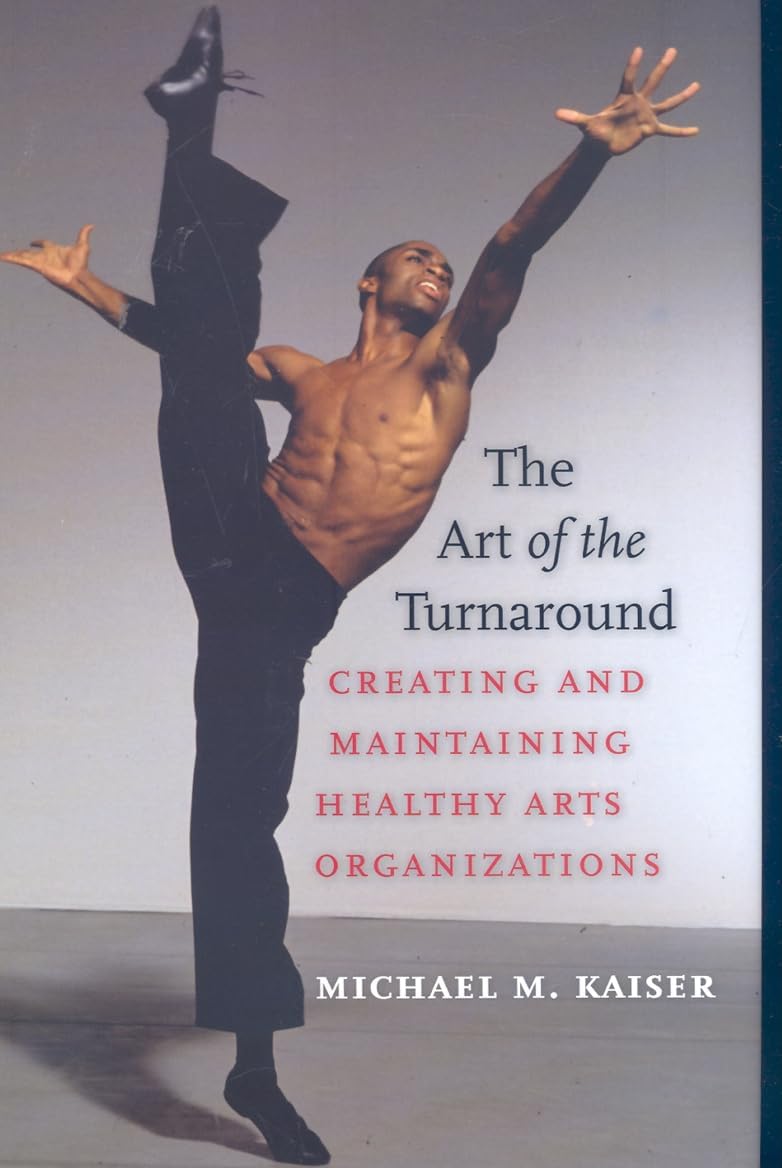
The Art of the Turnaround: Creating and Maintaining Healthy Arts Organizations
Product ID: 3714271
Buy anything from 5,000+ international stores. One checkout price. No surprise fees. Join 2M+ shoppers on Desertcart.
Desertcart purchases this item on your behalf and handles shipping, customs, and support to Kyrgyzstan.
Many arts organizations today find themselves in financial difficulties because of economic constraints inherent in the industry. While other companies can improve productivity through the use of new technologies or better systems, these approaches are not available in the arts. Hamlet requires the same number of performers today as it did in Shakespeare’s time. The New York Philharmonic requires the same number of musicians now as it did when Tchaikovsky conducted it over one hundred years ago. Costs go up, but the size of theaters and the price resistance of patrons limit what can be earned from ticket sales. Therefore, the performing arts industry faces a severe gap between earnings and expenses. Typical approaches to closing the gap―raising ticket prices or cutting artistic or marketing expenses―don’t work. What, then, does it take to create and maintain a healthy arts organization? Michael M. Kaiser has revived four major arts organizations: the Kansas City Ballet, the Alvin Ailey American Dance Theater, American Ballet Theatre, and London’s Royal Opera House. In The Art of the Turnaround he shares with readers his ten basic rules for bringing financially distressed arts organizations back to life and keeping them strong. These rules cover the requirements for successful leadership, the pitfalls of cost cutting, the necessity of extending the programming calendar, the centrality of effective marketing and fund raising, and the importance of focusing on the present with a positive public message. In chapters organized chronologically, Kaiser brings his ten rules vividly to life in discussions of the four arts organizations he is credited with saving. The book concludes with a chapter on his experiences at the John F. Kennedy Center for the Performing Arts, an arts organization that needed an artistic turnaround when he became the president in 2001 and that today exemplifies in practice many of the ten rules he discusses throughout his book. Review: A Must Read for any Arts Administrator or Board Member - The Arts, especially the performing arts are a passion of mine and my family. Kaiser's work as described in his book serves as a guide that can be generalized to challenges and opportunities facing the arts in America and elsewhere. Many join Boards unclear of their role or the role of the CEO. And many likely have little grasp of the funding cycles and sources of funds and deficits. Arts operate on a model so different from the for profit sector. Organizational management often fails in their fundamental roles of understanding their numbers and Boards often fail in their governance, such that turnarounds and failures to achieve turnarounds are all too common. The individual stories Kaiser shares and the group in aggregate serve as both good reading as well as a useful set of pointers that spell out the challenges and how he attacked them. As interesting as what was said, I was amused by what was left out and what lay between the lines on the human side. Also his own journey of self-discovery was clearly laid out. Those who criticize the book for lack of depth or being too personal miss the point. This is a 180 page or so personal narrative about one man's journey to the highest ranks of arts management. It is not a course, though he teaches one at the Kennedy Center. It presents a number of contexts and challenges and helps frame the work of arts management in a most readable and entertaining way. Anybody joining a non-profit board, especially in the arts would do well to read this book. Likewise anyone managing such organizations. Review: For More than the Arts - Hearing Michael Kaiser in person is what prompted me to explore this very interesting book. Kaiser has had remarkable success in nurturing several professional arts organizations to good fiscal and organizational success. I was part of a group of several hundred patrons and representatives of the arts to hear Mr. Kaiser interviewed by Maestro Michael Stern of the Kansas City Symphony. Honestly, I had no idea what to expect. It quickly became apparent that Kaiser is very smart, has an abundance of common sense accompanied by great instincts, and provides leadership that keeps people focused on the mission. The bulk of the interview was his "off-the-cuff" review of ten principles that have guided him in turning around struggling organizations. Also obvious, was that these ten principles apply not just to the arts but to many organizations, especially NPO's that rely on donors for their existence. Kaiser's principles are profoundly simple, yet powerful if diligently and faithfully applied. Immediately, I ordered copies of his book for key people on a number of NPO boards on which I serve. The principles are found right up front and the rest of the book illustrates them by recounting Kaiser's personal experiences of turnarounds. I highly recommend this book.
| Best Sellers Rank | #748,133 in Books ( See Top 100 in Books ) #45 in Performing Arts Industry #158 in Business of Art Reference #693 in British & Irish Poetry |
| Customer Reviews | 4.4 out of 5 stars 76 Reviews |
B**T
A Must Read for any Arts Administrator or Board Member
The Arts, especially the performing arts are a passion of mine and my family. Kaiser's work as described in his book serves as a guide that can be generalized to challenges and opportunities facing the arts in America and elsewhere. Many join Boards unclear of their role or the role of the CEO. And many likely have little grasp of the funding cycles and sources of funds and deficits. Arts operate on a model so different from the for profit sector. Organizational management often fails in their fundamental roles of understanding their numbers and Boards often fail in their governance, such that turnarounds and failures to achieve turnarounds are all too common. The individual stories Kaiser shares and the group in aggregate serve as both good reading as well as a useful set of pointers that spell out the challenges and how he attacked them. As interesting as what was said, I was amused by what was left out and what lay between the lines on the human side. Also his own journey of self-discovery was clearly laid out. Those who criticize the book for lack of depth or being too personal miss the point. This is a 180 page or so personal narrative about one man's journey to the highest ranks of arts management. It is not a course, though he teaches one at the Kennedy Center. It presents a number of contexts and challenges and helps frame the work of arts management in a most readable and entertaining way. Anybody joining a non-profit board, especially in the arts would do well to read this book. Likewise anyone managing such organizations.
J**D
For More than the Arts
Hearing Michael Kaiser in person is what prompted me to explore this very interesting book. Kaiser has had remarkable success in nurturing several professional arts organizations to good fiscal and organizational success. I was part of a group of several hundred patrons and representatives of the arts to hear Mr. Kaiser interviewed by Maestro Michael Stern of the Kansas City Symphony. Honestly, I had no idea what to expect. It quickly became apparent that Kaiser is very smart, has an abundance of common sense accompanied by great instincts, and provides leadership that keeps people focused on the mission. The bulk of the interview was his "off-the-cuff" review of ten principles that have guided him in turning around struggling organizations. Also obvious, was that these ten principles apply not just to the arts but to many organizations, especially NPO's that rely on donors for their existence. Kaiser's principles are profoundly simple, yet powerful if diligently and faithfully applied. Immediately, I ordered copies of his book for key people on a number of NPO boards on which I serve. The principles are found right up front and the rest of the book illustrates them by recounting Kaiser's personal experiences of turnarounds. I highly recommend this book.
J**S
Focused memoir that offers some guidance
This is less of a "how-to" and more of a book that describes, in detail, Kaiser's experiences turning around major arts organizations despite his limited prior background in the field. You do learn lessons with him along the way, and certainly see the scope of challenges that can face an arts organization. But if you are looking for a handbook, or a foundation for arts management, you may want to look elsewhere.
A**N
A wonderful book for those who are interested in the arts
A wonderful book for those who are interested in the arts. This book is well written and clear. It describes the author's work with the giants of the world of the arts. His methods are clear and intelligent. He analyzes the needs of the organization and creates a long term program to reach their goals.
B**B
If your Arts organization is struggling, read this book.
As I work on helping to turn around two small performing arts non-profits, I keep referring to this book. It's a great place to start and points one in the right direction. I've passed it around to Board Members and others involved, some have purchased their own copies (my copy is highlighted and heavily sticky noted). Michael Kaiser has turned around some of the great performing arts organizations when they were down on their heals. Artists often don't know anything about operating a business, so they fail. Large or small organization, you will learn something from this book. You will need to supplement with other material, but begin here. Mr Kaiser is a businessman who loves the arts. If that's not who serves on your Board and Management, get rid of them and learn who should be on those Boards and Management. I highly recommend this book for your performing arts organization.
A**R
I recommend this book to anyone who is involved with an ...
It is a well written book with incredible social implications. Kaiser is a man of risk and he takes this ability with him into all of the organizational crises. I, however, tired of the name calling, and the people with whom he came contact were helpful to him I suppose, but it certainly got very social. One thesis which did arise from the book is that most arts organizations which flourish do so with the help of governmental support, without which they would probably fail. Kaiser has a big personal ego and it helps him cope with what must have been a very traumatic existence during his battles of organizational survival. I recommend this book to anyone who is involved with an arts organization Board.
A**R
This book is beautifully written and very inspiring
This book is beautifully written and very inspiring. Reading about the way Michael Kaiser turned around the five organizations described here was profoundly reassuring and calming... I found it a very relaxing and enjoyable read for this reason! The clarity of his vision and the steadfastness with which he pursued his goals is something every arts professional can learn from.
S**R
A great read on the business of the art world
Great read on the problems and solutions while working in an artistic world. Very inspiring and gives the confidence to anyone who wants to move the world through art.
S**.
Really Helpful
While Kaiser's examples are all from larger arts organizations, and mostly US-based, the general insights enormously helpful, no matter the size of the organization you're involved in.
Trustpilot
2 weeks ago
1 day ago