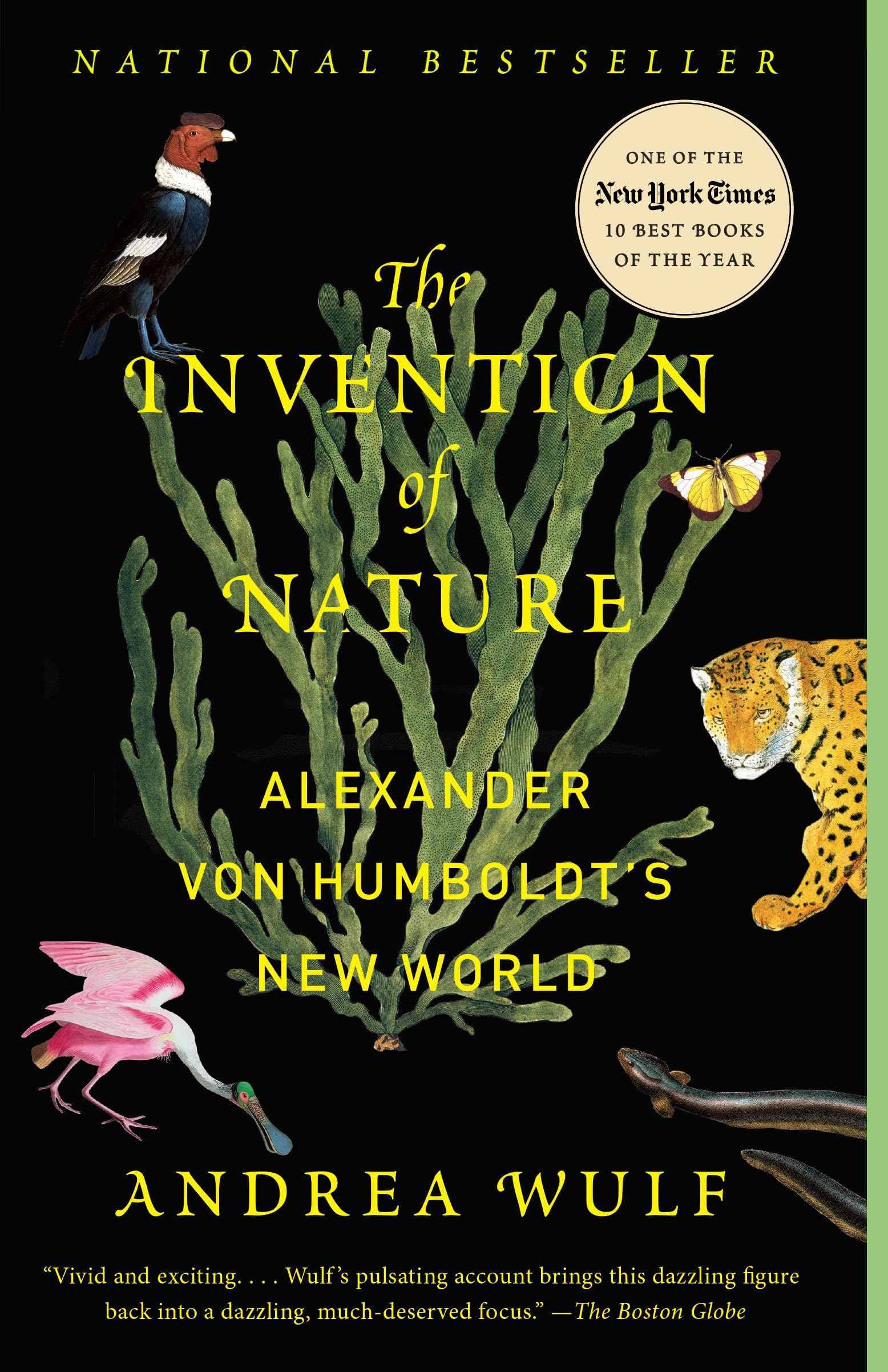
The Invention of Nature: Alexander von Humboldt's New World
Product ID: 34111215
Buy anything from 5,000+ international stores. One checkout price. No surprise fees. Join 2M+ shoppers on Desertcart.
Desertcart purchases this item on your behalf and handles shipping, customs, and support to Kyrgyzstan.
Buy The Invention of Nature: Alexander von Humboldt's New World on desertcart.com ✓ FREE SHIPPING on qualified orders Review: Comments on Andrea Wulf's The Invention of Nature: Alexander von Humboldt's New World - Andrea Wulf’s biography of Alexander von Humboldt is a beautifully written work that restores our awareness of a life that paradoxically seems largely forgotten and yet is somehow familiar once this wonderful book is read. And to classify this work as a biography is not totally accurate in that it is a biography, a history of science, and a commentary on the interconnectivity of life from the viewpoint of both aesthetics and science. As well, it documents how von Humboldt influenced a number of other individuals who are now famous and better known to us. Wulf gives us great detail of the life of the fascinating man Alexander von Humboldt. She conveys an insight into how his early life molded him into a frenetic, driven scholar with a lifelong thirst for both knowledge and adventure. Perhaps more commonplace in the late 18th century than today, he became vitally interested in what would become later known as “scientific specialties” such as geology and botany as well as in aesthetics. His early self-concept led to his first and most monumental journey, along with the botanist Aime Bonpland, across the northern reaches of South America lasting 5 years and led to his view of nature as an interconnected force, a view that would shape the remainder of his long life. While his insights now resonate with us, this book makes clear that his comprehensive understanding of nature was totally new at the time and that the reason it is now familiar to us was his tremendous influence on others to follow. Wulf brings into clear view the strong friendship between the youthful von Humboldt and the poet Johann von Goethe and how each influenced the other. Von Humboldt developed an appreciation of the artistic side of life through Goethe while Goethe developed a fascination with science through von Humboldt that influenced the writing of his Foust. Later in life, both because of his own fame and through his brother (a foreign minister of Prussia), von Humboldt would meet many other famous people, with wonderful vignettes developed by Wulf. One such acquaintance was Simon Bolivar, whom he met in Rome well after his own travels in South America. Bolivar, born in Spanish Venezuela, would seem to have been inspired by von Humboldt’s poetic vision of South American landscapes and would return to his native land as liberator and later, sadly, as a dictator. Even during his long years of brutal warfare he was said to have maintained a strong interest in nature that had been inspired by von Humboldt. Von Humboldt’s view of colonial South America went far beyond the aesthetic appreciation of the landscapes and of the amazing scientific discoveries. He spoke out against the evils of colonialism, and slavery. He also noted how deforestation adversely affected the water table, animal populations, the atmosphere and much more. For this he became known as the founder of environmentalism. Von Humboldt’s scientific studies in Europe, South America and later the Asiatic part of Russia are well chronicled and led him to develop his view on how all of life is interconnected and part of one vital force. For instance, he invented the concept of atmospheric isotherms, showing how landmasses and oceans affect weather patterns, developing the field of meteorology. Late in life he wrote the five-volume work he called Cosmos. Based on his life’s work, the word “ecology” was invented. In the latter portion of this work, Wulf speaks of several of the more famous people heavily influenced by von Humboldt. While some might feel that this turns a wonderful biography into an unnecessarily long book, I feel this adds a most worthwhile dimension to her work. And just as von Humboldt himself saw the interconnections across all of nature, in similar fashion Wulf brings out the interconnections between the life and writings of von Humboldt and those individuals influenced by him who have so greatly influenced and even shaped our modern views of science and nature. I only became aware of The Invention of Nature through a review published in the Wall Street Journal that focused on the landscape painter Frederic Edwin Church and his painting called “In the Heart of the Andes”. Church had been motivated by von Humboldt to appreciate both the emotional impact on us from nature and its scientific aspects. He trekked through some of the regions of South America previously covered by von Humboldt and Bonpland and painted this landscape that was so detailed that botanists could discern the name of each plant and tree on the canvas. It was first displayed in 1859 just weeks before von Humboldt’s death. This review led me to read the Invention of Nature. Wulf goes on to describe the massive influence by von Humboldt on so many others. Charles Darwin had a copy of von Humboldt’s Personal Narrative with him during the voyage of the HMS Beagle and would later refer to von Humboldt in his own writings. Henry David Thoreau read Personal Narrative, Views of Nature and Cosmos and mentioned von Humboldt often in his journals. He narrowed his own view of nature to that of Walden Pond but tried to make it as comprehensive and interconnected as that of von Humboldt’s cosmos. George Perkins Marsh read all of the major writings of von Humboldt and was very motivated by him, becoming the prototypical conservationist and writer of Man and Nature. Ernst Haeckel was a German physician, artist and zoologist who was enthralled with von Humboldt. He studied microscopic marine life and then developed them into amazing works of art that led to the Art Nouveau movement and monism. And finally John Muir was deeply influenced by von Humboldt. He owned and heavily studied all of von Humboldt’s major books and extended von Humboldt’s thoughts on the spiritual connections seen within nature. Beyond the conservationism of Marsh, Muir advocated for protection of our environment and of course founded the Sierra Club and contributed to the development of our National Parks system. All of this is brought out in fascinating detail in the latter portions of Wulf’s book. In conclusion, The Invention of Nature is a description not only of a remarkable life but also of how we have come to think of environment, ecology, and nature itself. From it, I feel, we can be inspired to appreciate the nature that surrounds us from small to great, to widen our own views in a way that can bring a revitalization to ourselves and to cause us to advocate for the environment. I believe Alexander von Humboldt would be extremely proud of The Invention of Nature. By Jerry W. Jackson, Birmingham, Alabama Review: First Banks, then Humboldt. the First Field Biologists - Beautiful book. The best biography of Alexander Humboldt today. Well written, well illustrated. Worth reading if you are an armature or a Field Biologist. One must know this man.
| Best Sellers Rank | #19,890 in Books ( See Top 100 in Books ) #15 in Environmental Science (Books) #24 in Environmentalism #52 in Traveler & Explorer Biographies |
| Customer Reviews | 4.6 4.6 out of 5 stars (4,989) |
| Dimensions | 5.12 x 1.15 x 7.96 inches |
| Edition | Reprint |
| ISBN-10 | 0345806298 |
| ISBN-13 | 978-0345806291 |
| Item Weight | 12.8 ounces |
| Language | English |
| Print length | 576 pages |
| Publication date | October 4, 2016 |
| Publisher | Vintage |
C**J
Comments on Andrea Wulf's The Invention of Nature: Alexander von Humboldt's New World
Andrea Wulf’s biography of Alexander von Humboldt is a beautifully written work that restores our awareness of a life that paradoxically seems largely forgotten and yet is somehow familiar once this wonderful book is read. And to classify this work as a biography is not totally accurate in that it is a biography, a history of science, and a commentary on the interconnectivity of life from the viewpoint of both aesthetics and science. As well, it documents how von Humboldt influenced a number of other individuals who are now famous and better known to us. Wulf gives us great detail of the life of the fascinating man Alexander von Humboldt. She conveys an insight into how his early life molded him into a frenetic, driven scholar with a lifelong thirst for both knowledge and adventure. Perhaps more commonplace in the late 18th century than today, he became vitally interested in what would become later known as “scientific specialties” such as geology and botany as well as in aesthetics. His early self-concept led to his first and most monumental journey, along with the botanist Aime Bonpland, across the northern reaches of South America lasting 5 years and led to his view of nature as an interconnected force, a view that would shape the remainder of his long life. While his insights now resonate with us, this book makes clear that his comprehensive understanding of nature was totally new at the time and that the reason it is now familiar to us was his tremendous influence on others to follow. Wulf brings into clear view the strong friendship between the youthful von Humboldt and the poet Johann von Goethe and how each influenced the other. Von Humboldt developed an appreciation of the artistic side of life through Goethe while Goethe developed a fascination with science through von Humboldt that influenced the writing of his Foust. Later in life, both because of his own fame and through his brother (a foreign minister of Prussia), von Humboldt would meet many other famous people, with wonderful vignettes developed by Wulf. One such acquaintance was Simon Bolivar, whom he met in Rome well after his own travels in South America. Bolivar, born in Spanish Venezuela, would seem to have been inspired by von Humboldt’s poetic vision of South American landscapes and would return to his native land as liberator and later, sadly, as a dictator. Even during his long years of brutal warfare he was said to have maintained a strong interest in nature that had been inspired by von Humboldt. Von Humboldt’s view of colonial South America went far beyond the aesthetic appreciation of the landscapes and of the amazing scientific discoveries. He spoke out against the evils of colonialism, and slavery. He also noted how deforestation adversely affected the water table, animal populations, the atmosphere and much more. For this he became known as the founder of environmentalism. Von Humboldt’s scientific studies in Europe, South America and later the Asiatic part of Russia are well chronicled and led him to develop his view on how all of life is interconnected and part of one vital force. For instance, he invented the concept of atmospheric isotherms, showing how landmasses and oceans affect weather patterns, developing the field of meteorology. Late in life he wrote the five-volume work he called Cosmos. Based on his life’s work, the word “ecology” was invented. In the latter portion of this work, Wulf speaks of several of the more famous people heavily influenced by von Humboldt. While some might feel that this turns a wonderful biography into an unnecessarily long book, I feel this adds a most worthwhile dimension to her work. And just as von Humboldt himself saw the interconnections across all of nature, in similar fashion Wulf brings out the interconnections between the life and writings of von Humboldt and those individuals influenced by him who have so greatly influenced and even shaped our modern views of science and nature. I only became aware of The Invention of Nature through a review published in the Wall Street Journal that focused on the landscape painter Frederic Edwin Church and his painting called “In the Heart of the Andes”. Church had been motivated by von Humboldt to appreciate both the emotional impact on us from nature and its scientific aspects. He trekked through some of the regions of South America previously covered by von Humboldt and Bonpland and painted this landscape that was so detailed that botanists could discern the name of each plant and tree on the canvas. It was first displayed in 1859 just weeks before von Humboldt’s death. This review led me to read the Invention of Nature. Wulf goes on to describe the massive influence by von Humboldt on so many others. Charles Darwin had a copy of von Humboldt’s Personal Narrative with him during the voyage of the HMS Beagle and would later refer to von Humboldt in his own writings. Henry David Thoreau read Personal Narrative, Views of Nature and Cosmos and mentioned von Humboldt often in his journals. He narrowed his own view of nature to that of Walden Pond but tried to make it as comprehensive and interconnected as that of von Humboldt’s cosmos. George Perkins Marsh read all of the major writings of von Humboldt and was very motivated by him, becoming the prototypical conservationist and writer of Man and Nature. Ernst Haeckel was a German physician, artist and zoologist who was enthralled with von Humboldt. He studied microscopic marine life and then developed them into amazing works of art that led to the Art Nouveau movement and monism. And finally John Muir was deeply influenced by von Humboldt. He owned and heavily studied all of von Humboldt’s major books and extended von Humboldt’s thoughts on the spiritual connections seen within nature. Beyond the conservationism of Marsh, Muir advocated for protection of our environment and of course founded the Sierra Club and contributed to the development of our National Parks system. All of this is brought out in fascinating detail in the latter portions of Wulf’s book. In conclusion, The Invention of Nature is a description not only of a remarkable life but also of how we have come to think of environment, ecology, and nature itself. From it, I feel, we can be inspired to appreciate the nature that surrounds us from small to great, to widen our own views in a way that can bring a revitalization to ourselves and to cause us to advocate for the environment. I believe Alexander von Humboldt would be extremely proud of The Invention of Nature. By Jerry W. Jackson, Birmingham, Alabama
E**H
First Banks, then Humboldt. the First Field Biologists
Beautiful book. The best biography of Alexander Humboldt today. Well written, well illustrated. Worth reading if you are an armature or a Field Biologist. One must know this man.
A**R
Scientist, explorer, polymath; the father of modern environmentalism
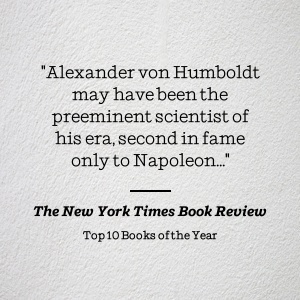
If I ask my learned friends to make a list of the top ten scientists in history, Alexander von Humboldt probably won't figure on the list; he probably wouldn't have figured on my own. And yet when he was alive, for a while Humboldt was the most famous scientist in the world. Thousands thronged to hear him speak, and the most distinguished personalities of the age visited him at his home in Paris and Berlin. He was a polymath in the true sense, excelling in science, philosophy, writing and adventure. He also laid the foundations for modern environmentalism and inspired scores of later writers and naturalists, including Charles Darwin, Henry David Thoreau, George Perkins Marsh and John Muir. Dozens of streets, mountains, forests, universities and scholarships around the world are named after him. Andrew Wulf has written an excellent biography of this remarkable mind which secures Humboldt’s place both as a brilliant scientist and explorer and as one of the founding fathers of modern environmentalism. It would not be off the mark to say that he paved the way for Darwin and natural selection. He was born in Prussia in 1769, when Europe was starting to crackle with reform and intellectual ferment. Humboldt inherited a large sum of money from a strict, authoritarian mother who wanted him to enter the law and civil service. But Humboldt was smitten by nature and exploration from a very young age and wanted nothing more than to travel to the far, wild reaches of the planet. His brother Wilhelm on the other hand took to law and diplomacy like a fish and held a succession of important ambassadorial posts in France and Italy; throughout their lives the brothers along with Wilhelm’s wife Caroline were to be close, in spite of their occasional disagreements. In his young days Humboldt’s scientific temper was molded by a short career as a mining inspector. This career gave him a chance to travel throughout Europe and appreciate some of the finer details of geology and the chemistry of minerals. Humboldt's early intellect was shaped in part by his own burning curiosity for reading and nature and in part by a formative friendship with Goethe; the two often visited each other and spent long evenings debating everything from science to poetry. Until Humboldt met Goethe he was a strict rationalist, but Goethe taught him that a true appreciation of nature comes when its scientific study is infused with a sense of wonder and feeling about its workings. The heady mix of Romanticism and Enlightenment thinking that pervaded Humboldt’s discussions with Goethe primed Humboldt for a novel appreciation of nature. Armed with these twin pillars of natural philosophy, Humboldt set off in 1799 on what would turn out to be the most important trip of his career. He decided to traverse as much of South America and especially Venezuela as he could. His goal, just like Darwin's twenty-five years later, was to study the native flora and fauna, including the mighty river systems of the South and the indigenous tribes. Humboldt was accompanied by a French botanist named Aime Bonpland who shared his enthusiasm for adventure and science. And what adventures they had. They climbed mountains in freezing weather and hailstorms, navigated rivers and forests filled with dangerous snakes, crocodiles, scorpions and spiders and came face to face with ferocious tribes who had never seen a European before. The duo’s hardiness – some would call it foolhardiness – in the face of extreme weather and dangerous conditions alternately evokes a sense of bravery and stupidity. The most vivid experience they had which really stood out for me was when they trotted in horses in a pool filled with electric eels so that the dangerous creatures would be roiled up to the surface by the horses’ hooves, ready for capture and study. Humboldt’s South American adventures took five years and planted seeds for two key ideas which laid the foundations for similar thinking by many of the world’s most important scientists, humanists and writers. Traversing diverse environments like mountains, rivers, oceans and rain forests, Humboldt was struck by the similarity in flora and fauna that he observed; many of the plant species at higher altitudes for instance were similar to ones he had seen in Europe. At the same time he also observed how crucial the dependence of life in these environments was on climatic conditions. These observations led Humboldt to conceive of life as a seamless whole whose parts are critically dependent on each other; perturb one part and you risk perturbing the whole. Without giving it a name Humboldt had discovered the biosphere. This was a profound insight in an age when the environment was considered as a limitless resource that was ripe for man’s taking. The sensitive dependence of various parts of life on each other was a novel idea at the time, and it became the precursor for much thinking on ecology, biology and climate change that we take for granted; it underlies for instance James Lovelock’s idea of Gaia, of seeing the earth as a living and breathing organism with interdependent parts. Humboldt also acquired a lifelong disdain for colonialism and slavery during his American sojourn. By the time he arrived in Venezuela the Spanish had already established a sizable stronghold in much of the continent. Humboldt was struck by the plight of both the natives and the lowly status of the Spaniards who were born in the exploited countries. He also appreciated the wealth of knowledge that infused the way of life of the indigenous tribes and their ancient civilization; a way of life that was slowly being eroded by the Conquistadors. Humboldt got a further opportunity to shape his thinking on these issues when he made his way to Philadelphia and Washington DC in his way back home. His goal was to meet Thomas Jefferson. Jefferson had already heard of Humboldt’s observations, and he thought Humboldt’s notes on South America and Mexico would be especially helpful to him as the United States sought to expand its territories in the South and the West. The two men struck up a warm, cordial relationship. The president and the scientist-explorer had much in common; they were both polymaths and leading intellects whose thinking was permeated by an appreciation of nature and exploration. Humboldt stayed at Monticello and admired Jefferson’s experiments in agriculture and architecture. He also found much to admire in the forward-looking and spirited Americans. But he also openly criticized slavery in the United States and made the obvious observation that the founding ideals of the country were in stark contrast to its exploitation of other human beings. These discussions made Jefferson uneasy but it did not affect the intellectual relationship that the two men enjoyed. Humboldt arrived back in Paris to thousands of spectators; stories of his adventures and his vivid writings had already made him famous. Paris with its museums and intellectuals was the place to be, and Humboldt developed friendships with several leading French scientists including the chemist Gay-Lussac and the paleontologist Georges Cuvier. But he also watched with dismay as, after what seemed to be a bloody but successful people’s revolution, Napoleon turned France into an empire-building state and semi-dictatorship. At the same time Napoleon did have some appreciation of science, so Humboldt could still work relatively unfettered in France. Humboldt’s most interesting friendship in France was with the South American revolutionary Simon Bolivar who was spending a short period in the world’s cultural capital after the death of his young wife, immersing himself in wine, women and song to recover from the grief. After meeting Humboldt, Bolivar had a renewed sense of urgency regarding the freedom of South Americans from the Spanish, and when he returned he started his incredibly resilient and successful campaigns for Latin American independence. While Humboldt thrived in France and wrote bestselling books on South America’s flora and fauna, his restless mind could not stop thinking of other places to explore. He set his sights on India and the Himalayas, and his determined sadly unsuccessful search is one of the great what-could-have-beens of the times. The culprit was the East India Company which had established a stronghold in India and whose express permission was needed to travel to the country. When Humboldt visited London – mobbed by famous scientists and crowds as usual – he tried to pull all the scientific and diplomatic strings which he could to secure passage to India. But the thorn in the East India Company’s side was his vocal criticism of colonialism, of which India was Britain’s self-proclaimed “jewel in the crown”; the Company would never agree to let this upstart intellectual who threatened to create a publicity nightmare for them enter India. Humboldt continued to try to get to India for the rest of his life, and one can only wonder what kind of perspicacious observations he would have unearthed had he been able to make the trip. If not India, Humboldt’s next choice was Russia which was still under the yoke of the Tsars. By this time Humboldt’s inheritance was gone and he was being funded by a stipend from the German King; it was a stipend that Humboldt grumbled about since it often involved accompanying the king on menial trips and small talk with court ministers. Humboldt was therefore gratified to secure funds from the Russian monarch. He was then 59 but still in his element. Accompanied by a few assistants and fellow scientists, Humboldt covered almost 10,000 miles in less than a month. The journey was again dangerous, and at one point involved barreling through a region stricken with an epidemic of anthrax. The official mandate of the trip was a mining exploration, but Humboldt often violated this mandate and strayed several thousand miles off the chosen route to perform his own experiments on the native flora and fauna. The result was again a view of the unity of life spread across diverse geographical and biological environments. Humboldt finally came home to Berlin after what turned out to be his last international trip. But his restless spirit was not done yet. He spent the next thirty years corresponding with leading lights like Darwin, Jefferson and Louis Agassiz. The crowning achievement of those years was a vast, multivolume, audaciously ambitious compendium of earth’s biosphere and the universe called “Cosmos”. Predating Carl Sagan’s Cosmos by a hundred and fifty years, Humboldt’s “Cosmos” sought to put all physical and biological phenomena on the same footing. Here was Humboldt the polymath at his best. In Cosmos Humboldt put together everything he knew about geology, anatomy, geography, paleontology, ecology and humanity to create a unified view of life. The volumes were lavishly illustrated with Humboldt’s own drawings as well as those from scores of correspondents. They were works not just of science but of literature, stamped with the influence of Goethe and the age of Romanticism. The volume of letters that Humboldt received from both scientists and fans during this time reached into the thousands. “Cosmos” was Humboldt’s last great work, and he died in 1859 at the ripe age of eighty-nine years, in his last years becoming one of the most famous people in the world. He was feted in all the world’s major capitals, and celebrations of his life lasted many days and drew crowds of thousands. The last part of the book charts the influence of this remarkable intellect on some of the best-known and most influential naturalists and writers of the nineteenth and twentieth century. Darwin found commonalities in his own observations of similarities among species and Humboldt’s work in Venezuela. Humboldt also had a great influence on Henry David Thoreau who took inspiration from Humboldt’s sensitive appreciation of nature in writing his famous ‘Walden’; Thoreau’s words exemplify the kind of poetry that Humboldt learnt from Goethe. The American naturalist George Perkins Marsh was also quite taken by Humboldt’s observations on the destructive influence of human activity on the environment, and especially on deforestation. Marsh’s “Man and Nature” anticipated Rachel Carson’s “Silent Spring”; Marsh today is regarded as America’s first serious environmentalist. Finally, John Muir whose wanderlust took him on foot from his home in Indiana to first Florida and then to Yosemite became America’s foremost influence on the founding of its national parks. Muir, Thoreau and Marsh all had heavily marked copies of Humboldt’s works on their shelves, and all extensively referenced Humboldt in their writings. What all of these naturalists and a horde of other successive writers gained from Humboldt was an appreciation of the unity of life, the seamless interdependence of its various parts on each other, and its great fragility and sensitivity to human intervention. As we debate climate change and greenhouse gas emissions, as we discuss nature’s depiction in art and poetry, as we pick up a snowflake and wonder at its multifaceted aspects of geometry and beauty, we are all walking in Alexander von Humboldt’s shoes.
H**N
A splendid account of Alexander von Humboldt and his importance for the environmental movement. Well informed and elegantly written.
J**Y
My friend wanted it for her birthday. Loved it
T**Z
Öncelikle bu kitabı bu fiyata bulabilmek güzel… Sonrasında hızlı kargo ve güzel paketleme memnuniyet verici… Teşekkür ederim…
W**Y
Review of ‘Invention of Nature: Alexander von Humboldt’s New World’ by Andrea Wulf This is an extraordinary work that looks in detail into the life and vision of a remarkable scientist of the late 18th and 19th century, a rare polymath and his place in scientific history. Alexander von Humboldt was a radical thinker with insightful and revolutionary ideas about nature that had everything to do with rational questions and empirical fact finding, as divorced from the divine origin of fixed species immune to the dynamics of nature. Here the author deftly takes pre-evolutionary ideas proposed by Humboldt and weaves them into the thinking of other 19th Century scientists, such as Charles Darwin, Ernst Haeckel, Henry David Thoreau, George Perkins Marsh, and John Muir, amongst others, stressing how Humboldt’s ‘Personal Narrative’ played such a prominent role in their evolving theories about nature. More importantly, perhaps, Humboldt’s vision that all human endeavors are deeply connected to nature, as Wulf expertly shows, are as important today as when they were first proposed by the great scientist who feared humankind might destroy itself as it slowly impacted vast tracts of land upsetting the rhythms of nature, many of which could not be reset over time. With climatic change looming as one of the greatest threats facing humans, a force largely unleashed by unthinking human greed and ignorance, Humboldt’s multi-disciplinary approach to scientific problems is all the more germane today than in the 19th century. I strongly recommend this book to anyone interested in environmental science and the future of the human species. W.C. Mahaney, author of ‘Ice on the Equator’,‘Hannibal’s Odyssey: Environmental Background to the Alpine Invasion of Italia’; and Bill Mahaney author of ‘The Warmaker-Hannibal’s Invasion of Italia and the Aftermath’ (fiction).
P**S
アレクサンダー・フォン・フンボルトの最新の伝記。と言われても、ぴんとこないと思います(どうやら英語圏の読者にとっても同じようです)。 ところが、これがめっぽう面白い。NYTとエコノミスト誌の2015のベスト本に選ばれていたので読んだのですが、期待をはるかに超える内容でした。 フンボルトは19世紀前半の世界でもっとも有名な人物の一人で、彼が死んだとき、世界は悲しみに沈んだといいます。 彼は何をした人なのか?彼は植物学、動物学、鉱物学、天文学、地質学、文明論から歴史、詩まで、あらゆる分野を横断する「博物学者」でした。 彼は南北アメリカ、欧州とユーラシア大陸を冒険し、自然の中に身をひたし、そこから「自然とは統合された全体である」というアイデアを得ます。 それは、現在の生態学やエコロジーなどの萌芽でした。タイトルの「自然の発明」はそれに従っています。 フンボルトは、専門家がタコツボに入ってそれぞれの分野を極めるようなやり方では決してとらえられない鋭い洞察を、分野を横断することで得たということです。 とにかく出てくる人の顔ぶれが豪華。フンボルトはゲーテの親友であり(あまりに親しく交わってシラーから嫉妬を受けた由)、シモン・ボリバルを叱咤激励し、ナポレオンとはそりが合わなかったが、メッテルニヒからは尊敬を受け、トマス・ジェファソンら合衆国建国の父らと深く交流し、ダーウィンはフンボルトに導かれて「種の起源」を著し、英国ロマン派の巨人S.T.コールリッジ、R.サウジーに霊感を与え、あまつさえE.A.ポーの「ユリイカ」は彼に献呈されている…と、欧州史のいちばん面白い時期のいちばん面白い人物(詩人、科学者、政治家、革命家まで!)が次から次に登場して、その交遊録を読むだけで無類に楽しい。詩と科学が未分化な「博物学」が生きていた時代の空気を感じ取ることができます。 フンボルトはある種身勝手で傲慢だったようですが、とにかく、冒険が大好きで頭の切れる風雲児の伝記は、それ自体痛快無類です。 この本はフンボルトに影響された人々が現在のエコロジー、自然保護のアイデアをかたちにしていくまでを描いており、たんなる伝記にとどまらない、21世紀において意味ある読み物にするという著者の意図が、みごとに結実しています。 フンボルトという人に関心が無くても、読めばたちまち引き込まれる読み物です。まちがいなくオススメの一冊。
Trustpilot
1 week ago
2 months ago