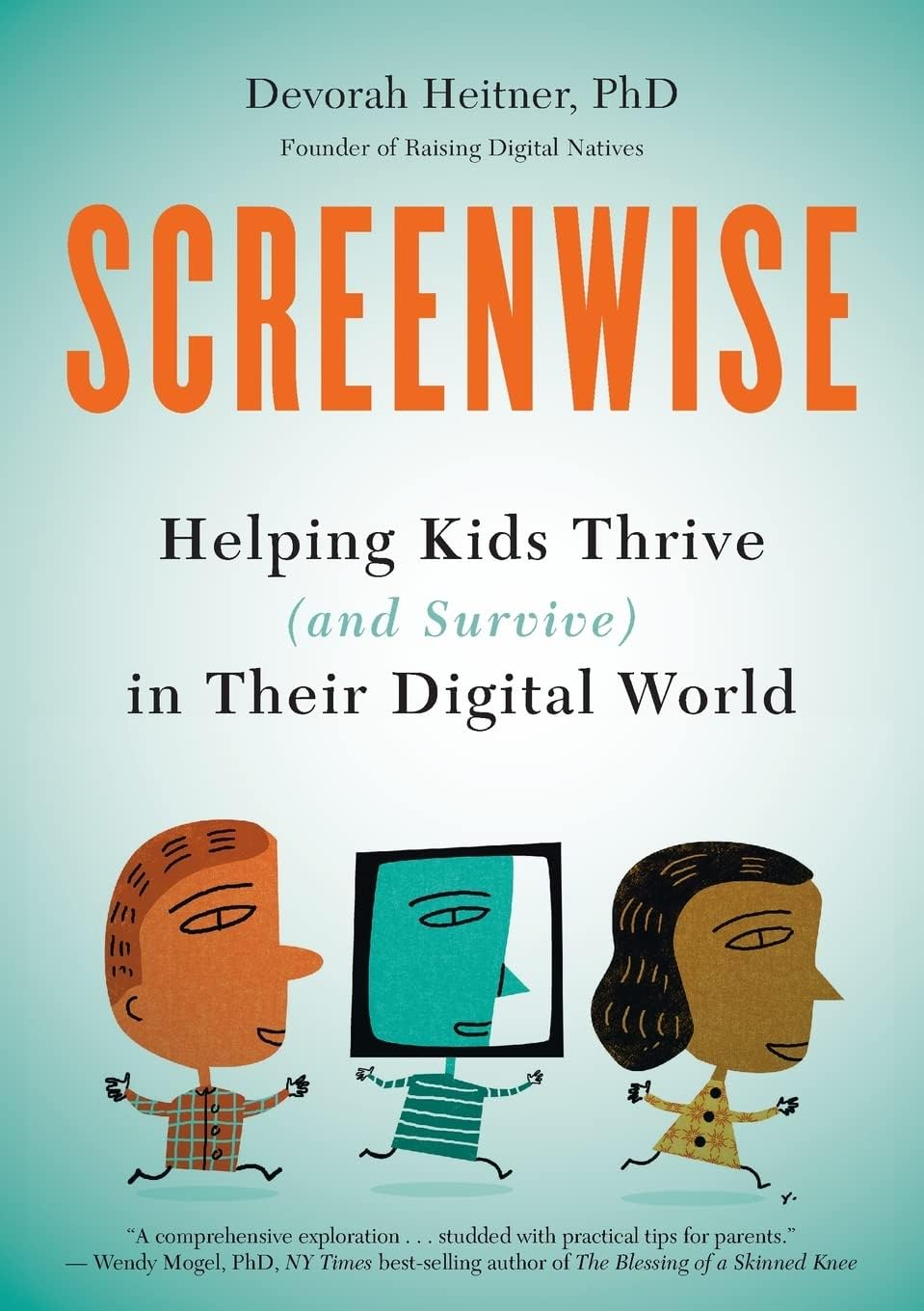
Screenwise: Helping Kids Thrive (and Survive) in Their Digital World
Product ID: 32631743
Buy anything from 5,000+ international stores. One checkout price. No surprise fees. Join 2M+ shoppers on Desertcart.
Desertcart purchases this item on your behalf and handles shipping, customs, and support to Kyrgyzstan.
Screenwise offers an encouraging perspective on how to thoughtfully guide kids in the digital age. Many parents and educators worry that kids are addicted, detached, or distracted because of their digital devices. Digital Citizenship expert Devorah Heitner, however, believes that technology offers huge potential to our children--if parents help them. Screenwise helps parents recognize that the social wisdom they have gained throughout their lives is a relevant and urgently needed supplement to their kid's digital savvy. These skills can help set kids up for a lifetime of success in a world fueled by technology. The core message of the book is that kids need mentoring, not (just) monitoring, and that kids deserve more empathy from adults about growing up in the digital age. Texting, gaming and social media are social spaces requiring social skills. The book offers advice on helping kids navigate friendship and identity issues that are common among new texters, gamers and social media users. Screenwise is a guide to understanding what it is like for children to grow up with technology, and to recognizing the special challenges--and advantages--that contemporary kids and teens experience thanks to this level of connection. Children's school experiences, family life and friendships are all shaped by digital connection. Educators and school leaders looking to engage parents around educational technology and wishing to create a culture of digital citizenship will benefit from this volume. Screenwise helps parents and educators move beyond discussions of "screentime" to evaluate different kinds of engagement with technology. Screenwise presents practical parenting "hacks": quick ideas that you can implement today that will help you understand and relate to your digital native. The book empowers parents to recognize ways that wisdom that they have gained throughout their lives is a relevant and urgently needed supplement to their kid's digital savvy.Based on real-life stories from families, the latest research, and Dr. Heitner's experience working with schools, Screenwise teaches parents what they need to know in order to raise responsible and empathetic kids in the digital age. Review: Menoring not monitoring - YES! - SCREENWISE isn’t what you’d expect from a typical media literacy book. Its advice on how to help children learn to ask relevant questions about the content of games, movies, music, or TV programs is brief and arguably too general to be all that useful. If I was judging it based on that criteria, the book would probably get a 3-4 star rating. I give it 5 stars because SCREENWISE is a very, very good parenting text about how to help children negotiate life with cell phones and social networks. It would be a great gift for parents of children/teens who carry their own phones or tablets or ever log on to a social network or multiplayer gaming site (like Minecraft). This highly accessible book is written as a conversation between the author and the reader, but is clearly research based with a sound understanding of child development and developmentally appropriate expectations. She skillfully distinguishes between old issues in new wrapping and new issues introduced by the constant connectivity, immediacy, and permanency unique to the digital world. To help parents see things through their children’s eyes, Heitner includes the voices of kids (culled through her own research). She gives parents a “heads up” about the things they need to look out for and then provides practical advice about how to engage children in conversations that will build the skills they need to productively and ethically manage life with devices on their own. Her mantra is “monitoring cannot substitute for mentoring,” which is why I think this counts as a valuable addition to a media literacy library. This is not a perfect book. As Heitner recognizes, it is entirely focused on middle and upper-middle class families. It will have limited value for those who aren’t part of that demographic. For example, it doesn’t address cultural conflicts unique to new immigrants and their American children or the challenges faced by families in homes that have sub-standard or no Internet or cloud connectivity. It assumes a parenting style that relies on negotiating with children and engaging them in conversation about sensitive issues – a practice that is not universally accepted, either because it doesn’t mesh with parents’ values or doesn’t match their skill set. Despite the gaps, there are millions of families that are grappling with the exact issues that Heitner addresses. For them, this book is gold. Review: Technology is here to stay, and kids need OUR help and guidance. Get that Luddite head out of the sand... and get Screenwise! - This book is truly a beacon in the darkness, both for parents who fear all screens and fruitlessly try to keep kids away from them, and for parents who may be worried by the amount or type of screen-based activities in which their kids engage, but remain hands-off and permissive because they don't know how to address it. Our family has screen-time limits for our school-aged kids, but so often these limits were leading to tantrums and power struggles because they were arbitrary. These limits lumped silly videos and games together with coding tutorials, historical research, and other far more useful online activities. In today's world, that simplistic approach just doesn't work. It makes kids feel bad about enjoying technology, when in fact we all use it multiple times a day (both for "redeeming" activities, and just for entertainment). Further, arbitrary limits set kids up to "cheat" when parents aren't looking-- and to lack the healthy awareness and guidance they need to navigate the online social world. It has been so helpful to approach technology in a new, more supportive way: taking an interest in the games of skill that our kids enjoy; using beloved characters from videos to discuss social skills in the real world; having open conversations about language and content that make videos and sites inappropriate for kids. I haven't even finished this book yet, and already I've had an incredible conversation with my daughter about a seemingly "silly" or "dumb" series of videos she kept talking about incessantly at the dinner table. It turns out that her interest in these videos was a way of working out an issue at school that was too hard to talk about directly. Once I took an interest in her interest, we were able to get to the bottom of things. Remember, this generation of kids is as good-hearted and hard-working as any generation in the past. Minecraft is not evil. Social media can be positive. Of course being glued to devices (or prioritizing them over real life) is not healthy, but Screenwise outlines helpful ways that parents can set a good example and get kids on the right track. The tone of this book is non-judgmental, optimistic, and so understanding toward Luddite parents like me, who have so much to learn. You don't have to be an expert in Pokémon Go or Roblox; you just have to get comfortable enough in your kids' world to guide them through it.


| Best Sellers Rank | #148,970 in Books ( See Top 100 in Books ) #117 in Parent Participation in Education (Books) #132 in School-Age Children Parenting #277 in Popular Child Psychology |
| Customer Reviews | 4.6 out of 5 stars 168 Reviews |
F**N
Menoring not monitoring - YES!
SCREENWISE isn’t what you’d expect from a typical media literacy book. Its advice on how to help children learn to ask relevant questions about the content of games, movies, music, or TV programs is brief and arguably too general to be all that useful. If I was judging it based on that criteria, the book would probably get a 3-4 star rating. I give it 5 stars because SCREENWISE is a very, very good parenting text about how to help children negotiate life with cell phones and social networks. It would be a great gift for parents of children/teens who carry their own phones or tablets or ever log on to a social network or multiplayer gaming site (like Minecraft). This highly accessible book is written as a conversation between the author and the reader, but is clearly research based with a sound understanding of child development and developmentally appropriate expectations. She skillfully distinguishes between old issues in new wrapping and new issues introduced by the constant connectivity, immediacy, and permanency unique to the digital world. To help parents see things through their children’s eyes, Heitner includes the voices of kids (culled through her own research). She gives parents a “heads up” about the things they need to look out for and then provides practical advice about how to engage children in conversations that will build the skills they need to productively and ethically manage life with devices on their own. Her mantra is “monitoring cannot substitute for mentoring,” which is why I think this counts as a valuable addition to a media literacy library. This is not a perfect book. As Heitner recognizes, it is entirely focused on middle and upper-middle class families. It will have limited value for those who aren’t part of that demographic. For example, it doesn’t address cultural conflicts unique to new immigrants and their American children or the challenges faced by families in homes that have sub-standard or no Internet or cloud connectivity. It assumes a parenting style that relies on negotiating with children and engaging them in conversation about sensitive issues – a practice that is not universally accepted, either because it doesn’t mesh with parents’ values or doesn’t match their skill set. Despite the gaps, there are millions of families that are grappling with the exact issues that Heitner addresses. For them, this book is gold.
F**S
Technology is here to stay, and kids need OUR help and guidance. Get that Luddite head out of the sand... and get Screenwise!
This book is truly a beacon in the darkness, both for parents who fear all screens and fruitlessly try to keep kids away from them, and for parents who may be worried by the amount or type of screen-based activities in which their kids engage, but remain hands-off and permissive because they don't know how to address it. Our family has screen-time limits for our school-aged kids, but so often these limits were leading to tantrums and power struggles because they were arbitrary. These limits lumped silly videos and games together with coding tutorials, historical research, and other far more useful online activities. In today's world, that simplistic approach just doesn't work. It makes kids feel bad about enjoying technology, when in fact we all use it multiple times a day (both for "redeeming" activities, and just for entertainment). Further, arbitrary limits set kids up to "cheat" when parents aren't looking-- and to lack the healthy awareness and guidance they need to navigate the online social world. It has been so helpful to approach technology in a new, more supportive way: taking an interest in the games of skill that our kids enjoy; using beloved characters from videos to discuss social skills in the real world; having open conversations about language and content that make videos and sites inappropriate for kids. I haven't even finished this book yet, and already I've had an incredible conversation with my daughter about a seemingly "silly" or "dumb" series of videos she kept talking about incessantly at the dinner table. It turns out that her interest in these videos was a way of working out an issue at school that was too hard to talk about directly. Once I took an interest in her interest, we were able to get to the bottom of things. Remember, this generation of kids is as good-hearted and hard-working as any generation in the past. Minecraft is not evil. Social media can be positive. Of course being glued to devices (or prioritizing them over real life) is not healthy, but Screenwise outlines helpful ways that parents can set a good example and get kids on the right track. The tone of this book is non-judgmental, optimistic, and so understanding toward Luddite parents like me, who have so much to learn. You don't have to be an expert in Pokémon Go or Roblox; you just have to get comfortable enough in your kids' world to guide them through it.
A**R
Mentoring vs Monitoring
I began reading this in search of guidelines for more structured screentime. While this didn't really address that directly, it challenged my attitude toward technology and its place in our home and children's lives. I liked the positive outlook and questions posed which encouraged me to examine my concerns and what I am comfortable with happening in our home. It also provides excellent questions for discussion with our children as well as further resources.
D**I
I have read everything on tech and find this book most useful
There is no reason why your child's tech life should stress you out if you read Screenwise. Dr. Devorah doesn't judge or lecture; instead, she identifies clearly what a parent's role should be. I am a parent coach and have read tons of books on kids and tech- this is the best one. Why? All the challenges addressed in the book are accurate, and Dr. Devorah directly informs a family with empathy ways to help the child at all ages. Screenwise is the practical guide for technology; if you want to raise a child who can make choices to feel empowered, educated, and elevated as a result of how they handle their digital world. ~ Di Ana Pisarri (Founder of the Parent Shift)
M**Z
I found this book readable and useful. The author seems to have a lot of ...
I found this book readable and useful. The author seems to have a lot of empathy for educators, parents and kids and the book is focused on problem solving-not lecturing. In my experience, parents can feel really helpless when our kids are out there in the digital world. The author of this book takes common problems like kids saying mean things on social media and breaks down all the ways that parents can address the problem-including different ways to model behavior, talk to our kids, get our kids to analyze their own behavior, as well as including strategies for limiting technology without completely cutting kids off. I came away with some good ideas that I never would have thought of on my own that I'm trying with my own kid and kids at work.
M**.
parents should strive to model the behaviors of a good Digital Citizen
As a business professional providing parental control solutions to assist in limiting the use of internet connected devices, Devorah's theme "Mentor, don't just Monitor" is absolutely critical when raising Digital Natives. I'm also a parent and understand there is often a technology gap between current generations of parents and children. Many of us did not grow up surrounded by technology, and parents struggle with finding a proper balance between our kids digital and analog worlds. Screenwise helps bridge the gap and provides valuable insights of how to assess your own digital literacy and becoming a tech-positive parent. It reminds parents that while our kids may be tech savvy, our life experiences will bring wisdom into the equation. And, as a mentor, parents should strive to model the behaviors of a good Digital Citizen. So, there are apps which can "pause the internet" when it's dinner time, prevent texting while driving and even set "bedtimes" when our kids devices will disconnect from the internet. Whereas the apps can be helpful, they are merely tools intended to assist parents in setting boundaries while promoting safe and appropriate use behaviors. It must begin with a conversation between parent and child. Screenwise discusses how "Empathy is the App" and a path toward trust and open communication. It requires a community to help kids thrive (and survive) in their digital world, and Screenwise is a great resource for parents, teachers, school leaders and administrators...I highly recommend it!
C**S
Good advice, a bit repetitive
There’s a lot of good things to consider in this book, but about a quarter of it is repetitions of phrases or whole paragraphs from previous chapters. I’d have also preferred a bit more research and understanding of child psychology to back the findings; the backing argument is a bit sparse.
J**N
Screenwise is filled with tons of great information informed by children's and parent's real experiences
When I opened the book and read the opening three questions, I almost cried because I felt they so closely captured my personal dilemmas. As a parent of a an eleven year old, I began to feel concerned about my daughter's social media presence and whether I had a full understanding of how to guide her on how to stay safe. In addition, I struggle with how much and how often to allow my kids to escape into screens. Screenwise is filled with tons of great information informed by children's and parent's real experiences. It shifted my thinking on how to perceive technology and how to relate to my children about it. The book was honestly too much to absorb with one reading, so I plan to go back to it many times as I try to figure out what ideas to implement in my own life. I strongly recommend this book for anyone with tween or teenage children. The philosophy of mentorship is spot on and it tackles many important issues that all parents will face as their kids grow up in this digital age. Buy it and use it as a reference book.
O**N
Great book for parents of children who love screens
This book was very useful for a project while i was studying. It is also a great book for modern parents. It offers parents a better understanding of children's fascination with gadgets, and helps them with tips to enter that world to guide, and support their children.
L**Z
No discussion around screen addiction
Looking for a way to feel more positive about the constant struggles with screen time management in our home. I found this book to be superficial and avoided the real issues of screen addiction. No brain science, no reference to kids with special needs, now a huge and growing population. Realised the promoters have links to tech industry. Helpful for parents of neurotypical kids with mild concerns possibly?
E**K
Screenwise Book Help Parents Raise Digital Natives
Raising kids in a digital age can be a bit daunting, especially if you have not quite figured it out for yourself. The tech age is constantly changing with new apps, games and devices vying for our attention. Digital media is pervasive and from a very young age kids have access to so much information. Am I the only parent that says "Ask Google" when my kids ask me yet another "why" question? Screenwise: Helping Kids Thrive (and Survive) in Their Digital World covers a broad range of topics to help kids become good digital citizens from how to navigate family life in the digital age, school life and friendships and dating, to helping parents become "tech-positive", and thinking about their kids growing up in the public online world. I definitely recommend Screenwise as one of the books to read to help navigate the new age of parenting digital kids.
Trustpilot
1 day ago
3 weeks ago