We remain fully operational. Our teams are working around the clock to ensure your deliveries continue safely.

DOWNLOAD THE APP


Customer Services
Copyright © 2025 Desertcart Holdings Limited
DOWNLOAD THE APP
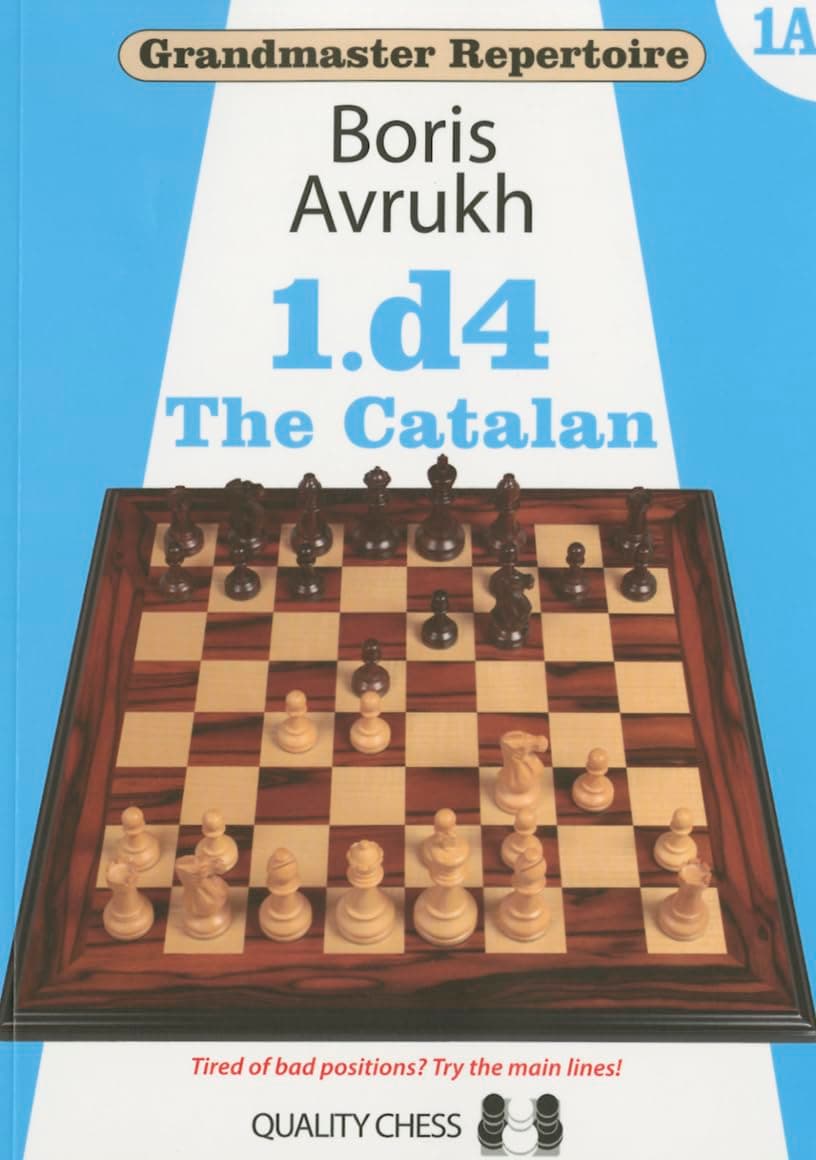

Grandmaster Repertoire 1A [Avrukh, Boris] on desertcart.com. *FREE* shipping on qualifying offers. Grandmaster Repertoire 1A Review: 1995...the last year that 1. e4 won a game in a World's Championship... - ...according to the Forward by Avrukh wherein he makes the point that at the very top levels there has been a trend from l. e4 to l. d4. Even Anand switched to d4 for his recent convincing victory over Kramnik in the World's Championship. I didn't really need any convincing since I made that switch years ago and have never regretted it. This book is volume 1 based upon a repertoire consisting of l d4 d5, 2 c4 and an early g3 and Bg2 in most lines. This volume devotes the first approximate 240 pages, and 12 chapters, to the Catalan. The next 9 chapters and 100 pages cover the Slav and the remaining 100 pages and 8 chapters cover the other 1 d4 d5 openings, i.e., the Chigorin, the Tarrasch, ...Bf5, Albin Counter Gambit, Queens Gambit Accepted, etc. Please note that in this volume only the Catalan uses the g3, Bg2 kingside fianchetto system. Avrukh promises that Volume 2 will use the kingside fianchetto almost exclusively. You can do not need buy the 2nd volume if you use some other system, such as the Trompowsky (and don't want to change), against 1d4 Nf6. However, I am so impressed with Volume 1 that I will certainly buy Volume 2. This book is one in a series by Quality Chess that emphasizes playing the main lines. It has no complete games. The first page of each chapter contains a variation tree indicating what is contained in the chapter. The end of the book also has an index of variations which obviously makes finding things easier. Each chapter contains all the variations shown on the preceding tree. It is here that one realizes what a monumental work this is. Avrukh includes so many comments, additional analysis, "busts" to previous theory and novelties that you would think that this would have been years in the making. Many of the variations are only partially from games since when Avrukh introduces a novelty, naturally what follows is his analysis rather than the moves from an actual game. This is a large, dense book but with a great deal of prose contained within the analysis and even though each variation probably averages about 15 moves and occasionally as long as 25 there is a lot of chess education that can be found in Avrukh's comments. Clearly this is a serious repertoire meant to be used against the world's best. It is certainly no "Starting Out with the...." type of book. I suppose in reality it is geared toward stronger players, though I think that just playing through the variation tree moves to get a basic feel for the repertoire and then starting to dip into the main body of the book should put anyone on the road to improving. Avrukh is well known as a leading analyst and theoretician. He is also one of the strongest players in the world. He is currently in the top 100 and has been in the top 50 and is rated about 2650. He says that this repertoire is 90% his own and he will be incorporating the other 10%. I think it is very likely that Avrukh is the strongest player ever to author a full repertoire volume. Finally, I should mention that the book itself is the typical high quality product of Quality Chess. The binding is solid, the paper is high quality with very little bleed and the print and diagrams are clear and attractive. Review: A place to start - I switched to 1. d4 not too long ago because I was fascinated by playing the White side of the Mar Del Plata King's Indian, Modern Benoni and various Queen's Gambit Accepted and Declined variations. While rounding up my White repertoire, I found some issues: I do not know how to play the White side of the Nimzo-Indian properly and was also unwilling to learn how to play against the Queen's Indian (some friends said that I should play the Fianchetto variation. I told them that the positions seem boring). In the Nimzo-Indian, I have always had trouble trying to develop properly and find ways to open up the board so that my Bishop pair will be active. I first started playing the Qc2 lines and wound up being outplayed by many of my opponents. I would give back a Bishop for a Knight in order to ensure that my structure isn't under attack but then my opponent would have a lead in space despite being down a pawn and still win. I tried the Rubinstein with that expectation that my structure isn't all quite that important, and the results were better... My sense of danger isn't the best fitted for White side of the 4. Qc2 Nimzo, and with the Rubinstein, I felt that even though my structure looks terrible it sure doesn't mean that I have a bad position. I compensate it for piece activity. I will definitely keep playing the Rubinstein as an alternative to the Catalan. I play the Black side of the Nimzo as well and tend to transpose into a Benoni or QGD depending on my mood against 3. Nf3... but I didn't have a variations for the Catalan. Played the Catalan as Black, and didn't even know the theory or ideas. I tried to play a Tartakower set up and I was smashed to bits. I was strangled so hard. That's when I bought this book knowing that I will be facing a lot of lines in the Catalan because of this book (as well as some home analysis!). At the time I also thought that the e3 Slav is lame and that not playing a4 in the QGA might be a mistake for White. After much realization that I do play the Queenside Fianchetto of the Anti-Meran, I gave the e3 Slav a whirl and now it is my full time choice against the Slav. Also, the e3 QGA goes with Avrukh's idea as White in the Catalan that allowing Black to expand pawns in the Queenside may provide Black with counterplay but can also turn Black's Queenside pawns into objects of attack if White plays courageously. I even turned that into my choice as White as well. I chose the open Catalan and the Main Line as my weapons for Black against the Catalan and it worked out very well! I scored some very nice dynamic wins against my chess mentor due to the fact I understood these positions better than he did says a lot about this book for me. The positions at all did not even occur to me as stale even though that's what other perceive it! There were pawn sacrifices that abound for both sides, lots of exchange sacrifices for the sake of space, weak squares all over the board!!! My gosh, this opening is very much violent. And playing the black side boosted my confidence to play the White side of the Catalan. Prepared some basic stuff; main lines, open Catalans, the Semi-Slav structures.... some others. Didn't prepare the Catalan very throughly, but expected what I felt like I should expect. So I beat up on a lot of players that try to keep a foothold on the center and keep me from playing e4 by keeping their pawn on d5, which I retorted with overloading their blind spot: e5. I also had some very entertaining and dangerous games in the main lines as well. I have always wanted to learn how to play chess better in general, and this opening provided a way for me to learn how to play bird's eye view positional chess with the idea that all tactical operations should ideally affect the rest of the board. It also helped with my understanding of playing the Black side of the Ruy and Scotch, open file play and Knight coordinations. Also, losing against better players with the Catalan makes postmortem analysis very interesting to study as well, because the Catalan is just so darn interesting!
| Best Sellers Rank | #1,140,548 in Books ( See Top 100 in Books ) #1,177 in Chess (Books) |
| Customer Reviews | 4.7 4.7 out of 5 stars (107) |
| Dimensions | 6.7 x 0.68 x 9.43 inches |
| ISBN-10 | 1907982884 |
| ISBN-13 | 978-1907982880 |
| Item Weight | 1.62 pounds |
| Language | English |
| Print length | 440 pages |
| Publication date | July 7, 2015 |
| Publisher | Quality Chess UK Ltd |
| Reading age | 5 years and up |
K**T
1995...the last year that 1. e4 won a game in a World's Championship...
...according to the Forward by Avrukh wherein he makes the point that at the very top levels there has been a trend from l. e4 to l. d4. Even Anand switched to d4 for his recent convincing victory over Kramnik in the World's Championship. I didn't really need any convincing since I made that switch years ago and have never regretted it. This book is volume 1 based upon a repertoire consisting of l d4 d5, 2 c4 and an early g3 and Bg2 in most lines. This volume devotes the first approximate 240 pages, and 12 chapters, to the Catalan. The next 9 chapters and 100 pages cover the Slav and the remaining 100 pages and 8 chapters cover the other 1 d4 d5 openings, i.e., the Chigorin, the Tarrasch, ...Bf5, Albin Counter Gambit, Queens Gambit Accepted, etc. Please note that in this volume only the Catalan uses the g3, Bg2 kingside fianchetto system. Avrukh promises that Volume 2 will use the kingside fianchetto almost exclusively. You can do not need buy the 2nd volume if you use some other system, such as the Trompowsky (and don't want to change), against 1d4 Nf6. However, I am so impressed with Volume 1 that I will certainly buy Volume 2. This book is one in a series by Quality Chess that emphasizes playing the main lines. It has no complete games. The first page of each chapter contains a variation tree indicating what is contained in the chapter. The end of the book also has an index of variations which obviously makes finding things easier. Each chapter contains all the variations shown on the preceding tree. It is here that one realizes what a monumental work this is. Avrukh includes so many comments, additional analysis, "busts" to previous theory and novelties that you would think that this would have been years in the making. Many of the variations are only partially from games since when Avrukh introduces a novelty, naturally what follows is his analysis rather than the moves from an actual game. This is a large, dense book but with a great deal of prose contained within the analysis and even though each variation probably averages about 15 moves and occasionally as long as 25 there is a lot of chess education that can be found in Avrukh's comments. Clearly this is a serious repertoire meant to be used against the world's best. It is certainly no "Starting Out with the...." type of book. I suppose in reality it is geared toward stronger players, though I think that just playing through the variation tree moves to get a basic feel for the repertoire and then starting to dip into the main body of the book should put anyone on the road to improving. Avrukh is well known as a leading analyst and theoretician. He is also one of the strongest players in the world. He is currently in the top 100 and has been in the top 50 and is rated about 2650. He says that this repertoire is 90% his own and he will be incorporating the other 10%. I think it is very likely that Avrukh is the strongest player ever to author a full repertoire volume. Finally, I should mention that the book itself is the typical high quality product of Quality Chess. The binding is solid, the paper is high quality with very little bleed and the print and diagrams are clear and attractive.
M**E
A place to start
I switched to 1. d4 not too long ago because I was fascinated by playing the White side of the Mar Del Plata King's Indian, Modern Benoni and various Queen's Gambit Accepted and Declined variations. While rounding up my White repertoire, I found some issues: I do not know how to play the White side of the Nimzo-Indian properly and was also unwilling to learn how to play against the Queen's Indian (some friends said that I should play the Fianchetto variation. I told them that the positions seem boring). In the Nimzo-Indian, I have always had trouble trying to develop properly and find ways to open up the board so that my Bishop pair will be active. I first started playing the Qc2 lines and wound up being outplayed by many of my opponents. I would give back a Bishop for a Knight in order to ensure that my structure isn't under attack but then my opponent would have a lead in space despite being down a pawn and still win. I tried the Rubinstein with that expectation that my structure isn't all quite that important, and the results were better... My sense of danger isn't the best fitted for White side of the 4. Qc2 Nimzo, and with the Rubinstein, I felt that even though my structure looks terrible it sure doesn't mean that I have a bad position. I compensate it for piece activity. I will definitely keep playing the Rubinstein as an alternative to the Catalan. I play the Black side of the Nimzo as well and tend to transpose into a Benoni or QGD depending on my mood against 3. Nf3... but I didn't have a variations for the Catalan. Played the Catalan as Black, and didn't even know the theory or ideas. I tried to play a Tartakower set up and I was smashed to bits. I was strangled so hard. That's when I bought this book knowing that I will be facing a lot of lines in the Catalan because of this book (as well as some home analysis!). At the time I also thought that the e3 Slav is lame and that not playing a4 in the QGA might be a mistake for White. After much realization that I do play the Queenside Fianchetto of the Anti-Meran, I gave the e3 Slav a whirl and now it is my full time choice against the Slav. Also, the e3 QGA goes with Avrukh's idea as White in the Catalan that allowing Black to expand pawns in the Queenside may provide Black with counterplay but can also turn Black's Queenside pawns into objects of attack if White plays courageously. I even turned that into my choice as White as well. I chose the open Catalan and the Main Line as my weapons for Black against the Catalan and it worked out very well! I scored some very nice dynamic wins against my chess mentor due to the fact I understood these positions better than he did says a lot about this book for me. The positions at all did not even occur to me as stale even though that's what other perceive it! There were pawn sacrifices that abound for both sides, lots of exchange sacrifices for the sake of space, weak squares all over the board!!! My gosh, this opening is very much violent. And playing the black side boosted my confidence to play the White side of the Catalan. Prepared some basic stuff; main lines, open Catalans, the Semi-Slav structures.... some others. Didn't prepare the Catalan very throughly, but expected what I felt like I should expect. So I beat up on a lot of players that try to keep a foothold on the center and keep me from playing e4 by keeping their pawn on d5, which I retorted with overloading their blind spot: e5. I also had some very entertaining and dangerous games in the main lines as well. I have always wanted to learn how to play chess better in general, and this opening provided a way for me to learn how to play bird's eye view positional chess with the idea that all tactical operations should ideally affect the rest of the board. It also helped with my understanding of playing the Black side of the Ruy and Scotch, open file play and Knight coordinations. Also, losing against better players with the Catalan makes postmortem analysis very interesting to study as well, because the Catalan is just so darn interesting!
V**A
Simply outstanding!
First of all, let me say that in the last two months I have won two tournaments, achieved a FIDE Master title and din't lose a single game, out of 16 played. And, most of that success I can contribute to the lessons I learned from this book. The most interesting thing is that I didn't reach any of the openings described in this book! My opponents usually opted for 1...Nf6, and on the rare occasions the played 1...d5, the game reached standard Slav or semi-Slav defence. I mostly worked on the Catalan sections, and didn't feel ready to play 1.d4 d5 2.c4 c6 3.Nf3 Nf6 4.e3, the system recommended in this book. But, by simply studying excellent analysis and explanations from Avrukh, I was able to bring my understanding of the game on the higher level! On many occasions, I was suprised to find that you can successfully play on win in the positions I would previously dismiss as completely level or boring. Therefeore, this is opening book, but by studying what is written here one will not only improve his opening play or learn new variations, but will also improve his chess understanding in general. But, one caveat: I really think you need to be above 2000-2100 level to benefit from this book. If the reader is below 2000, I think he will find it a little bit too difficult.
S**V
Un volume très épais du fait d'un travail important, le tout pour un prix avantageux. Avrukh ne nous livre pas de parties complètes, s'arrêtant au bord du milieu de jeu. Il est en effet plus important de comprendre en nous laissant la possibilité d'analyser par nous mêmes plutôt que de se noyer dans les détails. Bien que basé sur le jeu d'un grand maître, les schémas sont faciles à comprendre. La Catalane en particulier (plus de 150 pages) est d'un niveau d'analyse bien supérieur au livre de Nigel Davies que je trouve plus light. Enfin, la nouvelle idée dans la Tarrash redonne du peps à cette variante qui m'ennuyait auparavant. Vivement le Tome 2 !
M**É
Très bon profuit
F**2
Grandmaster Boris Avrukh's first book is, for my money, a classic. It isn't, perhaps, a work for beginners. It certainly is a work that serious club players (and maybe those above) will benefit from studying. This isn't just because of the 'fireworks' of some of the theoretical novelties, or the depth of analysis presented. 'Fireworks' after all sometimes blow up in your face and there is always more analysis - far more than any mortal will ever recall. What I really like about this book is that, after working with it for a while, you begin to build a real understanding of the kind of positions you are aiming for and the possibilities they present. Even the layout (often the cause of confusion and complaint in the average chess book)is well thought through. I don't often hand out full marks but in this case if I could give it 6 out of 5 if I could.
B**1
Der Verlag Quality Chess hat mit diesem Buch seinem Namen alle Ehre gemacht. Welcher Schachspieler hat sich bereits nicht über diese "nervigen" Nebenvarianten geärgert, in denen der Anziehende nach 1.d4 kein c4 folgen lässt? Da will man in einem Online-Blitz einen vollblutigen Königs- oder Nimzo-Inder spielen und muss sich dann mit dem Colle- oder dem Londoner System herumschlagen. Diese Systeme sind natürlich alle spielbar und haben den Vorteil, die Theorie enorm einzuschränken, doch sind sie nicht umsonst Nebenvarianten: Schwarz hat mehrere Möglichkeiten, gutes Spiel zu haben, da Weiβ im Zentrum weniger Druck ausübt als in den Hauptvarianten. Groβmeister Boris Avrukh schlägt in seinem Buch ein dreifaches(!) Schwarzrepertoire gegen jedes weiβe System vor, dass dem Nachziehenden gesunde und aktive Stellungen verspricht; das Ziel ist nicht steriler Ausgleich, sondern Gegenspiel: 1.) Ein Repertoire für den 1...d5-Spieler 2.) Eins für den Nimzo-/Damen-Indisch-Spieler (1.d4 Sf6 2.Sf3 e6) 3.) Eins für den Königs-/Grünfeld-Indisch-Spieler (1.d4 Sf6 2.Sf3 g6) wobei in den ersten beiden Fällen Übergänge möglich sind. Auβerdem werden das Trompowsky-System (1.d4 Sf6 2.Lg5), einige seltene Varianten (z.B. 1.d4 d5 2.e3 oder 1.d4 Lg5) und das berühmt-berüchtigte Blackmar-Diemer-Gambit (1.d4 d5 2.e4) behandelt. Auch wenn der Autor naturgemäß die schwarze Seite vertritt, so scheinen seine Vorschläge doch sehr objektiv und begründet zu sein; selbst mit Computerunterstützung (Fritz) habe ich bis jetzt keinen Fehler entdeckt. Als erfahrener Vereinsspieler (Elo 2200) kann ich dieses Buch nur wärmstens empfehlen.
M**Y
This is an absolutely great opening book - prime source of information. However, if you only want to learn a few practical lines it may be too detailed.
Trustpilot
4 days ago
1 week ago