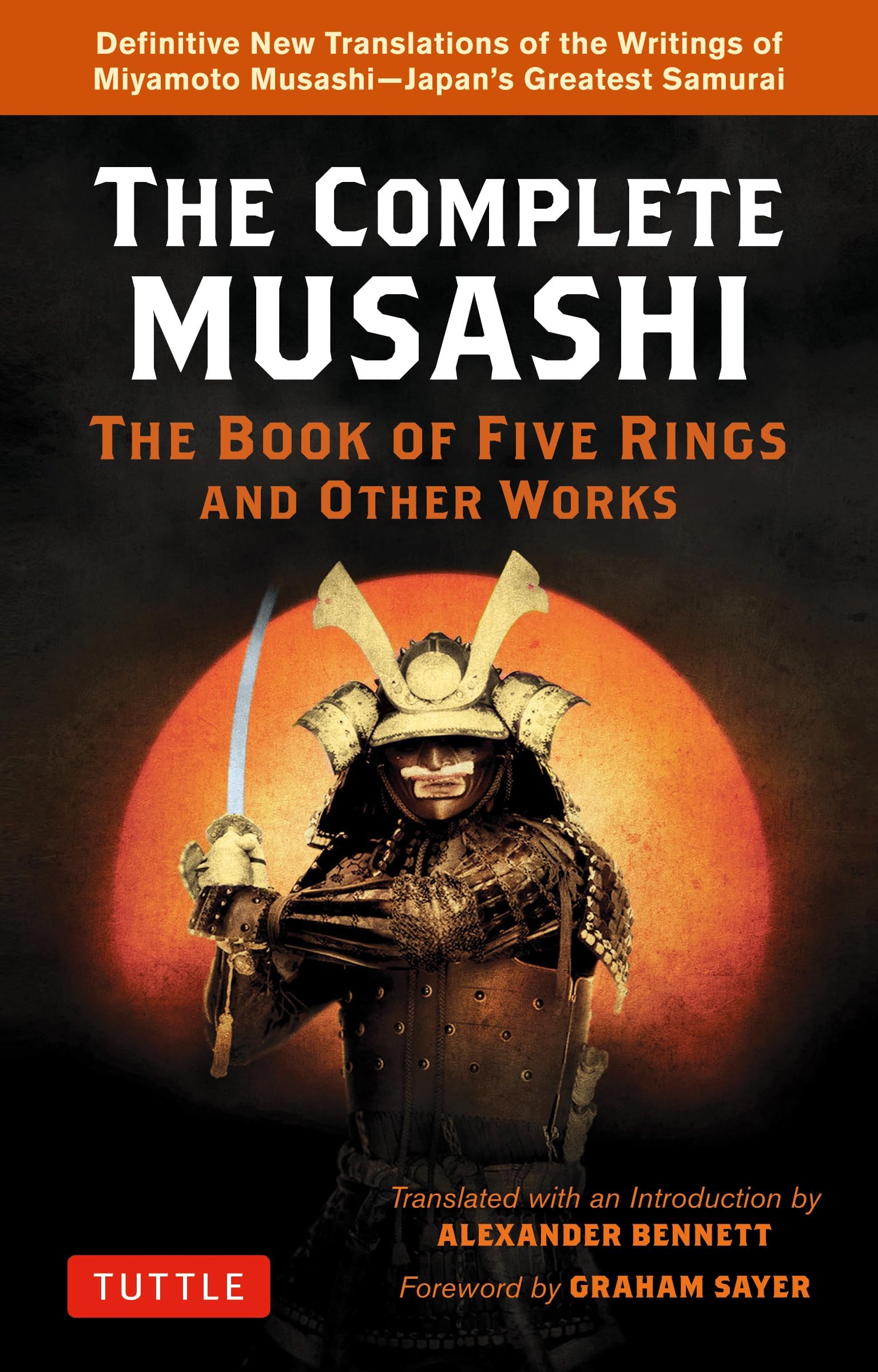
The Complete Musashi: The Book of Five Rings and Other Works: Definitive New Translations of the Writings of Miyamoto Musashi - Japan's Greatest Samurai
Product ID: 288952175
Buy anything from 5,000+ international stores. One checkout price. No surprise fees. Join 2M+ shoppers on Desertcart.
Desertcart purchases this item on your behalf and handles shipping, customs, and support to Kyrgyzstan.
The culmination of 25 years of research, Alex Bennett's groundbreaking English translation of Miyamoto Musashi's The Book of Five Rings reveals the true meaning of the original work. Plus, definitive translations of five more known works of Musashi! This piece of writing by famed samurai Musashi (1584-1645) is the single-most influential work on samurai swordsmanship, offering insights into samurai history, the Zen Buddhist state of "no-mind" that enables warriors to triumph and the philosophical meaning of Bushido—"the way of the warrior." Until now, English translations of The Book of Five Rings have been based on inaccurate copies of Musashi's long-lost original manuscript. Bennett's translation is the first to be based on a careful reconstruction of the original text by Japan's foremost Musashi scholar. By identifying discrepancies among the existing copies, adding missing texts and correcting over 150 incorrect characters, this source is the closest representation of Musashi's original work possible. Utilizing this new source, Bennett captures the subtle nuance of the classic Japanese text, resulting in the most accurate English translation of The Book of Five Rings available Enjoy complete, richly annotated translations of Musashi's most-known works: The Book of Five Rings Mirror on the Way of Combat Notes on Combat Strategy Combat Strategy in 35 Articles The Five-Direction Sword Pathways The Path Walked Alone The texts are richly annotated by Bennett, who includes an extensive introduction on Musashi's life and legacy. This paperback edition also includes a new introduction by Kendo Kyoshi 7th Dan Graham Sayer, who talks about the influence Musashi's writings have had on him as a person and martial artist. The Complete Musashi: The Book of Five Rings and Other Works will be widely read by those interested in Japanese culture, Samurai history and martial arts—setting a new standard against which all other translations will be measured. Review: Best book of five rings Translation from a swordsman. - Anyone seriously studying Japanese Swordsmanship should purchase THIS version of Go-Rin-No-Sho. Bennett sensei immediately dispels many of the myths of Miyamoto Musashi propagated through Pop-culture, and the Yoshikawa Eiji novel. This is a fact based historical account of his life and teachings as a martial artist and is the best translation of "The Book of Five Rings," it clearly explains in full historical context, every obscure reference and history behind the book. Furthermore this is the most accurate translation I have read to date, even going so far to explain the different readings of each word, and what Musashi was implying with each statement. Furthermore, this book not only included Go-Rin-No-Sho, but also Musashi's other lesser known works. Heiodokyo, Heiho Kakitsuke, Heiho Sanjugo-Kajo, Goho no Tachi no Michi, Dokkodo, Kokura-hibun. Bennett sensei himself is a master swordsman who not only is a 7dan in kendo, but also the international Naginata-do representative, and co-founder of Kendo-World. Furthermore he holds 2 PHD's and teaches the History of Budo at Kansai University. His credentials in the Japanese swordsmanship community are amazing. This unique perspective clarifies many of the esoteric aspects that most other translations of these works are missing. Review: Very informative - I had also purchased "The Book of Five Rings" written by Musashi (which is also included in this book) but this book has his other writings, and helps put into context "The Book of Five Rings" with footnote explanations and historical context. This book also explains the different manuscripts that have been attributed to Musashi and their reliability. It's a relatively easy and interesting read about a true historical badass and greatest swordsman of Japan.


| Best Sellers Rank | #19,200 in Books ( See Top 100 in Books ) #7 in Japanese History (Books) #19 in Military Strategy History (Books) #34 in Martial Arts (Books) |
| Customer Reviews | 4.8 out of 5 stars 1,189 Reviews |
A**R
Best book of five rings Translation from a swordsman.
Anyone seriously studying Japanese Swordsmanship should purchase THIS version of Go-Rin-No-Sho. Bennett sensei immediately dispels many of the myths of Miyamoto Musashi propagated through Pop-culture, and the Yoshikawa Eiji novel. This is a fact based historical account of his life and teachings as a martial artist and is the best translation of "The Book of Five Rings," it clearly explains in full historical context, every obscure reference and history behind the book. Furthermore this is the most accurate translation I have read to date, even going so far to explain the different readings of each word, and what Musashi was implying with each statement. Furthermore, this book not only included Go-Rin-No-Sho, but also Musashi's other lesser known works. Heiodokyo, Heiho Kakitsuke, Heiho Sanjugo-Kajo, Goho no Tachi no Michi, Dokkodo, Kokura-hibun. Bennett sensei himself is a master swordsman who not only is a 7dan in kendo, but also the international Naginata-do representative, and co-founder of Kendo-World. Furthermore he holds 2 PHD's and teaches the History of Budo at Kansai University. His credentials in the Japanese swordsmanship community are amazing. This unique perspective clarifies many of the esoteric aspects that most other translations of these works are missing.
M**L
Very informative
I had also purchased "The Book of Five Rings" written by Musashi (which is also included in this book) but this book has his other writings, and helps put into context "The Book of Five Rings" with footnote explanations and historical context. This book also explains the different manuscripts that have been attributed to Musashi and their reliability. It's a relatively easy and interesting read about a true historical badass and greatest swordsman of Japan.
A**R
Dope Sells Itself
Absolutely Amazing. A Must Have
M**N
Great translation with many extras.
I have a few versions of the book of five rings. This along with Thomas Cleary's version are my two favorites. I've read through and highlighted many parts of this book over and over again. There's always something new to find and with this version you can delve deeper into the mind of the greatest swordsman to ever live. I'm an avid reader and couldn't live without this book.
B**L
Good book
Interesting book about an interesting guy
A**R
Off the charts !
By far the best book on the subject of Musashi's five rings and his other texts. Reading it, I felt like a kid in a candy-store and had that feeling that I didn't want the book to end. It is incredibly well researched material, and very well written, and it really stands out as the only option among the many that are out there. Unfortunately the cover looks too much like it's a manga-book, when this book actually deserves something far classier, as I expect it will be overlooked on bookshelves and in advertisement by some potential buyers. But that is the only criticism I can offer on it. Buy it, you won't be disappointed !
W**N
Well Done!!!
Walks you through the history surrounding one of the most laudable swordsmen from Japan. Recommended for those who are serious about learning the history behind the philosophy, art and martial art.
A**R
Best translation by far.
As a kendo practitioner I've score translations of the go Rin no sho for clues that can improve my own concept of swordsmanship. Alex Bennett's new translation is the best by far. This is the case for several reasons: * It is the first translation based on a reconstruction of the original text (the original was destroyed and all we have are copies with their attendant scribal errors) * It is the first translation undertaken by someone not only fluent in Japanese but in swordsmanship. As such it captures elements that are hard to understand in other translations by people deficient in one of these areas * The translations are clear and approachable * The book contains several previously untranslated works by Musashi from earlier in his life allowing the reader to see how Musashi's own ideas on swordsmanship and combat strategy evolved throughout his life.
A**I
Outstanding
A truly masterful translation of Musashi's works. Nothing comes close to Bennett's work. Highly recommended.
C**N
Musashi
Wonderful book of the greatest samurai
O**Z
Inspirador
Un escrito de gran trascendencia heredado por Miyamoto musashi. Al leerlo sin agregar o quitar ideas basadas en las experiencias propias, se puede percibir la simpleza de las enseñanzas de musashi, las cuales pueden servir para superar barreras en cualquier ámbito.
E**F
excellent !
translated and anoted by a great martial artist.
S**.
Review of Complete Musashi: The Book of Five Rings and Other Works: Japan's Greatest Samurai
Overview Complete Musashi: The Book of Five Rings and Other Works, translated by Alexander Bennett, is a comprehensive collection of the writings of Miyamoto Musashi (1584–1645), Japan’s most legendary samurai. This edition includes The Book of Five Rings (Go Rin No Sho), Musashi’s seminal work on swordsmanship and strategy, alongside five lesser-known texts: Heidokyo, Heiho Kakitsuke, Heiho Sanjugo-Kajo, Goho no Tachi no Michi, and Dokkodo. Published in 2018, this volume is celebrated for its meticulous translation, based on a reconstructed original manuscript, and its rich annotations, making it a definitive resource for martial artists, historians, and those interested in Japanese philosophy and culture. Below is an insightful review of its content, translation quality, and broader appeal. Key Features Comprehensive Collection: Includes The Book of Five Rings and five other works, three of which (Heidokyo, Heiho Kakitsuke, and Goho no Tachi no Michi) are translated into English for the first time. Accurate Translation: Bennett’s translation corrects over 150 errors found in earlier copies, using a reconstructed original text for authenticity. Rich Annotations: Extensive footnotes and an introduction by Bennett, a renowned martial artist and historian, provide historical and cultural context. Foreword: A new introduction by Graham Sayer, Kendo Kyoshi 7th Dan, reflects on Musashi’s influence on modern martial arts. Visuals: Features black-and-white illustrations, including Musashi’s artwork, historical diagrams, and photos of monuments, enhancing the reader’s experience. Content and Insights The Book of Five Rings, Musashi’s magnum opus, is divided into five scrolls—Earth, Water, Fire, Wind, and Void—offering practical and philosophical guidance on swordsmanship, strategy, and the “Way” of the warrior. Written in 1645, it distills Musashi’s Niten Ichi-ryū (Two Heavens as One) dual-sword technique and his Zen-inspired approach to combat, emphasizing adaptability, mental clarity, and timing. Beyond martial arts, its principles resonate with business leaders and strategists, akin to Sun Tzu’s The Art of War. The additional texts, particularly Dokkodo (The Path of Aloneness), with its 21 precepts for disciplined living, reveal Musashi’s evolution from a brash duelist to a reflective hermit, offering timeless wisdom on self-mastery. Bennett’s inclusion of lesser-known works provides a holistic view of Musashi’s philosophy. For example, Heiho Sanjugo-Kajo (Thirty-Five Instructions on Strategy) lays the groundwork for The Book of Five Rings, while Dokkodo offers succinct life advice, such as “Do not seek pleasure for its own sake.” These texts, though concise, are dense with insight, urging readers to “study this well” or “examine this carefully,” reflecting Musashi’s emphasis on relentless self-improvement. Translation and Scholarship Alexander Bennett, a 7th Dan Kendo Kyoshi, Iaido 5th Dan, and Naginata 5th Dan, brings unparalleled expertise to this translation. His two PhDs and role as a professor of Budo at Kansai University, combined with his co-founding of Kendo World, ensure a deep understanding of both the Japanese language and martial arts culture. Unlike earlier translations (e.g., Thomas Cleary’s 2005 version or Stephen Kaufman’s 1994 edition), which relied on flawed copies, Bennett’s work is based on a careful reconstruction of Musashi’s original manuscript, correcting over 150 errors. His annotations clarify obscure references, such as historical figures or kanji nuances, making the text accessible to modern readers while preserving its authenticity. For instance, he explains Musashi’s use of “void” as a Zen concept of emptiness, not nothingness, enriching the philosophical depth. However, the translation’s technical focus on swordsmanship can feel dense for casual readers. Detailed passages on dual-sword techniques or combat footwork may overwhelm those seeking broader philosophical insights, as some reviewers note a desire for more mental rather than physical strategy. The inclusion of extensive footnotes mitigates this, but the prose remains direct and unembellished, true to Musashi’s utilitarian style. Usability and Appeal This edition is a treasure for martial artists, particularly kendo practitioners, as it offers practical insights into Musashi’s Niten Ichi-ryū and combat psychology. The historical context, detailed in Bennett’s 50-page introduction, dispels myths perpetuated by pop culture and Eiji Yoshikawa’s fictionalized novel Musashi (1935), such as exaggerated accounts of Musashi’s duels. For example, Bennett clarifies the historical ambiguity around Musashi’s famous duel with Sasaki Kojiro, providing a grounded perspective. The book’s appeal extends beyond martial arts to readers interested in Japanese history, Zen Buddhism, or personal development, as Musashi’s principles of resilience, focus, and discipline are universally applicable. The additional works, especially Dokkodo, resonate with modern audiences seeking minimalist, disciplined lifestyles. However, the book’s academic tone and focus on martial detail may deter readers unfamiliar with Japanese culture or those expecting a narrative-driven experience like Yoshikawa’s novel. The black-and-white illustrations, including Musashi’s own art (e.g., his famous cormorant painting), add cultural richness but are sparse compared to expectations for a visually vibrant edition. Value for Money Priced around £10–£15 (paperback/Kindle), Complete Musashi offers excellent value for its comprehensive content, scholarly rigor, and unique inclusion of newly translated works. Compared to standalone editions of The Book of Five Rings (e.g., Cleary’s at £8–£12), Bennett’s volume provides more context and additional texts, making it a better investment for serious readers. The durable paperback and clear layout, with color illustrations in some editions, enhance its appeal as a collector’s item for martial arts enthusiasts. Pros Most accurate English translation, based on a reconstructed original manuscript. Comprehensive collection, including three previously untranslated works. Rich annotations and introduction clarify historical and cultural context. Relevant for martial artists, historians, and those interested in Zen philosophy. Visually enhanced with Musashi’s art and historical images. Cons Dense, technical focus on swordsmanship may alienate casual readers. Academic tone lacks the narrative flair of fictionalized accounts like Yoshikawa’s Musashi. Limited color illustrations may disappoint readers expecting a more visual experience. Comparison to Alternatives Compared to Thomas Cleary’s 2005 The Book of Five Rings (£8–£12), Bennett’s translation is more accurate and contextual, though Cleary’s is more poetic and accessible to non-martial artists. William Scott Wilson’s The Lone Samurai (£15–£20) offers a biographical approach but lacks Musashi’s primary texts. For graphic novel fans, Musashi’s Book of Five Rings: The Manga Edition (£10–£15) is visually engaging but less scholarly. Bennett’s edition stands out for its completeness and authenticity, setting a new standard for Musashi translations. Verdict Complete Musashi is a masterful compilation that brings Miyamoto Musashi’s writings to life with unmatched accuracy and depth. Alexander Bennett’s expertise as a martial artist and scholar shines through, offering readers a direct line to the mind of Japan’s greatest samurai. While its technical focus may challenge casual readers, its rich annotations, historical context, and inclusion of rare texts make it essential for martial artists, historians, and philosophy enthusiasts. Whether you’re a kendo practitioner seeking to refine your technique or a reader exploring the Zen-inspired “Way,” this book is a profound journey into Musashi’s legacy of discipline and mastery. Rating: 4.5/5 Recommended for: Martial artists, Japanese culture enthusiasts, and those seeking practical wisdom on strategy and self-discipline.
Trustpilot
2 months ago
1 week ago