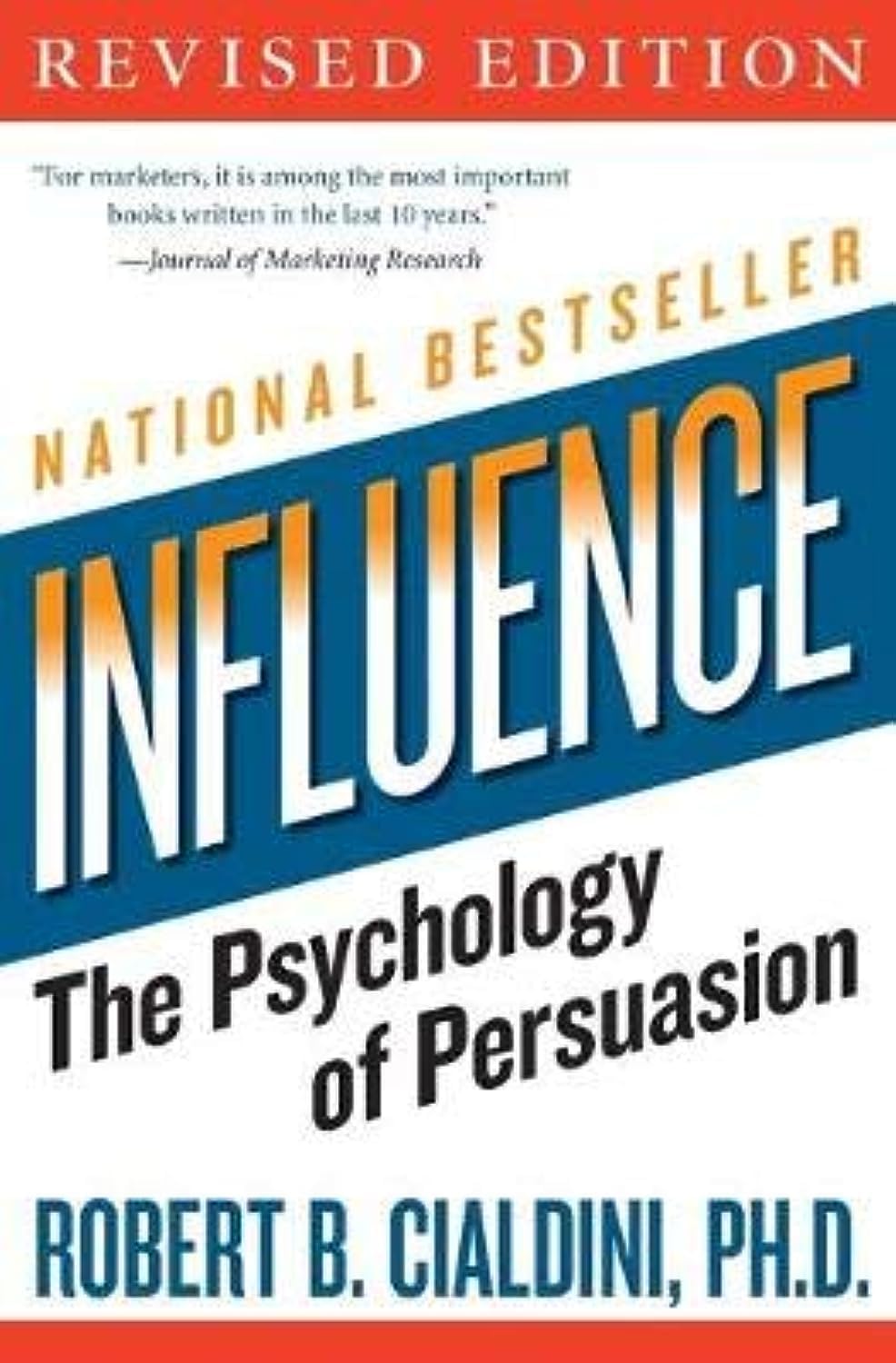
Influence: The Psychology of Persuasion, Revised Edition
Product ID: 286397
⚡6 proven influence weapons
🏆Top #15 in Marketing
📚Classic psychology insights
📈 Influence smarter, lead stronger — don’t get left behind!
Influence: The Psychology of Persuasion, Revised Edition by Robert B. Cialdini is a seminal book that distills six scientifically validated principles of persuasion—Reciprocation, Commitment/Consistency, Social Proof, Liking, Authority, and Scarcity. Highly rated and a top seller in marketing, this revised edition offers actionable insights for professionals in leadership, fundraising, and beyond, empowering readers to ethically harness and defend against influence in everyday interactions.
| Best Sellers Rank | #10,124 in Books ( See Top 100 in Books ) #12 in Marketing & Consumer Behavior #287 in Motivational Self-Help (Books) #322 in Success Self-Help |
| Customer Reviews | 4.5 out of 5 stars 13,077 Reviews |
C**R
Robert Cialdini's "Influence" - A Must-Read for Non-Profit Fundraising & Anyone in Leadership
Video Review:: Using The "Weapons of Influence" - for Good by Christian LeFer - I had heard about Robert Cialdini's definitive work, a book called "Influence - The Psychology of Persuasion" referenced repeatedly by my favorite marketing gurus, including Eben Pagan, but had not picked it up until recently; I regret not having read the book sooner. During my career as a copywriter and non-profit fundraising professional for political candidates and causes, I had learned by reverse-engineering and applying the tactics of getting people to "wake up" from what Eben Pagan calls an often "sleepy, boring existence" of much of everyday modern life - and to take some kind of action - by voting, giving, or volunteering. I had learned the practice, but not the theories, of influence. This is like playing guitar by ear without learning to read music: a limiting, (and frankly, lazy), way of musicianship. Why "Influence" is a must-read for Non-Profit Fundraising and all in Leadership Honing a craft often requires going back and re-examining the fundamentals; getting "back to school" as it were. As a consultant to charitable organizations and businesses who helps organizations in obtaining IRS tax-exempt status, non-profit fundraising, and implementing effective marketing systems, I have been carefully going back and re-visiting (or in this case, just visiting for the first time!) the classics on relationships, sales, marketing and human motivation. "Influence" by Robert Cialdini is among my most valuable reads so far - read on to see why I call it a "must read" for non-profit fundraising and business leadership - and even parenting! In the revised version of "influence" Robert Cialdini weaves a compelling and utterly readable fabric of what he boils down to "compliance" using analogy, anecdote and applied research. We learn why coercion doesn't work as well as commitment, how people form and ultimately force themselves to live up to a certain self-image - a self-image often directed or influenced by an outside person or interest who then uses that image to induce behaviors - and we also discover many other truths that many of us would rather not confront or believe about ourselves. The Moral Imperative of using Your "Influence" What I like about the book, and Cialdini's treatment of the sometimes disconcerting subject matter, is that he acknowledges that these "Weapons of Influence" are morality-neutral - they can be used for good or for evil. These six weapons, then, ultimately serve those who would use them. Being one who believes that I am fighting for good in this world (which I will admit, is often also the belief of madmen and used car salesmen), shouldn't I then learn about and wield these weapons as deftly as is possible? Certainly. And I hold scorn and pity for the one who sticks his head in the sand and refuses to learn these arts for the betterment of their fellow man. My biggest takeaway from this book is that, while we have all used the various weapons at times in our lives, I have a much better understanding of how they connect and reinforce each other. Cialdini uses the story of the Krishnas' "flower gift fundraising" model to demonstrate how the weapon Reciprocity works with that of Commitment/Consistency. When an expert says we're running out of some essential commodity, Authority is often powerfully coupled with Scarcity. Web platforms such as Facebook create an overwhelming elixer out of the remaining two two weapons, Social Proof and Liking. Whether you are involved with non-profit fundraising or simply as a traditional and foster parent, understanding these six human motivating values is invaluable, even indispensible. Conclusion: Influence by Robert Cialdini = Antidote for "Sheeple" Syndrome The final truth is that everyone from Mother Teresa to your dear old grandpa has an agenda, and has the need to get someone to do something, at some point. It may be in child rearing, in asking for help in a time of need, or in saving someone's life. The sooner any person understands the push and pull of using influence and it being used on them, the sooner they will lead a more rational, self-directed, and might I say more enlightened existence. Then, when the pitchman, the preacher, or the panhandler makes that momentous appeal in a way that will impact your wallet - or maybe even your very soul - you can go off into eternity having made the a more rational decision, and more likely for the right reasons. Perhaps no greater contribution has been made to awareness and enlightenment as it pertains to influence than Dr. Cialdini; I predict that my copy will become dog-eared, the pages yellowed as I pick it up again and again over the years, marveling over how my understanding of Influence has benefited me in non-profit fundraising, in business, in parenting, and in life. Christian is author of "7 Deadly Mistakes of Filing Your Non-Profit IRS Application - How to Avoid the Errors that Will Kill or Delay Your 501c3 Approval" and a consultant to business and non-profit leaders.
W**R
“You’re (definitely not) getting sleepy” with Caldini’s “Influence”!
Professor Robert B. Caldini, the author of this intriguing fact-dense book, divides it into a mere seven chapters, the first of which, “Weapons of Influence,” seems to just extend the so-titled “Introduction” by briefly describing those weapons, which are thereafter given full descriptions in the succeeding six chapters. These chapters include Reciprocation, Commitment and Consistency, Social Proof, Liking, Authority, and Scarcity. Why just six weapons? Well, Caldini starts with a quote from Albert Einstein: “Everything should be made as simple as possible, but not simpler.” Caldini goes on to explain that, just as lower animals have certain automatic stimulus/response mechanisms embedded in them, so, too, do humans. It’s how we have progressed as a species to where we are now. Like jujitsu masters, successful influencers take advantage of these mechanisms, leveraging them for their gain. And, if the readers of this book don’t use these mechanisms on others, they should at least be aware of how others can and very often do use the mechanisms on them. At opportune times throughout the book, Caldini uses the phrase “click, whir” to generally describe how we, like it or not (and many times not), automatically react to a stimulus. And the examples are fascinating! Perhaps the best, most vivid one I recall is towards the end of the book where he describes a waiter using multiple “tricks” of influence (covered in earlier chapters) to be the acknowledged revenue “rainmaker” of the restaurant. As it happens, I especially enjoyed reading the author’s reference to psychologist Jack Brehm’s work on psychological reactance. I had the pleasure of taking a graduate-level class with Professor Brehm at the University of Kansas. In this section, Caldini discusses the always interesting topic of the "terrible twos" as well as its teen-age version, the "Romeo and Juliet effect." IMHO, criticism is unfounded for this 2006 book’s Kitty Genovese murder section not mentioning the discovery in a 2007 “American Psychologist” article that “no evidence for the presence of 38 witnesses, or that witnesses observed the murder, or that witnesses remained inactive.” Indeed, in 2017 the “New York Times” called its own reporting “flawed,” saying the original article “grossly exaggerated the number of witnesses and what they had perceived.” Hard to blame Caldini for not anticipating this a year ahead of time in 2006. Hopefully, everything will be brought up to date in his next edition of the book, currently expected on 4 May 2021. Having gone through this well-written and well-researched book and seeing the many examples the author uses of each of the influence weapons, it seems to me as if one only needs to look at their names to “click, whir” bring to one’s mind many of the author’s detailed points. Indeed, one of his best points is that one can defend oneself from exploitation by first recognizing the uncomfortable feeling when these weapons are used against oneself. At any rate, just six weapons work nicely into the concept of the “Magic Number Seven,” the maximum number the average person can hold in short-term memory To make Caldini’s six weapons concepts easier to remember long-term, I’ve arranged them into an acronym: LARCCSS (Liking, Authority, Reciprocation, Commitment/Consistency, Scarcity, and Social proof). So remember to “Like or Leverage LARCCSS!” Yeah, you can have a LARK (or not) with this one! So, bottom-line, with all the wonderful concepts included in this book, let me unabashedly try to “influence” you: I highly recommend you buy it! Of possible interest: Strategy Pure and Simple: Essential Moves for Winning in Competition and Cooperation and George Washington's Liberty Key: Mount Vernon's Bastille Key – the Mystery and Magic of Its Body, Mind, and Soul , a best-seller at Mount Vernon. “Character is Key for Liberty!”
V**J
Great book but has some detestable remarks
"Click and the appropriate tape is activated; whirr and out rolls the standard sequence of behaviors." "Influence, The Psychology of Persuasion" by Robert Cialdini is a book about psychology and how people react to the weapons of influence. The book has been published numerous times and the first edition dated back to 1984. The good point is that, despite dramatic changes in lifestyle and technology, human psychology does not change much. We are still the social animals and the weapons of influence is as effective to us as ever, if not even more. The book is arguably one of the best selling psychology books ever (although we can classify it as a business or self-improvement book). Contents (Actually, to explore the contents, you can easily google "Influence, Cialdini" and there will be a lot to read. So, I'll keep it very brief.) Intro: Weapons of Influence 1. Reciprocation: The Old Give and Take ... and Take The rule of reciprocation is that when you give someone something, it is almost obligatory that the person who took it has to return the favour. This rule is very effective that you feel you need to give back even though you are not satisfied with the whole situation. 2. Commitment and Consistency: Hobgoblins of the Mind This is the shortcut of human beings. We tend to do what we set our mind to without thinking much. It reduces time spent but sometimes consistency without careful consideration can be disastrous. 3. Social Proof: Truth Are Us When you are thinking and doing one thing, it might be true or false. When too many people are thinking and doing that thing, our human mind tend to believe that it is true just because so many people do and believe in it. It might sound insignificant and Cialdini told us stories that the rule of "Social Proof" can lead to tragic deaths. 4. Liking: The Friendly Thief It is not as simple as that you will do something if you like it. The author wrote different perspectives of liking such as that salesperson often pretend to be similar to us in one way or another to trigger the sense of association and similarity that can deceive our judgment or sexy ladies in the ad can stimulate the "liking" and alters your perception towards the product. 5. Authority: Directed Deference We are born to obey authority from parents, teachers, etc. When we are adult, this same trait is still with us and we tend to obey and rely on people who we believe have higher authority. Authority comes in different forms such as titles, or even clothes. 6. Scarcity: The Rule of the Few People always perceive that less is more valuable. Not having something is more tolerable than losing something. We always fear losing things or desire rarer things that sometimes it clouds our judgment. ... I would like to compare this book to an ideal business book; the book that is easy to understand, distinct, practical, credible, insightful, and provides great reading experience. Ease of Understanding: 8/10: The book is structured nicely into 6 weapons of influence and each of them are explained sufficiently with many interesting researches. Those researches are not filled with complex statistics but common senses in everyday situations like a choice of cookie, car salesperson, poster ads, etc. Distinction: 9/10: It is a matter of then and now. At the time the book was first published I doubt that there were many book that explored into our mind on how we make decisions. The findings are eye-opening in how they explain the reasons why we do what we do. Currently, there are many similar books on this topic but it is likely that "Influence" has influenced most, if not all, of them. Practicality: 7/10: This book offers solid guidelines on how these methods work and how to avoid them. However, implementation is a different story because in many situations, there will not be enough time for you to implement it perfectly unless you are a natural born influencer. Nevertheless, this book is very useful if you have time to think and make decision. Credibility: 7/10: Each method is supported by many researches; they are very credible. Moreover, those methods are pretty much common senses and self-explanatory but most of the time, we are not even aware of them because they are built-in our behaviours and they are often triggered subconsciously and involuntarily. The points are taken because some researches might still be just coincidence because despite having many researches, some are not deep enough. Insightful: 9/10: This book is a great compilation of psychological researches about persuasion. There are more than 200 references in the bibliography section in a 280 pages book. Some of them might be shallow but that number of researches is intriguing and you will learn a lot from the book. Reading Experience: 2/10: I have been objective throughout my review, I need a place to be subjective and sentimental. You can ignore this completely but I do not like this book at all. Some remarks of the author has "influenced" me totally negatively. I will give you some examples. Regarding the mass suicide in a jungle settlement in Guyana, South America led by the Reverend Jim Jones under the name of The People's Temple. Approximately 910 died in the incident; people took strawberry flavored poison. The author suggested that due to the rule of "Social Proof", when people are uncertain of the situation, they follow others and all of them died in orderliness. "When viewed in this light, the terrible orderliness, the lack of panic, the sense of calm with which these people moved to the vat of poison and to their deaths, seems more comprehensible." On the other hand, when the author explained people who are sport fans who refer to the team they support "we" when the team win. For example, when the Philadelphia Phillies won the World Series, 11 million people - in a city of 1.5 million - crowded the streets to shout "We're Number 1" as their heroes passed in a victory parade. And when the team lost, the sport fans rather refer to the team as "they". Cialdini wrote "Unless I miss my guess, they are not merely great sports aficionados; they are individuals with a hidden personality flaw - a poor self-concept. Deep inside is a sense of low personal worth that directs them to seek prestige not from the generation or promotion of their own attainments, but from the generation or promotion of their associations with others of attainment." It continues "No matter which form it takes, the behavior of such individuals shares similar theme - the rather tragic view of accomplishment as deriving from outside the self." In the later chapter, there is an analogy of a shopper and fish; I find it very insulting to many people. It's about shopping. He explained that commercial fishermen use loose bait to attract a large schools of certain fish. When water is full of fish snapping mouths competing for the food. Fishermen drop unbaited lines and catch fish because it crazed food and will bite at anything, including bare metal hooks. He stated that a "Bargain Sale" sign is a loose bait and you, shoppers, are craving fish. "If the bait, of either form, has done its job, a large and eager crowd forms to snap it up. Soon, in the rush to score, the group becomes agitated, nearly blinded, by the adversarial nature of the situation. Human and fish alike lose perspective on what they want and begin striking at whatever is contested." Hence, while I felt terribly sorry for those in the mass suicide, we can imply that Cialdini sees them as psychologically normal but under a bad circumstance. While passionate sport fans (a majority of men) have poor self-concept and a rather tragic view of accomplishment. And girls fighting for clothes on sale (most female, obviously) are nearly blind food craving fish. Next time when you are going to support your sport team, take a look at a mirror and tell yourself how great you are instead. And ladies, alway buy full price. Overall: 7.0/10: Despite the fact that I detest some remarks and the general know-it-all egotistical attitude of the author, this is an excellent book. It will teach you how to beware of the influence from everywhere in every social setting. The six methods are very clear and the number of researches are remarkable if you decide to use them or to prevent them from influencing you. Unfortunately, the author has totally influenced my negatively but when thinking of it sensibly, I still recommend everyone to read the book.
C**R
Absolutely Astonishing
Language is my passion. I love it more than that early morning sunrise, that crisp smell of the first fall day, or the still picture of the outside world out my window on a dead end street after the first snow. I write books, I tell stories, I sell things to people, I make people feel better, I guide them through their problems, I solicit favors, and I make people see the world the way I see it. I'm part of Toastmasters International, I write cover articles online websites, I go through and edit people's papers for them in college for extra money here and there. I know that no matter what happens to this country, whether it collapses or it continues to grow, I will always be okay, because I have the ability to talk to people, sell to people, and persuade people of almost anything. I started reading this book about a year ago and read it in a day. I usually take my time reading books, but this one was so interesting and informative that I couldn't stop reading it. It is a bit dry, I feel its more analytical and scientific than it is mechanical--for a book on the mechanics of persuasion, I would suggest Maximum Influence by Kurt W. Mortensen or Persuasion: The Art of Getting What You Want from David Lakhani, these two books are much more mechanical--in fact, I consider Maximum Influence to be a sort of companion (though it is not really meant to be that way) to Influence. Robert Cialdini lays out his ideas and research into the psychology of persuasion, with adroit research, that comes off as absolutely brilliant. He begins the book with Weapons of Influence, where he skillfully sets the stage for everything that is to come, and details many basic techniques that we've probably all had done to us by one salesperson or another. Every find yourself buying a computer and, as you're standing at the counter and its been rang up, they bring up a warranty, after you decide on the warranty for a couple hundred, then they bring up tech support, then antivirus software, and by the time your done, your six hundred dollar computer purchase has ballooned to a hefty 1,000 or 1,200 dollar purchase, and your scratching your head, trying to justify the cost with everything you're getting. We've all probably been there once or twice, with one thing or another. He explains this process, why it works, a long with a dozen of others. Chapter 2 is reciprocation. A friend of mine went to a three day conference, for which, for lunch that day, they took everyone to a pizza place, and treated for the pizza. Now, you were allowed to drop the course and get a 75% refund, if you didn't like the program on the first day. When he talked to people at the end of the three days, none of them feeling really content with the whole program, they all said they had they had thought about dropping out, but it didn't feel right with them taking them out for pizza the first day. This is the act of reciprocation at its finest. The conference cost 1,500 a person, there were ten people, and they got food for the three days, which probably cost them a little more than 300 dollars, and no one wanted to speak up about feeling as if they weren't getting what they wanted. Reciprocation can be done on smaller scale, and is done everyday, with a small trinket, a bonus gift, or something else. Chapter 3: Commitment and Consistency: This chapter powerfully lays out how people will act under the feel of obligation, how, if someone is guided in their beliefs, their need to be consistent will push them to act against even their own wants. A good example of this, though maybe not a pleasant one, would be a guy who talks to a woman, asks her if she thinks of herself as adventurous and entertaining and looking for new experiences, and then asks her to go some place with him, and when she firsts refuses, challenge her with her own words. Chapter 4: Social Proof- People find it hard to act against the current. The stories he talks about in here so some of the darksides of social proof, but, that it can be used to instantly make you appear different to others is also invaluable. It also shows a clear psychology to why people act against their best interest sometimes. I feel this review may have gotten away from me. There is just so much in this book. The next three chapters, Liking, authority, and scarcity, you'll just have to read to get the depth of this book and its potential. By now though, you probably can see how this book lays out so clearly the ways these techniques can be used and by knowing them, you can spot them when they're being used on you, and you can use them to get what you want. Other books I'd recommend are The Sceince of Influence by Kevin Hogan, Maximum Influence by Kurt W. Mortensens, Persuasion The Art Of Getting What You Want by Dave Lakhani, and The Art of Speed Reading People by Paul D. Tieger and Barbara Barron Tieger.
E**S
Manipulation of "Click-Whir" Automatic Subconcious Responses
Excellent book, essentially a thesis on the subconcious underpinnings that causes different persuasive techniques to work. The concept is that the world we live in is so full of information that it is impossible to make all or even most decisions based upon our concious decision making process. Instead, throughout the course of our life our subconcious has developed methods that help us quickly process data. We do this all the time and don't even think about it, because it is part of our auto pilot (click-whir as Caldini calls it). You did this today when you instinctively avoided eye contact with a person you perceived as a begger. Stimulus results in response - automatically. Most of these unconcious decisions are in our best interest. However, Caldini points out ways in which our subconcious filter can be manipulated and all of his examples are exemplified by real life event examples and controlled experiment examples. Some of these are frightening and even disturbing (not just the tests but the real life stuff too-things like forseeable waves of suicides and avoidable fatal airplane crashes, amazing stuff). Personally I am a small business owner and prior to reading this book I had already been applying some of these tactics in my business but I never knew why. I only new that when I do x I make a sale, or I advertise this way because the experts say so and it does seem to work. After reading Influence (2 1/2 times so far) and referring to it regularly I now understand why those tactics that I used everyday worked. It is a tremendous guide for me as I read a plethora of "normal" marketing books (by normal I mean without the psychological slant)and am able to understand the psychology behind any marketing strategies or tactics they suggest. I will close with an example of ONE of the principles in the book "social proof." Prior to reading the book I already had my walls covered with pictures of my clients taken in my office, I have a tax preparation office with a niche of serving the Latino community. We always made sure they were smiling, many times I would be interacting with their little kid in some way when the picture was taken, other times the client would be shaking my hand as we both smile at the camera but in all cases they were sitting at my desk smiling. I also had pictures of clients posted in the lobby with a brief testimonial about the big refund we had got them and what they are going to do with the money. I had learned to do this because others businesses have had success with this. When I read this book Caldini opened my eyes to what I was doing to the subconcious of my clients. All of us tend to believe and trust people similar to ourselves. So as my clients sit at my desk the thought of distrust never even enters their mind. They are too surrounded by people just like them who were obviously happy with my services (smiling). By the way I do not consider what I do manipulating. In Caldini's book you will read some disturbing accounts of manipulation by immoral people. Obviously I set the stage for my pictures and testimonials etc but this is merely good marketing. Every picture on my wall is an actual client and they truly are happy with the service. We just help them smile. I will end now, I promise, with this last example. I just watched Barak Obama's nationwide 30 minute infomercial. This example is about marketing so wherever you land politically set politics aside for a moment(I voted for the other guy but that's beside the point). The 30 minutes was a collage of all sorts of different interviews, speeches, illustrations, and yes testimonials. As a matter of fact there were more testimonials than any other type of clip. The testimonials appeared random but I assure you they were far from random. They were all designed to bring credibility to the claims Barak had just made or dramatic emphasis to the problem he that he is going to "change." Also the person giving was far from random. In the first 10 seconds of each clip I could tell who the campaign was targeting. There were many testimonials from black, and latino voters (a key target for the Obama campain). He also had quite a few small business owners on there in an attempt to push back against the "Joe the Plumber" campaign of McCain. He had a testimonial from a retired brigadeer General assuring us that Obama is not too inexperienced but has the solution to the war. I would love to be a fly on the wall of each American's home as this played. I know I would have seen many examples of people's heads bobbing in affirmation as the testimonials played of the people "most similar" to them. Speaking of head bobbing did you see the little rally's he had with "heartland looking Americans" around him all bobbing there heads as he talked about the breakdown of healthcare or whatever the topic was. That's an entire different tactic and for that one I'll let you read the book.
O**H
Fundamental Psychological Principles!
Robert best summarizes the premise of his book: "Although there are thousands of different tactics that compliance practitioners employ to produce yes, the majority fall within six basic categories. Each of these categories is governed by a fundamental psychological principle that directs human behavior and, in so doing, gives the tactics their power. The book is organized around these six principles, one to a chapter. The principles--consistency, reciprocation, social proof, authority, liking, and scarcity--are each discussed in terms of their function in the society and in terms of how their enormous force can be commissioned by a compliance professional who deftly incorporates them into requests for purchases, donations, concessions, votes, assent, etc." Below are key excerpts from this book that I found particularly insightful: 1- "The impressive aspect of the rule for reciprocation and the sense of obligation that goes with it is its pervasiveness in human culture. It is so widespread that after intensive study, sociologists such as Alvin Gouldner can report that there is no human society that does not subscribe to the rule. And within each society it seems pervasive also; it permeates exchanges of every kind." 2- "The reciprocation rule brings about mutual concession in two ways. The first is obvious. It pressures the recipient of an already made concession to respond in kind. The second, while not so obvious, is pivotally important. Just as in the case of favors, gifts. or aid, the obligation to reciprocate a concession encourages the creation of socially desirable arrangements by ensuring that anyone seeking to start such an arrangement will not be exploited." 3- "Certainly, then, good personal consistency is highly valued in our culture. And well it should be. It provides us with a reasonable and gainful orientation to the world. Most of the time we will be better off if our approach to things is well laced with consistency. Without it our lives would be difficult, erratic, and disjointed. But because it is so typically in our best interests to be consistent, we easily fall into the habit of being automatically so, even in situations where it is not the sensible way to be. When it occurs unthinkingly, consistency can be disastrous." 4- "Once an active commitment is made, then, self-image is squeezed from both sides by consistency pressures. From the inside, there is a pressure to bring self-image into line with action. From the outside, there is a sneakier pressure--a tendency to adjust this image according to the way others perceive us." 5- "The tendency to see an action as more appropriate when others are doing it normally works quite well. As a rule, we will make fewer mistakes by acting in accord with social evidence than contrary to it. Usually, when a lot of people are doing something, it is the right tiling to do. This feature of the principle of social proof is simultaneously its major strength and its major weakness. Like the other weapons of influence, it provides a convenient shortcut for determining how to behave but, at the same time, makes one who use the shortcut vulnerable to the attacks of profiteers who lie in wait along its path." 6- "These results suggest an important qualification of the principle of social proof. We will use the actions of others to decide on proper behavior for ourselves, especially when we view those others as similar to ourselves." 7- "Few people would be surprised to learn that, as a rule, we most prefer to say yes to the requests of someone we know and like. What might be startling to note, however, is that this simple rule is used in hundreds of ways by total strangers to get us to comply with their requests." 8- "Compliance professionals are forever attempting to establish that we and they are working for the same goals, that we must "pull together" for mutual benefit, that they are, in essence, our teammates." 9- "This paradox is, of course, the same one that attends all I major weapons of influence. In this instance, once we realize that obedience to authority is mostly rewarding, it is easy to allow ourselves the convenience of automatic obedience. The simultaneous blessing and bane of such blind obedience is its mechanical character. We don't have to think; therefore, we don't. Although such mindless obedience leads us to appropriate action in the great majority of cases, there will be conspicuous exceptions--because we are reacting rather than thinking." 10- "The evidence, then, is clear. Compliance practitioners' reliance on scarcity as a weapon of influence is frequent, wide-ranging, systematic, and diverse...The first is familiar. Like the other weapons of influence, the scarcity principle trades on our weakness for shortcuts. The weakness is, as before, an enlightened one. In this case, because we know that the things that are difficult to possess are typically better than those that are easy to possess, we can often use an item's availability to help us quickly and correctly decide on its quality. Thus, one reason for the potency of the scarcity principle is that, by following it, we are usually and efficiently right.In addition, there is a unique, secondary source of power within the scarcity principle: As opportunities become less available, we lose freedoms; and we hate to lose the freedoms we already have." 11- "Very often in making a decision about someone or something, we don't use all the relevant available information; we use, instead, only a single, highly representative piece of the total. And an isolated piece of information, even though it normally counsels us correctly, can lead us to clearly stupid mistakes--mistakes that, when exploited by clever others, leave us looking silly or worse." 12- "We are likely to use these lone cues when we don't have the inclination, time, energy, or cognitive resources to undertake a complete analysis of the situation. Where we are rushed, stressed. uncertain, indifferent, distracted, or fatigued, we tend to focus on less of the information available to us. When making decisions under these circumstances, we often revert to the rather primitive but necessary single-piece-of-good-evidence approach. All this leads to a jarring insight: With the sophisticated mental apparatus we have used to build world eminence as a species, we have created an environment so complex, fast-paced, and information-laden that we must increasingly deal with it in the fashion of the animals we g ago transcended."
A**R
Had very hard time reading it
The book is outdated. The explanations are too long and topics are covered in a very boring way. There much better books, up-to-date that discuss the science behind influence and persuasion. I just made my best to finish it just because I started reading it and as it is considered as one of the best books written on this topic which I do not agree.
M**.
A great classic, but a bit outdated in some parts
Influence is a book about compliance and manipulation in general. The book offers detailed answers to two main questions 1/ what are the factors that cause one person to say yes to another person? And 2/ which techniques most effectively use these factors to generate compliance? Besides, there are many interesting, every-day sort of questions, that are posed and answered in the book. Just to mention a few: # Why should the voting of a Jury member secret while the Jury is discussing a case? # Why does a commitment made in public or by writing have such a powerful effect on the person who makes it? # Why do we need to shout help and ask for specifics when we really need help? # Why people commit more suicides after listening about suicides or disasters in the media? # Which factors cause a person to like another person? # Why do some people associate themselves so closely to their sport team that if their team is consistently losing they feel as losers as well? # Which tricks do car sellers play to trick us to buy something right here right now? # Why a TV commercial with a renowned actor playing a doctor selling pills has the same power as if he was a real doctor? After studying all the tactics used by sales people, and the myriad techniques they use to manipulate, Cialdini came with six basic weapons of influence, each one governed by a psychological anchor or shortcut in human behaviour: 1/Consistency, 2/ reciprocation, 3/ social proof, 4/ authority, 5/ liking, and 6/ scarcity. Each of them is analysed in an individual chapter, where we are shown the psychological shortcut that produces automatic auto-pilot reactions that are used by manipulators, why these anchors sit comfortably in the human psyche from an Evolutionary Psychology and Sociology point of view, and in which precise ways they work, work better and can be enhanced or downplayed. Examples from many lab tests, natural psychology tests, scientific bibliography and Cialdini's own personal life are used to explain these mechanisms with simplicity. Cialdini wants normal people, no matter we are a seller or not, to understand how our psyche works, because the trickster can be tricked and our psyche works using mechanisms that can be exploited and manipulated easily against us by anybody, for good and for evil. This is not a book on how to use or manipulate people and isn't directed to marketers or sellers specifically. A good part of Cialdini's work was done by infiltrating training programs from sales people and Cialdini mostly address the majority of people who don't use compliance techniques. However, he doesn't hold a grudge, nor want us to, against "compliance practioners" as he calls them (sales operators, fund-raisers, charities street workers, recruiters, advertisers, real-estate and travel agents, among others) are just people using the knowledge of our psyche without lying or masquerading anything. When they do, Cialdini advices war: "I he proper targets for counteraggression are only those individuals who falsify, counterfeit, or misrepresent the evidence that naturally cues our shortcut responses (...) The real treachery, and the thing we cannot tolerate, is any attempt to make their profit in a way that threatens the reliability of our shortcuts." "Influence" is an useful book, not only to be learn and be aware of the tricks that compliance professionals play on us, but also of the ways people use them in our private lives to get something from us even if it is just approval, lack of a reprimand, or just sex. Most importantly the section "How to say no" in each chapter tell us, exactly, what to do or how to recognise the manipulators, the psychological anchors discussed in the chapter, and how to respond and react so our decision is o-u-r decision. The book reads well, in simple English and is very entertaining and easy to understand.You will certainly get a few aha! moments as you can put into perspective what happened while booking a time with your hairdresser, your beauty salon, dealing with a charity worker that stops you in the street with a compliment, while a shop attendant shows you different stuff, dealing with a travel agent, dealing with your Real Estate agent, or while certain TV ads that do not make sense rationally but do make sense, totally, to your subconscious. There are too many people including quotes in their books, but the ones Cialdini uses at the beginning of each chapter are spot on, as they summarise each chapter to perfection. SOME CRITIQUE >>> Cialdini is a bit reiterative at times, goes for pages unnecessarily, and although I loved most of the examples that Cialdini mentions, there are too many and he could have cut a few without the book losing interest or quality. >>> Probably because the book was written in the 1980s, some stuff is really well-known nowadays and doesn't need of long explanations, or won't surprise anybody. I would say that people with a basic degree of education would not be saying what what what?! when reading about the bystander factor, the halo effect and the good cop-bad cop dynamics, or that our titles are something that can be used to trick people and that people who don't have them will attach to those to get a bit of the spark. >>> The book has not aged well with regards to a few points: 1/ Some contextual facts that were common in the 80s are are no longer in use, or even legal in some parts of the world, like door-to-door sales. We live in the world of the Internet, online stores, publicity everywhere we look at, constant spam and marketing on networking sites, and the use of our private meta-data by corporations to sell us things or know what we want to buy. I would have loved seeing an analysis on how the shortcuts presented in this book have morphed to adjust to the needs of the online world and market, if some of these shortcuts are now more prominent than others, and if new shortcuts have been added to the six mentioned here. 2/ The bibliography used and referenced is still mostly from the 70s and 80s, with a few additions from the 90s. It would have been great adding a modern bibliography in a "further reading" sort of chapter when the book was revised. 3/ The use of some vocabulary is no longer OK. Referring to primitive cultures is no longer acceptable or accepted without discussion and calling animals infrahumans it is an anthropocentric adjective that doesn't connect with the reality of the environment and the planet we live in. I would call a shark or alligator a suprahuman! 4/ Some social practices have changed dramatically in the last decades, even though Cialdini thought that they would not as they have a function in the human psyche. Well, it seems no longer. For example the hell-week practices in Universities, which were in decline in my University before I entered mine and banned when I was in. They might be alive in the American Fraternity Societies, but there is something called Open University that works quite well, is everywhere and expanding, and people don't need to be part of a group or enter any building that often. The world is quite different nowadays more than people in the 80s would have imagined. RENDERING FOR KINDLE The book has a word index at the end, but it is not linked in the Kindle edition of the book. The author advises using the search tool to find them. Well, Kindle's search tool is not the most accurate sensitive sort of search tool. Kindle books should be sold cheaper if indexes or features that were in the hard-copies are not available in the electronic edition. IN SHORT This is a great reading overall, informative, entertaining and useful for our daily life, to notice things to stop us from buying something we don't want to buy right now or just not to act in a way that feels is not you but we are being pushed into and is not in our best interest. Entertaining and eye-opening this might be a bible for manipulators, but also a bible to counter-attack those who want to bend our will for their own benefit. We should learn about how influence works because automated stereotyped behaviour works better now than in the 80s, as the pace of modern life is faster and more stressful, and we have less time and energy to pause and think for a second to ask ourselves what we really want. This being the case, we can be manipulated more easily today than 30 years ago.
S**H
If you haven't read it, then you should.
Summary: This book can’t be summarized. It can only be very, very strongly recommended. Recommended? YES. Buy it now if you haven’t read it. Table of contents: 1 Weapons of Influence 2 Reciprocation: The Old Give and Take…and Take 3 Commitment and Consistency: Hobgoblins of the Mind 4 Social Proof: Truths Are Us 5 Liking: The Friendly Thief 6 Authority: Directed Deference 7 Scarcity: The Rule of the Few Notes: Below are my key takeaways and some interesting points, but I’m telling you. Buy it. Read it. Trust me. * Expensive implies quality. Example: gems in a jewel case that weren’t selling were marked up and then sold at a “discount” to the markup (a price higher than the original price), and they sold like hotcakes. * Power of contrast. Example: If you go into a men’s store they’ll try and sell you an expensive suit before the sell you the expensive jumper because the contrast makes the sweater appear more affordable. * Reciprocity. Example: If someone buys you something (say, a Coke), you’re more likely to buy something from them (say, raffle tickets). * Concession. Example: If someone tries to sell you something and you pass (say $5 of $1 raffle tickets), they’ll try and sell you something less, that you’ll end up buying because you feel bad (1 $1 raffle ticket). Another term used here is “reject then retreat.” * Commitment leads to consistency leads to collaboration. Example: During the Korean war, the Chinese got American soldiers to make public commitments of various things. Then they made those commitments even more public, which the American soldiers had to stand by to be consistent. That consistency then led them down a path of minor forms of collaboration – without them really thinking about it as such. * Writing something down, even privately, strengthens your commitment to something. * People like and believe in commitment because their image and reputation are on the line (i.e. the Chinese concentration camp example above). * People like more what they struggle to get, even if it’s not that good. Example: frats (hey, it’s in the book, don’t hate the messenger). * People like to feel they have control over a decision – even if they really don’t. * The power of social proof, or the idea that if others do it it’s good. Example: introverted pre-schoolers who saw introverted kids become social in a movie were more inclined to go play. Another example: cults. People follow the crowd because they believe in the “wisdom” of the crowd. * Convince and you shall be convinced. Example: cults, where people who convince or convert others become more convinced (that’s why so many are evangelical). * Assign responsibility if you want things done. Example: a stabbing that took place over many minutes had 38 witnesses…it happened cause everyone figured someone else would call the police. * The power of copycats that’ll play on social proof. Example: if you find a wallet of someone like you and you’re more likely to return it (it’s true). Another (scary) example: more suicides when the press publicizes a suicide…more fatal “accidents” too. * Liking is an important part of influence. Attractiveness, similarity (identity and context), compliments, contact & cooperation all can make someone more influential. * The reason good cop/bad cop works is because the subject feels someone is on their side. * Associations are powerful. Bearers of good news get treated well, and bad news get treated poorly. Examples: weathermen (or Roman messengers reporting lost battles!) * People tend to defer to authority/experts. Examples: experiments involving shock therapy where people listened to a guy in a lab coat to inflict pain on another human being (incredible how strong this is). * The power of connotations and context over content, and how it can imply authority. Titles and clothing do this. * Gaining trust. Example: a waiter who advises against a more expensive item early in the meal will gain the trust of everyone at the table, and then he can suggest more expensive items and more items through the course of the meal. * Scarcity is powerful. There’s a psychological reaction…people don’t want to lose their freedom and don’t want to lose. This plays to a second point: competition. Invite 3 used car buyers at the same time and you’ll sell the car faster. A cookie is more attractive if there are two of them than if there are 10 of them. (Always as yourself when something is scarce: will the cookie taste as good if there are 10 of them?). Plus, if you saw that the number went from 10 to 2, you want it even more. It can even lead to revolt…when something is given and then taken away, people get mad; if something is never given at all, they don’t know what they’re missing. * “It appears that commitments are most effective in changing a person’s self-image and future behaviour when they are active, public, and effortful.” * “The most influential leaders are those who know how to arrange group conditions to allow the principle of social proof to work maximally in their favour.” * “Social proof is most powerful for those who feel unfamiliar or unsure of a specific situation and who, consequently, must look outside of themselves for evidence of how to best behave there.”
F**J
A Very Valuable Book
An excellent book, full both of great humour and important facts. Robert B. Cialdini combined field research and experiments to find out how persuasion works psychologically, and how it is often abused. He analyzes the six major 'weapons of influence', each in a comprehensive chapter. And each chapter ends with the section 'How To Say No', because that is the basic idea of the book: understand how (social) psychology is exploited, and then learn how to 'fight back', how to defend yourself - and society. Besides containing the best description that I know of the famous Milgram experiment, it covers topics like Hare Krishna, sects in general, mass suicides, plane crashes, car accidents, vendors' tricks, advertising, canned laughter, blaming the weatherman, military training, dangerous nurses, bystander inaction and much, much more. Table of Contents: 0. Weapons of Influence 1. Reciprocation: The Old Give and Take ... and Take 2. Commitment and Consistency: Hobgoblins of the Mind 3. Social Proof: Truths Are Us 4. Liking: The Friendly Thief 5. Authority: Directed Deference 6. Scarcity: The Rule of the Few
A**R
Influence - A few bits obvious, majorly quite interesting - worth a read overall.
A very enjoyable read where Dr. Cialdini cites lots of stories and examples to drive home the various aspects of influence which people might use to their profit at our expense. In the vein of the Tim Hartford or Malcolm Gladwell series of books, this work contains little nuggets which present daily experiences in a different light with many 'Aha!' moments throughout. Though not very revelatory for the seasoned sales and marketing professionals, who no doubt are aware of many of the subtle tricks mentioned here, it is worth a read for the rest of us who can be on our guard next time a smooth talking salesman or politician tries to Influence us. P.S. The language used is a bit academic in nature, but nothing so bad that you'll need to keep referring to a thesaurus. P.P.S. The references provided after the epilogue are worth a read by themselves.
V**R
A Must-Read for Understanding Persuasion!
Influence: The Psychology of Persuasion by Robert Cialdini is a phenomenal book that every marketer, salesperson, and anyone interested in the art of persuasion should read. Cialdini dives deep into the psychology behind why people say “yes” and how to apply these principles in everyday situations. The book is structured around six key principles of influence, each backed by research and compelling examples. Cialdini’s writing style is engaging and accessible, making complex psychological concepts easy to understand. I particularly appreciated the real-world applications and the ethical considerations he emphasizes, ensuring that persuasion is used responsibly. What stands out is how the principles can be applied not only in professional settings but also in personal relationships. It’s eye-opening to see how often we encounter these principles in daily life, often without even realizing it. Overall, this book is insightful, informative, and a fantastic resource for anyone looking to enhance their persuasive skills. I highly recommend it!
C**N
Amazing!
What a great book ! We feel whole connected with the author and can improve a lot our influence skills! Totally recommend it.
Trustpilot
1 month ago
1 day ago