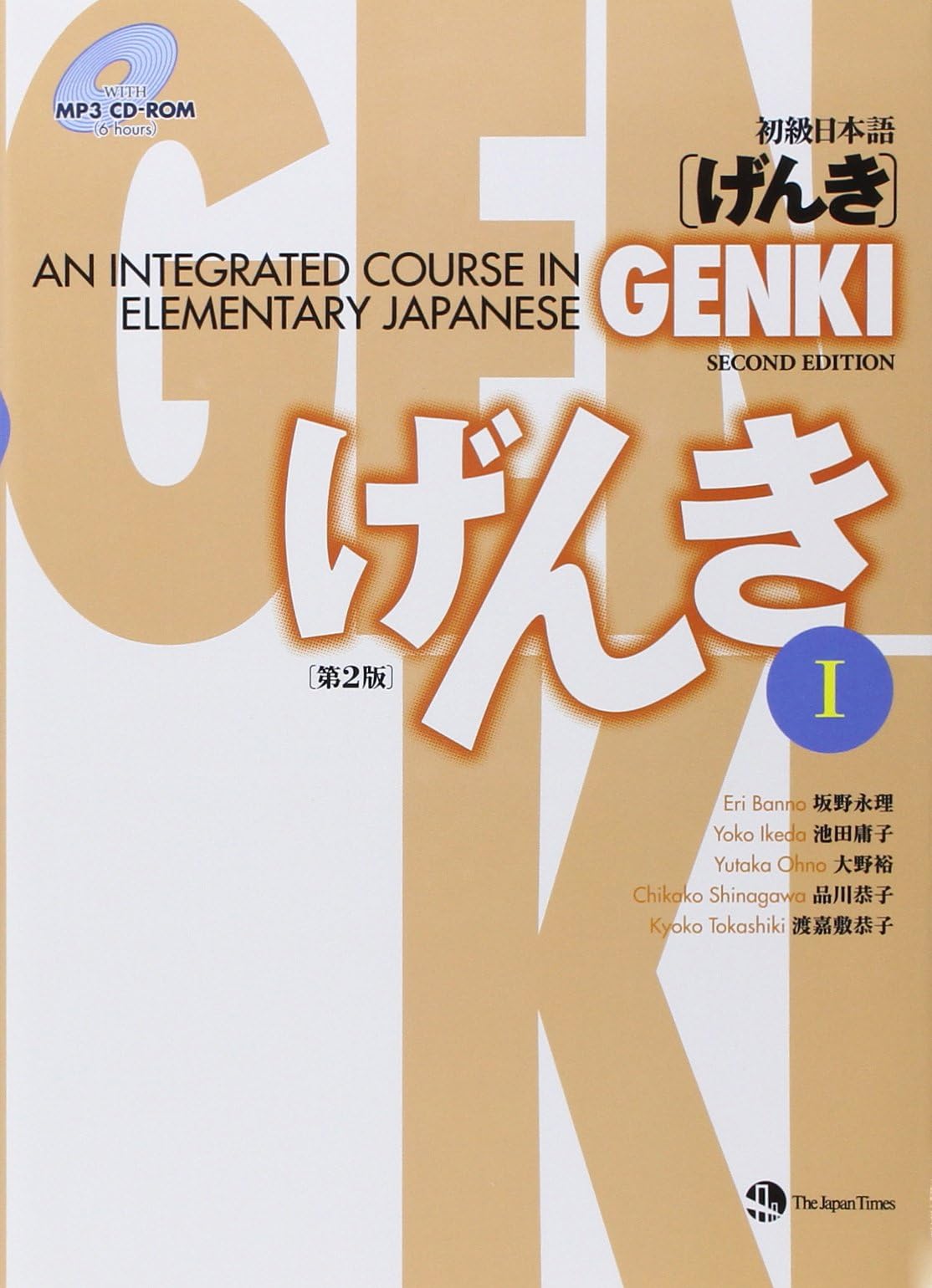
Genki 1 Textbook: An Integrated Course in Elementary Japanese
Product ID: 255416429
🌏Culture Notes for real-world context
🎧6 hours MP3 audio for immersive listening
📚Balanced 4-skill language training
🎌 Unlock Japanese fluency with Genki — your passport to language and culture!
Genki 1 Textbook is a comprehensive, second-edition Japanese language course designed to develop balanced skills in listening, speaking, reading, and writing. Featuring 6 hours of MP3 audio and new Culture Notes, it offers a modern, immersive approach widely adopted in the US and Europe for effective beginner learning.
| Best Sellers Rank | #241,767 in Books ( See Top 100 in Books ) #2,537 in Language Study for Children #4,792 in Words, Language & Grammar #6,450 in Language Study & Reference |
| Customer Reviews | 4.8 out of 5 stars 2,777 Reviews |
M**C
SUPER BUCH! besser als Grundstudium Japanisch oder Sauseschritt!
Es ist auf Englisch - aber mal ehrlich wer sich schon mit Englisch schwer tut... Das Buch ist wirklich angenehm aufgebaut - und die mitgelieferte CD unterstützt einen gut Die Grammatik wird gut mit Beispielen erklärt und die Übungen sind passend und machen Sinn. Von den Vocalbeln her muss ich zugeben das ich einen Anfang mit der Erlernung der Grundkanjis besser gefunden hätte. Also ein kleiner Tip meinerseits: Diese zuerst lernen - gibts genug Seiten im Netz Vom Schwierigkeitsgrad her würde ich GENKI als MITTEL einstufen in der UNI (Japanologie) benutzen wir das ar***loch Buch Grundstudium Japanisch welches ich als lieblos kalt hart unfreundlich unübersichtlich und unnötig SCHWER einstufen würde.
C**S
Best way to start learning Japanese
I've gone through the whole book, and the second volume. I can definitely say that this one of the best ways to get your foot in the door for learning Japanese. It teaches a good chunk of vocabulary and kanji, but more importantly, it teaches all of the basic grammar. Each lesson is formatted as a reading which you go through, followed by a vocab dump, then the lesson grammar, then practice. There is also reading and kanji that you're expected to learn at the back. Even though it's a bit pointless, it also comes with a cd that has audio for the book, which you can use for listening to the vocab. The CD is also used for listening practice. There are alternatives to this book such as Tae Kim's Grammar guide which is free, or Minna No Nihongo which is the other "Beginner Japanese Textbook" but I prefer Genki over them. It is also worth noting that many people also prefer Genki over those so guides and blogs are really common for Genki. If you do chose to buy Genki, here are my recommendations: 1.) Get Anki. It's a flashcard app. If you are learning Japanese, Anki will be shoved in your face non-stop. So get Anki and get a Genki flashcard deck. 2.) Don't just rely on Genki for Vocab or Kanji. Genki teaches the vocab it needs to teach it's grammar points, and a good chunk of N5 (JLPT, Japanese Language Proficiency Test) vocab. But, you'll need more vocab then what Genki provides to get anywhere in Japanese. I recommend downloading the Core 2K/6K deck for Anki. Same deal with Kanji. Genki gives you a good base, but it isn't enough. Get a dedicated Kanji source. Like James Heisig's Remembering the Kanji, or WaniKani. 3.) The Practice Section. Do them if you like. If you choose not to do the practice, which I did, then make absolutely sure that you have those grammar points as flashcards. Heck, even if you do the practice, still turn the grammar points and every sentence using them into flashcards. You will forget them if you don't 4.) Don't ignore listening. Any textbook will make you good at reading, and somewhat decent at speaking (In the sense that you'll know how to say what you want) but doesn't do anything for listening. Good luck having a conversation in Japanese if you can't hear what they're saying. So do the listening practice. Go further and find other sources to practice listening. Listening is Genki's biggest weakness.
A**N
Good Japanese Textbook
I like the Genki books. I grew up speaking Japanese and have gone to Japanese school and taken college level Japanese courses. I would have to say that this book compared to another one I have used is more user friendly. I liked the way that it is organized. To me, it is a pretty good introductory Japanese textbook. If you are an independent learner, it may not be the best textbook to learn from. There are a lot of group activities to do in the book. It would be great if you have someone to do it with. Also, I think it needs more examples or more exercises to practice the grammar/vocabulary introduced. A supplement might be good, not the workbook. The workbook have examples, but I can't figure out if I am right or wrong. It did not come with an answer sheet. I usually ask someone I know. There are other supplemental sources. I just want to say something about textbooks in general. Not all of them will suit a person's learning style. They are all different and they all suit each person differently. I just happened to like this one way more than Yookoso. As for the romaji issue, I personally did not care for it. If you are serious about learning Japanese, then learn Hiragana and Katakana ASAP. That is what will help you in advancing in your Japanese language learning. It opens up more doors in learning the language. Also, the textbooks are teaching basic grammar. Yes, there are several ways to say one thing, even in English. It really is up to the person to practice and eventually a particular style or way of saying things will be more familiar. I have spoken to Japanese people. I would say it one way and the other person would correct me by telling me a different way of saying it. Both ways were correct. One way was more mature. It has to do with style and familiarity and maturity level. It all comes down to continually learning the language.
M**U
TOP
é quello che cerchi quando stai studiando una lingua. Un manuale chiaro, esaustivo nelle spiegazioni, semplice, con tanti esercizi, una buona integrazione audio, con un indice che ti riporta tutti gli argomenti di grammatica e i pattern (e non generiche situazioni). quindi semplice da consultare, da avere sempre a portata di mano. Forse un po' costoso...? anche considerando che per la completezza ha anche un book esercizi, e che per arrivare ad un N4 c'è il GENKI II, con relativo book esercizi... in sintesi: Ne vale la pena? SI.
N**M
Good
Wonderful book
Trustpilot
1 month ago
3 days ago