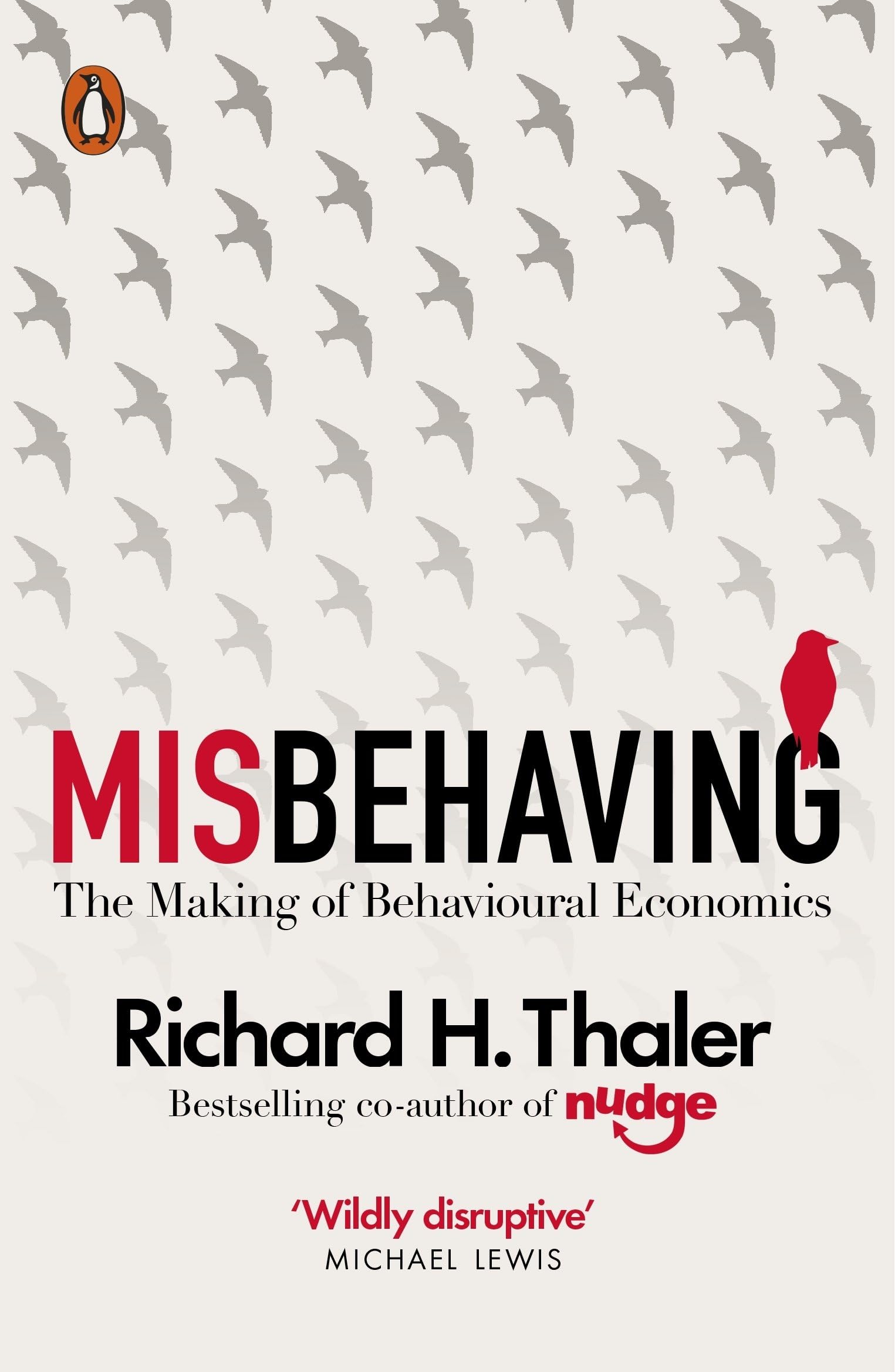
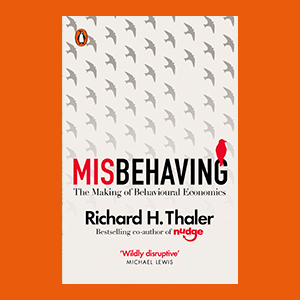
Misbehaving : The Making of Behavioural Economics
Product ID: 254015635
⭐4.6/5 star rating from 1,911 readers
🌍Global bestseller rank #7,983
📚Paperback edition
Desertcart purchases this item on your behalf and handles shipping, customs, and support to Kyrgyzstan.
📈 Decode human behavior, master the market!
Misbehaving by Richard H. Thaler is a groundbreaking paperback that fuses economics with psychology to reveal how real human behavior influences markets and policies. With a stellar 4.6-star rating from nearly 2,000 readers and a top 15 rank in applied psychology categories, this Penguin Books publication is a must-have for professionals eager to elevate their strategic thinking.
| Best Sellers Rank | #7,983 in Books ( See Top 100 in Books ) #14 in Popular Applied Psychology #14 in Occupational & Organizational Psychology #56 in Marketing & Sales |
| Customer Reviews | 4.6 out of 5 stars 1,911 Reviews |
D**D
Horrible print quality and book is damaged. Doesn't look authentic.
M**M
Capolavoro
Davvero splendido libro, Thaler riesce a spiegare concetti complessi con metafore semplicissime! Ottima lettura per chiunque, non eccessivamente matematico ma allo stesso tempo approfondito nei punti giusti. Splendida lettura, dovrebbe essere inserito in qualsiasi corso universitario di economia.
H**S
Full of great ideas and a wonderful writing style
This book is a great way to learn about behavioral economics, and it has the added attraction of being written by one of its most creative practitioners. The best way I can convey the power of this book is with some examples. Let me start with the case of the beer at the beach. Two friends are at the beach on a hot afternoon and one says to the other "I'm going to the hotel to get a beer. I'll first try the little stand run by a local, and if it is closed, I'll go to the bar in the hotel. In either case, I will be right back with the beer. How much is the most you will pay from the little stand for a cold Corona, and what is the most you will pay from the hotel bar for the same drink?" The second friend replies, "I'll pay up to 2 dollars at the stand and up to 4 dollars at the bar." Now this sounds quite reasonable but it is easy to see that it is completely irrational according to traditional economic theory. If the beer is worth 4 dollars from the bar, how could the same exact product be worth 2 dollars from the stand? Behavioral economics is about such well-experienced phenomena that are poorly represented by traditional economic theory. Here is a second example. An experimenter gives you 10 dollars and tells you that there is another subject in the next room. You must offer his some part of the 10 dollars, and if he accepts, you split the money accordingly. If he reject, you both get nothing. The experiments comments that you will never see the person in the next room, and you will have no chance to repeat the experiment with this person or any other. Standard economic theory says that if you think the other guy is rational and if you offer him any positive amount of money, he will take it, because something is better than nothing. So you offer him one dollar, he rejects, and you go home poor. The game, called the Ultimatum Game, has been play in the lab and in the field hundreds of times, and even with very large stakes, such as three month's salary. Offers of less that 30 percent of the pie are very often rejected. This is completely at odds with traditional economic theory. Now, why did the other guy reject your offer? A variety of experiments that I won't describe here (see my book The Bounds of Reason, Princeton University Press, 2009) make it clear that the guy thinks your offer unfair, and he rejects because it is worth more to him to punish your unfairness than to get 1 dollar. The point is that people are motivated by morality, not just self interest. This is shown again and again in behavioral economic experiments. Now, what is the relationship of the second example to the first? THEY ARE THE SAME! The thirsty beach vacationer thinks it is unfair to charge more that two dollars from the little stand, which has low costs, but will pay up to four dollars from the bar, which pays high rent to the hotel. The vacationer is willing to go beer-less to punish the little stand owner for overcharging. I want to stress something that Thaler says often, but not often enough: most the behaviors he describes are not at all irrational---far from it. They don't fit the standard model, but there is certainly nothing irrational about acting morally! Otherwise the only rational people would be sociopaths! Let me give an example. A friend of his was fighting with her young daughter, who refused to wear dresses to school, preferring pants and tee-shirts. The mother fussed that she spent good money for three nice dresses at the beginning of the school year, anb by Lord, the little girl had to make good use of them. The mother ask Thaler to intercede in the tiff. Thaler asked if the mother had anything against pants and tee-shirds, an she said no. He then explained the concept of "sunk costs," which are expenditures in the past that support an investment that is currently expected to be unprofitable (it is called the Concorde Effect in Europe---guess why). The correct advice is "don't throw good money after bad." In this case, the money you spent for the dresses is gone, and you can't get any benefit for you or your daughter by making her wear them. Now, there are certainly many cases in which people fall prey to the sunk cost fallacy, but I have found that in almost every case, this behavior is quite rational. On reason is that you might want to discipline yourself to be more careful about investments in the future, so sticking with a bad investment is just a therapeutic holding your feet to the fire. Another reason is that someone else is paying the costs, and if you fail you will be blamed. In the case of the mother and daughter, I bet anything that the little girl wanted the dresses at the beginning of the school year, and just changed her mind later. The mother is simply disciplining the girl. A third example: why do popular restaurants put up with long waiting lists of people who want to eat there? The "rational" solution is the raise prices at the restaurant at peak hours, so supply equals demand. But a restaurateur explained to Thaler that people judge the quality of a meal taking into account its price, so even though people would pay more, they would recall that the meal was not that good, probably without even realizing that they took the price into account in making that judgment. I can swear that I behave exactly 8in this way, yet I did not understand the phenomenon until I read it in this book. Wow! Super wow!! The only weakness of the book is Thaler's incessant theme of "traditional economics, bad---behavioral economic, good." This is simply false, and most people understand that this is the case. Moreover, behavioral economics has swept the field in the past two decades. This is greatly to the credit of economists as scientists. There have been many criticisms, but that is welcome and necessary in the evolution of economics as a discipline. Go ahead! Read this book. You'll like it. Take my word for it.
A**N
Complete, Compact, Hilarious and Horse's Mouth
He's taken his time and he's waited his turn, but Richard Thaler has delivered the definitive book on Behavioral Economics, the one you can't afford to miss. It's a summary of the main findings, a history of how they came about and a preview of coming attractions, with due care taken to pay tribute to those who came before Thaler and apportion credit to those who worked with him. The field is not as new as Thaler would have you think. There's bias in this account and it is a bias against those among his predecessors who tried to explain human behavior in a way that was consistent with mainstream economic theory. I'm thinking Gary Becker here (who tried to explain long lines outside empty clubs and packed cheap restaurants alike using an "upward sloping demand curve" and famously sat down to write a paper on suicide when his wife took her own life); I'm thinking the very same Robert Barro that Thaler makes fun of when he describes him as the smartest man ever, but who nonetheless made me understand in his book "Getting it Right" why superstars could get paid so much in a zero-sum game and got confirmation to his theory when Maradona was paid more than the rest of his team, Napoli, put together, and justifiably so because he not only took them to the Campionato, but also thwarted much more fancied teams from winning it. Thaler's predecessors operated in a world where most Economics books had to start with a chapter explaining why Economics is a science. Of course they had to stick to the utility-maximizing / profit-maximizing orthodoxy! Besides, orthodox economic theory was not all that shabby when it came to predicting human behavior. By the time Thaler was entering his prime, Economics no longer had to apologize to anybody and was much more open to heresy, of course. It was in a position to withstand additional questioning. Armed with a nice piece of math invented by Tversky and Kahneman it was ready to be taken to the next level. Thaler takes you through the whole thing in the space of the shortest 358 pages you will ever read. As he promises at the start, he tells it through a bunch of stories, mostly the stories of his collaborations and his epic fights with Economic Orthodoxy. The book is worth reading for the humor alone. The jokes range from pure slapstick (example p. 128: "we were trying to learn what ordinary citizens, albeit Canadians, think is fair") to the esoteric inside joke, like when he mentions Vishny is a common co-author of Shleifer (to the best of my knowledge he's never written a paper without Shleifer). If you're not laughing the whole time, basically, there are squadrons of jokes flying over your head. My favorite type of humor, relentless repetition, is also very well represented. I lost count of the number of times I read the expression "invisible handwave." The man is irrepressible, basically. You can't keep him down. There's a sadness that goes with this too, and it's that this is a bit of a category killer. "Misbehaving" Pareto-dominates all behavioral economics books that precede it in terms of readability, context, scope, you name it. I don't know what I would do with myself if I was Dan Ariely or if I was Steven Levitt (Roe v. Wade findings notwithstanding), to say nothing of Tim Hartford. They now have to accept that there's a book out there that beats their entire life's work on all fronts. The long problem set masquerading as a re-interpretation of behavioral economics that is Kahneman's "Thinking Fast and Slow" is the only true exception to the rule, it continues to stand alone, but relative to "Misbehaving" it's a cop-out. As he told Michael Lewis in the interview that preceded that book, Kahnemann did not want to write the history of the field, he did not want the book to have the feel of one's last book. So the door was left wide open to Kahneman's self-admittedly "lazy" student to jump into the breach. This he has done with gusto. Prospect Theory (how we are risk averse when we're winning and risk loving when we're losing) is taught straight from Tversky and Kahneman's 1976 graph and is used to explain: (i) transaction utility, including Costco's business model (ii) sunk costs (i.e. why you will carry on wearing an uncomfortable pair of shoes you paid 300 dollars for) (iii) the endowment effect (including later in the book how it undermines the Coase theorem) and (iv) "gambling with the house's money" at the casino, versus the fact that outsiders get overpriced toward the end of the day at the racetrack. Bucketing of budgets gets thrown in for free. Next comes a tutorial on Self-Control. Thaler explains that many humans discount future pleasure (or pain) on a scale that is totally unrelated to how we present-value bond cashflows and mainly operates on three levels: Now (intense), Later (much less intense) and Much Later (only slightly less intense than Later). This leads to preferences that are intertemporally inconsistent, a nightmare to Economic Orthodoxy, but very often true in real life. Heady stuff, and I promise, he makes it clear. He does not use graphs or charts or math. He explains it all with one picture: the famous cover of New Yorker magazine where everything this side of the Hudson is rendered in great detail, New Jersey through to California takes up as much space as West Manhattan and Asia is visible behind. You get that chart, you get how we humans really think about delayed gratification. Genius. A chapter follows which is a summary of "Thinking Fast and Slow" but without trying to shoehorn the rest of Behavioral Economics into that model. The next couple chapters deal with Fairness (the Ultimatum Game, the Dictator Game, the Punishment Game, cooperation games such as the Prisoner's Dilemma) and a revisit of the Endowment Effect as exemplified by the trading of Mugs with capital M. Then Thaler attacks Finance and the Efficient Market Hypothesis in Particular. Not that anybody sane thinks markets are efficient, but you could tear out the rest of the book and keep pages 203 to 253 as a quick guide to why markets are inefficient. Thaler starts with Keynes' "beauty contest" analogy for stock picking (we pick the girl we think most other people will like, not the one we really fancy). Next he explains why a stock ought to be worth the net present value of its dividends and takes the reader through Shiller's discovery that stocks move around tons more than dividends do (or can be reasonably expected to do), which proves they wander around tons relative to what they will ever pay out. He offers additional proof by going through closed-end funds' variation from their NPV and gets some serious kicks from pointing out that stocks on occasion sell for less than the market value of their listed subsidiaries. He's a bit of a showman, Thaler, he calls this "negative stock prices." From there he goes for the kill and notes that Royal Dutch Shell shares have a different price in New York versus Europe, and never more so than they did during the blow-up of LTCM, providing a real-life example of Shleifer and Vishny's mathematical formalization of Keynes' old aphorism that "the market can stay irrational for longer than you can stay solvent." At some point, Chicago had to follow Al Pacino's view that "you keep your friends close and your enemies closer" and put him on the faculty. From his angle, it was time to storm the citadel, and this is what Thaler chronicles next. He had been ready for them from day one. The book actually starts with "The Gauntlet," which is the series of challenges orthodox economists lay out for the behavioral crowd: 1. The "As If" challenge states that even if nobody is an expert in everything, society operates as if we all were, because through division of labor we all end up doing things we understand. 2. The "Incentives" challenge states that people respond to incentives once the stakes are large enough. All the wishy washy behavioral stuff washes away once we're talking real money. 3. The "Learning" challenge states that even if we get it wrong in "one-shot" games, in real life most games are "repeated" and behavior thus converges to what Orthodox Economics would suggest. 4. The "Invisible Hand" argument states that if we all go about doing what's best for us we nevertheless end up doing what's right for everyone else as well. Won't spoil it for you and take you through Thaler's answers to the above. It's after all what the book is really all about. But forgive me one indulgence, I've GOT to tell you about the bit where he demolishes Robert Barro: The Rational Expectations Hypothesis has a number of implications, chief amongst them the prediction that fiscal stimulus does not work. If the government writes you a check, the story goes, you know you'll be taxed for it in the future, so you save it rather than spend it. And the stimulus ends up being a damp squib. Thaler proves the circularity of this argument by suggesting a similarly circular counter-argument: what if the rational agents that compose this economy believed in Keynes' multiplier? What if they thought the stimulus will work and the economy will fly and their taxes will actually go down? Should they spend TWICE the check they were sent? From Chicago he goes on to a couple (well-earned) victory laps. He applies Behavioral Economics to Americal Football, where he advised three separate teams on how to conduct their affairs during the annual draft, to game shows he was allowed to set up with Endemol, where he proved that his theories can withstand some pretty high stakes and from there onto "nudging" people to contribute more to their pension and pay their taxes on time. He ends the book with a wish that one day there will be one Economics again, with the Orthodox Economics of utility maximization and profit maximization as a quaint special case. We're probably already there.
A**I
Very interesting titles, fun read
Studying finance while having a big interest in psychology made this book an absolute home run for me. Richard Thaler explains how real people actually make financial decisions in an entertaining and easy-to-follow way. It gave me tons of fresh perspectives for my studies. Highly recommended
Trustpilot
2 weeks ago
1 week ago