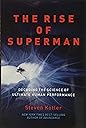



The Rise of Superman: Decoding the Science of Ultimate Human Performance
Desertcart purchases this item on your behalf and handles shipping, customs, and support to Kyrgyzstan.
Description
Wall Street Journal Bestseller In this groundbreaking book, New York Times –bestselling author Steven Kotler decodes the mystery of ultimate human performance. Drawing on over a decade of research and first-hand reporting with dozens of top action and adventure sports athletes like big wave legend Laird Hamilton, big mountain snowboarder Jeremy Jones, and skateboarding pioneer Danny Way, Kotler explores the frontier science of “flow,” an optimal state of consciousness in which we perform and feel our best. Building a bridge between the extreme and the mainstream, The Rise of Superman explains how these athletes are using flow to do the impossible and how we can use this information to radically accelerate performance in our own lives. At its core, this is a book about profound possibility; about what is actually possible for our species; about where—if anywhere—our limits lie.
Specifications
| Asin | 1477800832 |
| Dimensions | 6 x 9 x 1.01 inches |
| Edition | 1st |
| Isbn 10 | 9781477800836 |
| Isbn 13 | 978-1477800836 |
| Item Weight | 1.01 pounds |
| Language | English |
| Print Length | 234 pages |
| Publication Date | March 4, 2014 |
| Publisher | New Harvest |
Reviews
User
Concepts of ultimate human performance presented very well
Review – The Rise of Superman Steven Kolter“The Rise of Superman: Decoding the Science of Ultimate Human Performance” by Steven Kolter, founder and director of the Flow Genome Project, is a masterful followup to what Abraham Maslow and Mihaly Csikzentmihalya started years ago with the “Hierarchy of Needs” and “Flow.” This book traces the thoughts and achievements made possible by Flow through ultimate sports rapidly escalating achievements and then into music, play, work, and art. Kolter then projects what a possible future could be like, what with youth seeing the already high achievements, and then using heightened imagination and Flow technics to achieve even more astounding levels of achievement in nearly every field of human endeavor. Along the way Steven Kolter maps out the necessary triggers and bases for Flow to occur. These are well laid out.Steven Kolter devotes a chapter to the Dark Side of Flow. That is, what happens to individuals who find themselves in the doldrums, in life circumstances where time and priorities of life do not allow time for Flow. Mr. Kolter also addresses that Flow, with it's constant need for challenge, does lead many people into very risky areas of achievement, and that many have lost their lives or livelihood in the chase of Flow. Mr. Kolter emphasizes that Flow is the left hand path to success, not the right hand path of 10,000 hours practice. This is a scary chapter, but an aspect of Flow that must be addressed.The book reads well. I would put the grade level at about 11 or 12. The book is exciting, replete with lots of stories of extreme sports with rule breaking achievements and world record setting in such as skateboarding, snowboarding, acrobatic skiing, rock climbing, and the individuals who made the jumps in achievements in the ultimate sports. I feared in the third chapter that Mr. Kolter was going to go ultra technical in biometrics, bioanatomy, and bioneural chemistry, but he did not, pulling up just short of going overboard with those concepts. Yes, he does refer repeatedly to hypofrontality, and names serotonin and norepinephrine and other brain chemicals, but these are well explained and demonstrated.Not all of the material in the book is new. Mr. Kolter is standing on the shoulders of the giants who have gone before him. Mr. Kolter acknowledges those giants. But Mr. Kolter has achieved making the concepts of ultimate human performance accessible and understandable.
User
Ready to Rise!
I picked up Rise of Superman because I would like to spend more time in flow states. I believe in hustling hard and hustling smart but I know that I don't actually spend that much time in flow. Flow states are a result of evolutionary psychology that drastically increases awareness of the world around us. The book does a great job of illustrating flow state science by telling stories of superhuman feats accomplished by action & adventure athletes in flow. for these kinds of athletes reaching flow states is literally a matter of life and death, so they make great case studies of something that for everyone else is kind of nebulous. However, sometimes it's difficult to visualize a complex skate boarding trick, if you are not a skater. It would have been neat if the kindle version of the book linked to Youtube videos. It would have been interesting to see the book say more about addicts and flow states. As flow states naturally recreate the cocktail of neurotransmitters that addicts chase. You always hear that addicts need to replace one addiction with another, it would be really fascinating to see some research done on training addicts to enter flow states. I've said before that I think that the human capacity for invention, creativity, collaboration and generosity multiplied by the steep growth curves in technology have a real chance in the next 50 years of eradicating: poverty, war, hunger, disease, environmental issues, lack of education, even aging and death. If we can harness the power of flow, 50 years from now we will be able to look at the world and see these demons vanquished from the world.
User
A landmark book for innovators
We may have heard in our youth that we only use 10% of our brains. David Eagleman gave us “Incognito” to teach us that the other 90% (our subconscious) is very much in use and quite literally controls much more of us than we think. Nassim Taleb showed us in “Antifragile” that the most resilient and productive things become so when subjected to extreme variation in stressors. Norman Doidge in “The Brain That Changes Itself” helped us understand that our brains are not simply software running on top of hardware, but can actually be rewired with experience throughout life.To me, Steve Kotler gives us a first glimpse at what it might look like to rewire our brains to become hugely more productive by intentionally triggering stressors that take us into a scientifically based new mental state of ‘flow.’ This book is not about a metaphor, it’s about a relevant field of study in human neuroscience. Reading it, you will understand how when stressed under the right conditoins, the brain produces cocktails of key chemicals like norepinephrine to tighten focus (data acquisition), dopamine to enhance pattern recognition (data processing), and anandamide accelerates lateral thinking (widens search by pattern recognition system). These 3 chemicals mimic the effects of cocaine, LSD and marijuana, but so far no one has been able to mimic the balance and timing of the cocktail that internal generation creates.It also ties in the work of Charles Limb at Johns Hopkins who I had seen talk once on how jazz musicians experience deactivatation of their ‘dorsolateral prefrontal cortex’ when they go into flow. This means that going into flow requires turning off those parts that handle self-monitoring, control and thus inhibition. Some of these effects can now be triggered intentionally with electromagnetic pulses – something I first saw in the work for Allan Snyder at the ‘Centre for the Mind’ in Australia, but this integrates those observations with a broader view.It helps us begin to understand why freedom from rules and flexibility of action are key to innovation. It helps us understand how Taleb’s ‘skin in the game’ is actually important neurologically, and why humility, not arrogance, is key to breakthrough innovation.Although cast using a breadth of examples of extreme action sports, I agree this book signals the possibility of a whole new world of human productivity and creativity ahead. If there is a ‘new world’ of human productivity ahead, this book is the beach on a small island in the Caribbean.This book may be the most important book for innovation since Clayton Christensen’s “Innovator’s Dilemma”, and can’t wait to see where the seemingly emerging community of ‘flow hackers’ might take us? If we figure out how to trigger ourselves into flow in a wider array of tasks, I expect an avalanche of innovation for otherwise seemingly insurmountable problems – very exciting to think about!
User
NOT just for extreme sports people, BEST book on FLOW I have read
I have read a lot of books about flow. Of course, Mihaly Csikszentmihalyi's Flow : The Psychology of Optimal Experience, is the classic, but I found it lacking in a number of ways. It's value is in introducing the concept of flow to a broad audience, including me. But it lacks in detail, in practical use, and it bypasses the importance of community.I had grave doubts about Kotler's book, since, though active (hiking, biking, bikejor, horseback riding, etc.), I am not interested in extreme sports. They have always struck me as a show-offs "thing". Although I still believe that there is great truth to that, in many cases, I am now able to appreciate what extreme sports participants are getting internally and via community from their sports. But, far above and beyond knowledge of and appreciation for extreme sports is what Kotler has to say about flow. Flow, not extreme sports, is the real topic of this book. Extreme sports are just used as an example. Kotler does state that extreme sports are the only reliable way to experience flow, which I strongly disagree with. But I'm glad I continued on with this book after reading that line. There is so much great stuff in here!Kotler's own summary, in the preface, is good: despite the unusual "them" at the center of this story, this book is really about us: you and me. Who doesn't want to know how to be their best when it matters most? To be more creative, more contented, moare consumed? To soar and not sink?... Towards these ends, this book is divided into three parts. Part One examines just how far action and adventure sports athletes have pushed the bounds of the possible and explores the science of why (this work is based on over a decade of rearch...). It's here that we'll see how flow works in the brain and the body, how it massively accelerates mental and physical performance... Part Two of this book probes the nature of the chase: how these athletes have mastered flow, how they have redesigned their lives to cultivate the state, and how we can too. Finally, Part Three looks at the darker side of flow, wider cultural impacts, and the future.The beginning of the book covers the neuroelectricity, neuroanatomy, and neurochemisty of flow in a useful and interesting way. Detailed, but not too complicated. Kotler discusses Csikszentmihalyi, of course, but points out that Csikszentmihalyi missed the important element of decision making as an aspect of flow. Brainwaves are discussed, covering what is happening in the brain when different brainwaves are occurring, and how these relate to achieving and being in flow.Kotler discusses the work of Leslie Sherlin, an expert on the neuroscience of high performance. From the book: "That's the secret," says Sherlin, "extremely fluid brain control. Most people can't make it through the whole cycle. They get hung up somewhere. They either can't generate all the necessary brain states or they can't control them. Elite performers can produce the right brainwave at the right time, vary its intensity as needed, then smoothly transition to the next step. Mentally, they just take total charge of the situation." Flow states, which can be considered elite performance on overdrive, take this process one step farther. "In the zone, " says Sherlin, "you still see this same fluidity in the transitions between states, but you also see even more control. Instead of producing all these other brainwaves, really good athletes can transition smoothly into the zone, creating that low alpha / high theta wave, and then hold themselves there, sort of in suspended animation, shutting out the conscious mind and letting the implicit system do it's stuff." I found the rest of the book to be very helpful in actually achieving it. Kotler gives details on how to do so, not just theory. Theory is great, and can certainly be applied, but to learn what top researchers have discovered when studying it is very helpful. That all in here.The interrelationship between flow and creativity is well covered. Kotler tells us, "In flow, we are out resourceful, imaginative, ingenious best. Better still, the changes stick. According to research by Harvard Business School Professor Teresa Amabile, not only are creative insights consistently associated with flow states, but that amplified creativity outlasts the zone. People report feeling extraordinarily creative the day after a flow state"Learning about transient hypofrontality was very helpful. Kotler has a lot to say about it, but here's a good summary of why it is relevant, "In flow, parts of the PFC (a brain region) aren't becoming hyperactive; parts of it are temporarily deactivating. It's an efficiency exchange. We're trading energy usually used for higher cognitive functions for heightened attention and awareness."I also found the insight that flow isn't like a lightswitch to be very helpful in maintaining/obtaining flow. There are stages and degrees of flow. These are described in detail and are very useful in a practical way.While reading this book, I kept saying to myself, yes, but what about the social/community side of flow. Csikszentmihalyi seems to use it in examples, but bypass it in discussing the aspects of flow. The book, Trying Not To Try: The Art and Science of Spontaneity, by Edward Slingerland, is another wonderful book on flow. It is quite different from Kotler's book, as it focuses on what Eastern philosophy has to teach us about flow. One important aspect it covers well is the social side of flow. Anyway, then I reached chapter 8 in Kotler's book and was delighted to discover that he does cover the social aspect of flow. Some overlaps what Edward Slingerland says, and some is new inslght.I've already given this book as a gift once, and will be giving it to at least one other person as well. It can add so much to a person's life to understand and achieve flow regularly.Highly recommended!!
User
More Storytelling Than "Decoding" I didn't help me at all
I read this book in 4 days desperate to find out how to reach "flow" in my own life for athletic pursuits. I've looked up Steven Kotler and figured this book would be a good place to start. It says "decoding" but really its a lot of storytelling. He mentions Shane McConkey at in every phase of the book. Breaking the book into phases was also pointless bc its literally all story telling in every single phase you can't tell them apart. I appreciate the inspirational stories from the athletes but Kotler gives no real step by step approach or tangible information I can immediately apply to my own life to get into flow. All those decades of research and it appears as if flow is just as elusive as I thought before reading.
User
A thrilling read and the bleeding edge of the science and hacking of Flow!
Growing up a Flow junkie snowboarding the backcountry of Colorado's most magnificent terrain, and combining that with downhill mountain biking, acrobatics, and martial arts since age 3... this book not only brought back some of my most cherished memories of peak performance in flow states, but it also deconstructed and explained the science behind why I do what I do and why it feels so insanely good.The stories of the extreme athletes in here are incredible and so visceral that you feel like you are right there with them, tagging along for the ride of flow in death defying situations.The science is endlessly fascinating, and as in depth as it is in here, to know we are still just scratching the surface of how flow works and how we can engineer more of it into our work, play, and daily lives is just beyond exciting.My heart was racing during many of the stories, and the inspiration I am left with having finished the book is abundant and overflowing... Time to go hack flow in my own life and geek out with others to do the same!I firmly believe the more flow we each experience on a regular basis, the better and more abundant world we will work together to create.Thank you Steven Kotler, your team, the athletes, and everyone out there pushing the limits continually, rapidly making the impossible possible, setting new records, raising the bar higher and higher, and motivating the younger generations to live in a world rich with possibility, and rich with Flow.
User
An awesome read!
I am interested in anything to do with human performance and human development, so the combination of scientific research and extreme sports storytelling is truly entertaining. Flow-state, or peak performance state, is a state of being we all want to be in more, to maximise whatever it is we are committed to. Kotler talks about research that tells us what's happening in our brains and bodies while in this state, and how extreme sports athletes have been hacking into this state to achieve what should be impossible. And how they've been doing this intuitively and from a passion for what they do, but mostly without any professional training. He promises techniques for how we can apply this to our merely mortal lives, and that part of the book is a bit light - I could have done with some more "how to" suggestions. He points them out, almost out of a sense of obligation, and then goes on with more inspiring stories....still a really fun, entertaining and informative read.
User
Why do People Get Addicted to Extreme Sports?
Ever since Kotler's book West of Jesus I've been curious to see where his inquiries would lead him. Superman is well worth the wait!Full disclosure: I have published a strikingly similar book, The Alchemy of Action, also within the last year. I am delighted to find that The Rise of Superman is the closest to mine in spirit of any book out there. In many ways, it appears that our two books could become a boxed set.The Rise of Superman delves into the high-functioning state behind the feats of extreme athletes. Kotler uses the concept of "flow" as a framework for looking at the astonishing things a highly-tuned athlete can pull off by getting into "the zone." Flow was first delineated by Mihaly Csikszentmihalyi, best-known for his 1990 bestseller Flow: The Psychology of Optimal Experience. Kotler tells the colorful tales of many an athlete from a variety of fringe sports carried out on the ragged edges of human potential, then brings their lessons back to try to make them relevant to the rest of humanity, struggling to work more effectively, to rise to a higher state of function, and to just plain have more gripping fun in their everyday lives.As a high-level rock climber, I can say that when Kotler delves into our realm he mostly gets it right, and delivers an accurate representation of what we're up to and how it works and why we get addicted to climbing on steep walls. His answers lean toward the psychological while mine go more toward ferreting out the brain hormones behind what it is that juices us up out there where "this is your brain on action." Overall, though, our frameworks, and the stories behind them, are intriguingly complementary.It would be fun someday to share a venue with Steven Kotler and do side-by-side presentations.
User
Fascinating, enlightening, and beautifully written.
An excellent follow up to the book “Flow”
User
Amazing read,inspired me to find more flow!
The book highlighted experiences I have had in the past which were when I was in a flow state and didn't know it. It also gave me the tools I need to seek out and experience more flow in my life.
User
It teaches, it entertains, and it backs it up with fascinating science!
I've already read this as a Kindle format book several times, and for very good reason. First of all, the way it's written is fast-paced and fascinating. Incredible stories of extreme-sport and stunt professionals, and the science behind how they perform seamlessly under pressure is riveting and awe-inspiring. Second of all, learning the science is invaluable in today's world of distraction and chaos. I find that the more I understand flow state, the easier it is to get into flow state. Which leads to the last point: literally learning about flow state makes you better prepared to enter into it, and Steven Kotler gives you the tools to induce a flow state whenever you want (for the most part).Why get the physical book? Because I find my deepest and most meaningful learning is greatly facilitated by tactile experiences. It's also far more memorable when you physically highlight something in a book or write in the margins than it is doing those tasks on your electronic device (multi-stimulae memory). And of course I want to be able to lend this to my family members as we travel the world, so we can remind ourselves how to get into a state of flow when we're under pressure.If you're interested in reaching a high state of flow, this book won't disappoint. It teaches, it entertains, and it backs it up with fascinating science.
User
Un libro muy recomendable para aquellos que deseen alcanzar su maximo potencial
Los ejemplos e investigaciones realizadas por el autor.
User
Illuminante e zero chiacchiere
Trattazione di gran precisione scientifica di un argomento che è purtroppo davvero poco esplorato. Ma che a breve cambierà i concetti di "possibile" e "ordinario" agli occhi di tutti noi.
Common Questions
Trustpilot