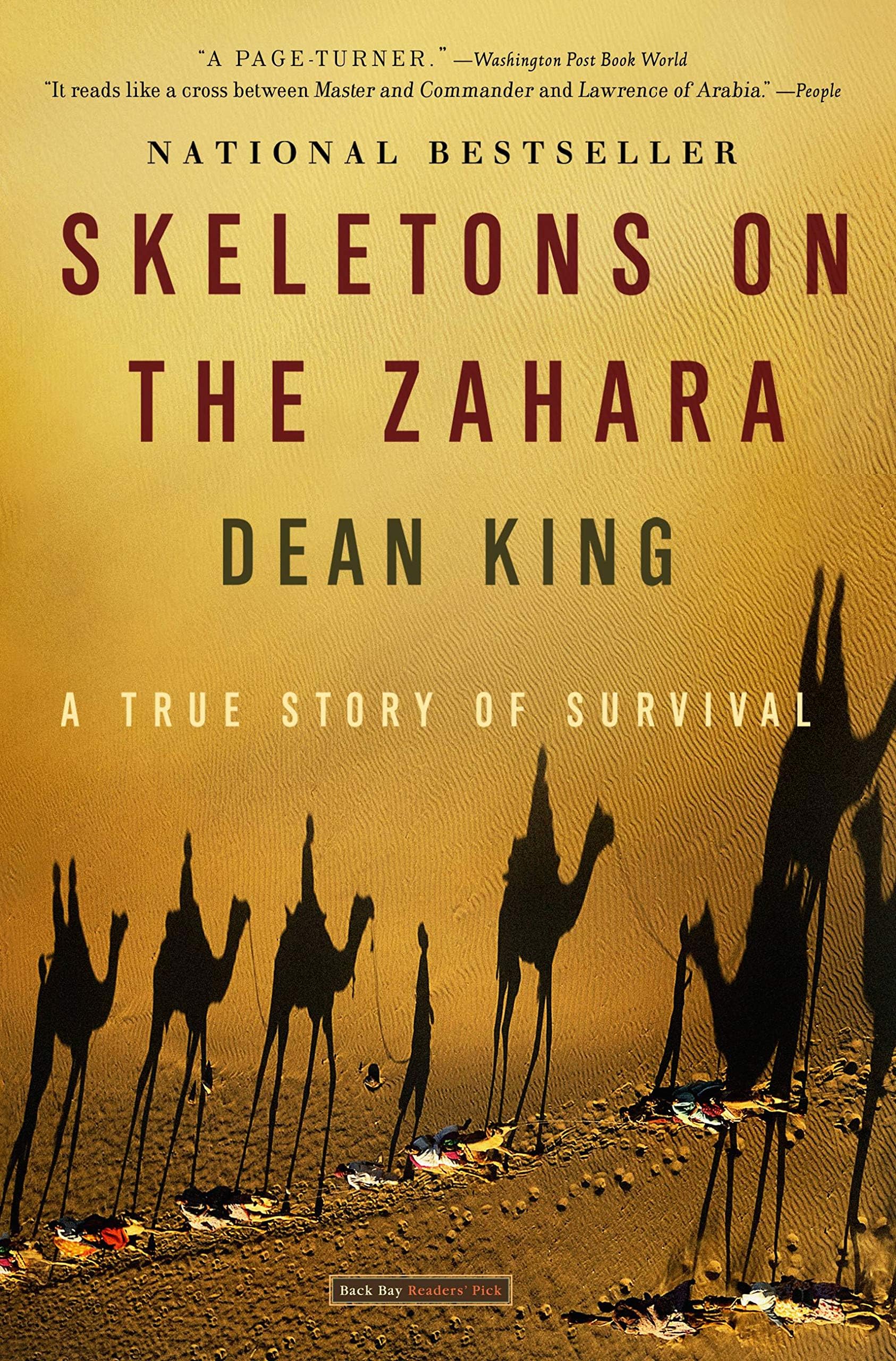
Skeletons on the Zahara: A True Story of Survival
Product ID: 237705
Buy anything from 5,000+ international stores. One checkout price. No surprise fees. Join 2M+ shoppers on Desertcart.
Desertcart purchases this item on your behalf and handles shipping, customs, and support to Kyrgyzstan.
This expansive book chronicles the true story of twelve American sailors who were shipwrecked off the coast of Africa in 1815, captured by desert nomads, sold into slavery, and subjected to a hellish two-month journey through the perilous heart of the Sahara. The western Sahara is a baking hot and desolate place, home only to nomads and their camels, and to locusts, snails and thorny scrub—and its barren and ever-changing coastline has baffled sailors for centuries. In August 1815, the US brig Commerce was dashed against Cape Bojador and lost, although through bravery and quick thinking the ship's captain, James Riley, managed to lead all of his crew to safety. What followed was an extraordinary and desperate battle for survival in the face of human hostility, starvation, dehydration, death and despair. Captured, robbed and enslaved, the sailors were dragged and driven through the desert by their new owners, who neither spoke their language nor cared for their plight. Reduced to drinking urine, flayed by the sun, crippled by walking miles across burning stones and sand and losing over half of their body weights, the sailors struggled to hold onto both their humanity and their sanity. To reach safety, they would have to overcome not only the desert but also the greed and anger of those who would keep them in captivity. From the cold waters of the Atlantic to the searing Saharan sands, from the heart of the desert to the heart of man, Skeletons on the Zahara is a spectacular odyssey through the extremes and a gripping account of courage, brotherhood, and survival. Review: 1817 Riley and crew American Brig Commerce shipwreck off Africa Sahara. Become slaves and tortured. Escape, Lincoln liked book - Skeletons On The Zahara is an excellent survival story by Dean King. He retells Captain James Riley's account of the 1817 US Brig Commerce shipwreck off the African Sahara desert, their capture by Arabs,enslavement and survival. This is a great action packed true story. I read the 353 page book in 2 days. The reader will not be board and gains much empathy with Captain Riley and his crew. There are some maps and a few B/W pictures of various men. I couldn't put the book down. The reader learns much about the Arabs in this region of African and how they treated Christians as infidel non humans. All they wanted them as slaves, to give them as much work as possible and having to cloth, and feed them as little as possible. Many were thought so little of, they were bought for as little as a blanket by other Arabs. If the slaves were lucky and perceived to have ransom value they were ransomed to diplomat consuls. They are captured by savage Arabs that enslave them. They treat Riley and his crew poorly with torture and almost starvation. They strip them of their clothing and many times the crew are almost naked. Their skin peals off in great sheets. Almost nothing to eat. Many times they must drink their own urine, others urine or camel urine to relieve their thirst. Camel milk helps keep them alive. A few of the Arabs showed some compassion even though they wanted the money of the slaves ransom. Riley and crew became walking skeletons with severe medical problems ( example 200 plus pound man down to 90 pounds).One almost goes blind. Some did not live many years after arriving back in the US. All were severely affected mentally and physically the rest of their lives. Only 1 lived to old age 82. I won't ruin the great ending David King tells about the ending of the survivors and helper lives. We see the long trek across the coast of the Sahara and eventually Riley and his crew are ransomed to the British consul .The British consul William Willshire helps save the Captain and four of his crew. Later two more are saved. Three are never heard from again. In his boyhood President Lincoln read Riley's book of the shipwreck of the Commerce and their survival and escape in the Sahara desert. It was one of his favorites. Look at all the 5 star reviews by reviewers. This is an excellent classic survival story. 5 stars and proudly added to our family library. Review: A compelling story of survival and perserverence of the human spirit - This is a difficult book to read, due to the unimaginable suffering undergone by the survivors of the wrecked American brig Commerce along the Northern Africa coast, but it is also a compelling and tightly written story that will hold the reader's interest and give tremendous insight into life in the barren desert lands of North Africa and the nomadic tribesmen inhabiting that area during the early 19th century. Briefly, the American ship is wrecked along the coast of the Saharan desert, a place well known for ill treatment of shipwrecked sailors by the nomadic tribes in that region, including robbery, torture, murder, but most often being taken as slaves. The brig's crew, after an aborted early escape attempt by lifeboat, are captured and taken as slaves. They were treated in a miserable manner, forced to travel and serve the nomad tribes without adequate food, clothing, shelter, and little ability to communicate with their captors. Several were sold and traded to other tribes and, with the exception of a few somewhat compassionate tribesmen lived a life best compared to those held in WWII concentration work camps. Their only hope was to find and convince one of their slave owners that they would be worth more if taken to more civilized areas of Northern Africa (i.e. Morocco and proximate cities) where the English and French officials would pay money to ransom them. While having no absolute knowledge that they would be successful in obtaining those ransoms, they nevertheless were able to convince (bluff, as it were) one of their more benevolent owners to take them there. The book gives comprehensive insight into the life of the nomads; their almost complete reliance on Camels (with their magnificent ability to subsist on essentially worthless shrubs, little water, and yet travel great distances) to enable their nomadic existence, Nourishment was essentially camel milk, supplemented by the occasional killing of a camel or goat. The Commerce crew would have suffered significantly even if they had been treated equally with the tribesmen, but they had a worse lot, often walking over hot desert lands with inadequate protection from the sun and heat, and getting what little milk or animal offal left after their captors had their fill. Ship's captain Riley, a robust man of over 200 pounds, weighed 90 pounds when he and what was left of his crew were finally ransomed. Much like other shipwreck novels, it is a story of survival, undergoing hardship, and how even under the most adverse conditions men can, and do, keep their will to live and ultimately survive. I enjoyed the book, and learned a lot in reading it.
| Best Sellers Rank | #89,734 in Books ( See Top 100 in Books ) #8 in North Africa History #49 in Expeditions & Discoveries World History (Books) #141 in Traveler & Explorer Biographies |
| Customer Reviews | 4.4 out of 5 stars 2,302 Reviews |
T**N
1817 Riley and crew American Brig Commerce shipwreck off Africa Sahara. Become slaves and tortured. Escape, Lincoln liked book
Skeletons On The Zahara is an excellent survival story by Dean King. He retells Captain James Riley's account of the 1817 US Brig Commerce shipwreck off the African Sahara desert, their capture by Arabs,enslavement and survival. This is a great action packed true story. I read the 353 page book in 2 days. The reader will not be board and gains much empathy with Captain Riley and his crew. There are some maps and a few B/W pictures of various men. I couldn't put the book down. The reader learns much about the Arabs in this region of African and how they treated Christians as infidel non humans. All they wanted them as slaves, to give them as much work as possible and having to cloth, and feed them as little as possible. Many were thought so little of, they were bought for as little as a blanket by other Arabs. If the slaves were lucky and perceived to have ransom value they were ransomed to diplomat consuls. They are captured by savage Arabs that enslave them. They treat Riley and his crew poorly with torture and almost starvation. They strip them of their clothing and many times the crew are almost naked. Their skin peals off in great sheets. Almost nothing to eat. Many times they must drink their own urine, others urine or camel urine to relieve their thirst. Camel milk helps keep them alive. A few of the Arabs showed some compassion even though they wanted the money of the slaves ransom. Riley and crew became walking skeletons with severe medical problems ( example 200 plus pound man down to 90 pounds).One almost goes blind. Some did not live many years after arriving back in the US. All were severely affected mentally and physically the rest of their lives. Only 1 lived to old age 82. I won't ruin the great ending David King tells about the ending of the survivors and helper lives. We see the long trek across the coast of the Sahara and eventually Riley and his crew are ransomed to the British consul .The British consul William Willshire helps save the Captain and four of his crew. Later two more are saved. Three are never heard from again. In his boyhood President Lincoln read Riley's book of the shipwreck of the Commerce and their survival and escape in the Sahara desert. It was one of his favorites. Look at all the 5 star reviews by reviewers. This is an excellent classic survival story. 5 stars and proudly added to our family library.
C**E
A compelling story of survival and perserverence of the human spirit
This is a difficult book to read, due to the unimaginable suffering undergone by the survivors of the wrecked American brig Commerce along the Northern Africa coast, but it is also a compelling and tightly written story that will hold the reader's interest and give tremendous insight into life in the barren desert lands of North Africa and the nomadic tribesmen inhabiting that area during the early 19th century. Briefly, the American ship is wrecked along the coast of the Saharan desert, a place well known for ill treatment of shipwrecked sailors by the nomadic tribes in that region, including robbery, torture, murder, but most often being taken as slaves. The brig's crew, after an aborted early escape attempt by lifeboat, are captured and taken as slaves. They were treated in a miserable manner, forced to travel and serve the nomad tribes without adequate food, clothing, shelter, and little ability to communicate with their captors. Several were sold and traded to other tribes and, with the exception of a few somewhat compassionate tribesmen lived a life best compared to those held in WWII concentration work camps. Their only hope was to find and convince one of their slave owners that they would be worth more if taken to more civilized areas of Northern Africa (i.e. Morocco and proximate cities) where the English and French officials would pay money to ransom them. While having no absolute knowledge that they would be successful in obtaining those ransoms, they nevertheless were able to convince (bluff, as it were) one of their more benevolent owners to take them there. The book gives comprehensive insight into the life of the nomads; their almost complete reliance on Camels (with their magnificent ability to subsist on essentially worthless shrubs, little water, and yet travel great distances) to enable their nomadic existence, Nourishment was essentially camel milk, supplemented by the occasional killing of a camel or goat. The Commerce crew would have suffered significantly even if they had been treated equally with the tribesmen, but they had a worse lot, often walking over hot desert lands with inadequate protection from the sun and heat, and getting what little milk or animal offal left after their captors had their fill. Ship's captain Riley, a robust man of over 200 pounds, weighed 90 pounds when he and what was left of his crew were finally ransomed. Much like other shipwreck novels, it is a story of survival, undergoing hardship, and how even under the most adverse conditions men can, and do, keep their will to live and ultimately survive. I enjoyed the book, and learned a lot in reading it.
G**S
Of Brutality and Nobility
Apparently the true story of Captain James Riley and his ill-fated crews' tale of shipwreck and subsequent capture and slavery was a popular story of the 19th century, mentioned even in the boyhood readings of Abraham Lincoln. Thanks to Dean King, this incredible story of survival, determination, and the range of the human spirit are rekindled in "Skeletons on the Zahara." In the summer of 1815, Riley and crew of the Commerce, a US merchant square-rigger home ported in Middleton, Connecticut, while heading from Gibraltar for the Canary Islands, shipwrecked off the treacherous coast of northwest Africa. Were it not for corroboration from a number of sources, including the published memoir of crewmember Archibald Robbins, this harrowing narrative of bondage and torture at the hands of the barbarous nomadic tribes of the Western Sahara Desert would simply not be believable. But through painstaking research, including his own journey through the desert retracing Riley's steps of nearly two centuries before, author King does an extraordinary job of detailing the tribulations and sufferings of the "Commerces", as well illuminating the customs and culture of the Islamic tribes of a desolate corner of the planet that to this day is mostly forgotten and hardly changed since Riley's fateful voyage. King wisely refrains from over-dramatizing the plight of Riley and his men; from the depths of depravity to the peaks of bravery and loyalty, of suffering and redemption, this story is best told unembellished. "Skeletons on the Zahara" is highly recommended for anyone with an interest in adventure, American history, nautical lore, Islamic culture, and the triumph of the soul over the body, and is yet additional proof to the old adage: fact is indeed stranger than fiction.
E**G
Phenomenal book about a tremendous ordeal.
This is a monumental work. I am amazed at the amount of research that went into the making of this book. If you like detailed historical accounts of survival, this book is for you. The author does a good job of placing the reader in the environment, maintaining suspense when necessary, and providing insight at key moments. I also appreciate the explanations at the end and the very readable Notes section. This is the first book I've read by Dean King, and I appreciate the effort he has put into the book. I look forward to reading some of his other works.
A**K
Sustained Through a Living Nightmare by a Dream
Skeletons on the Zahara tells a gruesome true story of shipwreck, slavery, survival, and ultimately freedom in an unimaginable medieval world that still existed less than two hundred years ago. Captain James Riley and the crew of the Commerce were bound for the Cape Verde Islands in August of 1815 when they strayed off course and foundered in the treacherous waters off Cape Bonjador on the Atlantic coast of north Africa. After undergoing incredible hardships they were taken captive by a band of Sahrawis - primitive desert Arabs of the coastal region who "pray earnestly to the Almighty God to send Christians ashore". The hapless crew was treated with mind boggling brutality, and their suffering as slaves "to some of the poorest people on earth, living in some of the harshest conditions imaginable" is utterly beyond belief. The story of how Captain Riley and several of his crew eventually found their way back to freedom makes for a relentless page turner - though one that is grim, devastatingly dark, and, but for a solitary dream, totally devoid of hope. So ghastly is this portrayal of man's inhumanity to man that that the reader is left simply spent, empty, and ultimately numb. Reading Skeletons on the Zahara is not enjoyable, but on some level it is surely useful and therefore recommended.
T**N
Not unlike Shackleton's Endurance, but better!
I could not put this down. Before bed, I would lay there wondering what would happen next. The characters were endearing, the treachery made me anxious, and the story consumed me totally. To imagine this actually happened is enough to make your whole world spin. It was easy to slip into their world and ask yourself if you could have done it as they had I do not give high ratings and I am not really a "book" person but I needed something to pass the time on the train for my daily commute. I would often sit at work and zone out of meetings to digest what I had read that morning. I was so sad when the story ended. It was as if I was saying goodbye to old friends for which together we had been through so much. I would highly recommend this. Also, how is this not a movie? We keep getting stupid reboots while great epics like this one are tucked away in the annals of history. Get it together, Hollywood! Furthermore, I used to think the greatest true story leadership read was Shackleton's Endurance. And while Endurance (Lansing) is phenomenal, I would argue Captain Riley of the Commerce offers more/better lessons to learn about leadership - for you corporate types.
T**D
A gripping account but incomplete
A very racy and edge of the seat account of the sufferings of the white slaves in Zahara by Dean King. King has left no stone unturned in his attempt to bring out the physical details of the sad adventures of the protagonist of the real story - Capt Riley. Many a time he ( King ) does a fact check on the narrative of the Captain which sometimes puts you off. King has gone to considerable length and expense to scientifically verify the accuracy of Riley's account. The graphic account of the geography and the lifestyles of the people in Zahara - all of which helped by the modern sophisticated technology - rivals the original and is praiseworthy. Now we come to the crux of the matter on which ground alone , this book loses its 2 stars. In my opinion it only deserves 3 stars. In his sordid desert trek , Capt. Riley develops a strong and unshakeable faith in the Almighty and his entreaties to God are filled with pathos and feelings of utter surrender to the Almighty's will. The resignation by Riley to the divine designs form an integral part of the original account. Where are these details in King's book ? I realize that Iam touching on a deeper and contentious question, the discussion of which is out of the scope of this brief review. In a flash I realize that it is the curse of our times. Bereft of a belief in the Almighty and utterly dedicated to the material realities of the world , we cannot conceive of the grace, beauty and the strength of Riley's convictions that mainly helped him to overcome the Himalayan odds facing him. This lack of faith has made us a weak willed , indolent and lazy generation. It is highly questionable whether any modern man can weather these storms with the kind of fortitude and patience that Riley displayed. The discussion of this " spirit force " of the Captain is conspicuoulsy absent in King's book. And , that becomes the downfall of this otherwise classic masterpiece. We may even go as far as to say that the author Dean King has not been faithful to the original. If at all he is an atheist , he should have left this story of Riley alone for in my opinion Riley's strong belief in God shapes the character and heart of this real life story. In one of the passages the agent of the savior , Bel Cossim remarks that Riley has been saved by God for some important purpose. Prophetic statement ! Within a span of five decades slavery was abolished in America. The book written by Capt. Riley about his privations and sufferings as a slave - which incidentally became the world's first known best seller - made a deep impact on the American President Lincoln's mind and caused him to set the slaves free. Thus Capt Riley's sufferings were vindicated.
P**N
Terrific
Tremendously well-written and researched. Difficult to put down. Read it in two days. What these men went through ... And the pitilessness of their fellow man. Utterly horrifying. But we know all about that. One of the men came out of the ordeal barely skin and bones at forty pounds! Every page is fascinating for one reason or another - customs, psychology, landscape etc. It's beyond amazing that not only one but that most of them survived. Highly recommended.
J**.
One of the best books you will be lucky to read.
An incredible story of life. A story that all Americans and British should read to understand the West's early conflict with Islam in North Africa. I was amazed and in awe of these men. The depth of faith and cruelty under the all seeing Eye of God.
D**Y
Intriguing insight into the world of men and the coastal Sahara
A very descriptive true story of survival on the raw ragged edge of life and death. Though Captain Riley was a Christian he was not spared from unimaginable suffering . One could say however that God was with him. Also his release would imprint him for life as an opponent of the slavery of men. This at a time in history where governments where being brought to a decision on the issue slavery. This book takes us to a place where few travel . That people that live here , and call it home not only amazed the author , but us as readers! The Arab world then was a brutal place...filled with treachery, and all evils. It seems rather amazing then to meet within the pages ,real God fearing Muslims who live on another plane than the 95%. One can only wonder then what has changed since this book was written nearly 200 years ago. Fascinating book really, well worth the investment of time and money.
G**N
True story of the wreck of the US ship 'Commerce'
I read this book detailing a shipwreck while on a group walking holiday in the Greek Islands, including on two boat trips! In the book the crew survived the shipwreck but were then cast ashore on the Barbary Coast and taken by locals into the Sahara (Zahara) Desert. I'd often inform my fellow holiday makers of the various deprivations and horrors the survivors had to endure and they would say to me "Why would you read such a distressing book?" I began to ask myself the same question but this is a true story and I think the answer is that it is inspiring to read how much the human body and spirit can endure and you also begin to ask yourself how you would cope in similar circumstances. Despite some of the horrible events described in the book I did really enjoy it and I followed it up with a similar book 'Death Raft' by Alexander McGee about the wreck of the ship Medusa which someone told me was similar. I chose this book because it was by Dean King the biographer of Patrick O'Brian and as I'd recently just finished reading the entire 'Master and Commander' series, I presumed this book would also be about seafaring adventures. However, although the first few chapters do deal with an ocean voyage the majority of the book is about what happened to the crew on land after they were shipwrecked.
W**A
Non Fiction
Very Good Book.
M**S
Zahara
Being shipwrecked is never pleasant, but being shipwrecked on Africa's endless Sahara coastline is about as bad as it gets. The misadventures of the poor crew members of the American brig "Commerce", hailing from the lush green hills along the Connecticut river, and having to survive in the bone-dry and hellishly hot Sahara, make for depressing reading. Departing in 1815, just after the end of the War of 1812, The "Commerce" makes a stop in New Orleans, then crosses the Atlantic and intends to sail south along the Canaries. The captain loses his bearings due to an unexpectedly fast ocean current, and the ship runs aground on the rocks near Cape Bojador, with all crew surviving. Suffering from terrible thirst, hunger and sunburn, they are eventually taken captive by the thoroughly nasty tribes inhabiting this forbidding part of our planet. Their new masters - albeit rather pious - treat them worse than slaves, at times preferring to throw away scarce water than feed it to their captives. Even the women in the tribe enthusiastically participate in mistreating the poor castaways. Probably unintentionally, 'Skeletons on the Zahara' is the ideal vacation book for cultural relativists - it might actually make them think. I do not want to give away the story, so suffice it to say that this is a book well worth reading - it is well written, riveting and provides lots of food for thought. It is a good idea to read it in small instalments, otherwise the endless suffering gets a bit too repetitive.
Trustpilot
1 month ago
2 weeks ago