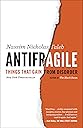


Antifragile is a standalone book in Nassim Nicholas Talebโs landmark Incerto series, an investigation of opacity, luck, uncertainty, probability, human error, risk, and decision-making in a world we donโt understand. The other books in the series are Fooled by Randomness,ย The Black Swan, Skin in the Game, and The Bed of Procrustes . Nassim Nicholas Taleb, the bestselling author of The Black Swan and one of the foremost thinkers of our time, reveals how to thrive in an uncertain world. Just as human bones get stronger when subjected to stress and tension, and rumors or riots intensify when someone tries to repress them, many things in life benefit from stress, disorder, volatility, and turmoil. What Taleb has identified and calls โantifragileโ is that category of things that not only gain from chaos but need it in order to survive and flourish. In The Black Swan, Taleb showed us that highly improbable and unpredictable events underlie almost everything about our world. In Antifragile, Taleb stands uncertainty on its head, making it desirable, even necessary, and proposes that things be built in an antifragile manner. The antifragile is beyond the resilient or robust. The resilient resists shocks and stays the same; the antifragile gets better and better. Furthermore, the antifragile is immune to prediction errors and protected from adverse events. Why is the city-state better than the nation-state, why is debt bad for you, and why is what we call โefficientโ not efficient at all? Why do government responses and social policies protect the strong and hurt the weak? Why should you write your resignation letter before even starting on the job? How did the sinking of the Titanic save lives? The book spans innovation by trial and error, life decisions, politics, urban planning, war, personal finance, economic systems, and medicine. And throughout, in addition to the street wisdom of Fat Tony of Brooklyn, the voices and recipes of ancient wisdom, from Roman, Greek, Semitic, and medieval sources, are loud and clear. Antifragile is a blueprint for living in a Black Swan world. Erudite, witty, and iconoclastic, Talebโs message is revolutionary: The antifragile, and only the antifragile, will make it. Praise for Antifragile โAmbitious and thought-provoking . . . highly entertaining.โ โ The Economist โA bold book explaining how and why we should embrace uncertainty, randomness, and error . . . It may just change our lives.โ โ Newsweek


| Book 3 Of 5 | Incerto |
| Country Of Origin | India |
| Dimensions | 13.18 x 3.12 x 20.32 cm |
| Edition | Reprint |
| Isbn 10 | 0812979680 |
| Isbn 13 | 978-0812979688 |
| Item Weight | 408 g |
| Language | English |
| Net Quantity | 1.0 Count |
| Print Length | 519 pages |
| Publication Date | 28 January 2014 |
| Publisher | Random House Inc |
User
Good insights
Book gave unconventional knowledge apart what is commonly understood.It removes many of myths that we were having.Excellent book.
User
Must read
Great read. Must have.
User
Good read
Haven't completed yet, but the book is good. Readability could've been better.
User
Good book
Best book. Read all books by NNT
User
Antifragility to survive, thrive and develop in unpredictable environment
Antifragile: Things That Gain from Disorder by Nassim Nicholas Taleb is a thought-provoking and insightful book that challenges readers to rethink their assumptions about risk, uncertainty, and resilience. Taleb is a renowned thinker and writer, and his ideas have had a significant impact on fields as diverse as finance, economics, and philosophy.The concept of antifragility, as introduced by Nassim Nicholas Taleb in his book "Antifragile: Things That Gain from Disorder", describes systems or entities that not only withstand stress, shocks, and uncertainty, but actually thrive and improve as a result. Antifragility is the opposite of fragility, where a system or entity is vulnerable to damage or collapse under stress, shocks, and uncertainty.Antifragile systems are characterized by their ability to adapt and learn from mistakes, to use variability and randomness to their advantage, and to improve through exposure to stressors. These systems are not only resilient, but they actively seek out and benefit from disruption and disorder.Taleb argues that antifragility is an essential characteristic for survival and success in complex and unpredictable environments. He identifies a range of antifragile systems, from biological organisms that improve through exposure to stressors, to businesses that thrive in volatile markets, to cultures and social systems that evolve through trial and error.In practical terms, the concept of antifragility has important implications for individuals, organizations, and societies. It suggests that instead of trying to eliminate risk and uncertainty, we should focus on building systems that can adapt and benefit from them. This might mean embracing experimentation and failure, seeking out diverse perspectives and approaches, and building redundancy and flexibility into our systems.Overall, the concept of antifragility challenges us to think differently about how we approach risk, uncertainty, and change. It offers a new perspective on resilience and adaptability, and suggests that there are opportunities for growth and improvement even in the most challenging and unpredictable situations.Overall, the book is an eye opener to think about risk and how to adjust to unpredictable environment.
User
dumbbells for the brain
What a phenomenal piece of writing. It almost feels like Nassim wants us to workout our brains. Donโt miss this.
User
Read and become Anti Fragile
If you had read "The Black Swan" or if you follow Nicholas Nassim Taleb on twitter, you are probably aware that many people find his style to be arrogant, pompous and cantankerous. And yet you will find there is a significantly group of individuals who love and values his insights and style of writing. Anti fragile is a hard book to summarise and categorise. (It cut across different domains like anthropology, economics, medicine, history, religion). Let me try to summarise the content nonetheless.What is Anti fragile? Many things/institutions/individuals are fragile to volatility. Like a vase which is fragile and breaks if it falls. What is the opposite of fragile? Many think that the opposite of fragile is robust. (Things which are unaffected by volatility). But Taleb says things which gains from volatility is the opposite and he calls it Anti Fragile. We may be intellectually blind to it not organically blind. Example: Hormesis, favourable response to small dose of toxins.Below are some interesting insights from the book.In Book one:Domain independence is domain dependence. Meaning one may be aware X is true in a specific domain and completely blind to the same X in a different domain.Stress is information. Information is anti fragile. Therefore stress is anti fragile. It is said that best horses lose when they compete with slower ones. If you want something to be done give to the busiest or second busiest person in work.Touristification of life: Eliminating randomness in life by trying too much to control life makes us fragile. You may find people who do well in academica to be boring. Hence erudition is anti fragile and academia is fragile.In Book two:Bottom up design is anti fragile because it has a lot of median variation. Top to bottom design is fragile because it has extreme variation. Therefore some form of volatility is good.The Great Turkey problem: fooled by the properties of the past and getting the story backward. Turkey is fed everyday by the butcher; everyday it confirms its staff analyst that the butcher loves turkey. Then comes a day when it's not a good idea to be a turkey. Therefore ABSENCE OF EVIDENCES IS NOT EVIDENCE OF ABSENCE.Modernity is the systematic extraction of humans from the randomness of life. Like a lion in bronx zoo.Intervention causes iatrogenics. Go for intervention only when the benefits outweighs the cost. Therefore only for extreme scenarios.In Book three:Having a library is anti fragile.Introduces Stoicism, Seneca the practical stoic and the domestification of emotions.Barbell strategy is the domestic of uncertainty. Instead of going for mid risk options, use 80% conservative risk and 20% extreme risk. In the event of black swan, you will be protected from fragility.In Book four:Make use of optionality. Option= asymmetric + rationality.Negatives of Soviet-Harvard types knowledge. Debunks some common misconceptions of Academia. Example wealth creates knowledge and not the other way around.Book five is for those who are technically inclined.In Book Six:Less is more. Importance of Subtractive knowledge. You get rich by not going bust.In Book Seven:Being ethical makes you anti fragile.Modernity provides talkers (Journalists and Economists)free option. Example Thomas Friedman openly advocate the war on Iraq (2003) .Despite all his predictions and advocacies were spectacularly wrong, he doesn't face any consequences of his action. The ancients were aware of the talker's free option and advocated skin in the game.Hammurabi code written in 1750BC Mesopotamia advocates skin in the game.
User
Taleb explains it pretty well. Usual boast though.
Taleb has explained the concept of Anti fragile so very well. Fragile, robust and anti fragile are very different things. It is his normal nature where he tries to get too deep into explanations, sometimes straying away from the topic. This usually takes some interest away. The usual boasting of his self confidence is also something you would sulk at a bit.Full marks to him for the concept and explanations. There is improvement required on the empathy quotient with the reader. Maybe that is what differentiates Taleb from all other writers in the market.
User
This book changed my life
When I first read Jurgen Appelo's Management 3.0 I was already deeply impressed. Then Frรฉdรฉric Laloux' "Reinventing Organizations" touched me even more. By a random pick from a "dotnet rocks" podcast about antifragile software architectures I detected this literature gem.This book is philosphical, yet practical for the day-to-day endeavours we encounter in our so-called modern world. It opens your eyes how things influence each other. That our world is not linear and non-predictable. And that it is good that way. Taleb demystifies the scharlatan sciences such as economics as taugh in universities today and detects the vulnerable point in our western societies. Yet this is not a book to complain about the atrocities of the world we're living in. Instead it makes courage. Courage to look at our world with different eyes. See what is a short gain, but probably non-lasting like a spark. Detect what is more lasting - or antifragile - since robustness is not the inverse of fragility.This book has impact on technology, society, sociology, almost every corner of our life. Still Taleb is not a radical: While pointing out how nature helps to cure itself and is the most persistent and antifragile institution ever he doesn't get into a mood of Darwinism or survival of the fittest. He just shows up where our limits are and what's the tradeoff of the lives we live today.Deeply impressing, a must-read. My world would be paler if I had missed this book.
User
Excellent
Excellent
User
excellent reading
insightful. not pacifist. direct.ideas in the book are self-standing and make logical sense.very helpful for understanding risks and systems
User
5 things Nassim Nicholas Taleb hates
The third book of Taleb's Incerto trilogy was published in November 2012 and is now available in paperback. His first two books, Fooled By Randomness and The Black Swan, sold so well that he was paid an advance of $4m for the final instalment.Antifragile is an interesting read both intellectually and personally. Taleb famously gives little away to journalists but in this book his personality shines out through his writing. So emotionally charged is the book, I thought it would be appropriate to review it by reference to the subjects contained that come in for the most vitriol from Taleb.1. BankersReaders familiar with Taleb's other writings will already know how he feels about bankers. Taleb's definition of antifragility (systems that get stronger under volatility, as opposed to fragile ones that break) stems from his work in banking. One criticism that is already gaining much ground elsewhere is the absence of "skin in the game" for traders gambling with their clients' money. But Taleb's dislike of bankers is not just an academic one. Personal insults abound, including a "suit" held to task for getting a porter to carry his bags to the gym.2. PoliticiansFragility is often seen at a relatively simple level, a glass being the obvious example, whereas antifragility is a property of complex systems - the human body, human populations or markets. Politicians come under fire on (at least!) two counts. First, they cause chaos by interfering with systems that they do not understand. In particular, interventions by politicians tend to favour eradication of error, which increases fragility and risk of collapse. Secondly, and more strongly, politicians frequently gain personal advantage at the cost of others by talking a good game that they do not practice in their own lives.3. EconomistsI don't think I need to explain why Taleb hates economists or give examples from the book. Instead I just want to mention Taleb's rather touching fondness for Nobel-prize winning economist Joseph Stiglitz. Despite Taleb naming the Stiglitz syndrome (predicting the future inconsistently and only taking credit for the ones that turn out to be correct) after him, Stiglitz does not come in for the same strength of insults dished out to other "fragilistas" and I am amused by my impression Taleb secretly quite likes him.4. Alternative MedicineTaleb has a disdain for all modern medicine, and a whole section of the book explains the wrongheadedness of risking a serious issue by using insufficiently tested medicine for a non-life-threatening condition. The terrible example of treating morning sickness with thalidomide makes this point well. But don't confuse Taleb's skepticism with a belief in alternative therapies - he "went postal" on receiving a letter of support from one such practitioner saying she understood how he felt.5. Orange JuiceTaleb's hatred for orange juice is an example of a wider disdain for the modern diet. He reveals his personal food rules, and very fascinating they are: no liquids that have not existed for at least one thousand years (i.e. wine, water and coffee only), no fruit not present in the ancient Mediterranean (no pineapples, pawpaws or other exotica) and observance of Greek Orthodox fasts for health rather than religious reasons. He considers oranges to be the equivalent of candy, as the modern variety have been intentionally bred for their sweetness.I found Antifragile to be thought provoking and very entertaining. It is full of contradictions and inconsistencies, but the sincere passion behind the main themes gives the book its charm. The most delicious irony is that according to Taleb's own criteria - a book is more likely to contain accurate useful ideas the longer it has been in existence - the reader made their first mistake in choosing to pick the book up.
User
Great insights & Climax towards the end although there were some unfair statements to Dr Stiglitz
Like his previous book, there are many extremely unique insights and with so many topics mashed into a single book; it is pretty normal to read the book two or three times (like I did with the Black Swan) in order to fully appreciate the depth of the author's knowledge and the wisdom of the ancients.However, like many reviewers, I too think the author should submit his essays for editing: there are parts that are dryer than usual.So to make it more readable and for the 2nd edition of the book, he should add more satirical jokes or funny thought experiments that lighten the mood (esp. for sub book IV?)The idea of iatrogenics (or harmful side effects from receiving treatments) is interesting (In Chinese Medicine, there's a saying,"medicine carries 30% of poison")Other key insights include Stoicism, skin in the game, and many useful heuristics. In fact, we could "platonize" his key insights into useful checklists!In sum, It's a great read epecially towards the end, and it's fun reading his rants against famous authors/scholars though there are places where I feel pity and a bit unfair to scholars like Mr Stiglitz who in March 2002 (on page 478) published a paper saying that Fannie Mae 's new risk based capital standard:"ON THE BASIS OF HISTORICAL EXPERIENCE, the risk to the government from a potential default on GSE debt is effectively zero"Is this statement really completely wrong? is the author not subjected to hindsight bias? At least 9 months later ,the author in chapter 19 wrote a journalist from NY Times came to him sometime in 2003 concerning about the Fannie Mae problems; Then he wrote "if he (Stiglitz) were a businessman, he would be wiped out and exited the gene pool"That sounds way too harsh and affirmative. I would say the author suffers from overconfidence (in the same way as Stiglitz for his 2002 paper) to assert such an outrageous statement.Does a businessman, if Dr Stiglitz were one, have no optionality to get rid of his exposure or simply sell his stakes when facts and conditions change? Is it fair to insinuate that Dr Stiglitz or all investors back in 2002 would be stupid enough, after conditions obviously had changed by say 2005, to stick with Fannie Mae until it was bailed out?I think you could only argue Dr Stiglitz was overconfident about his assessments but we never knew back then in March 2002 that Alan Greenspan would maintain interest rates at such a low level for so long, and the author only realised the problem sometime in 2003.Talab is correct that Dr Stiglitz didn't see himself potentially as being the Turkey, but everyone makes mistakes based on what information they have, and I presume if Dr Stiglitz were the businessman, he would be like Warren Buffett who mistakenly bought Gen Re and had to sell all those derivatives contracts to reduce exposure.So despite loving the author's work, I would advise him to be a bit more humble and shouldn't assume the "smartest of economist" to be the most stupid investor or businessman: buy and hold or not change course towards the end even when there were so many new evidences against his initial position like housing bubble and ninja loans etc.This is completely the opposite of the Turkey's confidence being maximum based on historical evidence of being fed daily, right before the chef cooks it.To conclude, it is slightly cheap to attack an economist who he too respects in order to become infamous with assumptions that are unlikely to be true.However his main point "Joseph Stiglitz problem" might be true: "Mental cherry-picking, leading to contributing to the cause of a crisis while being convinced of the opposite-and thinking he predicted it" (pg. 432)And with his super intelligence, the author probably knows his statement "exit the gene pool" being too harsh - the attacks are probably a ploy to gain controversy deliberately to promote his book !! (he actually explained that the more criticisms the author received, the greater the sales!!) So I am helping the author to sell his book!!Anyway, whether you agree or not, readers should be grateful for having such thought provoking wonderful book available !the glossary, appendix and notes (about 50 pages) have some more interesting and technical discussions.Thank you very much for writing such amazing book! Looking forward to the expanded version of Anti fragility in the near future with more satirical jokes and funny thought experiments in between the dry parts!
Trustpilot
5 days ago
2 weeks ago