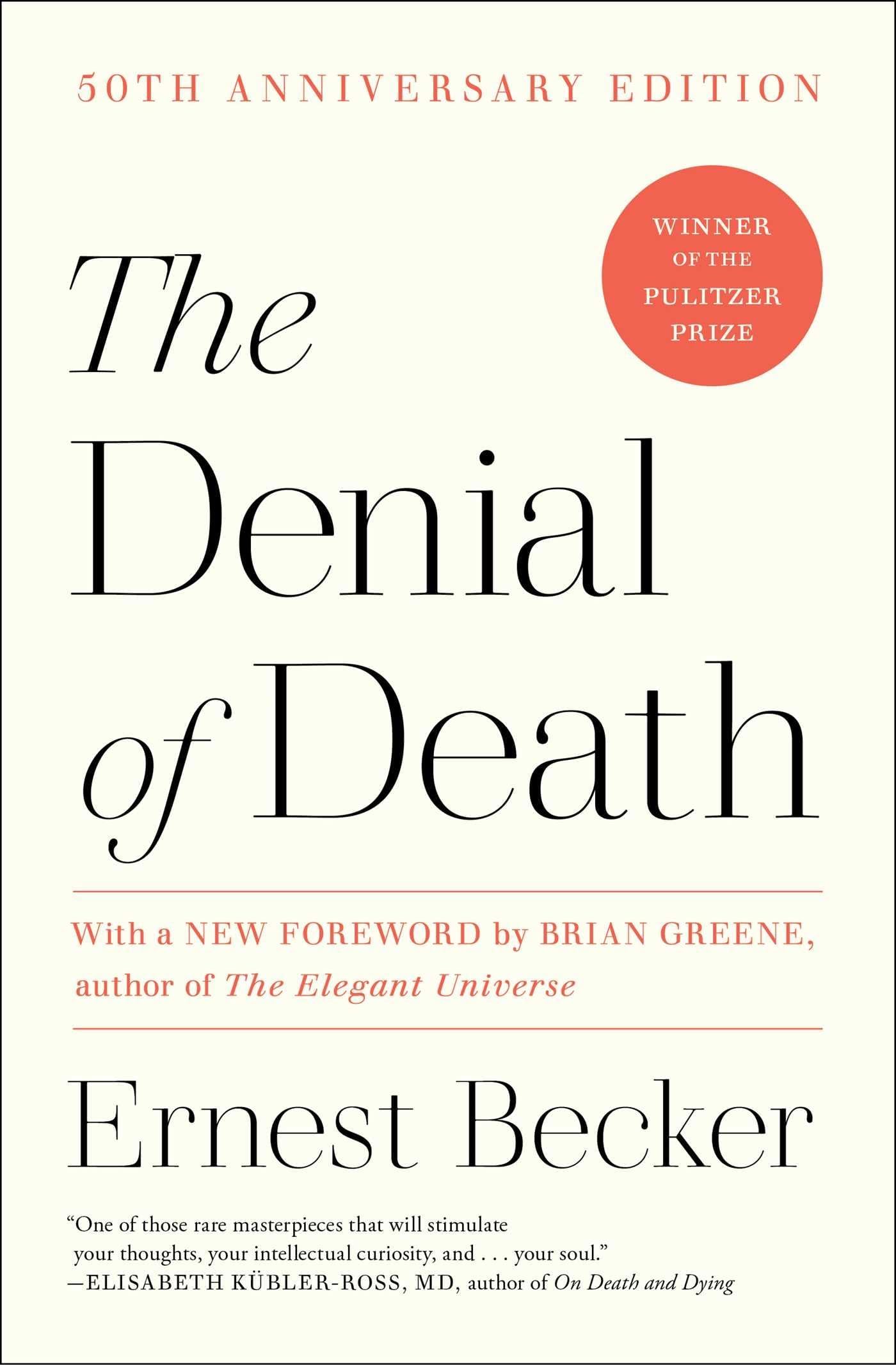

desertcart.com: The Denial of Death: 9780684832401: Ernest Becker: Books Review: A Monumental Book. - Becker's Pulitzer Prize-winning work addresses the fundamental drive of the human condition, delving into societal institutions, pathologies, and irrational behaviors. In his exploration, Becker presents a profound psychological argument for the pan-cultural religious impetus compelling individuals to merge with a beyond while also seeking individual distinction. He astutely illustrates the illusory nature of seemingly secular cultures, shedding light on the structural similarities they share with outgrown religious beliefs. Embedded within his argument is the rejection of truth as a highly valued principle in statecraft, compelling readers to reconsider their perception of societal realities. Through a three-part exploration, Becker skillfully navigates the complex human dilemma, offering a detailed outline of the problem, common solutions, and an incisive analysis of society through this framework. The fundamental struggle faced by humans, according to Becker, stems from a unique dichotomy that only humans grapple with. This symbolic identity places individuals in an existential dilemma; they are both capable of comprehending abstract concepts, such as infinity and atoms, yet they must confront the objectively meaningless nature of their lives and the prospect of their eventual demise. Becker suggests that one aspect of the fear of life lies in the overwhelming awe, fear, and incomprehensibility that comes with existence. In confronting the complexity of one's own existence, there arises a fear of being insignificant, leading to a struggle to find meaning in an incomprehensible world. These dual fears of life and death contribute to the heroic urges that Becker describes, urging individuals to strive for transcendence and create their own sense of significance even in the face of potential meaninglessness. One of the qualities of Man that fascinated Becker was how we have an instinctive sense to "be good." But what is goodness? The twin urges of Agape and Eros are a reflection of Man's pursuit of transcendence and individual significance. Agape is the reflex against the impermanence from death, seeking meaning through merging with an ultimate beyond. On the other hand, Eros is the reflex against the insignificance from life, striving for uniqueness and importance. This concept explains the dual motivations behind human behavior and the innate drive to create distinctions between Good and Evil in order to carve out meaning in the world. Both Agape and Eros enable us to navigate the complexities of existence by providing a sense of direction and cultivating individual greatness. However, there's a profound tension in this process as these twin urges can often be antagonistic to each other. In Becker’s view, character defenses, represented by identity and narrative, assist in giving individuals the sense of control and unique identity essential for functioning in the world. Becker also discusses the use of transference objects as a way for individuals to find grounding and direction in the complexities of life. These objects provide a source of identification and direction, helping individuals navigate the overwhelming awe, wonder, and fear that existence often brings. Both character defenses and transference objects serve as coping mechanisms to grapple with the terrifying dilemma of human existence. Becker’s view on how cultural elements play a role in our lives is insightful and intriguing. He discusses the concept of leaders as transference objects, emphasizing how the crowd's fascination with leaders highlights the hypnosis of power and the desire to merge with omnipotence. Beyond leaders, he delves into the idea of lovers as transference objects, explaining how romantic interests take on the role of encapsulating power, immortality, and the designator of good and evil. In both these cases, Becker demonstrates how cultural elements serve as symbolic structures fulfilling the innate human urge for heroism through Agape and Eros. This comprehensive analysis provides a deeper understanding of how individuals seek meaning and significance within cultural dynamics. Becker’s analysis of the effectiveness and benefits of religion highlights how it directly addresses the problem of transference by expanding awe and terror to the cosmos where they belong. It provides a framework that takes the problem of self-justification and removes it from the objects near at hand, allowing individuals to lean on powers that truly support and do not oppose them. However, the failures of modernity as outlined by Becker point out that globalization and analytical ability have rendered people cynical, depriving them of the ability to have faith. The diversity in ideology poses a threat to heroism, and it becomes disheartening to see 'authorities who are equally unimpeachable hold opposite views.' Becker's comparison of cultural heroes and societal outcasts sheds light on the existential dichotomy faced by those who venture into the realm of creativity. His contention that artists and societal outcasts are only separated by a small degree of "talent" implies that creativity and madness share a connectedness. Conferring cultural heroes with creative genius, Becker's analysis illustrates how the innovators who attempt to furnish an entirely new meaning to creation and history shoulder the weight of justifying previous and potential alternative meanings alone. As a result, the burden of fabricating one's own religion, as argued by Becker, leads to a hypervigilant state, facing the fear that no beyond can prevent creatives from exhausting every bit of themselves in the artistic process. Review: Timeless wisdom - The following sums up the central theme of this Pulitzer Prize-winner: "For now, it is enough to invoke Marcia Lee Anderson's complete scientific formula: `Stripped of subtle complications [i.e., of all the character defenses - repression, denial, misconceptions of reality], who could regard the sun except with fear?'"(p.66) Hereafter I'll quote extensively, as opposed to paraphrasing, in order to make it as beneficial for the interested individual as I can. Ernest chose a title that he knew would resonate with the public: The Denial of Death. But the book should have been called `The Denial of Life', because people not only repress their inevitable demise, but even more so their lives. The book is centered on the philosophy that every person starting in childhood creates an imaginary world where, to put it simply, everything is better and the people are nicer, so not to perceive the intricately problematic reality. Ernest aptly summarized prominent thinkers and students of human nature of the past 150 years, including Soren Kierkegaard, Otto Rank, Norman Brown, and Sigmund Freud. One might rightfully say that some of the latter men's conclusions were repudiated by modern thought. However, their fundamental findings - such as Freud's narcissist, Kierkegaard's `introvert', or Rank's artist - on characters of man are timeless. Details, tactics, and strategies of how to approach the very complex study of human nature change, but the nature itself doesn't. As much as I wish to discuss this book at length, I won't do it for lack of space. I'll succinctly outline the work of one philosopher, who is one of the most astute men in history, and briefly summarize two others, Sigmund Freud and Otto Rank. The 19th-century Danish philosopher Soren Kierkegaard analyzed man's inner characters. Even though more than 150 years have elapsed, his ingenuous analysis can readily be applied to our modern society. The immediate man - the modern inauthentic or insincere man - is someone who blindly follows the trends of society to the dot. Someone who unthinkingly implements what society says is "right." "He recognizes himself only by his dress,...he recognizes that he has a self only by externals." (p.74) He converts frivolous patterns to make them his identity. He often distorts his own personality in order to "fit into the group". His opinion means nothing even to himself, hence he imitates others to superficially look "normal." The introvert, the one "who tries to cultivate his interiority...he is a little more concerned with what it means to be a person", he who "enjoys solitude and withdraws periodically to reflect." (p.82) He enjoys reading and thinking about the deepness of life, human relations, and the universe in general. But Ernest wrote that introvert "is not an immediate man, but not a real man either, even though he gives the appearance of it." (p.83) And finally "the one who asserts himself out of defiance of his own weakness, who tries to be a god unto himself, the master of his fate, a self-created man." (p. 84) But "the ugly side of this Promethianism is that it, too, is thoughtless, and empty-headed immersion in the delight of technics with no thought to goals or meaning." (p.85) The aforementioned personalities are not what Ernest considered "real" men. Ernest, by interpreting Kierkegaard, regarded "the true individual, the self-realized soul, the 'real man,' is the one who has transcended himself." (p.86) (When he talks about self-transcendence throughout the book the text understandably becomes abstract.) He is the one who has admitted that his essential character has been a big lie, created to protect the self from the difficult reality of life. In order to psychologically survive such a realization one has to surrender oneself to the Ultimate Power of Creation, or so Ernest recommends. The book also talks at length about Freud, "perhaps the greatest psychologist who ever lived." (p.256), the man who was "like a Biblical prophet, who spoke a truth that no one wants to hear...whose pessimism [was] grounded in reality, in scientific truth." (p.94) He was a cynic who did not deceive himself about the man's "basic creatureliness," his inner animal. He was hated by many for unveiling that the fundamental nature of every man is weak and self-deceptive. He was the mentor of Otto Rank, who was a brilliant psychoanalyst. Eventually Freud severed his relationship with Rank due to irreconcilable disagreements. It seems that Becker worshipped Rank religiously. When Rank was 21, he impressed Freud so much with his intellect and insight that Freud made him a part of his inner-circle of confidants. Rank's most monumental work was his `Art and Artist'. In it Rank contemplated the creative type of man, who is the one whose "experience makes him take in the world as a problem...but when you no longer accept the collective solution to the problem of existence, then you must fashion your own...The work of art is...the ideal answer..." And now I'll briefly express my disagreement with Becker's ultimate cure for man's despondent predicament of "real" life. I certainly am not as knowledgeable as Becker and my opinion towards life will definitely change during the years, but now let's not be "the modern mechanical men in Russia, the near-billion sheeplike followers in China, and the brutalized and ignorant populations of almost every continent." (p.281) Even though Becker didn't advocate any particular religion, "finding god" unavoidably decays one's mind and leads him to Christianity, Islam, etc. The fact that can't be refuted is that religion in general, Christianity in particular, has been the most efficient and cruel oppressor of intellect for millennia. And, because it has also been the most potent restraint upon progress, one would only shrink and limit his horizons by adhering to it. And what I deem especially interesting about Ernest's prescription for a god is that it was a way to battle one's fear and dejection. Fear, that indelible and prevalent emotion of men in any culture was relied on by religion to compel men to follow man-made Biblical laws. I'm not an advocate of atheism. But I'm a proponent of full and interesting life, something that religion takes away by promising to arrange an eternal afterlife. Notwithstanding some of the Becker's conclusions that I don't agree with, this book is the best work on human nature that I know of; somewhat superior to `On Human Nature' by Edward Wilson. I must warn though that having read it thoroughly will not only alter your outlook on life and your relationships with your peers, but it will also make you sadder...but wiser.
| Best Sellers Rank | #9,522 in Books ( See Top 100 in Books ) #6 in Death #12 in Medical General Psychology #35 in Grief & Bereavement |
| Customer Reviews | 4.4 4.4 out of 5 stars (3,301) |
| Dimensions | 5.5 x 1.1 x 8.38 inches |
| Edition | First Free Press Paperbacks Edition |
| ISBN-10 | 0684832402 |
| ISBN-13 | 978-0684832401 |
| Item Weight | 10.4 ounces |
| Language | English |
| Print length | 336 pages |
| Publication date | May 8, 1997 |
| Publisher | Free Press |
T**A
A Monumental Book.
Becker's Pulitzer Prize-winning work addresses the fundamental drive of the human condition, delving into societal institutions, pathologies, and irrational behaviors. In his exploration, Becker presents a profound psychological argument for the pan-cultural religious impetus compelling individuals to merge with a beyond while also seeking individual distinction. He astutely illustrates the illusory nature of seemingly secular cultures, shedding light on the structural similarities they share with outgrown religious beliefs. Embedded within his argument is the rejection of truth as a highly valued principle in statecraft, compelling readers to reconsider their perception of societal realities. Through a three-part exploration, Becker skillfully navigates the complex human dilemma, offering a detailed outline of the problem, common solutions, and an incisive analysis of society through this framework. The fundamental struggle faced by humans, according to Becker, stems from a unique dichotomy that only humans grapple with. This symbolic identity places individuals in an existential dilemma; they are both capable of comprehending abstract concepts, such as infinity and atoms, yet they must confront the objectively meaningless nature of their lives and the prospect of their eventual demise. Becker suggests that one aspect of the fear of life lies in the overwhelming awe, fear, and incomprehensibility that comes with existence. In confronting the complexity of one's own existence, there arises a fear of being insignificant, leading to a struggle to find meaning in an incomprehensible world. These dual fears of life and death contribute to the heroic urges that Becker describes, urging individuals to strive for transcendence and create their own sense of significance even in the face of potential meaninglessness. One of the qualities of Man that fascinated Becker was how we have an instinctive sense to "be good." But what is goodness? The twin urges of Agape and Eros are a reflection of Man's pursuit of transcendence and individual significance. Agape is the reflex against the impermanence from death, seeking meaning through merging with an ultimate beyond. On the other hand, Eros is the reflex against the insignificance from life, striving for uniqueness and importance. This concept explains the dual motivations behind human behavior and the innate drive to create distinctions between Good and Evil in order to carve out meaning in the world. Both Agape and Eros enable us to navigate the complexities of existence by providing a sense of direction and cultivating individual greatness. However, there's a profound tension in this process as these twin urges can often be antagonistic to each other. In Becker’s view, character defenses, represented by identity and narrative, assist in giving individuals the sense of control and unique identity essential for functioning in the world. Becker also discusses the use of transference objects as a way for individuals to find grounding and direction in the complexities of life. These objects provide a source of identification and direction, helping individuals navigate the overwhelming awe, wonder, and fear that existence often brings. Both character defenses and transference objects serve as coping mechanisms to grapple with the terrifying dilemma of human existence. Becker’s view on how cultural elements play a role in our lives is insightful and intriguing. He discusses the concept of leaders as transference objects, emphasizing how the crowd's fascination with leaders highlights the hypnosis of power and the desire to merge with omnipotence. Beyond leaders, he delves into the idea of lovers as transference objects, explaining how romantic interests take on the role of encapsulating power, immortality, and the designator of good and evil. In both these cases, Becker demonstrates how cultural elements serve as symbolic structures fulfilling the innate human urge for heroism through Agape and Eros. This comprehensive analysis provides a deeper understanding of how individuals seek meaning and significance within cultural dynamics. Becker’s analysis of the effectiveness and benefits of religion highlights how it directly addresses the problem of transference by expanding awe and terror to the cosmos where they belong. It provides a framework that takes the problem of self-justification and removes it from the objects near at hand, allowing individuals to lean on powers that truly support and do not oppose them. However, the failures of modernity as outlined by Becker point out that globalization and analytical ability have rendered people cynical, depriving them of the ability to have faith. The diversity in ideology poses a threat to heroism, and it becomes disheartening to see 'authorities who are equally unimpeachable hold opposite views.' Becker's comparison of cultural heroes and societal outcasts sheds light on the existential dichotomy faced by those who venture into the realm of creativity. His contention that artists and societal outcasts are only separated by a small degree of "talent" implies that creativity and madness share a connectedness. Conferring cultural heroes with creative genius, Becker's analysis illustrates how the innovators who attempt to furnish an entirely new meaning to creation and history shoulder the weight of justifying previous and potential alternative meanings alone. As a result, the burden of fabricating one's own religion, as argued by Becker, leads to a hypervigilant state, facing the fear that no beyond can prevent creatives from exhausting every bit of themselves in the artistic process.
V**N
Timeless wisdom
The following sums up the central theme of this Pulitzer Prize-winner: "For now, it is enough to invoke Marcia Lee Anderson's complete scientific formula: `Stripped of subtle complications [i.e., of all the character defenses - repression, denial, misconceptions of reality], who could regard the sun except with fear?'"(p.66) Hereafter I'll quote extensively, as opposed to paraphrasing, in order to make it as beneficial for the interested individual as I can. Ernest chose a title that he knew would resonate with the public: The Denial of Death. But the book should have been called `The Denial of Life', because people not only repress their inevitable demise, but even more so their lives. The book is centered on the philosophy that every person starting in childhood creates an imaginary world where, to put it simply, everything is better and the people are nicer, so not to perceive the intricately problematic reality. Ernest aptly summarized prominent thinkers and students of human nature of the past 150 years, including Soren Kierkegaard, Otto Rank, Norman Brown, and Sigmund Freud. One might rightfully say that some of the latter men's conclusions were repudiated by modern thought. However, their fundamental findings - such as Freud's narcissist, Kierkegaard's `introvert', or Rank's artist - on characters of man are timeless. Details, tactics, and strategies of how to approach the very complex study of human nature change, but the nature itself doesn't. As much as I wish to discuss this book at length, I won't do it for lack of space. I'll succinctly outline the work of one philosopher, who is one of the most astute men in history, and briefly summarize two others, Sigmund Freud and Otto Rank. The 19th-century Danish philosopher Soren Kierkegaard analyzed man's inner characters. Even though more than 150 years have elapsed, his ingenuous analysis can readily be applied to our modern society. The immediate man - the modern inauthentic or insincere man - is someone who blindly follows the trends of society to the dot. Someone who unthinkingly implements what society says is "right." "He recognizes himself only by his dress,...he recognizes that he has a self only by externals." (p.74) He converts frivolous patterns to make them his identity. He often distorts his own personality in order to "fit into the group". His opinion means nothing even to himself, hence he imitates others to superficially look "normal." The introvert, the one "who tries to cultivate his interiority...he is a little more concerned with what it means to be a person", he who "enjoys solitude and withdraws periodically to reflect." (p.82) He enjoys reading and thinking about the deepness of life, human relations, and the universe in general. But Ernest wrote that introvert "is not an immediate man, but not a real man either, even though he gives the appearance of it." (p.83) And finally "the one who asserts himself out of defiance of his own weakness, who tries to be a god unto himself, the master of his fate, a self-created man." (p. 84) But "the ugly side of this Promethianism is that it, too, is thoughtless, and empty-headed immersion in the delight of technics with no thought to goals or meaning." (p.85) The aforementioned personalities are not what Ernest considered "real" men. Ernest, by interpreting Kierkegaard, regarded "the true individual, the self-realized soul, the 'real man,' is the one who has transcended himself." (p.86) (When he talks about self-transcendence throughout the book the text understandably becomes abstract.) He is the one who has admitted that his essential character has been a big lie, created to protect the self from the difficult reality of life. In order to psychologically survive such a realization one has to surrender oneself to the Ultimate Power of Creation, or so Ernest recommends. The book also talks at length about Freud, "perhaps the greatest psychologist who ever lived." (p.256), the man who was "like a Biblical prophet, who spoke a truth that no one wants to hear...whose pessimism [was] grounded in reality, in scientific truth." (p.94) He was a cynic who did not deceive himself about the man's "basic creatureliness," his inner animal. He was hated by many for unveiling that the fundamental nature of every man is weak and self-deceptive. He was the mentor of Otto Rank, who was a brilliant psychoanalyst. Eventually Freud severed his relationship with Rank due to irreconcilable disagreements. It seems that Becker worshipped Rank religiously. When Rank was 21, he impressed Freud so much with his intellect and insight that Freud made him a part of his inner-circle of confidants. Rank's most monumental work was his `Art and Artist'. In it Rank contemplated the creative type of man, who is the one whose "experience makes him take in the world as a problem...but when you no longer accept the collective solution to the problem of existence, then you must fashion your own...The work of art is...the ideal answer..." And now I'll briefly express my disagreement with Becker's ultimate cure for man's despondent predicament of "real" life. I certainly am not as knowledgeable as Becker and my opinion towards life will definitely change during the years, but now let's not be "the modern mechanical men in Russia, the near-billion sheeplike followers in China, and the brutalized and ignorant populations of almost every continent." (p.281) Even though Becker didn't advocate any particular religion, "finding god" unavoidably decays one's mind and leads him to Christianity, Islam, etc. The fact that can't be refuted is that religion in general, Christianity in particular, has been the most efficient and cruel oppressor of intellect for millennia. And, because it has also been the most potent restraint upon progress, one would only shrink and limit his horizons by adhering to it. And what I deem especially interesting about Ernest's prescription for a god is that it was a way to battle one's fear and dejection. Fear, that indelible and prevalent emotion of men in any culture was relied on by religion to compel men to follow man-made Biblical laws. I'm not an advocate of atheism. But I'm a proponent of full and interesting life, something that religion takes away by promising to arrange an eternal afterlife. Notwithstanding some of the Becker's conclusions that I don't agree with, this book is the best work on human nature that I know of; somewhat superior to `On Human Nature' by Edward Wilson. I must warn though that having read it thoroughly will not only alter your outlook on life and your relationships with your peers, but it will also make you sadder...but wiser.
N**D
My lowe starts is on the author not the sold product... Topic abit out dated
A**E
I am terrified of dying and I don't understand why no one else seems to think about it as much as I do. It's because they're all working on their, 'immortality projects' as Becker calls them. Like earning lots of money and having kids you feel more and more immortal. But you're not. You're just doing everything to try and ignore the fact that soon you will cease to exist and nothing you're doing now will mean anything to anyone!
O**.
A little tough to get into but extremely insightful, and a valuable read. Well worth your time.
C**D
Un'opera fondamentale di un grande antropologo e, nel suo ambito, forse tra i libri di maggior rilievo della seconda metà del XX secolo. Sebbene le argomentazioni principali non siano del tutto nuove, scrittori “esistenzialisti” (un'etichetta terribile) come Kierkegaard e Heidegger hanno sempre sottolineato l'importanza di riconoscere, accettare e abbracciare la realtà della propria finitudine, Becker porta questo tema in profondo territorio psicologico (Sigmund Freund, Otto Rank, Norman O. Brown), presentandolo al contempo in un linguaggio molto accessibile: Più cerchiamo di esorcizzare la morte dai nostri pensieri coscienti, più essa torna a perseguitarci, sia come individui che come società, sotto forma di comportamenti dannosi, violenza, dipendenza e un senso generale di disperazione e vuoto.
F**N
An epic milestone, a rare gift to humanity and must read for anybody really interested in the ways of human and the reason of being. Partly outdated, yet a true masterpiece as a whole and an invaluable piece to think about. Not an easy read but as easy written as possible given the task.
Trustpilot
1 month ago
3 weeks ago