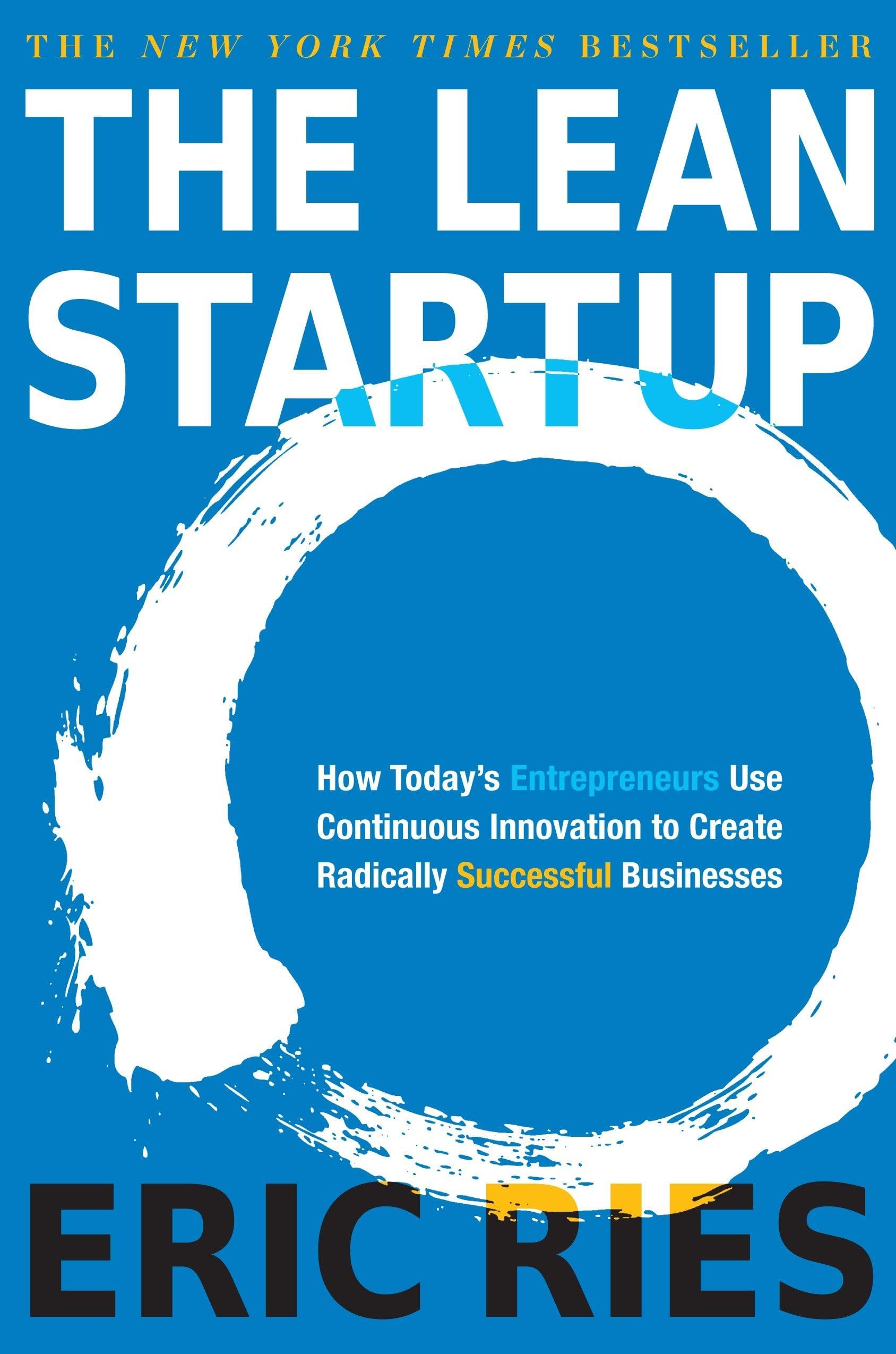
The Lean Startup: How Today's Entrepreneurs Use Continuous Innovation to Create Radically Successful Businesses
Product ID: 208925532
⚡Rapid validated learning
📈Build-Measure-Learn loops
🔄Pivot or persevere agility
Desertcart purchases this item on your behalf and handles shipping, customs, and support to Kyrgyzstan.
🚀 Innovate smarter, pivot faster, and build the future today!
The Lean Startup by Eric Ries revolutionizes entrepreneurship with a scientific approach to continuous innovation. It teaches startups and established companies alike how to efficiently test hypotheses, measure real progress with actionable metrics, and pivot strategically to create sustainable, successful businesses in uncertain markets.


| Best Sellers Rank | 172,772 in Books ( See Top 100 in Books ) 2 in E-Commerce (Books) 3 in Small Business 3 in Venture Capital |
| Customer Reviews | 4.5 out of 5 stars 17,831 Reviews |
A**N
A Bible, of sorts
I'm a second time entrepreneur, but by Eric Ries' analysis I'm actually a third time entrepreneur, because he counts the time I set something up as a consultant for a large corporation. So he had me at hello, even if it was through flattery. In fewer than 300 pages it gave me a good 15 flashbacks. Points where I was shouting out loud "exactly!" Embarrassingly, it also gave me a whole bunch of moments where I said "why did nobody tell me that back then." It's a MUST if you are starting a business. It's not without its faults. It's an advertisement for his consultancy, it could do without the references to Toyota (of which there's tons), it really reads like one of those self-help guides obese people read on airplanes; it's far from perfect. It is regardless AWESOME and it's a very quick read. Look away now if you don't want me to spoil it for you, here come the main points: 1. Entrepreneurship can happen in funny places. 2. Value = providing benefit to the customer. “Success is not delivering a feature; success is learning how to solve a customer’s problem.” 3. Launch! You’re not going to increase the value of the product without real customer input 4. Launch! You could be perfecting a product of no value 5. Launch! You WILL throw a lot of work away; the earlier you launch the less you’ll throw away 6. For all the above reasons, keep going through short cycles of BUILD, MEASURE, LEARN 7. Plan to learn; don’t say “I learned” as an excuse after a failure if you did not have a lesson planned in there. 8. There is a problem with launching: Once you’ve launched you give up on the “audacity of zero.” In plain English, you start collecting micro amounts. Vis a vis the naysayers, you were better off collecting zero and talking billions. Nobody said it would be easy… 9. Every venture has a value hypothesis and a growth hypothesis 10. Value hypothesis: your guess about why people will want this product a. Do consumers recognize they have a need you are trying to address? b. Would they pay money for it? c. Would they buy it from you? d. Can you build it? 11. Growth hypothesis: your guess about how you will add customers / sales 12. Design proper experiments to test the two hypotheses. A/B experiments, whatever 13. The Lean Startup recipe is a. Get a Minimum Viable Product out b. Go through Build, Measure, Learn loops / experiments to test the two hypotheses and keep improving the product c. Be happy to reject a few MVPs until you hit upon a good one 14. The MVP won’t be perfect, by definition, but a. Early adopters won’t mind b. Let customers decide it’s bad; they might love it (like IMVU’s jumping avatars) c. You can be creative about showing how it works: e.g. do a video d. You could do it mechanically, without the tech (concierge) for just a few users 15. Innovation Accounting consists of a. Establish a baseline: test your riskiest assumption via an MVP or an experiment or even a poll of your customers b. Tune the Engine: With the baseline secured, make the product better by picking good metrics that are relevant to your value hypothesis and your growth hypothesis and running Build, Measure, Learn loops to get the metrics to improve c. Pivot or Persevere: Every once in a while, decide if you’re doing well or if you need to Pivot 16. Vanity Metrics won’t get you anywhere. Be careful what you measure. Don’t look at aggregates, look at cohorts or split tests, for example. Use metrics that are relevant to your model. So if the model is viral, measure how many customers every customer brings. Not how your overall number of customers is growing (just because you paid for advertising, for example) 17. The three A’s of Metrics are Actionable, Accessible and Auditable. That’s how you get everybody on board. Don’t bother measuring if others can’t verify your work, if it will be very onerous to measure and if you have not agreed upfront what to do with the numbers. Additionally, “metrics are people too.” If they’re not, make it that way. Make them relevant to the customer. 18. Your engineers need to work as a team. They must work toward testing and delivering product for the customer. Not toward completing projects that get stuck because there is a bottleneck in testing, for example. 19. A startup’s runway is the number of pivots it can make. Money buys you the opportunity to make a fundamental change (or two) in your business strategy, but saving money without executing a pivot will just mean you die late. 20. Schedule a regular “pivot or persevere” meeting where both product development and business leadership teams attend. Maybe even outside advisors. 21. A catalog of pivots: a. Zoom-in Pivot b. Zoom-out Pivot c. Customer Segment Pivot d. Customer Need Pivot (e.g. bookings vs. cheap deals) e. Platform Pivot (e.g. client vs. hosted) f. Business Architecture Pivot (e.g. B2C to B2B, high-margin to high-volume) g. Value Capture Pivot h. Engine of Growth Pivot i. Channel Pivot j. Technology Pivot 22. Small Batches are individually more costly, but if you account for everything Large Batches can have very large costs too and you don’t find about them until it’s too late. 23. Small Batches allow the market to pull you in the right direction. 24. New Customers come from old customers in 4 ways a. Word of mouth b. As a side effect of product usage (can I Paypal you the money?) c. Through funded advertising (take proceeds from custy X, buy ads to attract custy y) d. Through repeat purchase or use (cable TV, not wedding planning) 25. There are three Engines of Growth. Find which one your business depends on and measure how it’s doing. And yes, more than one could be at work, but focus on the more important one. a. The Sticky Engine of Growth: measure customer acquisition rate + measure churn rate; measure them separately, or you might not see anything! b. The Viral Engine of Growth: measure if each customer brings > 1 customer through the door. Don’t despair if it’s 0.9, you’re close, experiment your way to pushing it above 1, but if it’s 0.3 you don’t have that growth model. c. The Paid Engine of Growth: measure what each customer will spend and measure your acquisition costs. 26. A time comes when you run out of early adopters. Don’t wait until then to make the product that the public at large wants. Moving to a higher quality product will slow you down, but you have no choice. And it will in the long term actually speed you up. The earlier you can afford to go high-quality the better. 27. Use the Five Whys as a guide to improving your quality. Get to the bottom of every complaint / problem by behaving like a 4 year old and responding to the answer to your question “why” with another “why” four more times. You will find that in the end you always end up with a person! Not with a process, not with an inanimate object. 28. Have everybody in the meeting when you do the Five Whys. Otherwise those absent will be blamed. 29. When you find the culprit, take the blame yourself for having designed the wrong process. Save your wrath for when the mistake is repeated. 30. Don’t send your baggage through the Five Whys project. Only use them for problems that arose after you instituted the policy. 31. If you are innovating inside a corporation, it is your job to protect the corporation. Otherwise others will make it their job to thwart you.
G**M
Lean or just princpled?
Ries pitches the lean startup as a principled based approach to product development. At one level what is being advocated is nothing more than a modified Deming's PDCA cycle and the exploitation of the feedback loop, as outlining in Deming's page 4 diagram from Out of the Crisis, via small batch sizes. The book is much more than this as he has operationalise these approaches. The modified Deming cycle of build-measure-learn is supported by validated learning and the use of actionable metrics to support decision making. Validated learning reflects Senge idea of organisational learning and actionable metrics are not vanity metrics, such as utilisation, but ones that have implications for the bottom line. Validated learning makes use of quick iterations to support learning. The learning comes from use using A/B testing to validate hypothesis based on a customer archetypical. This means that idea can be tried out very quickly to see of the original ideas have any value. uSwitch are using this method in the UK and have been very successful with test being run daily. Accountable metrics ensure that you are focusing on the right metrics and tuning the engine of growth. If you are not then this may lead to pivoting which he refers as repurposing. This has an echo of purposeful systems and Ackoff in which both means and the ends can be chosen. We do this by establish a baseline and measure progress towards the ideal. Periodically we need to validate the progress that we are making and either pivot or preserve. The baseline is based on minimum viable product (there is a section on what constitutes a minimum viable product in the book but it is similar in to Denne's Minimum Marketable Feature). The ideal is the numbers in the business case which may be conversion rate, the total number of customer or revenue. Too often people plan the plan and then execute the plan only to find when the funds or time run out that premise was flawed. The use of small batches and the ability to get customer feed promptly means that we can make good decisions and have the time to take action. What I also like are counter intuitive statements and there are a few in this book. I particularly like the points that he makes about the organisation needing to be protected from the start-up groups. Normally people talk about the group undertaking innovation being protected from the organisation but Ries points out that this does lead to repeatable innovation and gives IBM's creation of the PC as an example. I also like that he recognised that the approach is declarative in nature as it a framework and not prescriptive or a blueprint. There is a lot to recommend this book and I'm sure you will get something out of the time invested in reading it
A**B
Amazing and outstanding entrepreneur and business practises
For me this book was a big revelation, helping me to understand the importance of understanding both your product and customers that use it, as well as potential customers. This helps you to make better decisions.
D**A
Good
Good
M**D
Excellent and essential but the title sucks.
Eric Ries is an extraordinary entrepreneur. The innovative way in which he has launched The Lean Startup itself is testament to his incredible creativity and energy. Anyone, whether they are in technology or any other sector, who is involved in product development, should read this book, make sure that everyone in their team has read this book and then argued over a beer about whether it applies to them. Not everyone will agree with everything he says, no doubt some people will think they know better, good luck to them. Some people will rail against the use of terms like, 'Pivot', that Eric uses to describe the (entirely rational) process of discovering the market for a startup. Pivot runs the risk of being the most misunderstood and overused term in startup land as it has become a euphemisim for all sorts of things including, 'failed', 'given up' or 'lost interest'. It is hardly Eric's fault however that he has created and popularised a concept that powerful. Having been involved in successful and unsuccessful startups, and unsuccessful projects in large corporations, Eric has invested an obscene amount of his time and effort into working out why there is so much wasted effort in product development. More importantly, he has come up with a very plausible hypothesis for a better way of doing things better. Measurably better. I do have a big problem with this book and some of the language in it. To quote Eric Ries, "So here's my definition of a startup. A human institution designed to create something new under conditions of extreme uncertainity. And, of course, the importance of disruptive innovation in creating something that is truly different than what came before." For my money, that is not the definition of a startup. That is the definition of an inventor, an innovator, a startup, any business unit, product management team or organisation in the world. Why not apply that definition to another entity? "So here's my definition of Apple. A human institution designed to create something new under conditions of extreme uncertainity. And, of course, the importance of disruptive innovation in creating something that is truly different than what came before." Apple is the largest corporation in the world. Doesn't the definition apply equally well? And that is the essence of my problem with this book. It is keeping some extraordinary insights into how you can make things that people love in the world of startups. Grownups need to read this. They might sneer at the concept of a pivot, it is an overused term. I can't think of a single organisation that wouldn't benefit from the concept of minimum viable product though. The world would be a better place if big corporations understood this. They will waste less money making stuff people don't want. Kindle version: The Lean Startup: How Today's Entrepreneurs Use Continuous Innovation to Create Radically Successful Businesses Hard cover version: The Lean Startup: How Today's Entrepreneurs Use Continuous Innovation to Create Radically Successful Businesses
E**Z
Interesting but a bit high level or over hyped
For those seasoned product/service developers this book talks about some interesting case studies but much of it is mass market app/web style. There's some discussion around b2b but even that is large market. The book talks about fairly standard marketing principles and trying to focus on learning and adapting with decent metrics used to reflect what is happening rather than vanity metrics. It all makes sense and if you haven't already spotted the need to obtain customer feedback as early as possible then you need to read this book or rethink your career. Sad as it is, I do see organisations innovating behind a desk, running some validation as a token gesture and then building products for 9 months to find zero customer interest. I do feel though that the management of such organisations could read 20 books like this and still get it wrong. Without good sense behind it, any management initiative is going to struggle. An interesting point I've been left pondering is how to deal with the accusations of a MVP being merely slideware or vaperware. Eric Reiss may respond that markets which respond like that clearly need a more substantial MVP but in a technical b2b market where trust and technical competence is key, one can end up having to build a significant proportion of a product, undermining the whole point of an MVP. I suppose the 5 whys would probably lead us down some path to asking why it takes so long to build anything.... As you can see, the principles in this book aren't new but even as I typed this I'm thinking it's a worthy read even if it just gets you thinking rather than learning anything new
N**R
Does The Lean Start Up Work?
I come from an direct mail and affiliate marketing background, our normal MO is to sell other peoples products, usually those products have gotten to market and have already established they work from a product to customer fit point of view. We continually test new products and marketing strategies to see what works, and as a direct response marketer we build our fortunes (or lack of) on testing what sells and what does not, otherwise known as what people want to buy. For a better understanding of how to do this if you're not a tech start up in silicone valley try scientific advertising as a great starting point. If you are a tech startup you'll love this book, it's probably aimed at you primarily. If you have a regular business get this book the ideas that are presented are good and tried and tested by thousands of direct response marketers that tread this path every day. It is (like this review) full of waffle, but the waffle gives it context and context aids understanding so that's alright. So overall yes get the book, but, this is a poor imitation of a good book on this subject, start with the greats of direct response marketing and you'll truly get the idea. Neil Asher Roarlocal
P**K
An important read for new startup ventures
The Lean Startup is one of the core business books that revolutionised the business startup environment. Eric Ries stripped everything down to the core basic principles of being lean, and agile in response to customer feedback. This is not new but is collated and distilled in a very dynamic, yet clear structured manner. It must also be said that the Lean Startup is heavily biased towards the software industry and while also coming from that industry I may be unaware of how effective this approach is in other sectors, especially those that are heavily regulated and limited to the opportunity to, in reality, deliver prototypes to customers. I really appreciated the book’s celebration that you don’t have all the answers and you shouldn’t if you’re a startup with an innovative solution. The major point, however, is that you shouldn’t pretend or act like you do but embrace the uncertainty and develop an experimental approach to delivering a Minimum Viable Product – build, measure, learn. I found The Lean Startup not only great for advice, techniques and the analogous stories to help reinforce the approach, but it is an inspirational book that dares you to challenge everything and rationalise with customer validation that your vision is viable and scalable. When a book affects me it starts a chain reaction in my thought process so that I either gain a better understanding of where I need to go or may enable me to articulate what has been sitting just out of reach in my mind. This is one of those books. Other books that reinforce this new startup environment and are worth reading include: • Business Model Generation – Alexander Osterwalder • Four Steps to the Epiphany – Steve Blank • The Startup Owner’s Manual – Steve Blank • Running Lean – Ash Maurya
S**S
Back to basic du business modern
Il y a tant à dire sur cet opus qui est à l'origine d'un mouvement de fond dans le monde du business actuel. Il n'y a rien de révolutionnaire dans les idées de Ries (une roue de Demming reste une roue) de manière unitaire. Par contre l'hybridation des idées changent tout : l'auteur revisite le processus d'amélioration continue et le lean management pour les idées d'entreprendre, qu'elles soient internes ou externes à l'entreprise. Oui vous avez bien lu : ce livre ne s'arrête pas aux boutonneux de la silicon valley voulant lancer le prochain facebook mais bien TOUT le monde. * Vous avez envie de vous lancez dans une activité de cookies => vérifier que vous avez des clients potentiels, regardez ce qu'ils acheteraient, allez les voir et construisez le plus petit produit viable (un cookie ?) * Dans votre entreprise vous voulez lancer une nouvelle activité => pareil ! Oui, ce livre est vraiment rafraîchissant, vous fait grandir et vous oblige à trouver l'entr(e/a)preneur qui est en vous.
V**K
Excellent, critical ideas marred by poor presentation
This book is full of excellent ideas that I expect will be critical to running a startup. I feel that I'm much better equipped to take the plunge after reading this book. The fact that Eric's ideas are widely adopted nowadays — minimum viable product, pivot, metrics, and so on. Unfortunately, the book is hard to read, specifically the first half, which could be condensed to half its length, because there's too much repetition. The author leaves you to figure out what a term means from reading an anecdote spread over two pages rather than defining it explicitly and clearly defining it. Some chapter names are meaningless, like "Leap", and give you no indication of what to expect. Some case studies are not obviously connected to the point the author is trying to make — you scratch your head and try to figure out what it means, and what the point must have been, and what the moral of the story must have been. But, stick with it, and you'll be rewarded with a solid, well thought-out, evidence-based method on running a startup with less risk, stress, time, money and effort. Here's a summary of the book: Introduction: The lean startup method has five principles: 1) Entrepreneurs are everywhere. 2) Entrepreneurship is management, albeit a form of management that applies under the conditions of extreme uncertainty in a startup. If you think management is not cool and reject it, you'll have chaos and failure. 3) Validated Learning. Startups exist not to just make things, serve customers, or make money. They exist to learn how to build a sustainable business. 4) Build - measure - learn: Startups should go through this loop, as fast as possible. 5) Innovation Accounting is needed to measure a startup's progress, set up milestones, prioritise work, and for the people in it to hold themselves accountable. Chapter 1: - The lean startup draws from related fields like lean manufacturing and design thinking. - If a company commits itself to the wrong plan and executes that plan excellently at a big scale, it may not be able to pivot in time, because it has committed all its resources and time to the wrong vision. It will achieve failure. Chapter 2: - Startups can exist as islands of independence within big companies. Chapter 3: Learn: - Which actions are value-creating and which are wasteful? This question is at the heart of lean manufacturing as well. - Validate your assumptions more cheaply than building the entire product. - But not by asking people what they want — most of the time, they don't know in advance. - People who fail often give the excuse that they learnt a lot. - It's easier to raise money when you have zero revenue and users. Zero invites imagination. A small number invites questions about whether big numbers will ever materialise. - So, it's tempting to postpone getting any idea until you are sure of the success. But don't do that. - Early in a startup's life, revenue growth happens slowly. But the real progress is in validated learning. - Don't fall prey to vanity metrics, which are numbers that look good but are not the best indicators of your company's health. For example, if you have a web site that encourages people to download an app, page views on the web site is a vanity metric, because there are better metrics, like downloads of the app, signups, active users, etc. - Don't waste money on PR and buying media attention and getting written up in magazines. Focus on learning. Chapter 4: Experiment - The founder of Zappos first tested his e-store for shoes by fulfilling orders manually — going to a nearby physical shop, buying the shoes, and shipping them. After a month, a thousand orders were placed, validating his idea. - He observed real customer behaviour, interacted with them, and learnt about their needs, not asked hypothetical questions. - Customers react in unexpected ways, revealing information you might not have known to ask about, like returning shoes. - Startups have a value hypothesis and a growth hypothesis. - The value hypothesis is that customers derive value from the product or service once they start using it. - The growth hypothesis is about how new customers will discover a product or service. - Give your first few users wonderful attention, as if you're a concierge. - An experiment is actually a startup's first product, not just a theoretical enquiry. Chapter 5: - Startups have a build - measure - learn feedback loop. - The learning is how to build a sustainable business. - This learning is more important than revenue. - Minimise the time it takes for you iterate through this loop. - People are often trained and specialised in one aspect of this loop, like engineers trained to build. What matter is not one part, but how fast you can iterate through the entire loop. - Startups should use a scientific method. - To do so, they should know what hypotheses to test. - The two most important hypotheses are the value hypothesis and the growth hypothesis. - Every startup is based on assumptions, often not recognised as such by founders. - Some assumptions are validated by the existence of other products. For example, when Apple built the iPod, one assumption was that people want to listen to music in public places using earphones. But the popularity of the walkman validated that assumption. - "Leap of faith" assumptions are trickier, like saying that people want to pay $399 for a portable music player. - You want to validate them ASAP. - The riskiest ones first. - You do so by building one or more MVPs. An MVP lacks features that are needed later, but its purpose is to validate assumptions with as little time and effort as possible. - You should identify and list assumptions before, not after, building the MVP. Ideally give quantitative estimates like 20% of people will be interested in our service, and 5% will be willing to pay. That way, you can't claim later on that you succeeded, by defining the goal as what you actually achieved. - You actually run the build - measure - learn loop in reverse: start with what you want to learn (assumptions to validate), then think about what to measure to validate those assumptions, and then build that MVP. - Don't act as if your assumptions are true. Validate them. Otherwise your startup will fail. - You can look for analogs and antilogs. - An analog is a similar situation that validates your assumption, as with people listening to music in public using earphones. - An antilog is something that goes against your assumption. For example, an assumption behind the iTunes Music Store was that people are willing to pay for music, but Napster was an antilog. - Get out of the building and talk to users. Don't theorise. Chapter 6: Test - Start with a quick, crappy implementation. - Groupon began as a themed Wordpress blog with the coupons being PDFs mailed by Apple's Mail app to 500 people. - An MVP is not necessarily the smallest product to build, but the quickest to build. - It's hard for entrepreneurs to launch an MVP, because the vision they have of themselves is launching high-quality, polished products, not crappy ones. Overcome that hesitation. - If you don't know who the customer is, you don't know what quality is. - Users may be fine with what you think is low-quality stuff, and may actually find it better, disagreeing with your opinion as to what constitutes high or low quality. - Low quality is a problem only if it slows down the build - measure - learn feedback loop. - An MVP can also be a marketing pitch accompanied by a sign up page to gauge interest. - Or a video, in Dropbox's case. - You can have humans substitute for an algorithm. - Don't worry that an established company will copy your idea. Try pitching it to the managers there. They will do nothing, partly because they're already overwhelmed with good ideas. - MVPs often result in bad news. Or, rather, they bring it out. You're better off facing reality. Chapter 7: Measure - If you're making changes to your product resulting in more users, that's not good enough. It's storytelling. How do you know that your changes are causing the results? How do you know that you're drawing the right lessons from your changes? - You need innovation accounting. - Innovation accounting works in three steps: 1) Use an MVP to establish real data on where you are. Without a clear-eyed picture of your current status — no matter how far from the goal you may be — you cannot begin to track your progress. 2) Tune the engine to move towards the ideal. 3) Decide whether to continue on your current course or pivot. - An MVP gets you real baseline data — conversion rates, sign-up rates, trial rates, customer life-time value, and so on. - Don't optimise something (like making your app easier for new users to use) until you know that it's a driver of growth and is less than what you'd like. - Putting all these together, start with a baseline metric, then form a hypothesis as to what will improve that metric, and then perform a set of experiments designed to test that hypothesis. - Metrics about the customer acquisition funnel are important. - Running Adwords ads, even on a low budget is important, because it gives you critical data. - Cohort analysis is important. Here, you define a cohort, such as people who signed up during a given week, or those who used a certain feature. Then you track the performance of your app for that group of users. - Cohort analysis lets you prove or disprove theories like, if your number of users is declining, that people who signed up recently are abandoning the app while old users continue to use it. - Cohort analysis can point out problems when other metrics are all up and to the right (hockey sticks). - When you get poor quantitative results, they force you to declare failure and create the motivation, context and space for more qualitative research. - If you pivot, and the experiments you run afterward are more productive than the ones before, that's the sign of a successful pivot. - Don't focus on optimising, whether the conversion rate or the performance of your app, because you may be building the wrong thing, in which case no amount of optimisation will help. - A startup has to measure progress against a high bar: evidence that a sustainable business can be built. This is possible only if you've made clear, verifiable predictions ahead of time. - Sometimes, when you make changes and launch them, it's hard to look for cause-and-effect relationships after the fact. In that case, do an A/B test. - A/B testing can also tell you things like whether the social features you've added to a product matter. - Hypothesis testing can require you to build new infrastructure. For example, if you're testing delayed sign-up, you'll need to support a state where users have their data in the system but haven't yet signed up. - Industry norms like delayed sign-up helping may not be true in your case. - That may, in turn, reveal an insight, such as: customers were not basing their decision on whether to use your product on your demo. Maybe on positioning and marketing. - Good metrics must follow the three As: Actionable, Accessible, and Auditable. - Go by actionable metrics, not vanity metrics. Vanity metrics are those where the cause and effect relationship isn't clear. You don't know what change you made that led to an increase (or decrease) in this metric, like page views. Or maybe it has nothing to do with you, like a mention in a popular blog. An actionable metric is the number of customers. If it decreases by 50K, you know something is wrong. You can work on it and hopefully fix it. That's actionable. - Accessible means that you can understand what it means, like a "customer" as opposed to a "hit on your web site". - Auditable means that if a question arises as to the validity of the metrics, you should be able to verify it. The best way is to talk to customers, who will also tell you why something is happening, not just that it is. In addition, the mechanism that generates the results must not be too complex for the metric to be auditable. Chapter 8: Pivot - Companies that can't pivot may be stuck in the land of the living dead, neither growing quickly enough nor dying, consuming the time and money of the people involved. - Launching early and iterating means that if you pivot, you waste less time, energy and money. If you drag it on, you won't want to pivot because of sunk costs. - Go by actionable metrics, rather than vanity metrics that can give a feeling of false success. - A startup's runway is conventionally defined as the number of months, but it should be defined as the number of pivots it can make. - Don't cut costs by slowing down the build - measure - learn loop. Then you're just going out of business slowly. - Two telltale signs that you need to pivot are the decreasing effectiveness of product experiments and the general feeling that product development should be more productive. - Not having PR and media attention on you is good, because you can pivot without drama. - Some types of pivots are: + Zoom-in pivot (where you focus on a subset of your original product) + Zoom-out pivot + Customer segment pivot (where you realise that you're more successful with different customers from the ones you expected) + Customer need pivot (where you discover that the customer has more important needs than the ones you thought they had) + Platform pivot (where an app becomes a platform or vice-versa) + Value capture pivot (commonly called monetisation, but monetisation is more like a feature while value capture is more central to the product) + Engine of Growth pivot (moving between viral, sticky and paid engines of growth) + Channel pivot (moving between sales channels) + Technology pivot + A pivot is a hypothesis; we don't know ahead of time whether it will succeed. Chapter 9: Small Batch Sizes: - Optimise the entire system, not a piece of it. - Have a small batch size: deliver work in smaller units. - Launch each feature independently. - Continuous deployment. Launch many times a a day. - Have lots of automated tests. - Have your designer sit with the engineer and have them design and implement each screen together. As opposed to your designer working by herself for weeks and then delivering the entire result at once. - Smaller batch sizes are actually more efficient, despite our intuition. - Quality problems can be identified much sooner. If you make something no one wants, you'll learn sooner. - Large-batch systems tend to malfunction, and when they do, people blame themselves. - Large batches lead to multiple rounds of rework. - ... and to still larger batches, which becomes a death spiral. - And to interruptions, people being blocked on others, communication gaps, scheduling problems, and so on. - The longer a project takes, the more bugs, problems and conflicts it has. - Have minimum work in progress. - Pull, don't push. Start from the hypothesis that needs to be validated or the experiment that needs to be run, and pull work from product development in the smallest batch size to validate that hypothesis. - Small batches will also let you work with less capital. - Companies can stay lean as they grow. They don't need to become bureaucratic. Chapter 10: Engines of Growth: - New customers come from the actions of past customers. This happens in four ways: 1) Word of mouth. 2) As a side effect of product usage 3) Through advertising 4) Through repeat purchases (sticky) - Each of these engines has a feedback loop that leads to success. - One of the most expensive forms of potential waste for a startup is spending time arguing about prioritisation of new features. - The engines of growth help you prioritise better. - There are always a zillion new ideas about how to make the product better floating around, but most make a difference only at the margins. They are merely optimisations. - If you're using the sticky engine of growth, you will grow if the rate of new customer acquisition exceeds the churn rate. Track both. - The metric to focus on is the compound growth rate. If it's high, you're doing well. - Activation rate and revenue per customer have little impact on growth. (They're better suited to testing the value hypothesis) - If the churn rate and customer acquisition rate are the same, then the standard intuition to invest in sales and marketing doesn't work, because you will lose your new customers as well. - This is an example of vanity metrics misleading you. - The viral engine of growth depends primarily on people sharing it with friends, as a central feature of the app, not an afterthought. - The metric to focus on is the viral coefficient, which determines how quickly your app spreads. If it's 0.1, it means one of ten people using the app are referring a friend. - If the coefficient is less than one, the cycle of growth fizzles: if you start with 100 users, they refer 10 more, who refer one more, at which point the loop ends. - Exactly 1 gives you linear growth: if you gain 10 new users this week, you will gain 10 the week after that, 10 the third week, and so on. That's not good enough. - The coefficient needs to be > 1 for exponential growth. - Tiny changes in this number cause dramatic changes. If it's 1.01 per week, you end the year with twice as many users as you began. - If it's 1.1, you end the year with 140 times as many users as you began. - These are often free and ad-supported because being asked to pay comes in the way of viral growth. - The paid engine of growth relies on more paid sales. It's different from the sticky engine, which relies on repeat sales to the same customers. - If one company earns a revenue of ₹10 per user, and another earns ₹100, and they both reinvest their profit in acquiring new users, which one grows faster? A: It depends on the Cost Per Acquisition (CPA). If they are proportional, like ₹2 and ₹20, both grow at the same rate. - For faster growth, you need to reduce CAC or increase revenue. - The lifetime value (LTV) of a customer is the total revenue they generate over their lifetime, minus variable costs. - If LTV > CPA, the company will grow. - If < it won't, despite one-time tricks like using invested capital or publicity stunts. - Don't pursue multiple engines of growth, since it's complex to model all these effects simultaneously. Startups usually focus on one. - Product-market fit is the moment when a startup finally finds a widespread set of customers that resonate with its product. - A great market — a market with lots of potential customers — pulls product out of the startup. In a terrible market, the best product and best team are going to fail. - When you achieve product-market fit, it's exhilarating. - If you have to ask, you're not there yet. - Depending on which engine you're using, look at the appropriate metric, like viral coefficient for a viral engine. If it's 0.9 or more, you're on the verge of success. - The number doesn't matter as much as the direction and degree of progress. - Every engine eventually runs out of fuel. - Moving from early adopters to mainstream users is not automatic. The engine may stop and may require tremendous additional effort. - Be careful to not confuse growth coming from an engine already working efficiently for growth from product development. It's possible your work has no effect, in which case you can have a sudden stop. - To prevent this, focus on actionable metrics rather than vanity metrics, and use innovation accounting rather than traditional accounting. In other words, are you making progress on your actionable metrics? Are you running experiments and building MVPs to improve them? Are you verifying that, if you ran an experiment to reduce the churn rate, for example, that it has actually reduced the churn rate, rather than assuming that it did from increased revenue?
U**F
الغلاف جيد والطباعه افضل من كتب اخري
الكتاب افضل من ناحيه الطباعه والغلاف من كتابين سابقين اشتريتهم والتوصيل سريع
M**L
جودة ورق ضعيفه
لم اتوقع سوء جودة الورق، الورقة خفيفة جدا مايل لونها على رمادي وباهته. لكن للامانه لم ابدا بقراءة الكتاب بعد. ان شاء الله يكون المحتوى يعوض عن هذه المشكلة
I**H
The Godfather of “MVP” and “build-measure-learn”
Eric Ries gebührt der Respekt, mit seinem Buch dazu beigetragen zu haben, dass Begriffe wie “minimal viable product” oder der Entwicklungszyklus “build-measure-learn” zum Standardrepertoire agiler Prozesse gehören. Manchmal ertappe ich mich jedoch bei dem Gedanken, dass mit den Begriffen nur zu gerne auch angegeben wird, ohne wirklich zu wissen, was originär damit gemeint war oder gar die Unternehmensprozesse tatsächlich danach ausgerichtet werden. Deshalb: es lohnt - wie in den allermeisten Fällen - sich mit der Originalliteratur auseinanderzusetzen, um Zusammenhänge zu durchdringen anstatt sie nur an der Oberfläche zu tangieren. Auch wenn das Werk inzwischen 9 Jahre alt ist - eine Ewigkeit in unserer schnelllebigen Welt - hat es nichts an Aktualität eingebüsst. Der Autor entfaltet für Startups mit seinem Vorgehen „VISION (Start - Define - Learn - Experiment) - STEER (Leap - Test - Measure - Pivot or Persevere) - ACCELERATE (Batch - Grow - Adapt - Innovate)“ einen fundierten Weg, um auch heute noch erfolgreich Produkte bzw. Services am Markt platzieren zu können. Sympathisch ist der Gedanke, dass Unternehmertum und Startup-Mentalität nicht der Garage vorbehalten sind, sondern überall stattfinden können. Ries setzt sich für den Begriff des Entrepreneurs statt des Managers ein, um dies deutlich zu machen. Darüberhinaus macht er eindrücklich klar, weshalb „validated learning“ ein MUSS für Neugründungen ist, die sich am Markt auch langfristig durchsetzen wollen. Auch seine vier zentralen Fragen (S. 64) würden auch heute noch so manche Produktentwicklung, die völlig am Markt vorbeigeht, vermeiden. Man sollte diese als Poster neben die gängigen Scrum- und Kanban-Boards hängen, um täglich daran erinnert zu werden und sich danach auszurichten. Wie eingangs beschrieben ist der „Feedback Loop: build-measure-learn“ in zahlreichen Produktentwicklungsteams heute EIGENTLICH Standard, wird aber im Ries‘schen Sinne nicht konsequent gelebt. Ries zeigt auf, welche Daten sich zu messen lohnen, wie man eigene Hypothesen widerlegen kann und sollte, gerade wenn man ihnen zu gerne Glauben schenken mag. Trotz zahlreicher eindrücklicher Beispiele, die über die typischen Apples und Facebooks hinausgehen, wäre eine Art Matrix, mit welcher man das eigene Geschäftsmodell noch besser messen und Erfolge suchen bzw. Misserfolge schnell vermeiden kann, hilfreich. So bleibt zwar das Verständnis des theoretischen Rahmens, aber einen praktikablen Bezug, was die Ergebnisse der gemessenen Fakten bedeuten, bleibt offen. Das ist aufgrund der unterschiedlichen Geschäftsmodelle nachvollziehbar, als Startup-Unternehnmer*in oder Investor*in entstehen natürlich genau an dieser Stelle die entscheidenden Fragen. Dennoch: Auch nach vielen Jahren noch immer ein fundamentales Werk, das den Zeitinvest lohnt, um die daraus entstandene Entwicklung zu verstehen und vor allem, maßgebliche Hinweise für erfolgreiches “Entrepreneurship” abzuleiten.
Trustpilot
1 month ago
1 day ago