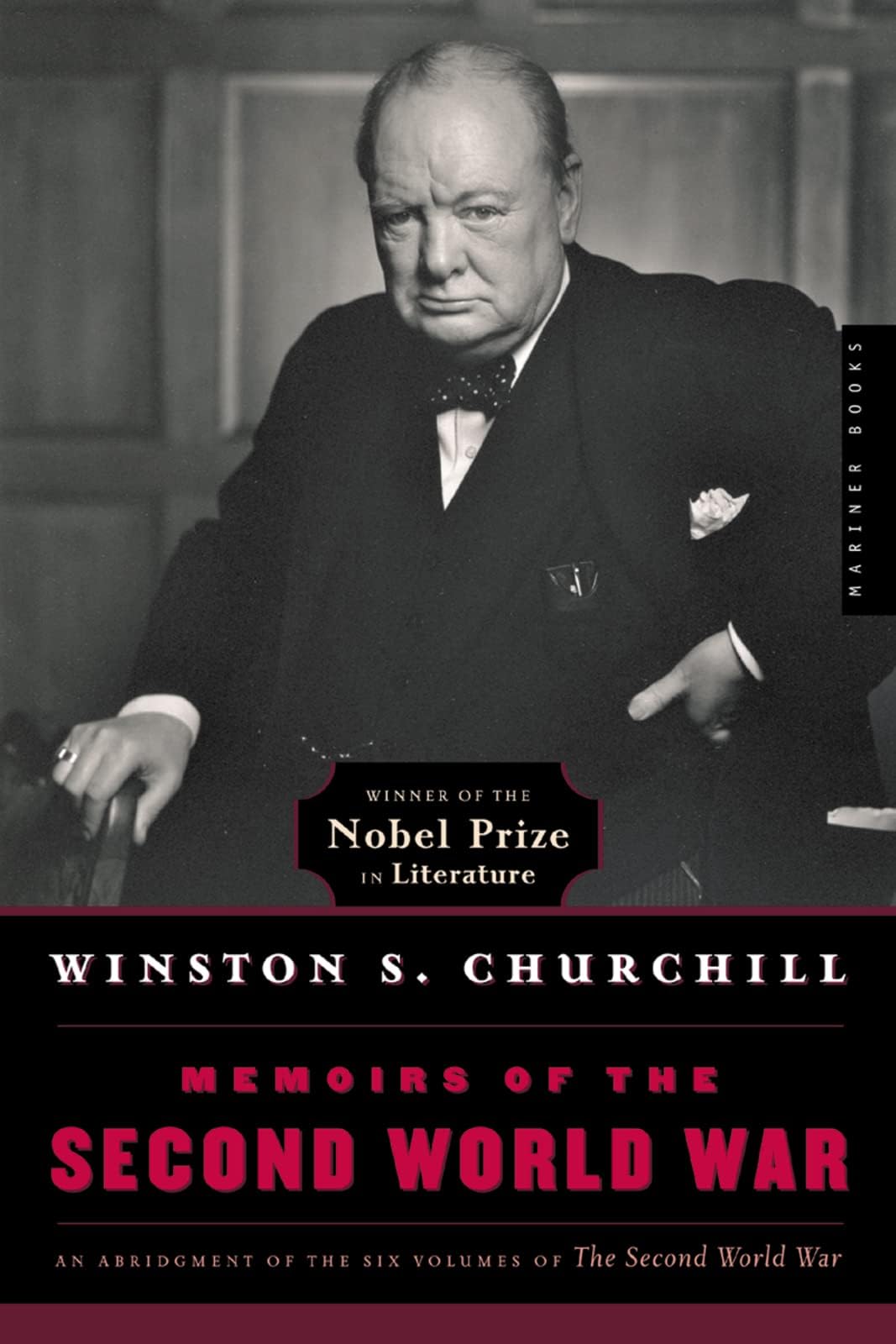
Memoirs Of The Second World War
Product ID: 20328803
Desertcart purchases this item on your behalf and handles shipping, customs, and support to Kyrgyzstan.
Former Prime Minister of Great Britain and Nobel Prize–winner Winston Churchill's quintessential account of the Second World War. As not only the most powerful player in World War II, but also the most eloquent voice of defiance in the face of Nazi tyranny, Churchill recounts this epic time in world history. Remarkable for his grand sweep and incisive firsthand observations, Memoirs of the Second World Wa r is a vital and illuminating work that retains the drama, eyewitness details, and magisterial prose of his classic six-volume history. Churchill's accounts offers an invaluable view of pivotal events of the twentieth century. Review: Very detailed and well written document - Since this book was updated, there are new facts have come out about the statistics of WWII and the roles the Allies and the Axis played in it. That's to be expected. It is one sided with Churchill at times believing in his absolute right and his problems getting his view across to the Americans and the Russians. At times he lays too much emphasis on the fact that Britain won the war with the "help" of the Allies. And at other times he states that without the Allies Britain would have been sunk. As confusing and horrible as that time was, reading another book about the American side would be also helpful as we had to fight the Japanese also and it was our POW's on the defensive there. It seems to downplay the effect the Japenese had on the war which was not trivial at all. Though he seems to describe the battle of Leyete and Midway fairly well. It's a good read, and it's interesting to see the other "side" of the war from a great man and you won't be sorry to read it. Review: Wiston Churchill - Memoirs of the Second World War - Excellent Abridgment of his six volume "The Second World War", but still over 1,000 pages. It gave me a new understanding of how all the individual events fit together from the highest levels in the USA and especially Britain. It must always be remembered that this is the War as Winston Churchill saw and fought it. Other views are also out there and should be read to gain a broad understanding of how other countries saw the war. This is not saying that Churchill was wrong - there are simply many opinions on the same subject because of the large numbers of people the War involved - each with a slightly different, or opposing, idea of what was the best path to take or even on what really happened in major battles. It is well worth the time it takes to read it. It is a valuable resource to those who want to understand Britain and her reasons for her actions. It also includes the contributions of the USA and the Soviet Union and gives personal insights into Roosevelt and Stalin.
| Best Sellers Rank | #101,291 in Books ( See Top 100 in Books ) #90 in Historical British Biographies #489 in Political Leader Biographies #816 in World War II History (Books) |
| Customer Reviews | 4.8 out of 5 stars 509 Reviews |
C**S
Very detailed and well written document
Since this book was updated, there are new facts have come out about the statistics of WWII and the roles the Allies and the Axis played in it. That's to be expected. It is one sided with Churchill at times believing in his absolute right and his problems getting his view across to the Americans and the Russians. At times he lays too much emphasis on the fact that Britain won the war with the "help" of the Allies. And at other times he states that without the Allies Britain would have been sunk. As confusing and horrible as that time was, reading another book about the American side would be also helpful as we had to fight the Japanese also and it was our POW's on the defensive there. It seems to downplay the effect the Japenese had on the war which was not trivial at all. Though he seems to describe the battle of Leyete and Midway fairly well. It's a good read, and it's interesting to see the other "side" of the war from a great man and you won't be sorry to read it.
T**E
Wiston Churchill - Memoirs of the Second World War
Excellent Abridgment of his six volume "The Second World War", but still over 1,000 pages. It gave me a new understanding of how all the individual events fit together from the highest levels in the USA and especially Britain. It must always be remembered that this is the War as Winston Churchill saw and fought it. Other views are also out there and should be read to gain a broad understanding of how other countries saw the war. This is not saying that Churchill was wrong - there are simply many opinions on the same subject because of the large numbers of people the War involved - each with a slightly different, or opposing, idea of what was the best path to take or even on what really happened in major battles. It is well worth the time it takes to read it. It is a valuable resource to those who want to understand Britain and her reasons for her actions. It also includes the contributions of the USA and the Soviet Union and gives personal insights into Roosevelt and Stalin.
D**L
Not just for War Enthusiasts
I have to say it. This is my favourite book. Honestly! I recommend it to friends all the time. And I believe it is not just for World War Two buffs, as other reviewers claim. It is very well written - Churchill can write! And the twists and turns - everything decided on the outcome of one event, be it the battle of Britain, or the breaking of Enigma - the book reads like a fantastic fictional account, but it is all true (at least from to Churchill's perspective). I have personally read it 3 times, and will try again for a fourth sometime soon. Or perhaps I will purchase the 6 volume set and see all the details. Still, my advice - read it! A great read, informative, and shows some of the reasons the world is in the state it is today. Dave Montreuil
J**L
The history of the Second World War from one of the most important allied leaders in the conflict.
The history of the Second World War from the perspective of one of the most important allied leaders in the conflict. Churchill is not a man without his faults, before, during or after the war but I shudder to think what would have happened to England during the war without his as Prime Minister.
M**S
A mini-series of WWII
A much more manageable, but perhaps lazy way, of digesting Churchill's six volumes of WWII. Reads more like a mini-series where it is difficult not to push on to the next episode. Of course Churchill's first hand perspective makes it unlike anything else. This reader is more interested in Churchill than the events of the War, but either way it is an interesting read.
L**N
Well worth the time to read
With so many books that have been written from the American viewpoint (and I was born in the good old USA), it was refreshing to get the British view, straight from the Lion's mouth. Yes, he does make himself a bit more of a hero then he needed to, and it is a bit slanted, but what memoirs aren't? In fact this makes me very sad that Stalin and Roosevelt never wrote one, it would be wonderful to have been able to compare the three memoirs. I really enjoyed his "proper" English tone and words. By the time I was done reading it, it almost made me wish I had read the full 4,000+ unabridged one. Perhaps one day I will find the time. A must read for anyone getting deep into WWII.
S**E
Nobel Prize writing, and deservedly so
Churchill said that history would be kind to him because he intended to write it. He wasn't kidding. He may have been an irascible difficult fellow, but the man could communicate.
A**R
Satisfied customer!
I recommend the memoirs for those who enjoy the gamesmanship and people behind the great events of the 20th century. WSC's six-volume history is a great reference source; this memoir condenses the scope of events of those six volumes in a lengthy but accessible format. Churchill moves back and forth from trumpeting his insights and triumphs to expressing his frustrations at his inability to secure a better outcome for all parties. Great events on a human scale.
F**I
Nobel prize: now I understand why
Amazing, a must-have for everyone who wants to learn contemporary history by having an excellent time reading
H**H
excellent read
Fascinating insight into the mind and the challenges facing a war leader. At 1000 pages also quite manageable as a bedside read.
A**R
Amazing tale, brilliantly narrated.
If you are a 2nd world war buff...This is for you.
M**S
Recibirlo impoluto
Todo bien y rápido. Solo puedo decir que estos libros de tapa blanda tengan una mejor protección, las esquinitas ligeramente dobladas.
P**0
Excellent livre d'histoire sur la seconde guerrre mondiale
Le plus intéressant dans ce livre se situe au début du livre où il raconte la suite d'erreurs politiques qui ont conduit à aider à l'accession au pouvoir d'Hitler et de la façon dont les anglais le laisse prendre possession des pays de l'Europe de l'Est en entraînant les français dans leur faiblesse. Par rapport aux mémoires de guerres de Charles de Gaulle, Churchill est un politique qui apprends à faire la guerre tandis que De Gaulle est un militaire qui apprends la politique. Et la différence de regard sur ces évènements est dans cette situation. Churchill est un homme de pouvoir et ses mémoires sont différentes entre la partie où l'Angleterre est seule en guerre et la partie où il n'est plus que le collaborateur des américains. Si Churchill raconte dans le détail comment il a réussi à convaincre De Gaulle de partir pour Londres, il se tait sur ce qui l'amènera à l'humiliation de Casablanca (où Giraud est préféré à De Gaulle). Si De Gaulle raconte dans le détail la difficulté de l'alliance anglaise et le mépris de Roosevelt derrière une courtoisie de façade, Churchill ne cite que l'échec du débarquement de Dakar sans parler des autres victoires des forces françaises libres et de l'aide de la résistance. On peut comprendre que Churchill n'ait eu d'autre choix que de s'aligner sur la position de Roosevelt (on ne mord pas la main qui vous sauve). Churchill était à la fois premier ministre et ministre de la guerre, ses mémoires se partagent entre les relations politiques (avec Roosevelt et Staline) et l'aspect militaire qu'il apprends en faisant des erreurs (la défaite contre Rommel à Tobrouk malgré une armée anglaise deux fois plus nombreuse a fait hurler le parlement). Comme De Gaulle, il ne cache pas ses sentiments dans ses mémoires même si il les place derrière un positivisme de façade et la conviction qu'il a dès le départ que l'Angleterre gagnera cette guerre... tout en étant conscient que l'erreur d'Hitler d'avoir attaqué l'URSS a permis cette victoire.
Trustpilot
2 weeks ago
3 weeks ago