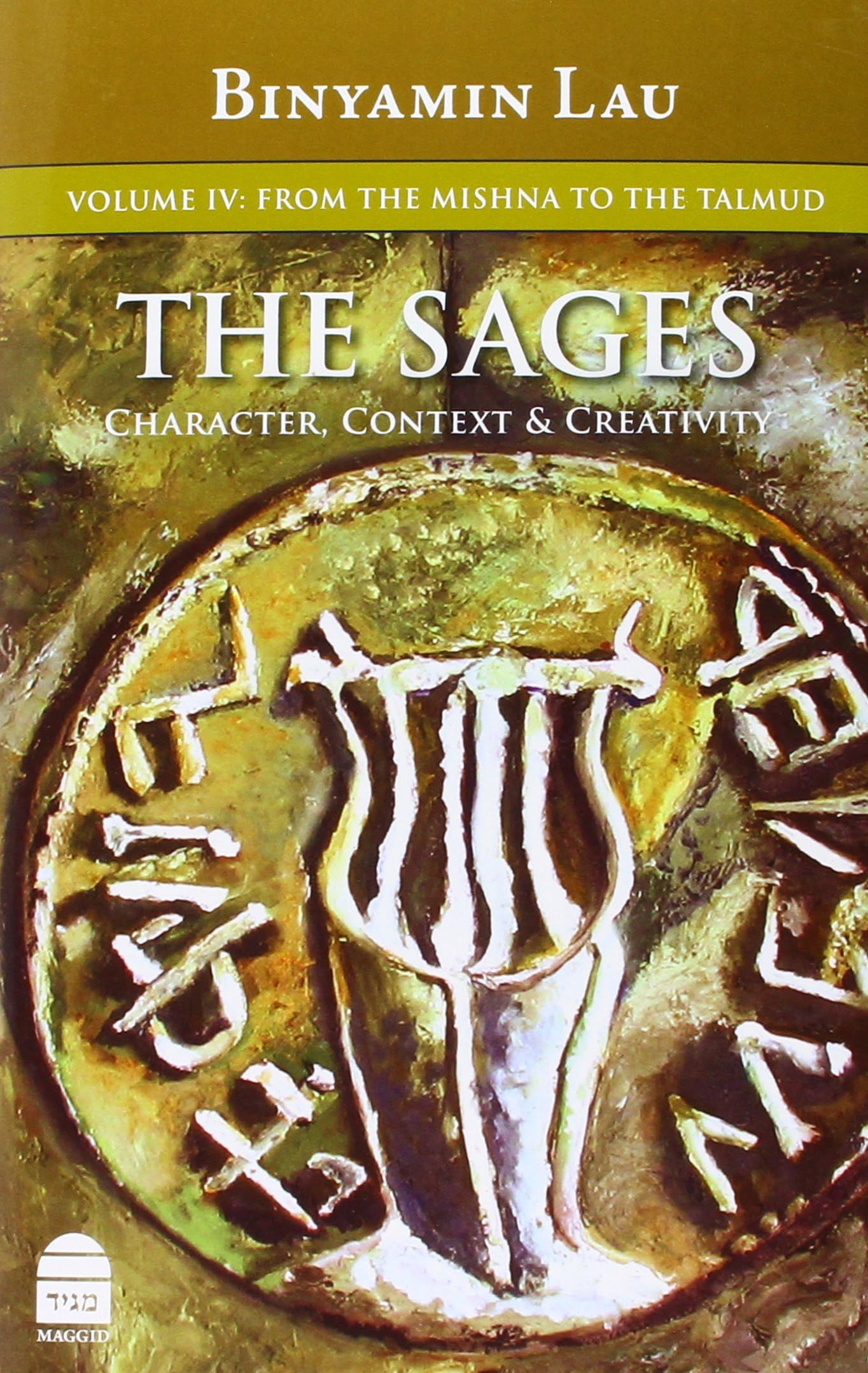

The Sages: Character, Context, & Creativity: Volume IV: From the Mishna to the Talmud
Product ID: 20042015
Desertcart purchases this item on your behalf and handles shipping, customs, and support to Kyrgyzstan.
The Sages brings the world of the Talmud to life, revealing the stories of the men behind its pages. This fascinating multivolume series explores the lives and times of great Jewish sages (azal )their teachers and disciples, their families and professions, the values they cherished and ideologies they opposed, the historical challenges they faced and the creative wisdom with which they faced them. Highly original and profoundly engaging, The Sages draws readers closer to the world of azal while deepening their understanding of our own. This series is the first work by the influential Jerusalem rabbi Binyamin Lau to appear in English. Review: This series is probably the best history of the development of modern Judaism currently in ... - Pg 311 of the book promises a future 5th volume covering the gradual transition of the Land of Israel from pagan to Christian Roman rule, beginning with the rule of Diocletian in +284 CE. This series is probably the best history of the development of modern Judaism currently in print. The four volumes now available cover the entire 2nd Temple period, the two great wars against Rome, the completion of the Mishnah about +210, and the beginnings of the Talmud through +270 CE. The only negative point on the series is a lack of any index. One hopes that a consolidated names index and subject index will be in the final volume. Review: A very informative book. - I bought the book to use for a research project.
| Best Sellers Rank | #637,479 in Books ( See Top 100 in Books ) #123 in Talmud (Books) #914 in History of Judaism #1,587 in Religious Philosophy (Books) |
| Customer Reviews | 4.7 out of 5 stars 27 Reviews |
L**N
This series is probably the best history of the development of modern Judaism currently in ...
Pg 311 of the book promises a future 5th volume covering the gradual transition of the Land of Israel from pagan to Christian Roman rule, beginning with the rule of Diocletian in +284 CE. This series is probably the best history of the development of modern Judaism currently in print. The four volumes now available cover the entire 2nd Temple period, the two great wars against Rome, the completion of the Mishnah about +210, and the beginnings of the Talmud through +270 CE. The only negative point on the series is a lack of any index. One hopes that a consolidated names index and subject index will be in the final volume.
F**S
A very informative book.
I bought the book to use for a research project.
S**3
Great
Great book to learn about the Sages!
A**R
Wonderful treatise. Easy to understand and quite well written
Wonderful treatise. Easy to understand and quite well written.
L**S
Five Stars
Great book!
J**Y
Five Stars
Great stuff and great buy!!!
M**R
Five Stars
APLUS X TEN
I**N
This book is part of an excellent informative series about the history of Judaism and the development of its laws
One of the best series of books that I enjoy reading is the very well-written, comprehensive, informative, and engrossing four volumes by Binyamin Lau, a highly respected Orthodox rabbi with a PhD. Lau introduces his readers to the history of Rabbinic Judaism, and the philosophy and ideology of its leaders with fascinating anecdotes and explanations of their sayings. He reports on the changes that occurred in Judaism due to new developments and tells many sayings and anecdotes about the ancient sages which he analyzes in an interesting and reasonable fashion. He doesn’t consider the stories about the sages as legends that are worthless or as truthful reports. Instead he accepts the scholarly view that much in the reports is legendary, but we are able to learn a lot from them about the culture and history of the times as well as the ideas that concerned the sages and common people. In his first volume of this series, among many other subjects, Rabbi Lau discusses the origin of the Oral Law. He takes the position that the Oral Law was not revealed by God, but the spirit of the Oral Law derives from the Written Torah and it is as if the Oral Law was revealed at Sinai, and he states that the Oral Law must keep developing. We “do not have an exact date for the beginning of the Oral Law…it seems that the beginning of this period must be placed somewhere between the time of Ezra and Nehemiah (about 450 BCE) and the ascent of Alexander of Macedonia (333 BCE).” Lau describes the struggles accompanying the onset of the Oral Law. He speaks about the Sadducees and Pharisees. “The Sadducees attempted to maintain the ancient regime.” “Their goal was to arrest the steadily increasing trend of Torah study in the tradition of Ezra” who introduced many innovations into Judaism, but they were innovations that needed further change. Therefore, the “Pharisees forged a new path, paying attention to questions of community, economics, foreign policy and security.” The Oral Law emerged from these worldly concerns, and the Pharisees grew into rabbinic Judaism when the Temple was destroyed in 70 CE. In his second volume, Rabbi Lau tells how in 70 CE Rabbi Yohanan ben Zakkai realized that further changes must be made in Judaism as a result of the Roman destruction of Israel and the ending of sacrifices that had been a central element in Judaism and the critical element of all of the holidays. This was a period that emphasized the need for religious unity. While in the past, Jews followed whatever opinion satisfied them, ben Zakkai and his colleagues ruled that the conservative teachings of the school of Shammai were not the law, but instead the more innovative and people-oriented decisions of Hillel’s school, and they enacted new laws. But they had opposition. Then as now, there were sages who insisted on maintaining the ancient practices. In the third volume, Lau tells about Judaism from 138 CE to 220, from the restoration of the nation after the destruction of the Bar Kokhba rebellion of 132-135 CE against Rome to the codification of the Mishnah by Rabbi Yehuda HaNasi, the first code of Jewish law. As after the temple destruction, Judaism had to change to meet the new challenges. Rabban Shimon ben Gamliel became the patriarch, the national leader of Jews in Israel, a time when Israel was also populated by Romans and Christians. There were rabbis who refused to accept ben Gamliel’s leadership and the patriarch had to deal strongly with them. He also had rabbinical antagonists in Babylon who insisted that they had a right to their own leadership, and he had to fight to unite the people in both nations. He also developed new laws because of the new times. In the fourth volume, Lau relates the history of the Jews until the death of the famed Rabbi Yohanan in 279 CE, how the sages experienced a halakhic revolution with the shift from a pluralist to a normative approach to Jewish law. This was a time when the Mishna of Rabbi Yehuda HaNasi became the cornerstone of Jewish law and other collections of Mishna were ruled to be not halakha. This was done under the authority of Rabbi Yohanan over the objection of Rav and others. Lau gives readers fascinating information about the elders of Judaism during the generations after Rabbi Yehuda HaNasi, about Babylonian sages such as Samuel, “a true renaissance man” who taught “The law of the land is the law,” and Rav who cursed Samuel, the world and teachings of Rabbi Yohanan who was responsible for the development of the Talmud of the land of Israel in contrast to the later Babylonian Talmud, the differences between the teachings of Rabbi Akiva and Rabbi Yishmael, whether the Mishna was written down or transmitted orally, how leading sages such as Rabbi Yehoshua ben Levi felt that leaders were more important to Judaism than the sages, the view that practices of the pious is not part of halakha, how the Romans who controlled Israel at that time treated Jews, and how the decline of the Roman empire effected Jews and their religion, and much more. Anyone who wants to know about the beginning of Rabbinic Judaism, upon which modern Judaism is based, should read this excellent series.
Trustpilot
3 weeks ago
4 days ago