We remain fully operational. Our teams are working around the clock to ensure your deliveries continue safely.

DOWNLOAD THE APP


Customer Services
Copyright © 2025 Desertcart Holdings Limited
DOWNLOAD THE APP
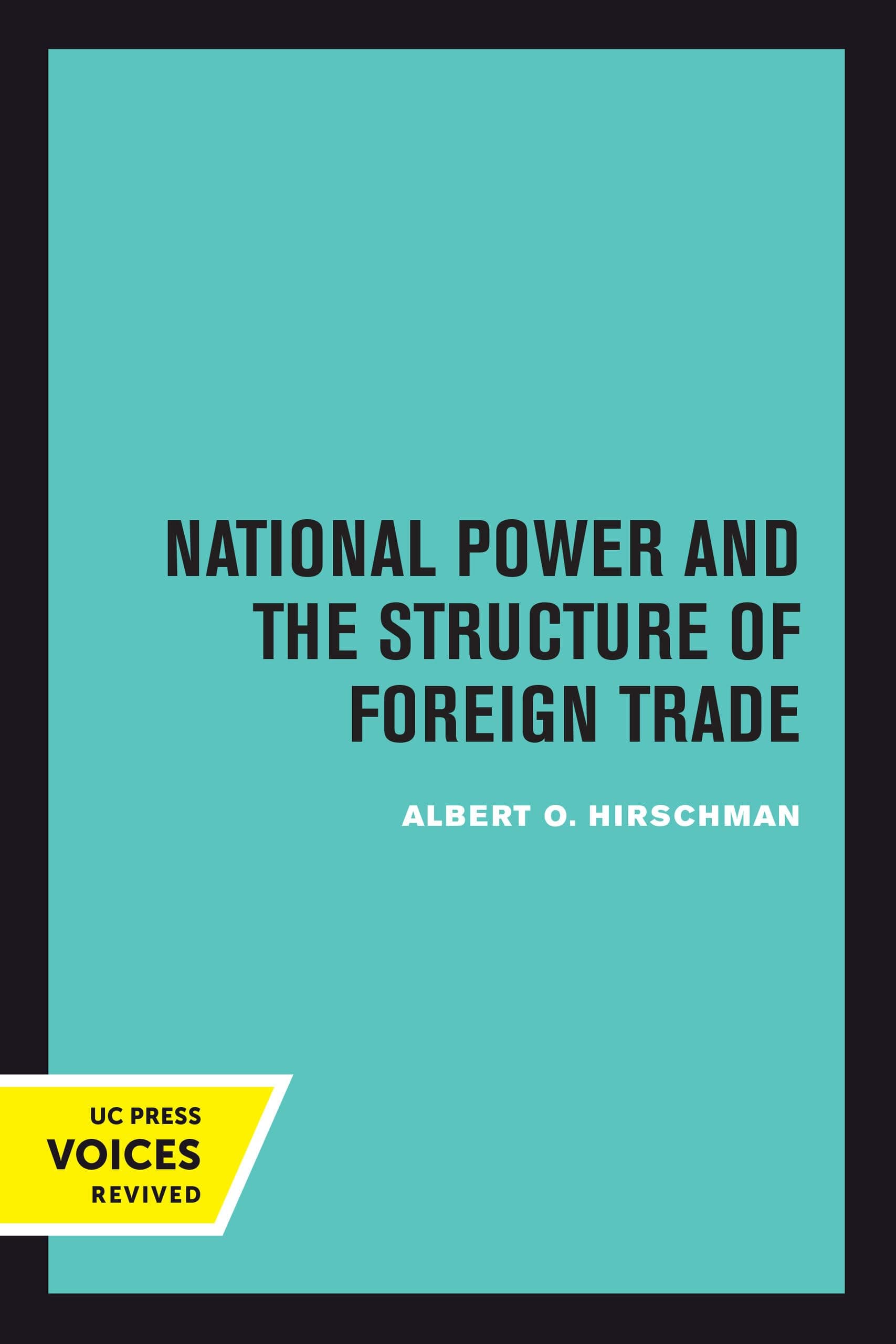
Buy National Power and the Structure of Foreign Trade (The Politics of the International Economy, 1) Reprint,Expanded by Hirschman, Albert (ISBN: 9780520301337) from desertcart's Book Store. Everyday low prices and free delivery on eligible orders. Review: national power and the structure of foreign trade - Hirschman's 'National Power and the Structure of Foreign Trade' is an influential yet sorely overlooked theory of trade relations that was first published in 1945. The manipulation of modern trade relations between major powers and the countries that depend on them for development stands as testament to the timelessness of Hirshman's analysis. Focusing of pre-WW2 Germany, Hirschman highlights the intentions of actors within its government to create trade dependencies, through monopolisation of markets, in which other nations would be forced to rely on German goods. He postulates that similar strategies form the basis of power maximisation in the international arena. Although Hirshman's book heavily influenced dependency theory in the 1960's and 70's, possibly leading to the book's being republished in 1980, his cutting dissection of liberalism (J. S. Mill and Adam Smith) and its implications for neo-liberalism should be of interest to anyone concerned with the motivations behind trade relations, past, present and future. Sadly, the book is no longer in print, and current scholars in political science are the worse off for it. This is particularly so as copies are difficult to obtain. If you are studying in this field however, it is worth the effort. If we can get it back onto reading lists in universities then perhaps the demand will be enough to force a reprint. Review: Ouy of date - Out of date
| Best Sellers Rank | 480,821 in Books ( See Top 100 in Books ) 2,509 in Business & Economic History 100,262 in Society, Politics & Philosophy |
| Customer reviews | 4.1 4.1 out of 5 stars (12) |
| Dimensions | 15.24 x 1.24 x 22.86 cm |
| Edition | Reprint,Expanded |
| ISBN-10 | 0520301331 |
| ISBN-13 | 978-0520301337 |
| Item weight | 272 g |
| Language | English |
| Print length | 196 pages |
| Publication date | 20 April 2018 |
| Publisher | University of California Press |
D**E
national power and the structure of foreign trade
Hirschman's 'National Power and the Structure of Foreign Trade' is an influential yet sorely overlooked theory of trade relations that was first published in 1945. The manipulation of modern trade relations between major powers and the countries that depend on them for development stands as testament to the timelessness of Hirshman's analysis. Focusing of pre-WW2 Germany, Hirschman highlights the intentions of actors within its government to create trade dependencies, through monopolisation of markets, in which other nations would be forced to rely on German goods. He postulates that similar strategies form the basis of power maximisation in the international arena. Although Hirshman's book heavily influenced dependency theory in the 1960's and 70's, possibly leading to the book's being republished in 1980, his cutting dissection of liberalism (J. S. Mill and Adam Smith) and its implications for neo-liberalism should be of interest to anyone concerned with the motivations behind trade relations, past, present and future. Sadly, the book is no longer in print, and current scholars in political science are the worse off for it. This is particularly so as copies are difficult to obtain. If you are studying in this field however, it is worth the effort. If we can get it back onto reading lists in universities then perhaps the demand will be enough to force a reprint.
P**Y
Ouy of date
Out of date
S**9
I bought this book after a column in the Financial Times indicated it might contain some of the intellectual foundations for the tariff policy being pursued by the Trump administration. It is a dense read (thankfully short), particularly for a non-economist. The discussion of varies trade strategies pursued by Germany leading up the WW I was interesting. However, application of the various theoretical trade strategies was very difficult to relate to present day conditions, unless you focused on the general theme of the book that international trade strategies can be pursued by countries to maximize their power and war-time advantage over other counties.
Trustpilot
5 days ago
1 day ago