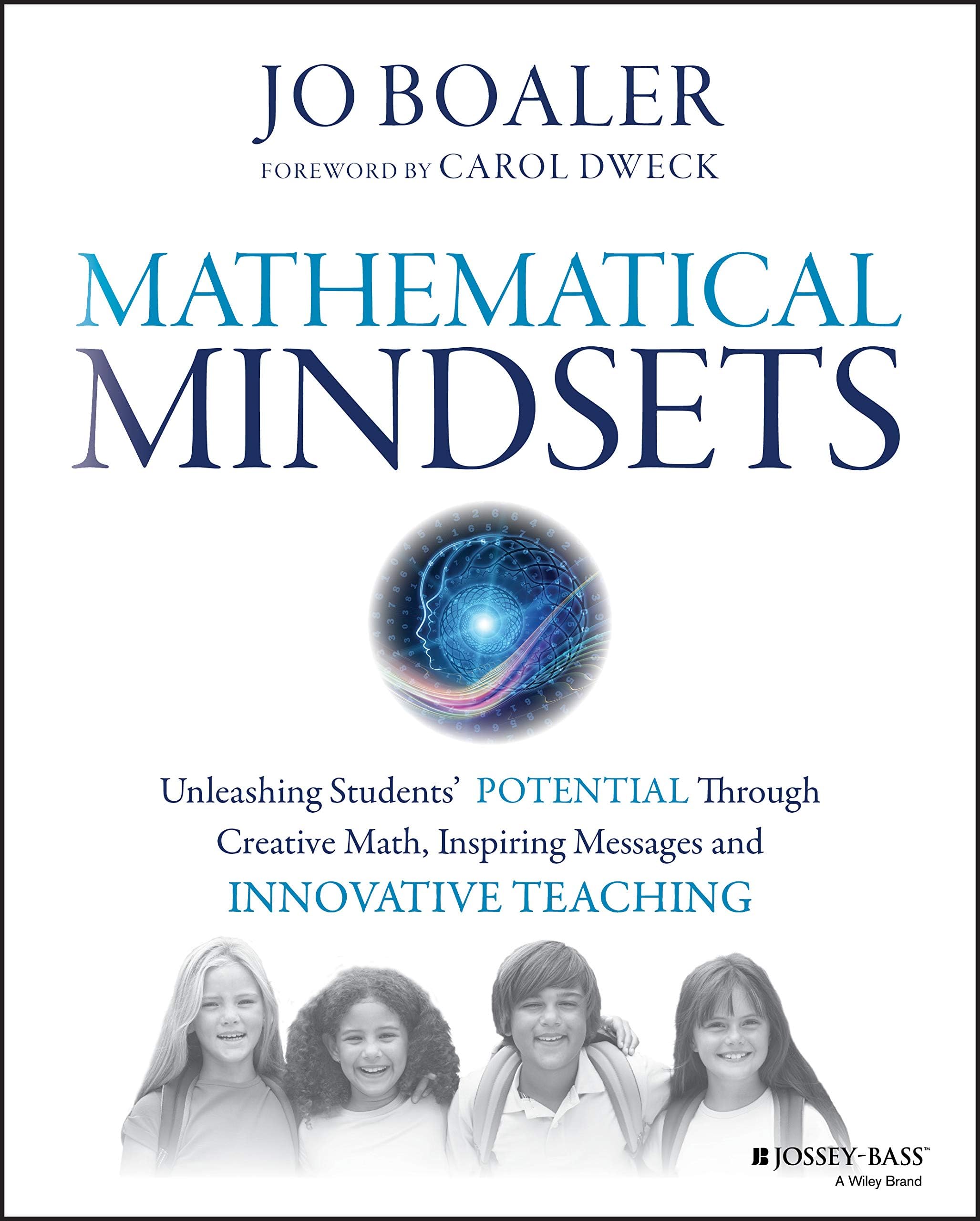
Mathematical Mindsets: Unleashing Students' Potential Through Creative Math, Inspiring Messages and Innovative Teaching
Product ID: 19883465
Desertcart purchases this item on your behalf and handles shipping, customs, and support to Kyrgyzstan.
Banish math anxiety and give students of all ages a clear roadmap to success Mathematical Mindsets provides practical strategies and activities to help teachers and parents show all children, even those who are convinced that they are bad at math, that they can enjoy and succeed in math. Jo Boaler—Stanford researcher, professor of math education, and expert on math learning—has studied why students don't like math and often fail in math classes. She's followed thousands of students through middle and high schools to study how they learn and to find the most effective ways to unleash the math potential in all students. There is a clear gap between what research has shown to work in teaching math and what happens in schools and at home. This book bridges that gap by turning research findings into practical activities and advice. Boaler translates Carol Dweck's concept of 'mindset' into math teaching and parenting strategies, showing how students can go from self-doubt to strong self-confidence, which is so important to math learning. Boaler reveals the steps that must be taken by schools and parents to improve math education for all. Mathematical Mindsets : Explains how the brain processes mathematics learning Reveals how to turn mistakes and struggles into valuable learning experiences Provides examples of rich mathematical activities to replace rote learning Explains ways to give students a positive math mindset Gives examples of how assessment and grading policies need to change to support real understanding Scores of students hate and fear math, so they end up leaving school without an understanding of basic mathematical concepts. Their evasion and departure hinders math-related pathways and STEM career opportunities. Research has shown very clear methods to change this phenomena, but the information has been confined to research journals—until now. Mathematical Mindsets provides a proven, practical roadmap to mathematics success for any student at any age. Review: a challenge to conventional thinking - Prof. Boaler has encouraged me to try a more open approach with my teaching in algebra. I have tried to present a more open-minded perspective for my students than I have in the past. I have also tried to emphasize that it’s alright, and actually good, to make mistakes, when we struggle to learn, because then we are growing. I also tried to present the problems we have worked on in class in a more open-minded way. One can, to a certain extent, emphasize an open-minded viewpoint even with the very narrow procedural, and rule-oriented problems that we tend to work in an algebra class. For instance, one can emphasize that there are usually several approaches to solving problems, not necessarily the book’s or mine. The focus on narrow, procedural problems is, as Prof. Boaler emphasizes, just a focus on one facet of mathematics, often not the most important. There is a whole aspect of critical and creative thinking that is being neglected. I like her analogy for the types of problems she seeks: Low-floor and high-ceiling. Switching students from a fixed mindset to a growth mindset is very challenging. For example, projects in which the students engage in creative and critical thinking are frequently inefficient relative to narrowly focused procedural problems. Do the students actually learn what they need as adults when there is a more open-minded, i.e. a greater growth mindset, environment? Isn’t it the procedural, the calculations, that they need to learn? Isn’t that the heart of mathematics? If we consider actual mathematicians, we recognize this is not actually the case. As students develop into mathematicians, they become interested in formulating problems, in mathematical reasoning, and in developing intuitions about the mathematics. Also, many (most?) mathematicians work collaboratively, rather than in the isolated ways we encourage in our competitive environments in schools. Inevitably, aren’t mistakes bad. Aren’t our limitations as human beings, and the limitations of our environments, simply forcing a fixed, rather than a growth, mindset on us? We become expert and seek to minimize errors. As one grows, certainly those things we become expert and proficient at become more automatic. The limitations we are subject to are, more often than not, amount to such an accommodation with our environment. This can make us want to neglect the struggles, the mistakes and the ambiguities inherent in learning. However, they are essential elements of learning and the growth of our minds, and they force us to consider more open-minded approaches, more creative and critical approaches, to progressing. This is the case even as we grow older and more fixed in our ways. We can make an allusion to Plato's allegory of the cave. We all tend to live in Plato’s cave: Seeing shadows reflected on the wall. Perhaps we are barred from reality, or perhaps we are just limiting ourselves. Research in neuroscience seems to suggest that, at least to a fair extent, we limit ourselves. Even when we are old, there is a certain plasticity to our minds: A growth mindset is of at least some merit even for older people. There is at least some substantial evidence that we can improve learning in the classroom, and help students be more effective and creative, by developing a growth mindset, and by helping students develop such a mindset. This is Prof. Boaler’s main perspective. It seems to open all sorts of doors for people learning mathematics, not only to greater proficiency at mathematics but to more appreciation of mathematics and its aesthetic aspects. It also seems to be a very helpful perspective even for students who already achieve highly in mathematics. I can recommend Prof. Boaler’s book even if you disagree with her point of view. She is trying to challenge, in a well-supported way from experience and research, ideas that are common among many teachers of mathematics and in our culture generally. I think her book is very thought-provoking. Review: A Must-Read! - A must-read for parents, teachers, and anyone involved in schools and education policy, especially as it relates to math! It's impressive how well the book addresses all these different audiences. There's not a lot of education jargon, and Boaler has plenty of relevant anecdotes to illustrate her ideas, making the book completely accessible to non-educators. There is is a good overview of the recent math education and mindset literature, without going too far into the arcane world of education research. At the same time, everything is well cited, so anyone who wants to delve into the details can flip to the references and find what they need. As a math teacher, I can say that this book really fills a void. In one readable and well-integrated volume, Boaler takes on such diverse topics as how people learn math; the importance of mindset and how it relates to math; how best to serve students at many different levels of math achievement; what math has to do with educational equity, and more. Parents of students who are struggling in math will welcome learning about the research on math phobia and will find that Boaler provides much practical advice on how to change course. Parents of high-achieving math students need to read this book since it provides an important counterpoint to the default of channeling "gifted" students into accelerated math tracks, often without ever giving them a chance to explore math beyond an algorithmic level. You'll have a much better idea of what you might want to advocate for in order to serve your child well through their educational career. Anyone interested in advancing educational equity will find that Boaler has much to say about how the teaching of math has historically contributed to inequity, and how it needs to be part of the way forward. Teachers and administrators interested in de-tracking their math programs will want to read this book because it not only provides important rationales for creating heterogeneous classrooms but also explains the comprehensive changes in pedagogy that are necessary for all students to be empowered and challenged.



| Best Sellers Rank | #122,877 in Books ( See Top 100 in Books ) #54 in Mathematics Study & Teaching (Books) #131 in Math Teaching Materials #349 in Mathematics (Books) |
| Customer Reviews | 4.7 out of 5 stars 1,802 Reviews |
M**E
a challenge to conventional thinking
Prof. Boaler has encouraged me to try a more open approach with my teaching in algebra. I have tried to present a more open-minded perspective for my students than I have in the past. I have also tried to emphasize that it’s alright, and actually good, to make mistakes, when we struggle to learn, because then we are growing. I also tried to present the problems we have worked on in class in a more open-minded way. One can, to a certain extent, emphasize an open-minded viewpoint even with the very narrow procedural, and rule-oriented problems that we tend to work in an algebra class. For instance, one can emphasize that there are usually several approaches to solving problems, not necessarily the book’s or mine. The focus on narrow, procedural problems is, as Prof. Boaler emphasizes, just a focus on one facet of mathematics, often not the most important. There is a whole aspect of critical and creative thinking that is being neglected. I like her analogy for the types of problems she seeks: Low-floor and high-ceiling. Switching students from a fixed mindset to a growth mindset is very challenging. For example, projects in which the students engage in creative and critical thinking are frequently inefficient relative to narrowly focused procedural problems. Do the students actually learn what they need as adults when there is a more open-minded, i.e. a greater growth mindset, environment? Isn’t it the procedural, the calculations, that they need to learn? Isn’t that the heart of mathematics? If we consider actual mathematicians, we recognize this is not actually the case. As students develop into mathematicians, they become interested in formulating problems, in mathematical reasoning, and in developing intuitions about the mathematics. Also, many (most?) mathematicians work collaboratively, rather than in the isolated ways we encourage in our competitive environments in schools. Inevitably, aren’t mistakes bad. Aren’t our limitations as human beings, and the limitations of our environments, simply forcing a fixed, rather than a growth, mindset on us? We become expert and seek to minimize errors. As one grows, certainly those things we become expert and proficient at become more automatic. The limitations we are subject to are, more often than not, amount to such an accommodation with our environment. This can make us want to neglect the struggles, the mistakes and the ambiguities inherent in learning. However, they are essential elements of learning and the growth of our minds, and they force us to consider more open-minded approaches, more creative and critical approaches, to progressing. This is the case even as we grow older and more fixed in our ways. We can make an allusion to Plato's allegory of the cave. We all tend to live in Plato’s cave: Seeing shadows reflected on the wall. Perhaps we are barred from reality, or perhaps we are just limiting ourselves. Research in neuroscience seems to suggest that, at least to a fair extent, we limit ourselves. Even when we are old, there is a certain plasticity to our minds: A growth mindset is of at least some merit even for older people. There is at least some substantial evidence that we can improve learning in the classroom, and help students be more effective and creative, by developing a growth mindset, and by helping students develop such a mindset. This is Prof. Boaler’s main perspective. It seems to open all sorts of doors for people learning mathematics, not only to greater proficiency at mathematics but to more appreciation of mathematics and its aesthetic aspects. It also seems to be a very helpful perspective even for students who already achieve highly in mathematics. I can recommend Prof. Boaler’s book even if you disagree with her point of view. She is trying to challenge, in a well-supported way from experience and research, ideas that are common among many teachers of mathematics and in our culture generally. I think her book is very thought-provoking.
E**.
A Must-Read!
A must-read for parents, teachers, and anyone involved in schools and education policy, especially as it relates to math! It's impressive how well the book addresses all these different audiences. There's not a lot of education jargon, and Boaler has plenty of relevant anecdotes to illustrate her ideas, making the book completely accessible to non-educators. There is is a good overview of the recent math education and mindset literature, without going too far into the arcane world of education research. At the same time, everything is well cited, so anyone who wants to delve into the details can flip to the references and find what they need. As a math teacher, I can say that this book really fills a void. In one readable and well-integrated volume, Boaler takes on such diverse topics as how people learn math; the importance of mindset and how it relates to math; how best to serve students at many different levels of math achievement; what math has to do with educational equity, and more. Parents of students who are struggling in math will welcome learning about the research on math phobia and will find that Boaler provides much practical advice on how to change course. Parents of high-achieving math students need to read this book since it provides an important counterpoint to the default of channeling "gifted" students into accelerated math tracks, often without ever giving them a chance to explore math beyond an algorithmic level. You'll have a much better idea of what you might want to advocate for in order to serve your child well through their educational career. Anyone interested in advancing educational equity will find that Boaler has much to say about how the teaching of math has historically contributed to inequity, and how it needs to be part of the way forward. Teachers and administrators interested in de-tracking their math programs will want to read this book because it not only provides important rationales for creating heterogeneous classrooms but also explains the comprehensive changes in pedagogy that are necessary for all students to be empowered and challenged.
C**R
Every Math Teacher Needs This Book!
Mathematical Mindsets completely transformed how I teach math. Jo Boaler gives both research-backed insights and practical classroom strategies that challenge the fixed mindset so many students carry. This book helped me move beyond drill-and-kill instruction and toward open, creative tasks that build confidence and deep understanding. My students are more willing to take risks and actually enjoy math now! Whether you're a new teacher or a veteran, this is essential reading. It should be part of every school’s professional development library.
L**N
Students learning by lower stress math teaching methods performed as well or better than students under pressure to be fast.
I appreciated that there is a lot of good information about how math is learned, and support for the more modern methods of teaching math for understanding, rather than the production-oriented methods that don't really teach good math understanding. I personally think there needs to be more middle-ground than Jo Boaler does, and I didn't care for the areas where she cited her own research so much, but that may be somewhat unavoidable in this context. Overall, good information, a little heavy on pictures without significant info in the captions (or on the page, for that matter), but very worthy of thought from a teaching perspective, for those teaching math, whether through regular schools, alternative settings, homeschool, etc.
M**6
Great Book for Education
I bought this book about two weeks ago and just finished it. I was thoroughly impressed with the book. I study computer science but also many other fields of mathematics, and plan on going into teaching at a university. The contents of this book are geared more towards children but I believe the concepts apply almost everywhere. These are the kinds of ideas that are needed to change education in the U.S. around. From personal experience I can say that universities are stuck in a similar rut where people get left behind because they aren't quick enough or not great at taking tests in an hour time. I have had a class similar to ones described in the book as the "model" class and I can say that I learned significantly more and was much more involved in the class. It also seemed that some of my fellow students were too, as they started the class out thinking it would just be boring, but since we were involved almost every class period, they often enjoyed the class and pushed for learning more. Thus i can only say that this book should be read by anyone who is passionate about education or just wants to teach a class at work. It will show new ideas that are vital to learning instead of number crunching. I feel that it (aside from a few grammatical errors) was well written and the citing of sources was nice to see, with a large bibliography to back the claims up. Overall it is a good read, and a relatively quick one.
C**A
MUST READ!!!
Jo Boaler, In her book, Mathematical Mindsets, has wonderfully executed the importance of having a growth mindset - a mind that does not limit oneself based off perceived ability. She has especially emphasized the importance of a growth mindset in mathematics, for educators and students alike. Mathematical Mindsets has provided insight on the value of mistakes and how we can promote the idea that all students are capable of achieving in mathematics. As an educator, Jo Boaler has helped me to change the way that I view and teach mathematics. This book has transformed my belief that mathematics are only accessible to certain students; instead, every student can definitely be a “math student”! This is a MUST READ and I can not wait to share everything that I’ve gained with my future colleagues!! ~Esther, Abby, Cayla and Kayla
M**S
High Praise
If you have constantly had that feeling the way your child is being taught math at school is insufficient, getting them frustrated, etc get this book. My high-achieving daughter has always been held back in math at her school, forced to do countless repetitions of things she already knows. Then, when I asked for more for her (test scores very high also) was told she didn't master her times tests quickly enough as a lame excuse for why she needed more work!! Ms. Boaler explains why times tables, repetition etc are bunk and has the experience and research to prove it. My poor daughter even said to me "Mom, I am into quality, not quantity." She even knew that the methods used in school weren't what she needed and craved to be and think mathematically. This book will explain the why and gives parents and educators many examples of how to think and teach mathematically. 5 stars isn't enough for this book. Thank you Jo Boaler.
A**A
A Must Read!
There have been 2 books that have changed how I teach math. The first was Number Talks and now this one. I understand common core math but I was one of the die-hard hold outs for memorizing math facts. THIS is the book that changed my mind. It goes through the neurological nuances of how the brain learns during various mathematical activities to show you the actual impact on your student. It shows you how a growth mindset in math is essential and then teaches you how to integrate this into your lessons. This is the one book you must read now!
M**D
Bought for a university course I took. This was the textbook. Great condition.
Had to buy it for a class I took. Seems like an informative book--but I don't know, because I didn't read through it once. The textbook-scam continues...
M**A
Request for translation to Spanish
This is a great book for parents. I wonder to know if a translation to Spanish will come soon. Thank you.
A**R
Transforming the the mathematics teaching paradigm
A very insightful book that changes the paradigm of math teaching from rote and procedure based to one of creativity, collaboration, connection and visualization. This is a must read for all parents and teachers endeavoring to inculcate a love for mathematics and helping their children/students to understand the conceptual underpinnings of mathematics. This will stand in very good stead for the children not only in math but for all other aspects of problem solving
A**R
Inspirational and practical book on on how to approach maths. Love it!
Though only part way through this exciting book I am hugely one over by Jo Boaler's incites into maths and maths teaching. Like many I didn't much excel at maths at school and certainly didn't enjoy it. But ever since I have had a sneaky suspicion that maths might be a great deal sexier than I had once given it credit. This book proves my suspicions correct! It's refreshing to say the least to know that making conceptual and calculation mistakes is such a positive experience for the brain and learning. This is just one of the many empowering messages contained in the book. As a one time primary teacher I was trained to help kids to 'embed' their learning but in all honesty never really understood how to actually apply this to maths teaching. Now I am inspired to return to my own maths learning and see where this takes me and I have already got some concrete tips on how to approach maths from the outset with my young children. I had been slightly dreading bringing maths to my children (we are home schooling initially) and feeling unworthy of the task, but no more! Thanks Jo for giving me a whole new way to look at Maths. I think this book is for anyone, but especially those who feel they might have missed something when they see excited, secret scribbling in response to the number 421 on countdown.
C**E
Strong recommendation for math teachers and parents
A fantastic book for professional development in math teaching, with state of the art ideas backed by research and with practical suggestions for application in the classroom. Quite revolutionary.
Trustpilot
2 weeks ago
2 months ago