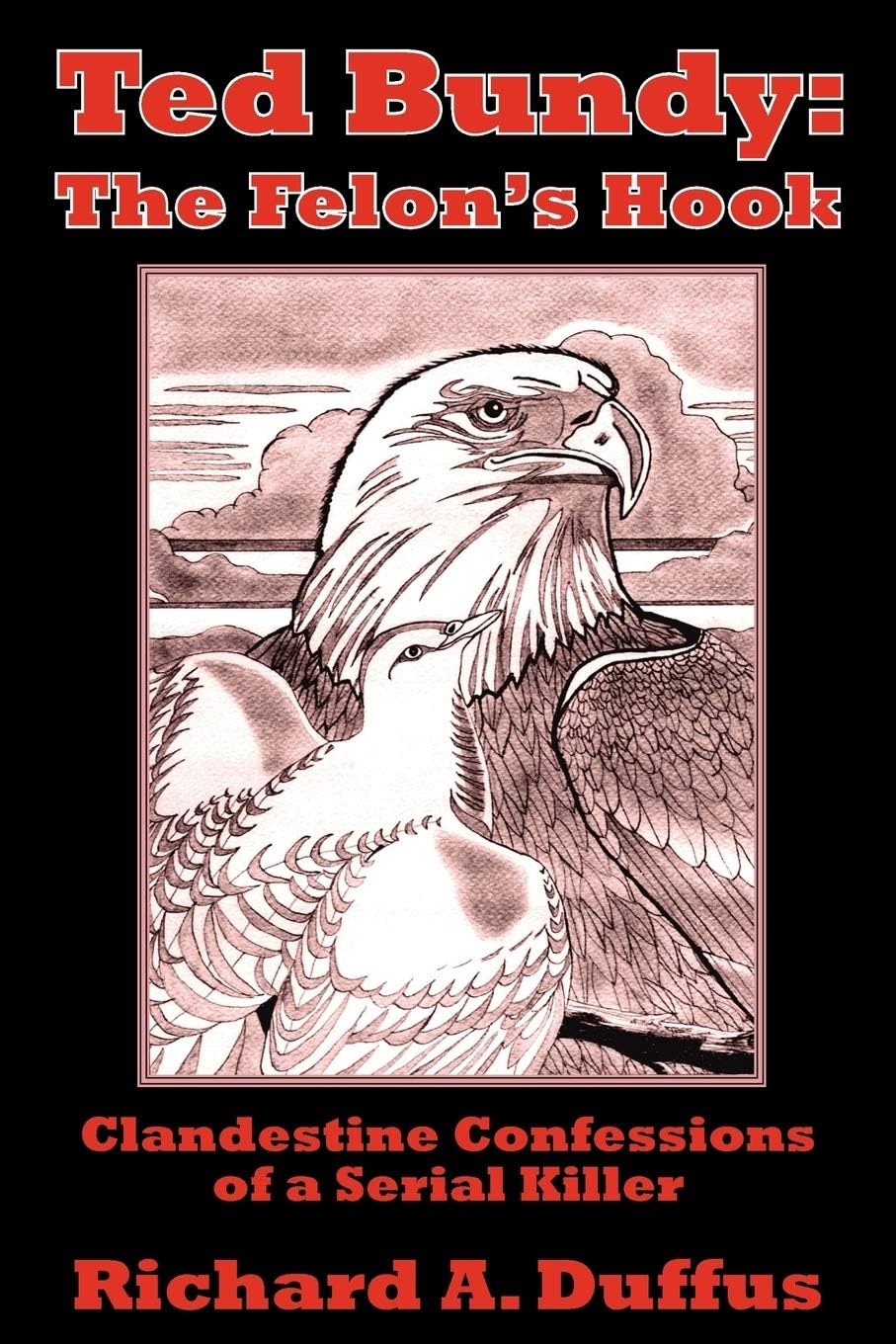

Ted Bundy: The Felon's Hook
Product ID: 19585238
Ted Bundy: The Felon's Hook [Duffus, Richard A.] on desertcart.com. *FREE* shipping on qualifying offers. Ted Bundy: The Felon's Hook Review: Bundy Talks? - What would you do if you thought the infamous Ted Bundy corresponded with you and was trying to tell you something? I am sure most of us would be compelled to try and figure it out. Some of us would feel almost morally obligated to do so. That's exactly what happened to this author and he takes you on his journey with him. Some of his conclusions you will agree with and others you will not but to me the important thing is the journey and the insights shared with the reader. The author challenges the canon of Bundy scripture! The author concludes that Bundy was gay and it was repressed. To me this is a very real possibility and many puzzle pieces fall into place. He certainly doesn't advocate that this is the sole cause of his murders; absolutely not but it could be ONE piece of the puzzle. The author discusses the very real damage done by society's bigotry and the bullying that often happens and causes people to repress their homosexuality and the devastation that can cause. There is no question that Bundy had psychopathic traits. He, as well as his fellow serial killers, are like 'Perfect Storms' of psychological and social influences that react with pre-existing (genetic/early nurturing) conditions that prove fertile ground for the serial killer to emerge. On Death Row, Bundy's hands were tied. He expressed on numerous occasions the wish to be understood and to be open. The appeals process hinders any such openness. Also, anything coming out of Bundy's mouth or on paper quickly became newsworthy and was often misconstrued and he knew it. Everything he did was a 'commercial product' to be used by newspapers to sell editions and to buy and sell for profit. Could he have tried to get a message out and how would he do that when even his mail was picked over? One the things I appreciated most was that the author brought together multiple sources covering the same event when normally we would have to pull out many different books and articles to get the same. He included quotes from sources that you can't get anymore because they are out of print, and he cited newspaper articles quoting some of our favourite players at the time these things were actually happening. Lots of `new to me' stuff. A good Bundy book to have on the shelf for its references alone. It was interesting getting to know Bobby Lewis (a convicted murderer) through the author's eyes and getting a behind the scenes look at the Rolling case. Bobby was lucky to have a friend like the author and I can't help but think that the friendship showed Bobby another way of being and changed his life for the better. So the above was worth the `price of admission' alone but the `star' of the book for me was Chapter 15 - The Road to Hell. This is where the author shines as far as I am concerned. He offers an analysis by summarizing psychological and social factors that contribute to serial murder and violence. Regardless of whether you agree with the author's conclusions, some very important issues were brought to the forefront and offered me some new lines of enquiry in my struggle to understand the 'why' of serial murder and violence. Review: Makes You Question What You Always Thought You Knew About Bundy - Once upon a time, author Richard Duffus was lonely and looking for a partner in crime. So he sent out a personal ad and received a very interesting letter sent from a Florida prison. The convict who wrote the letter was Bobby Lewis and he claimed to be gay as well. The two kept up a correspondence for months. Lewis asked for money, and in return, he sent Duffus sketches. Duffus soon learns that Lewis is friends with none other than the infamous Ted Bundy, who pipes in with some sketches and letters of his own. As time goes on, Duffus begins to do some research on Ted Bundy, curious to find out more about this cryptic man who intruded on what he felt was a budding relationship with another gay man. He doesn't understand comments this mysterious stranger makes such as "I wanted to write and tell you that you have made a difference in how things go for me around here. Bob got me high and it was good, Thanks to you (P. 135)!" As he reads more about Bundy from books by authors such as Ann Rule and Richard Larsen, he begins to wonder if Bundy might be a closeted homosexual himself, and if that might be what led him to kill so many young women (though he's hesitant to excuse the behavior, and also hesitant to link homosexuals with acts of violence). He begins to wonder if the whole correspondence was a masquerade and a way for Bundy to hide behind his good friend (who was actually very much straight) and pull a classic Cyrano de Bergerac move. After all, Bundy is known for his third person confessions and the way he talks in puzzles. Was he really a repressed young man whose inability to act on his true desires pushed him over the edge and caused him to take out his aggression on the ones who only served to mock what he could never truly possess because he did not want what everyone told him he must want to be a normal, functioning member of society? It definitely makes you question everything you thought you knew about Ted Bundy. Duffus makes it clear that the intention is not to excuse a murderer's evil actions but, instead, try to understand how toxic society can be toward those who are different. I had a dream about Bundy a few years ago. I had the dream two days after his 66th birthday, though I highly doubt I knew the significance of the date at the time. I only came to realize it years later. In my dream, he looked like a woman masquerading as a man. And we were sitting in a theater. Certain aspects of that dream take on more significance now that I've read several books about him this year. So many people have described him as being very feminine. And I also noticed so many things that made me wonder if he was repressed. A google search on the subject led me to this book. Some evidence that may back up Duffus' claims are the following: 1. Ted Bundy was very withdrawn as a child and didn't feel comfortable using a public locker room (P. 256) 2. Ted Bundy visited gay bars and enjoyed the company of homosexuals (P. 258) 3. Ted Bundy once made an appearance at a Seattle gay bathhouse where he stayed for an extended period of time (P. 258) 4. Bobby Lewis responded to Duffus' speculations by stating that he did in fact believe his close friend was repressed. "As to whether Ted as gay it like so many things it's not a yes or no -- he hated women. He was gay in that what his desires were -- he would have loved a strong man -- he was feminine in many ways, But he never had a sexual relationship with another man. That was part of his problem. He could not let his real self out -- or at least one of his real self, He had a few. In so many way he tried to come across to the public as real macho when in reality he was just the opposite (P. 254)." 5. Duffus mentions that there was lost footage of Bundy "camping it up" and "mincing about the courtroom like a little peacock" at one of the trials. Duffus quotes a witness: "The locals watching the news with us all asked how this guy, so obviously gay, could have been involved with so many women. That might have been Ted's motive in the first place (P. 260)." But Duffus suspects "it was more likely a temporary release of a long-repressed demeanor (P. 260.)" 6. Duffus also comments on Bundy's eager to please attitude around men, and especially "men of power (261)." He wonders if "The games he played with them were Bundy's back-handed way of expressing his affection toward them and showing by his cleverness that he was worthy of them (P. 261))." 7. He once mentioned that he "always felt more comfortable with women than with men, in working situations and social situations (261)." Duffus analyzes things he read about Bundy, picking apart a particular quote in Rule's book that always stuck out to me as well. And there's a hint of sexual abuse in Bundy's past which Duffus touches on a little bit. It definitely puts a whole new spin on everything you ever thought you knew about Bundy. So many things that seemed creepy before still seem creepy but also take on a new meaning, such as his passive-aggression and inability to get close to his romantic partners. He put on a good act, but when it came to being truly intimate, he would withdraw. Then there were the "games" he would play with policemen. I think of another Bundy book I read as well. Jerry Thompson, who was in part responsible for the investigation into Bundy, despite everyone's claims that he was not their guy, was interviewed by another author for the book "I'm Not Guilty" and spoke of how uncomfortable Ted made him. His complaints were that Ted would bend over backwards to accommodate his demands, call him constantly and tease him about following him around town. He felt that this was not the behavior of an innocent man. But when you entertain the idea that Ted might have been a repressed homosexual, it gives you a whole new perspective of the situation and the interactions seem almost flirtatious. I found it hard to follow Duffus's logic at times, but I think he makes you think and it's definitely interesting to hear his take. He also has an interesting theory regarding Bundy's motivation for doing that final interview with Rev. James Dobson. Much of what's in this book is only speculation. But I think he may be onto something. I recommend this book if you're interested in the Bundy sketches or if you want to learn more about Bundy from a different angle. The book also discusses Bobby Lewis's connection to the Gainesville Ripper.
| Customer Reviews | 4.1 4.1 out of 5 stars (11) |
| Dimensions | 6 x 1.3 x 9 inches |
| ISBN-10 | 0983949514 |
| ISBN-13 | 978-0983949510 |
| Item Weight | 1.88 pounds |
| Language | English |
| Print length | 646 pages |
| Publication date | April 15, 2012 |
| Publisher | Darksider Press |
"**T
Bundy Talks?
What would you do if you thought the infamous Ted Bundy corresponded with you and was trying to tell you something? I am sure most of us would be compelled to try and figure it out. Some of us would feel almost morally obligated to do so. That's exactly what happened to this author and he takes you on his journey with him. Some of his conclusions you will agree with and others you will not but to me the important thing is the journey and the insights shared with the reader. The author challenges the canon of Bundy scripture! The author concludes that Bundy was gay and it was repressed. To me this is a very real possibility and many puzzle pieces fall into place. He certainly doesn't advocate that this is the sole cause of his murders; absolutely not but it could be ONE piece of the puzzle. The author discusses the very real damage done by society's bigotry and the bullying that often happens and causes people to repress their homosexuality and the devastation that can cause. There is no question that Bundy had psychopathic traits. He, as well as his fellow serial killers, are like 'Perfect Storms' of psychological and social influences that react with pre-existing (genetic/early nurturing) conditions that prove fertile ground for the serial killer to emerge. On Death Row, Bundy's hands were tied. He expressed on numerous occasions the wish to be understood and to be open. The appeals process hinders any such openness. Also, anything coming out of Bundy's mouth or on paper quickly became newsworthy and was often misconstrued and he knew it. Everything he did was a 'commercial product' to be used by newspapers to sell editions and to buy and sell for profit. Could he have tried to get a message out and how would he do that when even his mail was picked over? One the things I appreciated most was that the author brought together multiple sources covering the same event when normally we would have to pull out many different books and articles to get the same. He included quotes from sources that you can't get anymore because they are out of print, and he cited newspaper articles quoting some of our favourite players at the time these things were actually happening. Lots of `new to me' stuff. A good Bundy book to have on the shelf for its references alone. It was interesting getting to know Bobby Lewis (a convicted murderer) through the author's eyes and getting a behind the scenes look at the Rolling case. Bobby was lucky to have a friend like the author and I can't help but think that the friendship showed Bobby another way of being and changed his life for the better. So the above was worth the `price of admission' alone but the `star' of the book for me was Chapter 15 - The Road to Hell. This is where the author shines as far as I am concerned. He offers an analysis by summarizing psychological and social factors that contribute to serial murder and violence. Regardless of whether you agree with the author's conclusions, some very important issues were brought to the forefront and offered me some new lines of enquiry in my struggle to understand the 'why' of serial murder and violence.
C**A
Makes You Question What You Always Thought You Knew About Bundy
Once upon a time, author Richard Duffus was lonely and looking for a partner in crime. So he sent out a personal ad and received a very interesting letter sent from a Florida prison. The convict who wrote the letter was Bobby Lewis and he claimed to be gay as well. The two kept up a correspondence for months. Lewis asked for money, and in return, he sent Duffus sketches. Duffus soon learns that Lewis is friends with none other than the infamous Ted Bundy, who pipes in with some sketches and letters of his own. As time goes on, Duffus begins to do some research on Ted Bundy, curious to find out more about this cryptic man who intruded on what he felt was a budding relationship with another gay man. He doesn't understand comments this mysterious stranger makes such as "I wanted to write and tell you that you have made a difference in how things go for me around here. Bob got me high and it was good, Thanks to you (P. 135)!" As he reads more about Bundy from books by authors such as Ann Rule and Richard Larsen, he begins to wonder if Bundy might be a closeted homosexual himself, and if that might be what led him to kill so many young women (though he's hesitant to excuse the behavior, and also hesitant to link homosexuals with acts of violence). He begins to wonder if the whole correspondence was a masquerade and a way for Bundy to hide behind his good friend (who was actually very much straight) and pull a classic Cyrano de Bergerac move. After all, Bundy is known for his third person confessions and the way he talks in puzzles. Was he really a repressed young man whose inability to act on his true desires pushed him over the edge and caused him to take out his aggression on the ones who only served to mock what he could never truly possess because he did not want what everyone told him he must want to be a normal, functioning member of society? It definitely makes you question everything you thought you knew about Ted Bundy. Duffus makes it clear that the intention is not to excuse a murderer's evil actions but, instead, try to understand how toxic society can be toward those who are different. I had a dream about Bundy a few years ago. I had the dream two days after his 66th birthday, though I highly doubt I knew the significance of the date at the time. I only came to realize it years later. In my dream, he looked like a woman masquerading as a man. And we were sitting in a theater. Certain aspects of that dream take on more significance now that I've read several books about him this year. So many people have described him as being very feminine. And I also noticed so many things that made me wonder if he was repressed. A google search on the subject led me to this book. Some evidence that may back up Duffus' claims are the following: 1. Ted Bundy was very withdrawn as a child and didn't feel comfortable using a public locker room (P. 256) 2. Ted Bundy visited gay bars and enjoyed the company of homosexuals (P. 258) 3. Ted Bundy once made an appearance at a Seattle gay bathhouse where he stayed for an extended period of time (P. 258) 4. Bobby Lewis responded to Duffus' speculations by stating that he did in fact believe his close friend was repressed. "As to whether Ted as gay it like so many things it's not a yes or no -- he hated women. He was gay in that what his desires were -- he would have loved a strong man -- he was feminine in many ways, But he never had a sexual relationship with another man. That was part of his problem. He could not let his real self out -- or at least one of his real self, He had a few. In so many way he tried to come across to the public as real macho when in reality he was just the opposite (P. 254)." 5. Duffus mentions that there was lost footage of Bundy "camping it up" and "mincing about the courtroom like a little peacock" at one of the trials. Duffus quotes a witness: "The locals watching the news with us all asked how this guy, so obviously gay, could have been involved with so many women. That might have been Ted's motive in the first place (P. 260)." But Duffus suspects "it was more likely a temporary release of a long-repressed demeanor (P. 260.)" 6. Duffus also comments on Bundy's eager to please attitude around men, and especially "men of power (261)." He wonders if "The games he played with them were Bundy's back-handed way of expressing his affection toward them and showing by his cleverness that he was worthy of them (P. 261))." 7. He once mentioned that he "always felt more comfortable with women than with men, in working situations and social situations (261)." Duffus analyzes things he read about Bundy, picking apart a particular quote in Rule's book that always stuck out to me as well. And there's a hint of sexual abuse in Bundy's past which Duffus touches on a little bit. It definitely puts a whole new spin on everything you ever thought you knew about Bundy. So many things that seemed creepy before still seem creepy but also take on a new meaning, such as his passive-aggression and inability to get close to his romantic partners. He put on a good act, but when it came to being truly intimate, he would withdraw. Then there were the "games" he would play with policemen. I think of another Bundy book I read as well. Jerry Thompson, who was in part responsible for the investigation into Bundy, despite everyone's claims that he was not their guy, was interviewed by another author for the book "I'm Not Guilty" and spoke of how uncomfortable Ted made him. His complaints were that Ted would bend over backwards to accommodate his demands, call him constantly and tease him about following him around town. He felt that this was not the behavior of an innocent man. But when you entertain the idea that Ted might have been a repressed homosexual, it gives you a whole new perspective of the situation and the interactions seem almost flirtatious. I found it hard to follow Duffus's logic at times, but I think he makes you think and it's definitely interesting to hear his take. He also has an interesting theory regarding Bundy's motivation for doing that final interview with Rev. James Dobson. Much of what's in this book is only speculation. But I think he may be onto something. I recommend this book if you're interested in the Bundy sketches or if you want to learn more about Bundy from a different angle. The book also discusses Bobby Lewis's connection to the Gainesville Ripper.
C**A
Five Stars
haven't finished yet
A**R
Very unusual and interesting book. Different than the loads of Bundy books that are out there.
I was reluctant to read another serial killer book, but this was worth it. It is not an easy read, but it is an honest and refreshing look at this psychopath. The book delves into the authors personal dealings with Bundy and his cohorts. This is NOT the typical Ted Bundy rehash that can be found in umteen other books over flowing with cliches and obvious observations. Anyone can write a book about what they saw in the news. This is a very personal look into the correspondence that played over several years. If you only read one Ted Bundy book this would be the one to get.
Trustpilot
1 week ago
1 month ago