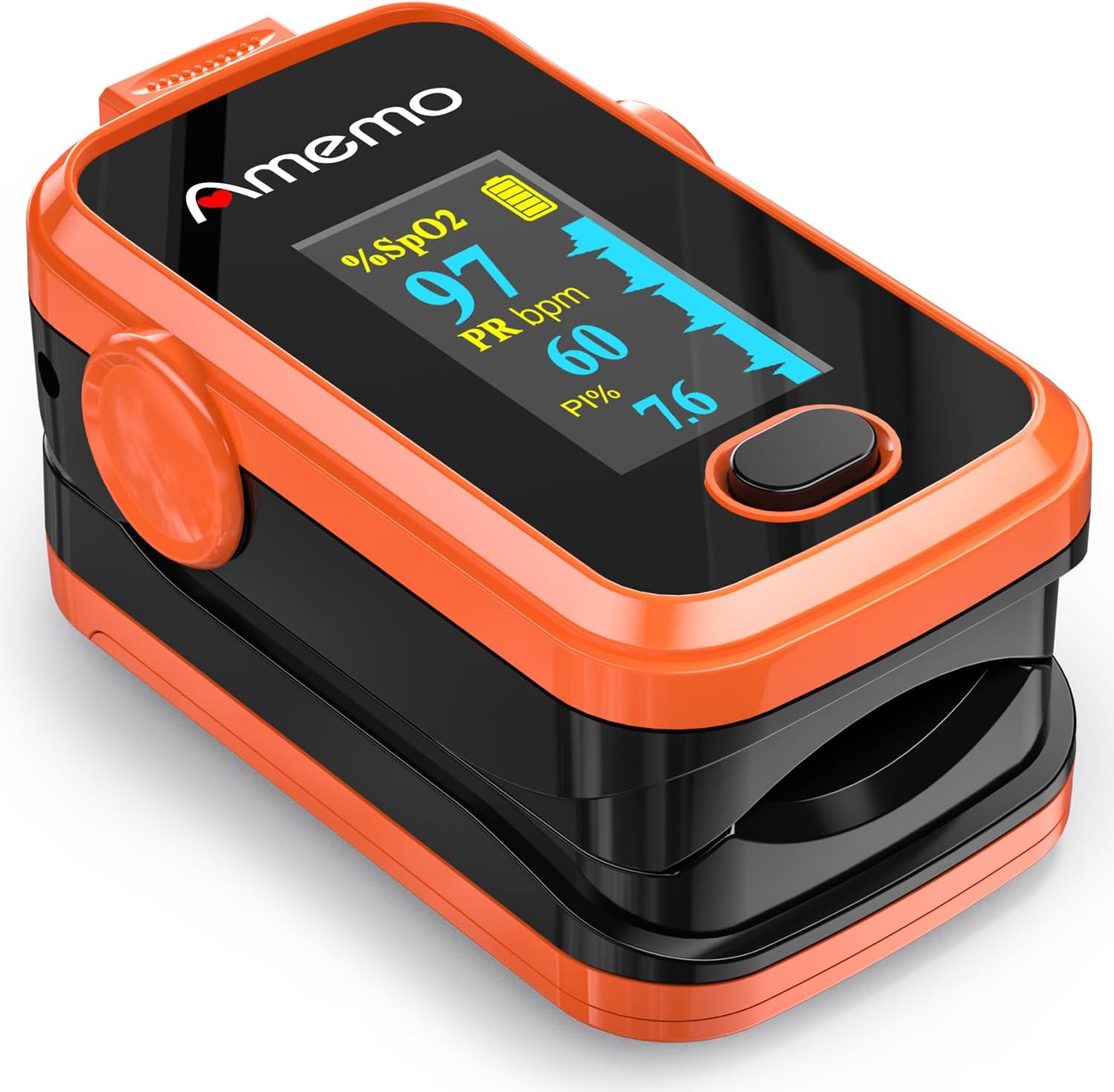
TL ; DNR - model A310 of OEM manufacturer Aeon Technology ; - FDA-cleared dual probe (red/near-IR) pulse oximeter ; - has EU's CE mark and a TÜV SÜD's certification for it ; - has ± 3% RMS-error accuracy & 1% SpO2 resolution ; - acceptable precision of 2% or less repeatability error ; - minimum 25-30 sec measuring time for reliable data. __ # 1. UPDATE (July 2022). Before the start of the CoV2 pandemic, I got this device to monitor the amount of oxygen carried by my red blood cells when at 1500m or more, elevations at which not only the reduction of oxygen's partial pressure starts to affect my body, but also can take a long time to adjust to it when coming from ~300ft above sea. Nevertheless, with the pandemic's arrival, the device had a steady routine use at home over the last two and a half years with no issues. For mountaineering purposes, it has been tested on a Pic Aneto’s couloir gig in 2022 and worked very well. I'm satisfied with it. # 2. DEVICE. This type of conventional pulse oximeter [ PO ], based on light pulses from red and near-IR LEDs used in a transmission configuration, has been adopted as a routine non-invasive, indirect method for estimating the fractional oxygen saturation, SpO2, which indicates how much functional hemoglobin is bound to oxygen compared to how much of it is unbound. It is established technology, so the conventional POs, despite their range of prices, are nearly identical in function, and, if reasonably well designed, provide similar data. Not only higher prices do not necessarily translate into higher accuracy, but also a manufacturer’s claim that its own signal processing method (DSP, SET, etc) was found to be better in a given clinical study is often negated by other study results. A good rule of thumb in selecting a PO is to search if its model is indeed listed as cleared in the FDA's "510(K) Premarket Notification" database, which requires data submission to FDA to demonstrate that the device is safe and effective. # 3. SOURCE. This device is the model A310 (and not A310L, as still stated in the Product Description section of this page) of the OEM manufacturer Aeon Technology Co. Ltd. (Shenzhen, China). The A310 available here is distributed by Amemo Inc. (Milpitas, CA), and sold by the storefront of the Tianyi Star Aviation Technology Co. Ltd. (Beijing, China). The seller's claim in a reply of the Q&A section, that they "recently discovered that other companies sell this product" is a non-sense sales pitch as they, like the other retailers of the OEM A310, buy it from Aeon Technology. # 4. VALIDATION. The A310 is FDA approved. Under the orange silicone cover of the base it has a sticker with the serial number, and a “CE 0123” approval mark showing that its CE mark (assuring conformity with EU’s health and safety protection standards) is certified by the German company Tüv Süd, in whose database the Aeon’s certificates can be found. (This has validity value, since in March 2022, 11 of 15 POs, bought from Amazon and other online platforms, and tested by the UK’s consumer website “Which?” failed to comply with the CE regulations.) # 5. SPECS. The device measures SpO2, heart rate [ PR ], and the so-called perfusion index [ PI ], the ratio of pulsatile to non-pulsatile blood flow. Be aware that the specs in the Product Description section of this page, at the time of this update still do **not** conform to those in the A310 user manual (v.2 March 2020) or the 510(k) application to the FDA, particularly in SpO2% accuracy. The device has the following specs -- Display Range: SpO2 35-100%; PR 30-250 bpm; PI 0-20 % (can reach ca. 30% during unstable initial phase) / Accuracy: ±3% for SpO2% between 70 and 100 (unspecified if less); ±1 bpm PR; ±0.1% for PI% of 0 to 1 and ±1% for PI% of 1 to 20 / Resolution: 1% SpO2; 1 bpm PR; 0.1% PI. # 6. ACCURACY. PO manufacturers typically claim an accuracy in the ±1 to ±3 range, which is a laboratory estimate using the root mean square error. But that is a statistic --often referred to as A(rms)-- based on the standard deviation of differences between simultaneously measured SpO2 data and directly-read arterial data in healthy subjects, combining data dispersion and offset under highly controlled conditions. Of course, that does not happen in at-home measurements, which is why claims of high accuracy are meaningless for non clinical or lab use. Given the 95 % or higher oxygenation of arterial blood in healthy people, their SpO2% values can be expected within the 93 to 100 range because of the associated errors of the PO technique as well as the normal variation of arterial oxygenation in a single subject and among subjects. # 7. PRECISON. In addition to how close is a PO reading to the value in arterial blood (i.e., accuracy), one needs to consider how close to one another are repeated readings (i.e., precision) -- keep in mind the latter is independent of the former. Repeatability differences are evident in my attached figure ploting SpO2% [top] and PI% [bottom] data collected every 5 minutes from my left thumb (after 30 seconds from inserting the finger and turning on the device); in each plot, the respective mean value is shown by a solid line, and the standard deviation limits by dotted lines. While the sample is only 16 repetitions, the data suggest a repeatability of ±2% or less. Always repeat at-home PO measurements -- do not miss the oximetric forest for the trees. # 8. MEASURING ISSUES. (a) Selecting a routine target finger -- There is published evidence that oximetry provides different percentages in the same person depending on the selected finger. A small study of right-hand dominant, healthy subjects not wearing nail polish concluded that the right thumb and middle finger yielded the statistically highest SpO2. However, you ought to determine your best finger for PO, as this can vary; I have mixed handedness and my left thumb consistently yields the highest values, followed by the right one and the middle finger of both hands. This is shown in my other attached figure, where after normal full (rather than deep) breaths over 30 seconds, the SpO2 readings were taken 15 and 30 seconds after turning on the device -- the fingers were measured in a non-sequential manner with a 2-minute resting period between tests. (b) Measuring time -- SpO2 readings can vary initially till the device becomes relatively stable, typically within the first minute. Use the plethysmograph (the yellow vertical display on the screen’s right margin) as a guide for accepting SpO2% data once the waveforms are distinctly formed and their amplitude is consistent (in this condition, the PI% should be higher than 1, rather than 0.2). This is likely the only advantage, unless you are a physician or trained nurse, of having a waveform display of how blood volume changes with heart beats. Disregard the recommendation of Amemo in this webpage of "press the operating button, and then wait. Within 10 seconds, you’ll have an accurate reading of you SpO2 levels and pulse rate." That is FALSE. It takes at least some 10 to 15 seconds for all three measurements to appear in the display (PI is the first and SpO2 the last), and then readings begin to stabilize at least another 10 to 15 seconds later. (c). External error sources -- POs yield inaccurate data under a number of conditions. The main known causes are motion artifacts (hand movement, PO slippage), cold fingers, anemia, direct sunlight or bright ambient lights, mechanical-force pulsations from nearby arteries, pulsatile variations of tissue thickness in the light path other than in the arteries, nail polish, and some degrees of skin pigmentation. It is a long list and you should run a search to see if there is a type of error that may systematically affect PO readings in your case. ___