
Buy anything from 5,000+ international stores. One checkout price. No surprise fees. Join 2M+ shoppers on Desertcart.
Desertcart purchases this item on your behalf and handles shipping, customs, and support to Kyrgyzstan.
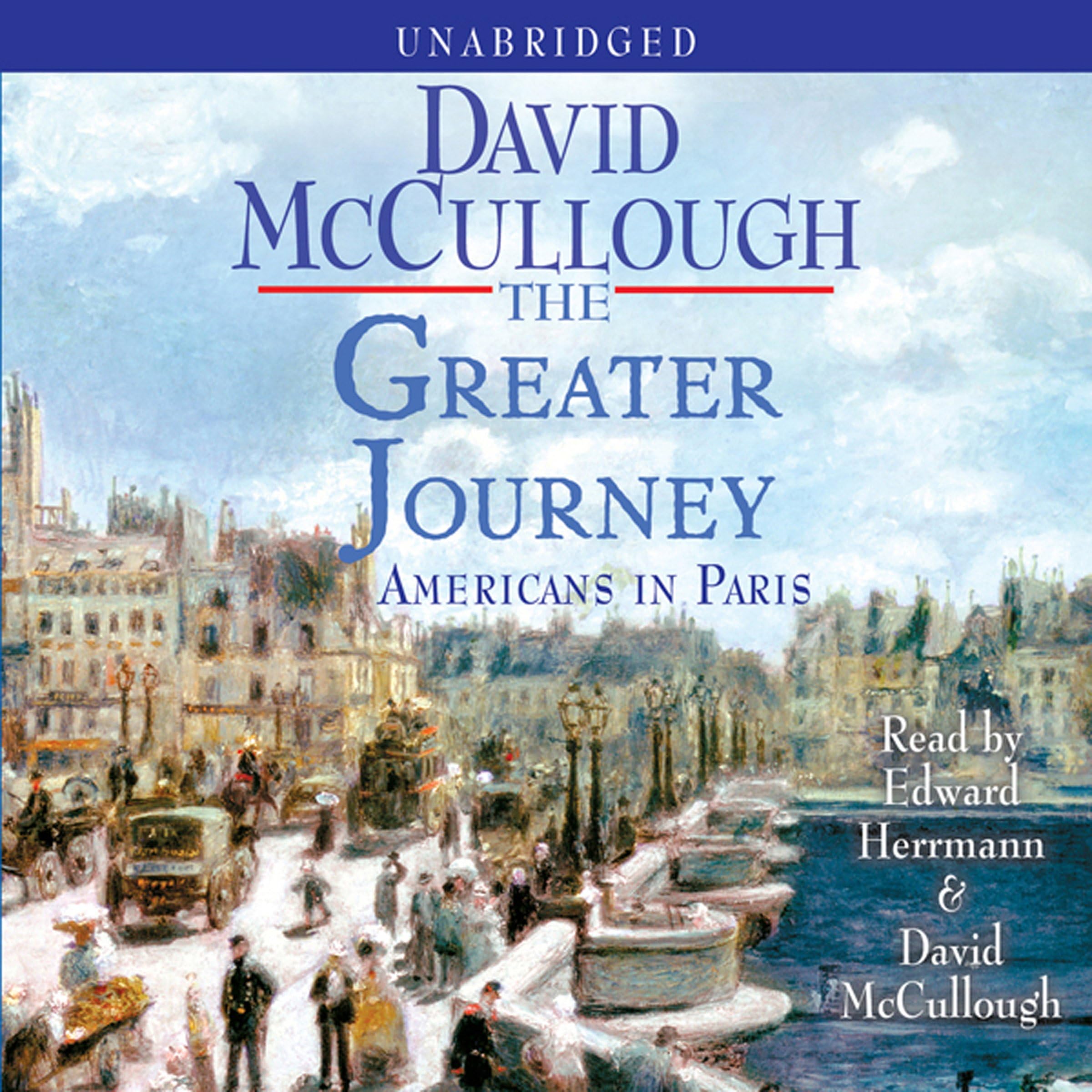
desertcart.com: The Greater Journey: Americans in Paris (Audible Audio Edition): David McCullough, Edward Herrmann, Simon & Schuster Audio: Books Review: Masterful Writer McCullough Makes 19th Century Paris Come ALIVE - FIVE STARS !!!!! - Every time David McCullough puts his fingers to the typewriter that he uses to write with, he seems to transform our understanding of the topic he is studying. Whether it was President Harry Truman or for me Mornings on Horseback, I have walked away from his books with an enlightened feel for the topic that I have only been able to achieve with very few authors. James Michener is one who comes to mind immediately. With this book, The Greater Journey, the author has now thoroughly engaged the reader with a topic seldom written about but very deserving of study. It is only natural that we as Americans feel we live in a self centered world; after all we have 2 vast oceans that have protected our shores from invasion for several centuries, and probably will for several more. It simply does not occur to us that since our beginnings, many Americans have chosen to spend considerable time abroad, and in some cases decades of their lives. During the 1800's and specifically from 1830 until 1900, there was a wave of intellectual migration that headed not west to America, but east to Paris, France from America. Keep in mind that we now sit in a country that is preeminent in the world, financially, intellectually, and probably culturally as well. Back then, we were just forming as a nation. The Indian wars were still in process, and the Civil War would also take place, which became the second re-creation of the United States. McCullough is totally aware of this comparison and makes wise use of it throughout this 456 page book composed of 14 distinct chapters separated into 3 parts, followed by a wonderful epilogue, and a very useful bibliography. The author understands history, and is always mindful of the relative positions of different nations. During this period we were not yet the top dog that we were to become after World War I. Europe still controlled the world's greatest universities and they were already centuries old. If you are going to read this book in a physical format as opposed to the Kindle digital version, you are in for a treat because the paper chosen is exquisite, and the font selection is superb. If you are an older reader as I am, you will appreciate the time that was taken to design the book appropriately for readers that still relish a physically well made book, and that's what we have here. This is the story of a 70 year period in the history of Paris, and the scores of Americans who occupied it, lived there, and helped participate in the transformation of what is called the city of light. It is also the story of scores of for want of a better word can be called expatriate Americans, although many of them did return to their native United States at different times. McCullough is one of the few authors who truly captures the essence of an environment and then proceeds to envelop it with a reality that absorbs and perhaps even demands our attention as readers. His description of the relationship between James Fennimore Cooper and Samuel F.B. Morse and their joy in living in this magnificent city and the effects it had on their work will remain in the reader's soul for many years after the book is put back on the shelf. When Morse painted his masterpiece, it was done in Paris, and perhaps after reading this book, one realizes it could only have been done in Paris. The city of lights already had vast boulevards, and extraordinary parks decades before the United States designed them. Indeed, New York City's Central Park which would be created later in the century would take much from Paris, and other European cities. The Americans who would go to Paris and spend years there would recall later after returning to the United States the joy of the parks, the energy of the city itself and the sheer unequalled cultural delights that embodied Paris. Visually we can still see much of this in the work of the Impressionist School of painting. I found the author's handling of Mary Cassatt, who was a Philadelphia born daughter of American socialites who went on to be an illustrious painter as a principal part of the Impressionist school, to be particularly well done. Her relationship to Edgar Degas the renowned painter of the ballet and horses, as well as landscaping is thoroughly chronicled in the book. McCullough's ability to weave life into life, with Paris as the focal point constantly holding the book together in such a way that the reader feels compelled to continue to read, not pausing to eat is what in the end keeps the author at the pinnacle of his profession today. It is obvious that this book was a labor of love for the author. It comes shining through with the admiration that McCullough holds for both Oliver Wendell Homes the American medical student in Paris, and Ralph Waldo Emerson, a name we all recognize. He even takes the time to take us through the time that Mark Twain spent in this wonderful city. Not only was Paris transformed by the Americans that occupied it during this century, but Paris itself went through extraordinary changes and development. Kings re-invented the city several times during this century. Vast numbers of poor were displaced and sent to the country. It was invaded during this period as well. Later vast tree lined streets and boulevards would be created that became the envy of Europe. The Louvre would be increased in size enormously in an attempt to make it the most important museum on the entire continent, and France would succeed in this effort. McCullough intertwines the story of Paris, its growth, its impact on the Americans and what the Americans brought back to America as a result, into a book in such an imaginative way that the reader will find himself revisiting this book from time to time. In the end the book is riveting, and this is a phrase I find myself continuing to use every time I pick up a book written by this author. Many lives are captured in this masterpiece. They include George Healy the portrait painter, Nathaniel Hawthorne whose writings still continue to occupy many a college freshman's late nights, and future American Senator Charles Sumner who would have his views on slavery refined while living in Paris. Indeed he became an abolitionist as a result of his Parisian experience. CONCLUSION: Prior to reading The Greater Journey, I believed I had a good understanding of 19th century Paris. Having studied the art of that period, going to the Louvre, and sitting in on lectures dealing with Paris in the 1800's, I looked forward to seeing what this author could add to the story. I did not expect what I got, which was to have him blow away my understanding and replace it with something that came alive and stood on many different legs of understanding, but isn't that what great writing can do. It can simply make things come alive again. You feel as though you are there, and McCullough puts us right there in the thick of the action. Although it is not the whole story, if you have any interest at all in understanding the transformative art period that was the Impressionist movement it is vividly captured here in the lives of Augustus Saint-Gaudens with John Singer Sargent, and Mary Cassatt. David McCullough is already an acclaimed author with two Pulitzers and two national Book Awards, and it looks like with this book, he's got another Pulitzer coming down the pike. Thank you for reading this review. Richard C. Stoyeck Review: Delightful Stories, Beautifully Told - I have a colleague who likes to say of her favorite authors that, if they wrote a book about paint drying, she'd be delighted to read it. Though perhaps exaggerated, I feel that just this sentiment applies here. I am, by training, a theologian and a biblical scholar. By avocation, I am a reader of history but usually of the mid-20th century (World Wars, Civil Rights, etc). Thus, a book on Americans in 19th-century Paris is anything but my area of expertise or interest. Reading about 19th-century Europe is about as close as I come to reading works of the "paint-drying" variety. Yet, David McCullough has once again managed to captivate me with these interwoven stories of inventors, doctors, and artists and the deep entwinement that marks American and French history. The book is interesting, first of all, because the book centers on a place rather than a person (McCullough is perhaps first thought of by most as a biographer), so I was curious to see if and how he could "bring to life" a 19th-century city. Of course, this is the David McCullough of "John Adams" fame, so there was never much in the way of doubt as to what he could actually accomplish. There is an unbelievable ease to his writing. Though his scholarship is immense (especially when you consider all the excerpts from personal letters and diaries), it never weighs the story down nor does it give the book the "clunky" feel so common to most academic works. Perhaps that is due to McCullough's virtually-inerrant sense for the "telling" anecdote that encapsulates the point or captures the spirit of what he is trying to convey. Here are stories of the formative years of many of America's "leading lights" of the 19th century: Samuel F.B. Morse, George Catlin, Mary Cassatt, Oliver Wendell Holmes, and John Singer Sargent, among others…all told with ease and grace and fine sense of the entanglement that makes human life and society so rich and exciting. If the book does anything, I believe it shows, first of all, the deep kinship that bonds the United States of America to the country of France. It also reminds me that, though world history is vast and complicated, for all intents and purposes, the modern world revolved around Paris for much of the 19th century…artistically, technologically, medically, politically. Perhaps our postmodern ethos has made us so intent on telling the "forgotten" stories of history (a moral duty, no doubt) that we've almost lost the ability to discern the "pivotal" stories that have shaped not just the contemporary moment but the trajectories of decades and even centuries to come. There are "centers" to world events (assuredly not all Western European or North American), and McCullough's thoughtful portrayal has me considering where such influence might be found today. That is the ultimate power of good history: to recall the past in such a way as to reshape our comprehension of the present. And that is precisely what David McCullough's work unfailingly does.
R**T
Masterful Writer McCullough Makes 19th Century Paris Come ALIVE - FIVE STARS !!!!!
Every time David McCullough puts his fingers to the typewriter that he uses to write with, he seems to transform our understanding of the topic he is studying. Whether it was President Harry Truman or for me Mornings on Horseback, I have walked away from his books with an enlightened feel for the topic that I have only been able to achieve with very few authors. James Michener is one who comes to mind immediately. With this book, The Greater Journey, the author has now thoroughly engaged the reader with a topic seldom written about but very deserving of study. It is only natural that we as Americans feel we live in a self centered world; after all we have 2 vast oceans that have protected our shores from invasion for several centuries, and probably will for several more. It simply does not occur to us that since our beginnings, many Americans have chosen to spend considerable time abroad, and in some cases decades of their lives. During the 1800's and specifically from 1830 until 1900, there was a wave of intellectual migration that headed not west to America, but east to Paris, France from America. Keep in mind that we now sit in a country that is preeminent in the world, financially, intellectually, and probably culturally as well. Back then, we were just forming as a nation. The Indian wars were still in process, and the Civil War would also take place, which became the second re-creation of the United States. McCullough is totally aware of this comparison and makes wise use of it throughout this 456 page book composed of 14 distinct chapters separated into 3 parts, followed by a wonderful epilogue, and a very useful bibliography. The author understands history, and is always mindful of the relative positions of different nations. During this period we were not yet the top dog that we were to become after World War I. Europe still controlled the world's greatest universities and they were already centuries old. If you are going to read this book in a physical format as opposed to the Kindle digital version, you are in for a treat because the paper chosen is exquisite, and the font selection is superb. If you are an older reader as I am, you will appreciate the time that was taken to design the book appropriately for readers that still relish a physically well made book, and that's what we have here. This is the story of a 70 year period in the history of Paris, and the scores of Americans who occupied it, lived there, and helped participate in the transformation of what is called the city of light. It is also the story of scores of for want of a better word can be called expatriate Americans, although many of them did return to their native United States at different times. McCullough is one of the few authors who truly captures the essence of an environment and then proceeds to envelop it with a reality that absorbs and perhaps even demands our attention as readers. His description of the relationship between James Fennimore Cooper and Samuel F.B. Morse and their joy in living in this magnificent city and the effects it had on their work will remain in the reader's soul for many years after the book is put back on the shelf. When Morse painted his masterpiece, it was done in Paris, and perhaps after reading this book, one realizes it could only have been done in Paris. The city of lights already had vast boulevards, and extraordinary parks decades before the United States designed them. Indeed, New York City's Central Park which would be created later in the century would take much from Paris, and other European cities. The Americans who would go to Paris and spend years there would recall later after returning to the United States the joy of the parks, the energy of the city itself and the sheer unequalled cultural delights that embodied Paris. Visually we can still see much of this in the work of the Impressionist School of painting. I found the author's handling of Mary Cassatt, who was a Philadelphia born daughter of American socialites who went on to be an illustrious painter as a principal part of the Impressionist school, to be particularly well done. Her relationship to Edgar Degas the renowned painter of the ballet and horses, as well as landscaping is thoroughly chronicled in the book. McCullough's ability to weave life into life, with Paris as the focal point constantly holding the book together in such a way that the reader feels compelled to continue to read, not pausing to eat is what in the end keeps the author at the pinnacle of his profession today. It is obvious that this book was a labor of love for the author. It comes shining through with the admiration that McCullough holds for both Oliver Wendell Homes the American medical student in Paris, and Ralph Waldo Emerson, a name we all recognize. He even takes the time to take us through the time that Mark Twain spent in this wonderful city. Not only was Paris transformed by the Americans that occupied it during this century, but Paris itself went through extraordinary changes and development. Kings re-invented the city several times during this century. Vast numbers of poor were displaced and sent to the country. It was invaded during this period as well. Later vast tree lined streets and boulevards would be created that became the envy of Europe. The Louvre would be increased in size enormously in an attempt to make it the most important museum on the entire continent, and France would succeed in this effort. McCullough intertwines the story of Paris, its growth, its impact on the Americans and what the Americans brought back to America as a result, into a book in such an imaginative way that the reader will find himself revisiting this book from time to time. In the end the book is riveting, and this is a phrase I find myself continuing to use every time I pick up a book written by this author. Many lives are captured in this masterpiece. They include George Healy the portrait painter, Nathaniel Hawthorne whose writings still continue to occupy many a college freshman's late nights, and future American Senator Charles Sumner who would have his views on slavery refined while living in Paris. Indeed he became an abolitionist as a result of his Parisian experience. CONCLUSION: Prior to reading The Greater Journey, I believed I had a good understanding of 19th century Paris. Having studied the art of that period, going to the Louvre, and sitting in on lectures dealing with Paris in the 1800's, I looked forward to seeing what this author could add to the story. I did not expect what I got, which was to have him blow away my understanding and replace it with something that came alive and stood on many different legs of understanding, but isn't that what great writing can do. It can simply make things come alive again. You feel as though you are there, and McCullough puts us right there in the thick of the action. Although it is not the whole story, if you have any interest at all in understanding the transformative art period that was the Impressionist movement it is vividly captured here in the lives of Augustus Saint-Gaudens with John Singer Sargent, and Mary Cassatt. David McCullough is already an acclaimed author with two Pulitzers and two national Book Awards, and it looks like with this book, he's got another Pulitzer coming down the pike. Thank you for reading this review. Richard C. Stoyeck
J**K
Delightful Stories, Beautifully Told
I have a colleague who likes to say of her favorite authors that, if they wrote a book about paint drying, she'd be delighted to read it. Though perhaps exaggerated, I feel that just this sentiment applies here. I am, by training, a theologian and a biblical scholar. By avocation, I am a reader of history but usually of the mid-20th century (World Wars, Civil Rights, etc). Thus, a book on Americans in 19th-century Paris is anything but my area of expertise or interest. Reading about 19th-century Europe is about as close as I come to reading works of the "paint-drying" variety. Yet, David McCullough has once again managed to captivate me with these interwoven stories of inventors, doctors, and artists and the deep entwinement that marks American and French history. The book is interesting, first of all, because the book centers on a place rather than a person (McCullough is perhaps first thought of by most as a biographer), so I was curious to see if and how he could "bring to life" a 19th-century city. Of course, this is the David McCullough of "John Adams" fame, so there was never much in the way of doubt as to what he could actually accomplish. There is an unbelievable ease to his writing. Though his scholarship is immense (especially when you consider all the excerpts from personal letters and diaries), it never weighs the story down nor does it give the book the "clunky" feel so common to most academic works. Perhaps that is due to McCullough's virtually-inerrant sense for the "telling" anecdote that encapsulates the point or captures the spirit of what he is trying to convey. Here are stories of the formative years of many of America's "leading lights" of the 19th century: Samuel F.B. Morse, George Catlin, Mary Cassatt, Oliver Wendell Holmes, and John Singer Sargent, among others…all told with ease and grace and fine sense of the entanglement that makes human life and society so rich and exciting. If the book does anything, I believe it shows, first of all, the deep kinship that bonds the United States of America to the country of France. It also reminds me that, though world history is vast and complicated, for all intents and purposes, the modern world revolved around Paris for much of the 19th century…artistically, technologically, medically, politically. Perhaps our postmodern ethos has made us so intent on telling the "forgotten" stories of history (a moral duty, no doubt) that we've almost lost the ability to discern the "pivotal" stories that have shaped not just the contemporary moment but the trajectories of decades and even centuries to come. There are "centers" to world events (assuredly not all Western European or North American), and McCullough's thoughtful portrayal has me considering where such influence might be found today. That is the ultimate power of good history: to recall the past in such a way as to reshape our comprehension of the present. And that is precisely what David McCullough's work unfailingly does.
S**B
Good insight on those times
B**A
This is a beautifully written and interesting narrative, concerning those Americans who sailed or came by steamer ships from New York and other eastern seaboard ports and as far south as Louisiana to France. Some arrived at Le Havre, others at Calais and Boulogne, after which they faced an onward 24 hour journey to Paris by a diligence. It certainly raises the question - what drove these Americans to undertake such a potentially dangerous crossing of the Atlantic, not necessarily speaking any French and having, in most cases, limited financial resources? David McCullough's book spans the period 1830 to 1900, a period known as the Belle Époque, meaning the Beautiful Epoch. Throughout this period, Paris was the acknowledged hub from the standpoint of technical and artistic knowledge and accomplishment and it was this that drew Americans from the New back to the Old World. Whilst Paris was an exciting, perhaps romantic city, until 1853 it was nonetheless a Medieval cesspit. The narrative follows the fortunes of a number of talented American (and French) individuals, some of whom will be well known, others not but there are plenty of surprises as their respective life-stories unfold. Many of the people David McCullough introduces would experience the July Revolution, culminating in the overthrow of King Charles X, equally, some remained in Paris during the Franco-Prussian War and the Siege of Paris. Not that it was in question but this is a further example of David McCullough's skill at historical narrative. It is an enjoyable, informative book. A highly recommended read.
I**S
Initially, I became familiar with McCullough’s work through the HBO series “John Adams”. I was amazed at his thorough style and attention to every detail in respect to a lesser known founding father. With “The Greater Journey” David McCullough has brought us another great century of American history. This time he follows the journey of ex-pats living in Paris, the center of civilization. They were there on a mission to learn and better themselves in order to help their new nation advance. There are so many stories and characters that when I picked up the book it was a bit intimidating. However, this book turned out to be a page turner, as the author masterfully intertwines all these stories into a beautiful work of art and history. And David McCullough knows about art. The book has a quite a few pictures of art works produced in this era by masters such as Morse, Healy, St. Gaudens, Sargant, and Cassat. The descriptions of these works and the creative process they went through is simply excellent. The bibliography alone is over one hundred pages. Furthermore, this book beyond the individual stories of its characters also brings to light the history of Paris in the 19th century. From revolutions, and violence, and war, to an age of enlightenment, and prosperity, finishing with the Belle Époque. I would highly recommend this book as good reading to be savored and cherished. The sacrifices that these generations of Americans went through in pursuit of knowledge and artistic growth are truly inspirational.
I**H
This is a fascinating book. Well-written (a very experienced author; winner of two previous Pulitzer Prizes I gather) and as much a biography of Paris in the Nineteenth Century as it is of the Americans of all sorts who lived in the city. Some famous names but many I'd not heard of before. The author uses their own letters to give an insider's feel to the book. The sections in the middle of it on the Second Empire, the Siege of Paris and the Commune are simply riveting.
P**S
Un libro espectacular, escrito por un gran historiador. Se lo di de regalo a mi madre y le encanto!
Trustpilot
2 weeks ago
2 months ago