
Desertcart purchases this item on your behalf and handles shipping, customs, and support to Kyrgyzstan.
🖤 Print Strong, Print Smart — The Pro-Grade PLA+ You Can't Afford to Miss!
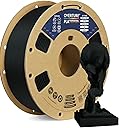
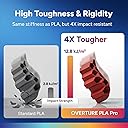
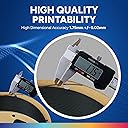
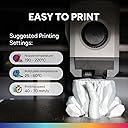
OVERTURE PLA Plus (PLA+) 1.75mm filament delivers professional-grade 3D printing with 5× enhanced impact toughness, ultra-precise ±0.02mm diameter consistency, and a patented clog-free formula. Designed for durability and minimal warping, it supports smooth, reliable prints at elevated temperatures (220-240°C). Vacuum-sealed for moisture protection and backed by dedicated support, this 1kg black filament is perfect for functional prototypes, mechanical parts, and high-strength applications.


| ASIN | B07YDN56F2 |
| Additional Features | Durable |
| Best Sellers Rank | #787 in Industrial & Scientific ( See Top 100 in Industrial & Scientific ) #53 in 3D Printing Filament |
| Brand | OVERTURE |
| Brand Name | OVERTURE |
| Color | 00-1kg Black |
| Customer Reviews | 4.5 out of 5 stars 6,960 Reviews |
| Item Diameter | 1.75 millimeters |
| Item Weight | 1 kg |
| Manufacturer | OVERTURE |
| Manufacturer Part Number | OVJPLAPLUS |
| Material | Polylactic Acid |
| Material Type | Polylactic Acid |
| Model Number | UK-MATTEPLA17511 |
| Number of Items | 1 |
| Special Feature | Durable |
| UPC | 810031290659 |
| Unit Count | 35.27 Ounce |
| Warranty Description | 2 |
H**E
Pretty tough stuff!
I've been wanting to try PLA + for a while now and decided to try this. I've had an overall good experience with Overture filament. And in summary, this filament has been great. It prints well, and prints produced at appropriate heat and speeds are pointedly less brittle than standard PLA prints. My only gripe is this filament is rather hygroscopic. Diving in to details, again, I've had zero issues with printing with this filament. I've ran this filament through 0.4 mm, 0.8 mm, and 1.0 mm nozzles ( I have multiple printers) and have never had any clogs or adhesion issues, even when I ran prints far too quickly. I also gratefully note that I haven't had any tangles or snags in the filament windings. Returning to my note about heat and speeds, in my limited experience, this PLA extrudes and adheres better at hotter temps. For common PLA, I run a nozzle temp of 200-220 Celsius; For this PLA+, I've noticed better bed and layer adhesion and smoother extrusions at 220-240 Celsius. In terms of speed, I run it about the same as common PLA, with an overall average of 60 mm/sec. I'll go as slow as 20 mm/sec for small, delicate prints and up to 80 mm/sec for larger, rougher prints. Again, I've noticed this filament is rather hygroscopic. I'll be completely honest here; I do 3D printing as a hobby only, so I'm quite careless about my filaments, leaving them in the open on the printers for a week or more. When they aren't on the printers, I do keep them in a sealed storage box but I'm digressing here; With a fair amount of filament from other vendors, I can leave the filament out and only after weeks of leaving it out will I see the slightest sign of moisture in the filament. After only a few days of sitting out, this filament popped, fizzled and even bubbled the next time I used it, there was so much moisture in it. Since this is a result of my carelessness, I won't dock stars for this. But I feel it's worth noting that great care must be taken to keep this filament dry.... Oh, and I forgot to note that I live in a dry, arid region. Finally, to return to my mention of strong prints. Again, this PLA+ isn't harder than PLA, it's actually softer, gummier. This lends it more strength because instead of prints directly snapping, prints that are overstressed will simply stretch, bend and compress until surfaces slowly peel apart, like sticky gummy candy, and/or separate at a layer line. Some time ago, I 3D printed a holding box for a LiFe battery. I messed up some dimensions, so although the box printed well, I couldn't use it. That box was printed from PLA and I decided to see how brittle PLA was. When I smashed it, it literally shattered. Fast forward to printing with this, I printed another battery box, for a different battery, and once again messed up some dimensions. Remembering that I smashed the old box to see how the PLA reacted, I decided to do the same to this new, scrapped box. It wouldn't shatter....Heck, it wouldn't even break any pieces off! The box split across several layer lines, but after several minutes of smashing the box, it was still literally in one piece, albeit split many times. I've got a big project planned that's likely going to use all of this up, but if I have any remaining, I'm going to print a small decorative object and put it outside. I'm curious as to how well this stuff resists the elements. But overall, I'm very satisfied with this filament and will get more as the need arises!
A**.
Amazing temperature range and strength.
Just received my first roll of Overture PLA+. I hoped for the Space Gray but got black (see below). Regardless, I decided to proceed with printing and testing of the accuracy / temperature range. The first print I did was the Benchy Boat. I printed at 205c, 60mm/s, 0.2mm layer height, 60c bed, with a 20-line brim (to help with adhesion). I simply clicked print, waited for the first 3 brim lines to lay down, then walked away! Returned later than afternoon to find an ALMOST perfect Benchy sitting on the print bed. There was a visible 'seam' on the back of the boat, which I had never noticed with other Benchy's. It could have been an error on my part. The overall 'look and feel' of the boat was a bit more rigid/rough than standard PLA.. That is to say, it LOOKED amazing, and NO issues with the arch, overhang on the bow, or the doorway gap. Just, in general, the model doesn't 'feel' as smooth as some of the standard PLA prints I've done.. Minor gripe. Also, I'm not extremely happy with 'black' as it just doesn't allow for highlights/shadows of details in models. Not the product's fault, it was Amazon's. The second print I performed was the 'Temperature Tower'. This was the first time I've ever printed a Temperature Tower before, and I tried to print it (twice) without any additional bed adhesion (brim or raft). It failed both times after about the second tower printed. Lost adhesion and started creating 'yarn' or filament on the print bed.. For the third "Temperature Tower", I decided to print with, again, a 20line brim, and it worked perfectly.. And, amazingly(!), EVERY single temperature between 190 and 230 looks nearly identical. Zero stringing, Zero sag, nothing that would distinguish the temperatures from one another, aside from the gloss. This material seems to be more 'glossy' on the higher end 210c+ and more matte at the 190-200c range. Layer lines/lamination did not appear to be an issue. I'll continue to print and monitor with the adhesion. It could just very well be the temp tower (it has a very small footprint). If it becomes a larger issue, I'll update the review. PS - About COLOR: I Purchased the "Space Gray" color of Overture PLA+ from Amazon, but received plain "Black".. Looking now, at the screenshots, it appears even the photos represent plan "Black".. I believe Amazon has mistakenly labeled the "Black" color as "Space Gray".. Be aware, if you order "Space Gray" you will 99% receive "Black" UPDATE: Used almost 800g of the spool now and adhesion issues are VERY MINOR. Raised rating to 5 stars. I went through a 4-day torture test print of a full-size cosplay helmet and it worked flawlessly.. No jams, no sags, no stringing, and the part feels VERY durable.. I'm happy.
E**R
Great PLA+ filament; easy to use, even for a novice to 3D printing
**Second update** Trying to buy more. Looks like Amazon can't keep enough in stock that it's backordered. One of the two brands/filaments I keep coming back to because of how well it differentiates itself from the crowd of competitors. **First Update** Since using up my first spool of Overture PLA Pro (PLA+), I've ventured into trying other brands and other types of plastics including for various reasons (different properties e.g. strength, exposure resistance, colors, cost), and none have been as easy and forgiving to use as Overture's PLA Pro. Prints using other filaments often look as if they have been visited by a family of itsy-bitsy spiders. Even after optimizing for retraction, temperature, print speed; other filaments still exhibit a relatively greater degree of wispy stringing that need post-production cleaning. Overture's PLA Pro has spoiled me rotten with very little to no stringing on virtually all printed parts. As much as I love to tinker, I'd prefer spending more tinker time on design than optimizing extrusion settings; I'm going back to Overture for PLA because I just want my filament to "work." **Original Review** I bought and used this as my starter filament for my Ender 3 v2. As a novice to 3d printing, this is the very first filament I've ever used in my life (I skipped using the short wrap of starter sample PLA filament included by Ender). My very first print ever came out almost perfect using settings that fall within Overture's recommended nozzle/bed temp and print speed (my settings: nozzle 210C, bed 60C, print speed 60mm/s, fan 20-100%). Prints adhered to the glass bed very firmly and were hard to knock over during printing, but prints easily released once the bed cooled down (the trick is to make sure the Ender OEM glass plate is very clean (i.e. clean with rubbing alcohol before each use). Even prints with very narrow footprints hung on (this recommendation does not apply to PETG, which needed an adhesive like glue stick or hairspray for good 1st layer adhesion). If any warping occurred, warping was very minimal and almost unnoticeable; I have not found it necessary to add a brim when using this filament. Adherence was very good, including in overhanging parts printed without support structures. Printed items are surprisingly strong (Overture advertises 5x strength over typical PLA); printed figurines with 15-20% infill resisted a dropped carpenter hammer at 4-6 inches without deformation. That is, prints have high rigidity (i.e. less plastic deformation than PETG), but once they they deform, they don't have much elasticity to return to their original shape and may instead fracture/break. Considering this is a variant of PLA, it's not intended for structural items, but it was much stronger than I expected it to be, very easy to use for a novice, and produced nice looking prints including litophanes. I would definitely recommend.
A**M
Black Super PLA +
Zero problems with this filament. No tangles, nice print quality, and very strong prints. My setting were .15mm layer height, 220c nozzle, 65c bed and about 85mm/sec. You will want to use a raft with this, as it will tend to curl if you don't. Update: I'm on my second spool of this stuff. Everything I print holds together. Everything I print is smooth and accurate. After trying a few different types of filament, I have settled on this being my go to choice for anything that needs to be durable, and wont get too hot. I have made everything from prototype machine parts to toys for the kids, and even a new toothpick for my old Swiss Army knife and a few guitar picks. This filament just does everything well. I have played with the settings on my printer and have not had any issues from 200C to 220C, and from 30mm print speed to 85mm, it just flat out prints.
D**C
Nice filament
Overture is rapidly becoming my go-to brand for matte colors of PLA as it gives consistently good results with no fuss on my Ender 3 V2 printer though I don’t always buy it from Amazon because of the wildly changing prices on Amazon. I don’t have a good way to judge objectively whether the “plus” version is better than the regular but I can say it’s not worse and I’ve stopped buying the regular in favor of plus because it prints very well (at slightly higher temperature) looks good and in theory is tougher and more impact resistant. I used yellow for the first time this week. It is a nice medium yellow that looks great- I am using it to print telescope pieces now and looking good so far. The only thing I don’t like is the somewhat disordered spooling. I’ve never had a fatal tangle but if you don’t keep careful track of the filament end while changing spools it disappears into the spool and easy to accidentally tuck under itself when you retrieve the end thus setting up a potential tangle. Logically I don’t think it can tangle unless the user loses the end and I expect that is what has happened to the people that negatively review based on a tangle they've had.
J**Y
It's got the goods
So, I've been living in a little bit of a bubble and one day popped out and boom, PLA+. Wowzers Bowsers. I'll give it a 5. I'll dish it. Printed a ton of stuff I wouldn't have traditionally printed in PLA. Printed a few things that would have just shattered in regular PLA. In particular, a spring arm on a trap. I remember when I first printed that on PLA, and it broke quickly. Printed in PETG, it was awesome, and I still have the original one I printed in PETG from years ago. This was the perfect test for the PLA+, and oh it did it. I've been printing other springy things with it too, and it's been great. Uhh, almost as good as PETG? Eh, I might could use some setting tweaks to get it there, so I can't say that. At least not in terms of structural integrity. In terms of performance in hot conditions, it performs about as well as PLA, which isn't as good as PETG from my experience of having accidently left models in hot cars on hot days. I didn't find it difficult to print. I did have the temperature a little higher than I traditionally would have for PLA. All the prints I did with it came out great. I've gotten a green and red roll so far, and both were great to work with. I like the surface quality. It's not overly shiny in a cheap plastic way, but is still a little shiny. In particular with the green, I printed a bunch of gravitrax type parts, and they all turned out great, and felt great. The rails had a little spring to them; the risers all felt solid, and really showcased the quality of the plastic. I liked the shade of red. It is a little more subdued than your typical oversaturated plastic red.
J**.
High quality for prints
We use the Matte PLA all the time, however needed this specific color for a print. The PLA+ still stood up to the quality we have come to expect from Overture. Hard to beat the filament made by them!!
C**N
Great option for strong metallic-looking prints
These metallic colors of PLA+ are fantastic. Over the past year or so, I have bought several rolls each of the copper, bronze, and moonlight silver colors and will continue to do so. They contain enough metallic flake that they look 'fancy' when reflecting light, yet retain the strength of Overture's PLA+, which I am a big fan of. It prints consistently and can take a beating, so it's great for prints which get handled a lot. The metallic shine is not as reflective as silk PLA, which I think is a good thing. Silk PLA tends to be too shiny, resulting in a gaudy or fake appearance when trying to have a printed part look like metal. The metal flake in this filament is more like car paint, more of a classy look, whereas silk PLA is more like chrome spraypaint. The actual surface finish is not very shiny when printing at 220 C - it is somewhere in the satin range and hides layer lines pretty well. So, if you are going for an appearance of metal on parts that can actually take a moderate load (e.g. gear teeth) without breaking, this filament works very well.
C**B
Reliable and great colour!
Bright colour. Flawless printing. Feels well into the printer. No tangles or mess even in hour-long prints.
T**Z
Excellent product
This filament worked well for my first project in my 3d printer.
K**N
Très bonne qualité
Vraiment top ce pla, excellente qualité et la couleur est très belle
M**Y
Best filament on earth !
Prints so clean and the best filament I’ve ever used ! I will be using Overture for my go to
M**O
Perfetto
Articolo come da descrizione, tutto perfetto, ottimo materiale.
Trustpilot
1 month ago
2 days ago