We remain fully operational. Our teams are working around the clock to ensure your deliveries continue safely.

DOWNLOAD THE APP


Customer Services
Copyright © 2025 Desertcart Holdings Limited
DOWNLOAD THE APP
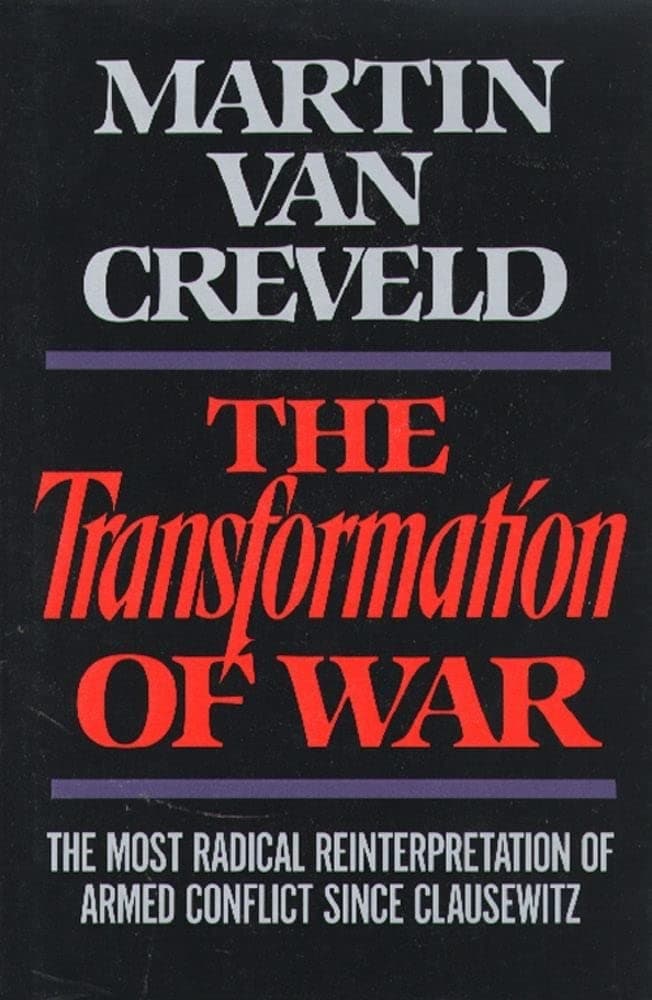
The Transformation of War: The Most Radical Reinterpretation of Armed Conflict Since Clausewitz [Van Creveld, Martin] on desertcart.com. *FREE* shipping on qualifying offers. The Transformation of War: The Most Radical Reinterpretation of Armed Conflict Since Clausewitz Review: Helps understand the changing face of violence in the modern world. - This book is very enlightening, if that is the word one should use to describe a book about the subject of war, violence, assault, systematic rape, mass killing and everything that goes with it. Others have outlined very well the subject of the book and given a similar rating to mine. Max Weber said that the state was the only one authorized to the legitimate use of violence. In a rather long-winded and sometimes tedious argumentation, Van Creveld explains how this is no longer the case, and how the nice tidy little distinction mad by Von Clausewitz of state, govt and people no longer holds: violence is now dispersed and in the hands of many groups whose war-mongering is very different from that of standing armies with the latest military equipment. Modern armies and their weapons are not well suited to this kind of war of "low-intensity conflict", as he describes it. Before emigrating to the US, I saw how this happened in my native Ireland: the Irish Republican Army was a very effective force against a sophisticated modern British Army. Thank God ( and timely American intervention ) that bloody struggle seems over, but the IRA said that its strategy, while not always successful, broughtt its opponents to the negotiating table. I have also seen it in Mexico (I have a home there) where the drug cartels are now more like a military insurgency than a band of organized bandidos. Witness what happened in recent months. Government soldiers arrested the son el "El Chapo" Guzman (now in a US prison), and after a day-long standoff with the Narcos, his captors were forced to hand him over. That particular day, the Narcos called in firepower from the surrounding mountains which rushed to the scene and took over the city of Culiacan, using guerilla tactics to pin down the local populace ( everyone had to stay put ), and threatened the army with blowing everyone to bits. As well as their standard AK-47s, they had Barret 82 rifles, rocket-propelled grenades, weaponry to bring down army helicopters (which they did) and a host of other equipment to impose their will. The Mexican army could have won, but with terrible bloodshed, loss of life and perhaps just barely. It is not an exaggeration to say that drug cartels control maybe eight of Mexico's 32 states. Although the Mexican army is a well-equipped and well-trained force, it does not seem to have found an effective way to contain, much less, eliminate the cartels, which day by day become more sophisticated. ( Perhaps the government could use more deadly, clandestine means, but they are reluctant to do so because of public reaction, which the Narcos know too well ). This is indeed an ongoing low-intensity conflict of the type discussed in the book. ( and happening very close to the US border ). I use this example to validate Van Creveld's argument, that modern armies and weaponry are simply not enough to confront terrorists, armies of religious fanatics, drug cartels, 'freedom' fighters, and so on. Although written 30 years ago, and although it may exaggerate somewhat the extent of this threat, I feel its conclusions and message have to be taken very seriously. And I am sure they are, by all students of military history and strategy. Review: A very advanced book - This is one of the best books that I have read on war. The book covers history, government, religion, economics, law (both domestic and international). All of these areas are apart of warmaking. The author writes the book with the assuption that the reader as an indepth understanding of all these areas. If you do not have a good understanding of each of these areas, then reasoning of this book will be lost on you. The age of this book having been written in the early 90's is what caught my eye. That made this author not one of the current glut of the new trend of writting on counterinsurgency, Islam, and the current trends of warfare now. The author speaks of many of the same techniques as the new Army/Marine's counterinsurgency manual. Again this was written 16 years ago. I only gave this four stars because with the obvious knowledge that the author has, the conclution that the modern state and its military is going to come crumbling down is completely wrong. Even given the date of this book I find the conclusion too large of a stretch, making it an emotional arguement and one not based on sound scholary work. Which completely surprizes me with it being set in the middle of such an amazing work. Over all this an excellent work and is a must read for those who want to learn about war and how it is wage. It is also superior to most of all the new books that have been published in the last five years.
| Best Sellers Rank | #284,032 in Books ( See Top 100 in Books ) #498 in Naval Military History #6,343 in World History (Books) #7,470 in Politics & Government (Books) |
| Customer Reviews | 4.3 out of 5 stars 111 Reviews |
A**W
Helps understand the changing face of violence in the modern world.
This book is very enlightening, if that is the word one should use to describe a book about the subject of war, violence, assault, systematic rape, mass killing and everything that goes with it. Others have outlined very well the subject of the book and given a similar rating to mine. Max Weber said that the state was the only one authorized to the legitimate use of violence. In a rather long-winded and sometimes tedious argumentation, Van Creveld explains how this is no longer the case, and how the nice tidy little distinction mad by Von Clausewitz of state, govt and people no longer holds: violence is now dispersed and in the hands of many groups whose war-mongering is very different from that of standing armies with the latest military equipment. Modern armies and their weapons are not well suited to this kind of war of "low-intensity conflict", as he describes it. Before emigrating to the US, I saw how this happened in my native Ireland: the Irish Republican Army was a very effective force against a sophisticated modern British Army. Thank God ( and timely American intervention ) that bloody struggle seems over, but the IRA said that its strategy, while not always successful, broughtt its opponents to the negotiating table. I have also seen it in Mexico (I have a home there) where the drug cartels are now more like a military insurgency than a band of organized bandidos. Witness what happened in recent months. Government soldiers arrested the son el "El Chapo" Guzman (now in a US prison), and after a day-long standoff with the Narcos, his captors were forced to hand him over. That particular day, the Narcos called in firepower from the surrounding mountains which rushed to the scene and took over the city of Culiacan, using guerilla tactics to pin down the local populace ( everyone had to stay put ), and threatened the army with blowing everyone to bits. As well as their standard AK-47s, they had Barret 82 rifles, rocket-propelled grenades, weaponry to bring down army helicopters (which they did) and a host of other equipment to impose their will. The Mexican army could have won, but with terrible bloodshed, loss of life and perhaps just barely. It is not an exaggeration to say that drug cartels control maybe eight of Mexico's 32 states. Although the Mexican army is a well-equipped and well-trained force, it does not seem to have found an effective way to contain, much less, eliminate the cartels, which day by day become more sophisticated. ( Perhaps the government could use more deadly, clandestine means, but they are reluctant to do so because of public reaction, which the Narcos know too well ). This is indeed an ongoing low-intensity conflict of the type discussed in the book. ( and happening very close to the US border ). I use this example to validate Van Creveld's argument, that modern armies and weaponry are simply not enough to confront terrorists, armies of religious fanatics, drug cartels, 'freedom' fighters, and so on. Although written 30 years ago, and although it may exaggerate somewhat the extent of this threat, I feel its conclusions and message have to be taken very seriously. And I am sure they are, by all students of military history and strategy.
R**K
A very advanced book
This is one of the best books that I have read on war. The book covers history, government, religion, economics, law (both domestic and international). All of these areas are apart of warmaking. The author writes the book with the assuption that the reader as an indepth understanding of all these areas. If you do not have a good understanding of each of these areas, then reasoning of this book will be lost on you. The age of this book having been written in the early 90's is what caught my eye. That made this author not one of the current glut of the new trend of writting on counterinsurgency, Islam, and the current trends of warfare now. The author speaks of many of the same techniques as the new Army/Marine's counterinsurgency manual. Again this was written 16 years ago. I only gave this four stars because with the obvious knowledge that the author has, the conclution that the modern state and its military is going to come crumbling down is completely wrong. Even given the date of this book I find the conclusion too large of a stretch, making it an emotional arguement and one not based on sound scholary work. Which completely surprizes me with it being set in the middle of such an amazing work. Over all this an excellent work and is a must read for those who want to learn about war and how it is wage. It is also superior to most of all the new books that have been published in the last five years.
D**S
Amazing!!!
When I finished reading this book I could hardly believe that a writer could prophesize the future war events in such a clear way. Van Creveld's thesis is that war as we know it in the last 3,5 centuries (waged between states and organized armies) has reached its end and is now in a process of radical tramsformation. Analyzing many examples from the military history he suggests that we are entering into an era where states lose the monopoly of waging war and confront non-state actors who do not embrace the same philosophical values. Van Creveld overturns Clauzewitz's traditional views one by one, using very convincing arguments, and unfortunately he is confirmed by international events today. While reading the book there were many cases when I was dumbfounded by the fact that a writer completing his work near the end of the Cold War could see our era with such a clarity, and I was really amazed by the fact that the book was written in 1991. It is more modern than anything else I have read on the subject of modern war and surpasses even contemporary analysis. Van Creveld does not avoid to touch even hot topics, like the sheer joy of fighting (paraphrasing Clausewitz he states that war is more the continuation of sports by other means than politics) the taboo of introducing women in the armies, the role of religion in the motivation of war and the very important argument that war does not begin when someone is willing to kill but when he is willing to die for a cause. The accuracy of his predictions is often so amazing that it becomes terrifying, especially when he states that in the future the war leaders will not be legitimate government officials but something like "The Old Man in the Mountains", meaninig the kind of warfare waged by assassins in the Middle Ages. He is also very critical against the current military-industrial complex and its super-expensive creations of high tech weapons, saying that all this paraphernalia of old war are like dinosaurs about to face extinction. This is a highly recommended book and it is sure that it will challenge many of your establised views on war.
P**R
A masterpiece!
This book tells you why and how war is fought, what for and by whom and what war is all about. It covers the crucial role of the law of war and why state armies have been keeping losing wars against insurgents since World War II. P.S. Martin van Creveld has actually annotated the books he listed under Selected Bibliography. Very informative to read his comments of these books.
W**A
For My Husband
This book is for my husband since he loves any and all books, especially ones about war. He is enjoying this book!
M**H
If you know your history then half of this book ...
If you know your history then half of this book is not very engaging. The writer explains how conduct of war has developed starting from end to beginning. It's confusing and not all is particularly insightful. However, the real meat is in the beginning and in the end: the future of war. Van Creveld absolutely nails it. After reading this you'll think very differently about conflicts today.
E**D
Start with the ending
Mr. Van Creveld did some good work here. This volume gives a good background on the history of war and warfare. The problem is that he spent too much time on the historical perspective. Most of the treatise should have focused on the prologue i.e. how and why war will be transformed. Now, these comments may be unfair because the book was written before September 11th (i.e. the early 90s) Bottom Line: Mr. Van Creveld needs to immediately start on the next book because he has hard data to back up his assertions.
D**N
Five Stars
Excellent book highly informative
Trustpilot
1 month ago
2 weeks ago