Buy anything from 5,000+ international stores. One checkout price. No surprise fees. Join 2M+ shoppers on Desertcart.
Desertcart purchases this item on your behalf and handles shipping, customs, and support to Kyrgyzstan.
💧 Stay ahead with smart, non-contact liquid sensing—because your projects deserve precision without compromise.
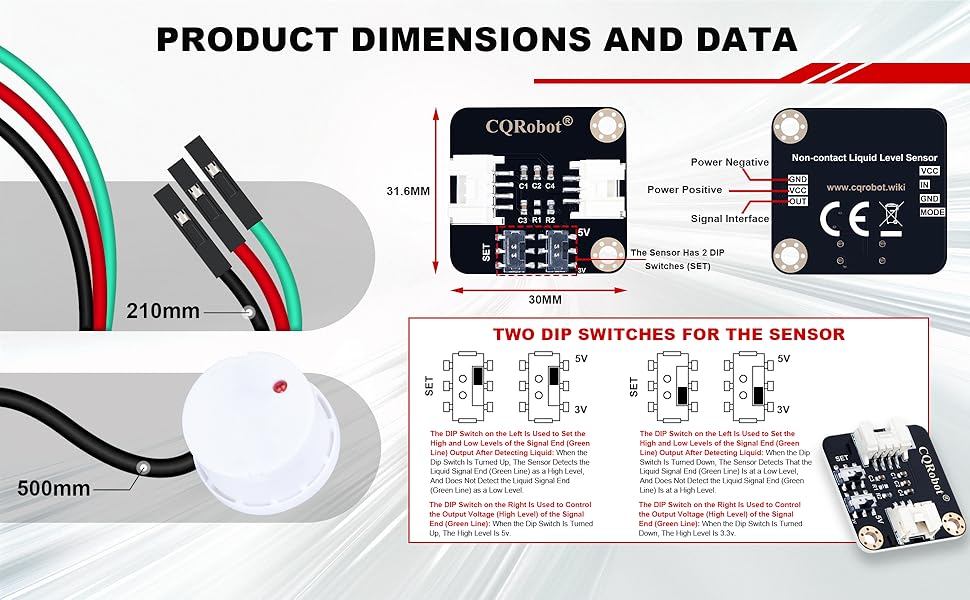
The CQRobot Non-Contact Water/Liquid Level Sensor offers high-sensitivity, non-invasive liquid detection through non-metallic container walls up to 12mm thick. Featuring selectable 3.3V or 5V output and DIP switch-configurable logic, it integrates effortlessly with popular microcontrollers like Arduino and Raspberry Pi. Designed for industrial, agricultural, and hobbyist applications, it delivers reliable, interference-resistant detection without direct liquid contact, ensuring durability and maintenance-free operation.


| ASIN | B07ZMHJ6NN |
| Batteries Required? | No |
| Batteries included? | No |
| Best Sellers Rank | 39,611 in Business, Industry & Science ( See Top 100 in Business, Industry & Science ) 38 in Liquid Level Sensors |
| Colour | Non-Contact |
| Customer Reviews | 4.5 4.5 out of 5 stars (356) |
| Date First Available | 25 Oct. 2019 |
| Item Package Quantity | 1 |
| Item Weight | 50 g |
| Item model number | CQRSENYW001 |
| Manufacturer | CQRobot |
| Material | Acrylonitrile Butadiene Styrene |
| Package Dimensions | 10.21 x 7.49 x 2.21 cm; 50 g |
| Part number | CQRSENYW001 |
| Plug profile | Surface Mount |
| Size | Liquid Level Sensor |
| Specific uses | Industrial Production, Aquarium, Chemical Solution, Agriculture, Gardening |
| Style | Non-Contact Type-1 |
J**N
Worked as expected
I received this water level detector for free through Amazon Vine in exchange for an honest and unbiased review. This is a PCB with a water level sensor designed for use in embedded projects. The PCB has two switches that are not well documented: one switches the signal line between active-high and active-low, and the other allows the board to be powered at either 3.3 V or 5 V. It’s very basic — you either get a signal when water is present or you don’t. On the detection module there is a tiny adjustment screw, and after a few minor tweaks I was able to detect the water level in my plastic water jug. It won’t activate on metal, and if you touch it, it will trigger on your finger. A red LED on the detector shows when it has detected water, which is helpful during setup. Ideally, the detector pad needs to make contact with the side of whatever you are detecting. The pad is flexible and can be glued or zip-tied in place. The signal wire would typically be connected to a GPIO pin on an embedded device, but when powered at 3.3 V I found that this line only reached about 2 V. This is probably acceptable for most applications, but it should be considered when designing something that uses this detector. That said, it works well through glass or plastic and was perfect for measuring how much water is in my water butts in the garden.
V**I
Very easy to set up
This water level detector works great and it is very simple to setup. It features a very basic operation of on or off. This is great for controlling the set liquid level sensing weather for pump control or water level alarm systems. I have been using this with my raspberry pi 4 using home assistant to measure my rain water collection tanks and it was very easy to setup and use. This is a great quality sensor and perfect for any project needing water level automation. And for the price it's really excellent value for money to. I highly recommended it, thanks so much.
A**R
Reliable non-contact liquid detection, but expensive and lacks printed instructions
💧 The box contains a single capacitive non-contact liquid level sensor with a short connector lead. The module is compact, clearly laid out, and arrives well protected. There is no printed documentation included, so I relied on the markings on the PCB and the product listing to confirm pin-out and switch positions. 💧 This sensor detects the presence of liquid at a fixed point and nothing more. It behaves like a simple on or off switch, triggering when liquid reaches the height where it is mounted. It does not report a graduated level, so monitoring multiple levels would require several sensors. In my case, I am using it to detect when a container is effectively empty, which suits this type of device well. 💧 Power and logic flexibility are handled by two small DIP switches on the board. One selects 3.3V or 5V operation, and the other inverts the output logic. I used it at 3.3V with an ESP32 without issue, and the single GPIO output keeps the wiring and code simple. Integration with ESPHome and Home Assistant was straightforward as the signal is just high or low. 💧 The sensor works on non-metallic containers such as plastic provided the wall thickness stays within the stated limits. It does not function on metal tanks. One of its main strengths is that it mounts externally and never contacts the liquid, which avoids corrosion and fouling. It is not waterproof, so outdoor use would require a protective housing, and thick garden water containers may push the limits of detection. 💧 With no moving parts, it should be suitable for continuous use, and so far it has behaved consistently. Long-term durability remains to be seen. At £15.99, it performs its job well and integrates cleanly with common microcontrollers, but for a single-point detection sensor it does feel expensive. It makes sense where non-contact sensing matters, though it is not a low-cost component. ✔️
D**N
Works well
This non-contact liquid level sensor from CQRobot has been fantastic. I used it with Arduino for a few small projects and it works exactly as described. Setup was straightforward and it paired with my boards without any headaches. The non-contact detection makes it great for all kinds of liquids — no corrosion, no sticking — and it reads consistently in the 3–10 mm range I needed. In my use it’s been stable and accurate whether near water in an aquarium test or checking reservoirs in a small automated system. Build quality feels solid and it’s responsive without false triggers. If you’re doing DIY electronics involving liquid monitoring — especially with microcontrollers — this is a dependable sensor that’s worth the price.
I**K
Works with both the raspberry pi and arduino
First and foremost, I absolutely love how this water/liquid level sensor works with both the raspberry pi (including the latest raspberry pi 5) as well as the arduino. Hence it is perfect regardless of which one you have or want to use. Secondly, one of the biggest advantages of this sensor is that it is non-contact. This particular one is a capacitive sensor allowing you to measure water or liquid levels similar to how a touch screen works. Thirdly, and most importantly, it works perfectly! I have been using it for a month and it has proven to be both reliable and accurate. It is also fantastic value for money especially given the quality of this sensor! Overall, very happy with it! Would definitely recommend!
S**S
Works very well
Bought for an Arduino project. Monitors a barrel and triggers a pump when level rises and of when drops. Was very pleasantly surprised by the operation of the sensor. Worked straight from the box.
E**O
Sensor de nivel de líquido sin necesidad de contacto directo con el líquido. La ventaja que tienen este tipo de sensores por una parte es que no sufren la corrosión ni la acumulación de cal que tienen los que están en contacto directo con los líquidos. Este sensor una de las utilidades que tiene es determinar cuando el nivel de líquido de un tanque alcanza un cierto nivel. Puede usarse para calcular la lluvia acumulada o para avisarnos de cuando debemos rellenar un depósito de agua para riego de plantas o avisarnos de cuando debemos vaciar la cubeta en la que recogemos el agua del aire acondicionado. Os recomiendo ponerlo en una caja estanca, quedando solo el sensor fuera y dejando dentro el arduino, raspberry, esp32 o el microcontrolador que uses. Por uno de los huecos puedes sacar un alimentador o instalar un usb en la caja para recargar la batería, en caso de querer usarlo así.
J**Y
Le capteur à été utilisé avec un mcu pour contrôler le niveau de remplissage d’eau d’un réservoir d’un système et le vidanger lorsqu’il est plein. Le problème est que lorsqu’une goutte d’eau éclabousse au hasard la lentille du capteur, ce dernier s’active alors de manière erronée tant et aussi longtemps que la goutte persiste sur cette dernière. Dans ma situation, cela occasionnait une vidange erronée du réservoir. J’ai dû opter pour un autre type de capteur (capacitif) afin de palier à la situation…
T**O
Ces capteurs fonctionne hyper bien il me permettent de remplir et de contrôler le niveau d'un réservoir avec un Arduino
F**A
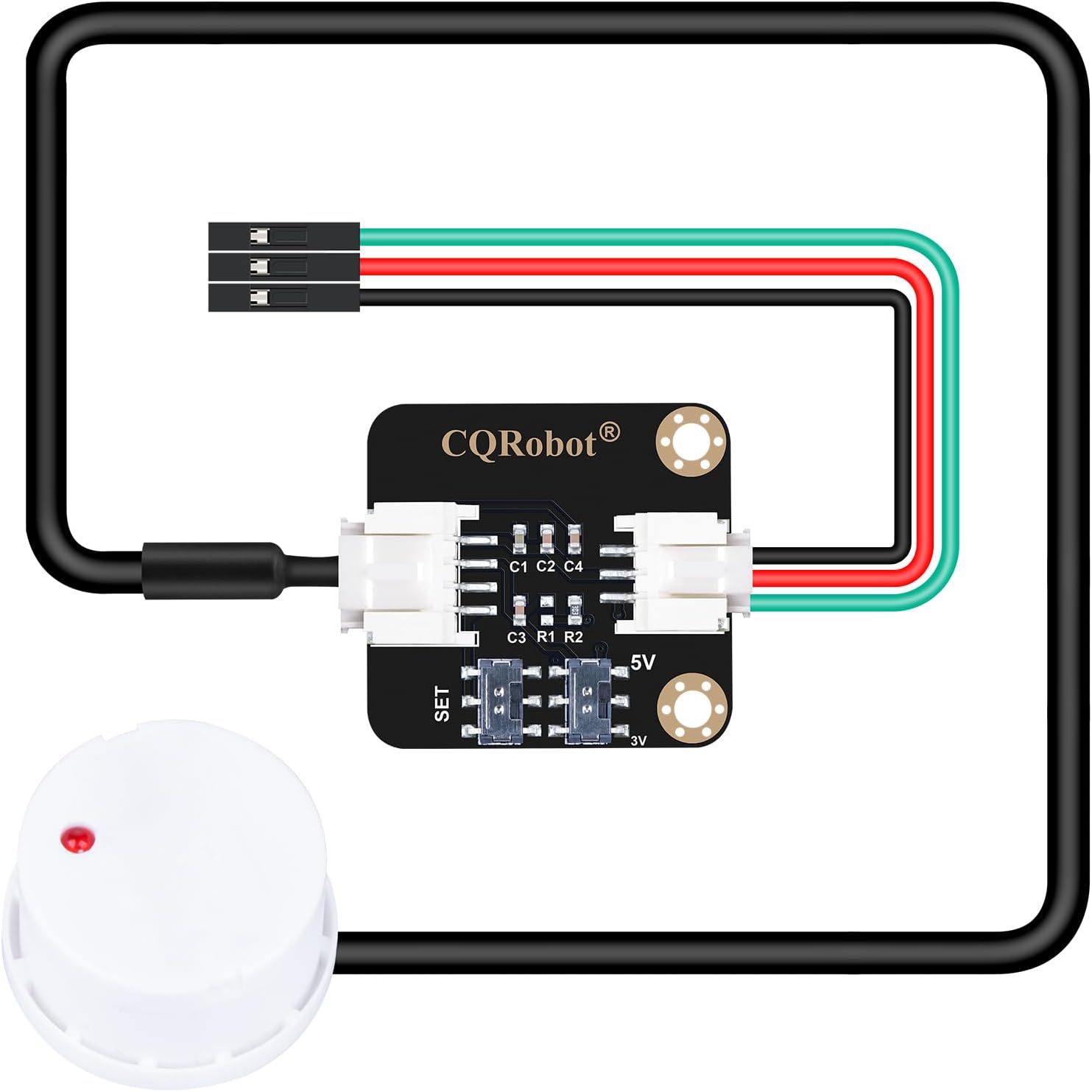
Complemento para Arduino o Raspberry de alta calidad, bien protegido y fabricado con esmero, este sensor permite comprobar el nivel en un depósito sin entrar en contacto con el líquido, ideal para aplicaciones industriales, un lujo para tener en clase… PRESENTACIÓN: Viene en una pequeña cajita, protegido con una bolsita sellada anti-UV, lo que garantiza que lo recibamos en buenas condiciones. No trae ningún tipo de manual, aunque en la web del fabricante disponen de una página exclusiva para este set, con una explicación exhaustiva del montaje, con ejemplos de posicionamiento, esquema de pruebas e incluso códigos de ejemplo, tanto para Arduino como Raspberry: _ Sensor de nivel de líquido sin contacto, adecuado para instalar en las paredes externas de recipientes, depósitos o tanques, sin contacto directo con líquido, sin corrosión, sin deterioro por ácidos y álcalis, libre de incrustaciones u otros desechos. _ La sonda tiene un diámetro de 28 mm., la placa es de 30 x 30 mm, el cable entre sonda y placa mide 48 cm. y por el otro lado el cable a la micro-controladora mide 30 cm. _ La sonda puede detectar el nivel de agua hirviendo, ya que soporta trabajar hasta 105 °C, y tiene un acabado IP67, lo que permite trabajar a la intemperie… _ Tratamiento especial para interferencias y campos electromagnéticos… _ Especial para contenedores NO METÁLICOS, como plástico, vidrio, cerámica, etc… _ La distancia de detección puede alcanzar 12 mm _ Tiene un interruptor para seleccionar el voltaje de entrada, entre 3 y 5 V. _ Tiene un interruptor para seleccionar el modo de funcionamiento, abierto o cerrado. Pensado especialmente para aplicaciones industriales, este es un dispositivo listo para su uso. Simplemente hay que conectarlo a una placa de Arduino o Raspberry según el esquema indicado en la web del fabricante. Un lujo para tener en Institutos y Escuelas para aulas de robótica, electrónica y mecánica de fluidos. Nosotros hemos realizado la prueba con una placa Arduino UNO cargada con el código fuente del fabricante, una jarra de cristal de 6 mm. de grosor y ha detectado perfectamente cuando el nivel a llegado al módulo de tres líquidos diferentes, agua, aceite y gaseosa con muchas burbujas… Ha sido muy interesante… En resumen, si buscas una sonda de nivel de líquidos, especial para usar por el exterior del contenedor, esta es una de las mejores opciones, muy bien fabricado, con la información necesaria en la web del fabricante… Ideal para aplicaciones industriales, comerciales y sobre todo para uso educativo en Secundaria o Formación Profesional… Saludos!!!
F**A
Complemento para Arduino o Raspberry de alta calidad, bien protegido y fabricado con esmero, este sensor permite comprobar que un líquido llega a un determinado nivel por medio de un sistema fotoeléctrico de alta precisión… PRESENTACIÓN: Viene en una pequeña cajita, protegido con una bolsita sellada anti-UV, lo que garantiza que lo recibamos en buenas condiciones. No trae ningún tipo de manual, aunque en la web del fabricante disponen de una página exclusiva para este set, con una explicación exhaustiva del montaje, con ejemplos de posicionamiento, esquema de pruebas e incluso códigos de ejemplo, tanto para Arduino como Raspberry: _ Sensor de nivel por contacto, con una estructura de diodo emisor incorporado y fototransistor, encapsulados, haciendo que no entren en contacto directo con el líquido. _ La sonda tiene un diámetro de 20 mm., tiene un encapsulado de plástico, goma de estanqueidad y un sistema de rosca y tuerca para sujetarla a la pared del recipiente. _ La placa es de 30 x 30 mm, el cable entre sonda y placa mide 48 cm. y por el otro lado el cable a la micro-controladora mide 30 cm. _ La sonda puede detectar líquidos calientes hasta un límite de 105 °C. _ Tratamiento especial para interferencias y campos electromagnéticos… _ Tiene un interruptor para seleccionar el voltaje de entrada, entre 3 y 5 V. _ Se puede instalar en cualquier posición, horizontal, vertical, diagonal, cabeza abajo… Pensado especialmente para aplicaciones industriales, este es un dispositivo listo para su uso. Simplemente hay que conectarlo a una placa de Arduino o Raspberry según el esquema indicado en la web del fabricante. Un lujo para tener en Institutos y Escuelas para aulas de robótica, electrónica y mecánica de fluidos. Nosotros hemos realizado la prueba con una placa Arduino UNO cargada con el código fuente del fabricante, varios vasos de cristal, plástico y metal, con líquidos diversos como agua, aceite, gaseosa, agua hirviendo y chocolate caliente muy espeso… Ha detectado todos los niveles con precisión así que tocaban la punta de la sonda, a destacar que no le afectó el vapor del agua hirviendo ni la densidad el chocolate… Perfecto… En resumen, si buscas una sonda de nivel de líquidos de calidad superior, con detección óptica y lista para conectar a un micro-controlador, esta es la opción de lujo, con calibración y sensibilidad garantizadas y una estética fácil de usar… Ideal para profesionales… Saludos!!!
Trustpilot
1 month ago
2 months ago