We remain fully operational. Our teams are working around the clock to ensure your deliveries continue safely.

DOWNLOAD THE APP


Copyright © 2025 Desertcart Holdings Limited
DOWNLOAD THE APP
Buy anything from 5,000+ international stores. One checkout price. No surprise fees. Join 2M+ shoppers on Desertcart.
Desertcart purchases this item on your behalf and handles shipping, customs, and support to Kyrgyzstan.
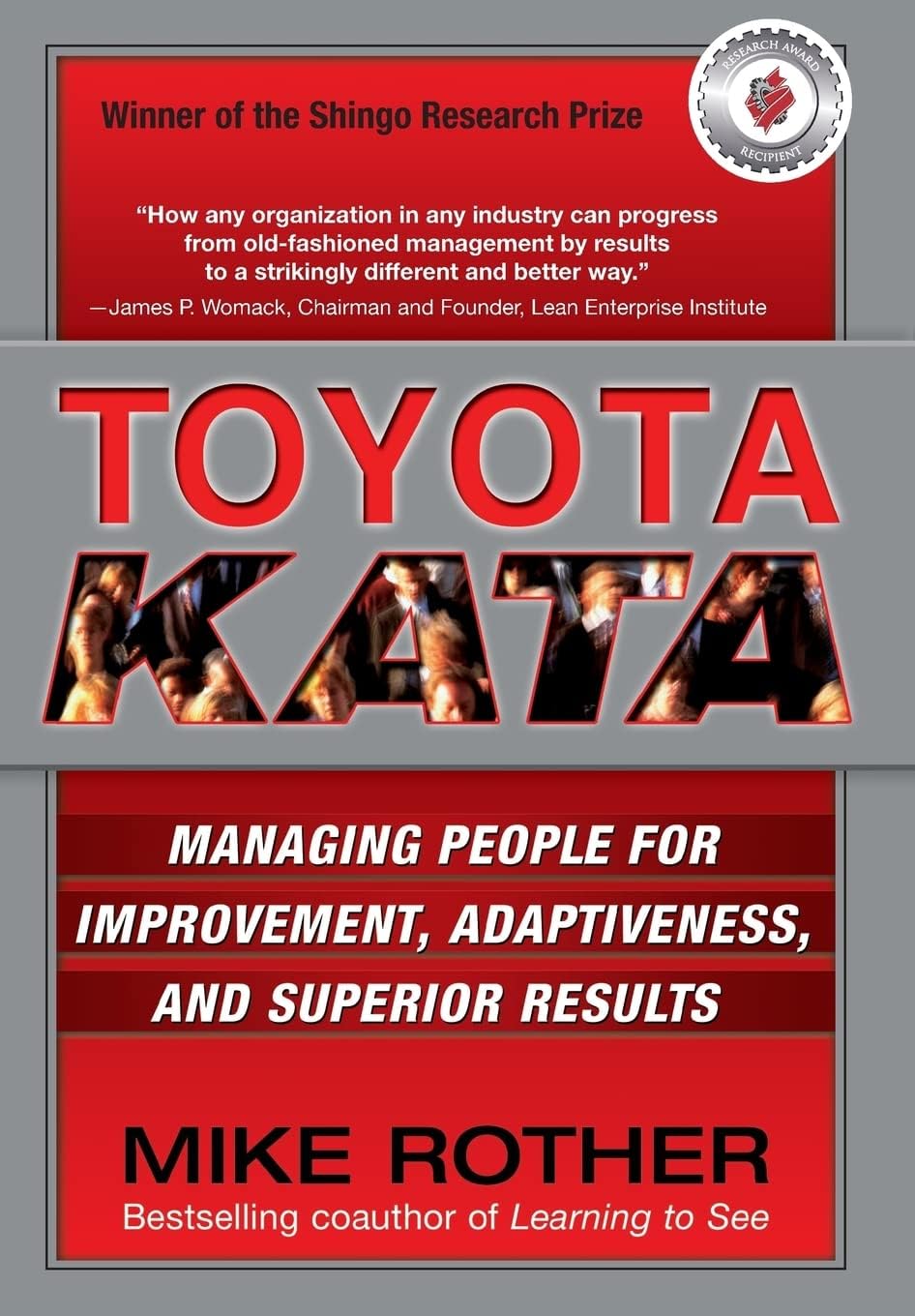
desertcart.com: Toyota Kata: Managing People for Improvement, Adaptiveness and Superior Results: 8601400847824: Rother, Mike: Books Review: Lean is really about a focused approach to Improvement and Toyota Kata is the best book to learn about it - The Toyota Kata is my 2011 book of the year. It started me on a lot of thinking streaks and opened a lot of threads for how to effectively do my job as a Lean/Agile consultant. I already read it twice and suspect will reread it again and keep it for reference on my iPad kindle. The examples are mainly from Production and it takes a bit of abstraction to map it to Knowledge Work / Product Development, but it is worth the effort. At a very very high level this book is about the Toyota approach to management - which is to have a focused approach to improvement (The Improvement Kata) and a focused approach to teaching people how to focus on improvement (The Coaching Kata). As a practitioner of Agile and Kanban in software/product development environments, I love this focus on what REALLY makes Toyota tick. There's certainly a lot of bad mouthing of Lean and Toyota's approach to production out there, calling it tool-focused and mechanistic/unfocused. The Kata is book is very aligned with our view of Lean as Kanban practitioners - the key being the thinking about improvement rather than the actual tools. Let me try to review it by trying to apply it to the context of a Kanban team. The Improvement Kata The Kata starts with understanding the direction. Let's say we bought the Kanban / Lean Startup cool-aid and are aiming at the direction of faster end to end feedback and effectiveness through having dramatically shorter Cycle Times. Then we grasp the current condition. This is similar to the "Visualize the work" step in Kanban. Establish the Next Target Condition can mean - ok now that we understand our mean cycle time is 8 weeks and it is unstable - ranging 4-12 weeks and the direction is towards a stable cycle time of days not weeks, lets aim at stable 8 weeks meaning to reduce the variability from 4 weeks in each direction to 1 week in each direction. Sounds like a reasonable next target condition to me. Now we try to make that happen and encounter obstacles. We would need to overcome them. The Improvement Kata talks about a daily cycle of looking at the current actual condition, in light of the current target condition, understanding the obstacles explaining the gaps between the actual and the target, and urging us to choose one of the obstacles and work to address it in small experimentation steps using the PDCA cycle (Plan Do Check Act). On top of this approach sits the Coaching Kata with Five Questions that are aimed at coaching people on using the Improvement Kata. The aim is for managers to coach their people in their improvement work. The Five Toyota Kata Questions - Mike Rother This is great stuff. Really great. The key point here is the focus on the job of people to always improve in a focused way, and the job of management to work on improvement themselves but also work to improve the improvement capabilities of their people. Use this as a repeating building block, tie it to the value system and objectives of people throughout the organization and you stand a real chance for improvement work to become part of your DNA. I'm just not clear on how to implement this in Product Development/Knowledge Work. Our processing cycles are orders of magnitude slower than in production. Which means we either do coaching/improvement cycles without the ability to see samples of finished work - which invalidates the scientific nature of the experimentation cycles, or we have to suffice with much slower improvement cycles, which makes improvement part of the outer-loop cadence (e.g. retrospectives, operation reviews) rather than the inner-loop cadence (e.g. Daily Syncs). Which is a real shame because it seems Mike associates a lot of the power of the Kata with the fact it is done very often. At the moment I'm planning to use the Improvement Kata / Coaching Kata for outer-loop cadence, but am still trying to find a way to run it for the inner-loop. If you have some idea or experience with this, help me out... A possible direction is to do the improvement/coaching kata for local internal processes e.g. Dev/Test in the inner-loop. If a developer is using TDD then we can apply the Kata for his TDD cycles. For a tester we can do it for his exploratory testing sessions or for his test cases. A few more key points for me: - Having a reason/vision helps you avoid relaxing processes and instead focus on becoming more effective WITH them. - The Ability to work according to Sequence/Priority is an indication of maturity and can be a target for a pull system. - Having target outcomes are important but it is even more important to manage the means or conditions which will allow reaching those outcomes. - Having target conditions doesn't mean specifying the solution. The solution will emerge from experimentation cycles (PDCA). Mike Rother's Lean is very compatible with Complexity Thinking. Reading Chasing the Rabbit and the Toyota Production System reinforces this view btw. - To develop your own capability of improvement, the effort will have to be internally led, from the top. If the top does not change behavior and lead, then the organization will not change either. I hope I sparked your interest in this great book. There is still lots of work to be done mapping the Improvement/Coaching Katas to Knowledge Work, but even at raw unmapped form there are great insights in this book. Highly Recommended. My only hope is that someone will write a good mapping of the Toyota Kata to Knowledge work with its slower cycles. Who knows... Review: By FAR the best of the 15+ "Lean" books I've read. Don't waste time on the others until you read this one. - I'd previously given this book a 5 star review based upon reading. Now I can reaffirm based on DOING! Two weeks ago we launched our first real Lean "experiment"/ improvement process. I took the role of mentor in the teaching kata, and guided my Production Manager to help me write an A3 for how to dramatically reshape our shipping department. I didn't feel entirely comfortable, as I didn't have solid experience with ANY of the tools which are touted to fill up most "Lean" books. But by simply simply writing and mentoring the teaching of an A3, as taught in this book, we discovered all sorts of issues we hadn't been considering. And then, when we began to implement the formal plan -- as this book forewarned us to expect -- we uncovered a lot of additional considerations. That was several weeks ago. We are continuing to iterate on the improvement kata; it is clear we are on the right track to substantial improvement in the department and it is also more clear than ever that Lean isn't about "quick fix", short-term thinking (another lesson from this book). I've now purchased SIX copies of the book as we are picking up speed, proceeding to roll Lean out through all the aspects of our national business. It will doubtless take me years to really feel I am a fully experienced "Lean" practitioner. But I can't praise this book enough: Forget reading all the other books until you've really read this one. I wish I could take at least one star away from pretty nearly all the other Lean books out there so this one would really stand out as the shining STAR that it is. ---- Previous review: Of the probably 15 books I've read so far on "lean", this one stands alone in actually trying to teach the thinking *behind* Toyota's mindset of continuous improvement. As the author himself admits -- despite all the books, seminars, and consulting -- NOBODY has yet duplicated Toyota's results. You can be pretty sure you will fail, also, if you try to implement lean as a group of tools taught by a consultant. The tools are absolutely the LEAST important aspect of Toyota's success. In the author's words: "What we have been doing is observing Toyota's current visible practices, classifying them into lists of elements and principles and then trying to adopt them. This is reverse engineering ... and it is not working so well." I do think Lean has a lot to offer; It only makes sense that there a better and worse ways to do everything and that improvement really has no limits. The proper place to start, and to ground, is in the philosophy and more subtle behaviors at Toyota. The particular techniques are pretty much valueless without culture change and this is the only book I've read so far which really teaches that.


| Best Sellers Rank | #74,450 in Books ( See Top 100 in Books ) #2 in Lean Management #303 in Business Management (Books) #819 in Leadership & Motivation |
| Customer Reviews | 4.6 out of 5 stars 725 Reviews |
Y**T
Lean is really about a focused approach to Improvement and Toyota Kata is the best book to learn about it
The Toyota Kata is my 2011 book of the year. It started me on a lot of thinking streaks and opened a lot of threads for how to effectively do my job as a Lean/Agile consultant. I already read it twice and suspect will reread it again and keep it for reference on my iPad kindle. The examples are mainly from Production and it takes a bit of abstraction to map it to Knowledge Work / Product Development, but it is worth the effort. At a very very high level this book is about the Toyota approach to management - which is to have a focused approach to improvement (The Improvement Kata) and a focused approach to teaching people how to focus on improvement (The Coaching Kata). As a practitioner of Agile and Kanban in software/product development environments, I love this focus on what REALLY makes Toyota tick. There's certainly a lot of bad mouthing of Lean and Toyota's approach to production out there, calling it tool-focused and mechanistic/unfocused. The Kata is book is very aligned with our view of Lean as Kanban practitioners - the key being the thinking about improvement rather than the actual tools. Let me try to review it by trying to apply it to the context of a Kanban team. The Improvement Kata The Kata starts with understanding the direction. Let's say we bought the Kanban / Lean Startup cool-aid and are aiming at the direction of faster end to end feedback and effectiveness through having dramatically shorter Cycle Times. Then we grasp the current condition. This is similar to the "Visualize the work" step in Kanban. Establish the Next Target Condition can mean - ok now that we understand our mean cycle time is 8 weeks and it is unstable - ranging 4-12 weeks and the direction is towards a stable cycle time of days not weeks, lets aim at stable 8 weeks meaning to reduce the variability from 4 weeks in each direction to 1 week in each direction. Sounds like a reasonable next target condition to me. Now we try to make that happen and encounter obstacles. We would need to overcome them. The Improvement Kata talks about a daily cycle of looking at the current actual condition, in light of the current target condition, understanding the obstacles explaining the gaps between the actual and the target, and urging us to choose one of the obstacles and work to address it in small experimentation steps using the PDCA cycle (Plan Do Check Act). On top of this approach sits the Coaching Kata with Five Questions that are aimed at coaching people on using the Improvement Kata. The aim is for managers to coach their people in their improvement work. The Five Toyota Kata Questions - Mike Rother This is great stuff. Really great. The key point here is the focus on the job of people to always improve in a focused way, and the job of management to work on improvement themselves but also work to improve the improvement capabilities of their people. Use this as a repeating building block, tie it to the value system and objectives of people throughout the organization and you stand a real chance for improvement work to become part of your DNA. I'm just not clear on how to implement this in Product Development/Knowledge Work. Our processing cycles are orders of magnitude slower than in production. Which means we either do coaching/improvement cycles without the ability to see samples of finished work - which invalidates the scientific nature of the experimentation cycles, or we have to suffice with much slower improvement cycles, which makes improvement part of the outer-loop cadence (e.g. retrospectives, operation reviews) rather than the inner-loop cadence (e.g. Daily Syncs). Which is a real shame because it seems Mike associates a lot of the power of the Kata with the fact it is done very often. At the moment I'm planning to use the Improvement Kata / Coaching Kata for outer-loop cadence, but am still trying to find a way to run it for the inner-loop. If you have some idea or experience with this, help me out... A possible direction is to do the improvement/coaching kata for local internal processes e.g. Dev/Test in the inner-loop. If a developer is using TDD then we can apply the Kata for his TDD cycles. For a tester we can do it for his exploratory testing sessions or for his test cases. A few more key points for me: - Having a reason/vision helps you avoid relaxing processes and instead focus on becoming more effective WITH them. - The Ability to work according to Sequence/Priority is an indication of maturity and can be a target for a pull system. - Having target outcomes are important but it is even more important to manage the means or conditions which will allow reaching those outcomes. - Having target conditions doesn't mean specifying the solution. The solution will emerge from experimentation cycles (PDCA). Mike Rother's Lean is very compatible with Complexity Thinking. Reading Chasing the Rabbit and the Toyota Production System reinforces this view btw. - To develop your own capability of improvement, the effort will have to be internally led, from the top. If the top does not change behavior and lead, then the organization will not change either. I hope I sparked your interest in this great book. There is still lots of work to be done mapping the Improvement/Coaching Katas to Knowledge Work, but even at raw unmapped form there are great insights in this book. Highly Recommended. My only hope is that someone will write a good mapping of the Toyota Kata to Knowledge work with its slower cycles. Who knows...
I**H
By FAR the best of the 15+ "Lean" books I've read. Don't waste time on the others until you read this one.
I'd previously given this book a 5 star review based upon reading. Now I can reaffirm based on DOING! Two weeks ago we launched our first real Lean "experiment"/ improvement process. I took the role of mentor in the teaching kata, and guided my Production Manager to help me write an A3 for how to dramatically reshape our shipping department. I didn't feel entirely comfortable, as I didn't have solid experience with ANY of the tools which are touted to fill up most "Lean" books. But by simply simply writing and mentoring the teaching of an A3, as taught in this book, we discovered all sorts of issues we hadn't been considering. And then, when we began to implement the formal plan -- as this book forewarned us to expect -- we uncovered a lot of additional considerations. That was several weeks ago. We are continuing to iterate on the improvement kata; it is clear we are on the right track to substantial improvement in the department and it is also more clear than ever that Lean isn't about "quick fix", short-term thinking (another lesson from this book). I've now purchased SIX copies of the book as we are picking up speed, proceeding to roll Lean out through all the aspects of our national business. It will doubtless take me years to really feel I am a fully experienced "Lean" practitioner. But I can't praise this book enough: Forget reading all the other books until you've really read this one. I wish I could take at least one star away from pretty nearly all the other Lean books out there so this one would really stand out as the shining STAR that it is. ---- Previous review: Of the probably 15 books I've read so far on "lean", this one stands alone in actually trying to teach the thinking *behind* Toyota's mindset of continuous improvement. As the author himself admits -- despite all the books, seminars, and consulting -- NOBODY has yet duplicated Toyota's results. You can be pretty sure you will fail, also, if you try to implement lean as a group of tools taught by a consultant. The tools are absolutely the LEAST important aspect of Toyota's success. In the author's words: "What we have been doing is observing Toyota's current visible practices, classifying them into lists of elements and principles and then trying to adopt them. This is reverse engineering ... and it is not working so well." I do think Lean has a lot to offer; It only makes sense that there a better and worse ways to do everything and that improvement really has no limits. The proper place to start, and to ground, is in the philosophy and more subtle behaviors at Toyota. The particular techniques are pretty much valueless without culture change and this is the only book I've read so far which really teaches that.
K**I
Why you don't always get what you see
"While it has been said imitation is the best form of flattery, unfortunatly those that try to imitate Toyota based on what they see on the shop floor are often left scratching their heads as to why "Lean" hasn't lasted too long or "doesn't work". I'm glad this book addresses why copying the tools will not create sustainability without having the thinking and behavior in place. This book demonstrates that Lean is not about tools, but it is about people development. Developing the capabilities within the people so they can design what method is needed. I am also glad the book has surfaced that behavior changes need to happen at all levels of the organization. However I was a bit let down that the book did not get into management theory. Based on Toyota's demonstration of their culture and behavior it's probably a fair assumption that Toyota is based upon Theory Y, however the author does not address this dynamic of the system. Overall I am glad to see a book that really starts to scratch the surface about what Lean has always been about, releasing the potential of people. This will really be an eye opener for those who believe they are Lean because they are using Lean tools but haven't changed traditional mass production management practices and approaches."
B**E
Toyota Kata formulates the essense of creating a problem solving culture!
Ok, finally a review of Toyota Kata. It took me a while to start this wonderful book. I remember (it's been a while) first encountering it and not expecting much of it. Another Toyota book, I thought, how much can it contribute to the existing Toyota literature. Answer: A lot! Toyota Kata formulates some insights that are consistent with most work and studies of Toyota but they've never been expressed this way until Mike Rother's Toyota Kata came along. The author, Mike, never worked in Toyota but has studied Toyota extensively. The not so surprising result of the research was that the secret of Toyota is it's ability to continuously improve. The more surprising part of his work is that he believes the key to that culture is the management culture or style that is applied within Toyota. Management consistently improves continuous improvement by coaching people to expand their problem solving capabilities. Mike's goal became to learn this and discover how to be able to do that in other organizations. A kata is a series of movements in martial arts that are frequently repeated to make them automatic. The author took the idea of kata and asked what the frequently repeated 'movements' are that enables a problem solving improvement culture. He discovered two of these: (1) improvement kata, and (2) coaching kata. The improvement kata is what the entire organization does. In short, establish a longer term goal, a shorter term goal, spend a lot of time and be brutally honest where you are now and experiment with improvements and measure if you are getting closer towards your long term improvement goal. The coaching kata is what the management does to coach the organization to adopt the improvement kata. While reading Toyota kata, I often reflected on Taichii Ohno stories of problem solving that eventually led to the Toyota Production System, and the Toyota Kata approach does suggest similar (perhaps nicer) working styles. In that sense, i think that Mike is expressed a basic core practice of creating an improvement culture? Will it make it easier to create such an culture? Perhaps a little. But it isn't easy, constantly repeating these Kata's to practice problem solving skills. I do think this will definitively help organizations who are sincerely trying to improve forward. Highly recommended!
M**M
I am so glad that I studied this book!
I must admit I initially avoided reading this book as I was not a big fan of "Learning to See." But a steady stream of recommendations forced me to capitulate, open up my mind, and give it a try... for which I have been greatly rewarded! Pro: + Brilliant break down of Toyota's tribal knowledge... I've just gotten a bit wiser! + Gives the user a systematic way to manage smarter + Good introduction to basic concepts like one-piece flow, vision/direction setting, and similar + Concise history of where the Western management system came from + Useful to any leader, even those not interested in "lean" or Toyota's continuous improvement methods! Con: - Overuses, "more on that in the next section" indicating the flow of information is out of sequence. - Weak visuals - I adjusted about half of them during note taking (FYI - I think there is math error in Figure A2-13). - Please add more references - what study did you use to come to conclusion x, y, or z? Naysayers call this stuff a fad until we show them the science. - Rother says on page 17 that Toyota's kata "precedes principles." I don't buy this. Kata is a system guided by certain principles and not something "beyond" them. The principles (and related systems) behind kata may be more important than others, but it definitely does not precede them. Every system, or kata, should have an aim, and for maximal impact/consistency that aim guided by a principle. Neutrals: > Include more about Eastern culture - I get that kata can be successfully brought to the West. However, I think it's definitely more prevalent in the Eastern culture so I conclude that the conditions there must be in some way be more conducive than those elsewhere. Consider the Japanese tradition of "cherishing" problems and not hiding them! No one's fault, merely an unfortunate situation! In the West, however, "I'm sorry" is usually interpreted as, "I was at fault" leading to a tendency to blame, resulting in people hiding problems and making kata harder to establish. Bottom line: Highly recommended! Either 2nd or 3rd in my entire operational excellence/lean library (ranking would depend on who is asking and the problem at hand). Don't let anything prevent you from putting this at the top of your reading queue, even if that means putting down another book. Note: When reading a book like this, I read it slowly, making tons of notes. It takes me several extra weeks, but it allows extra reflection time, prevents me from skimming, and helps foster a deeper understanding and appreciation for the author's view point. I mention this because some of my "con" points may sound critical but this is not the case at all! I respect each author, and show this by offering ideas - after all it is far easier for me to nod my head in agreement than say nothing...
L**P
The focus on the underlying culture and mindset to achieve high performance is what distinguishes this book
My background is in process improvement for over 25 years. Much of the writing and approach to process improvement focuses on the mechanics and not the underlying management philosophy necessary to achieve high performance through continuous improvement. In contrast, the author does a great job at describing his deeper insights about the intellectual foundation of what has made Toyota such a dominant force. He makes those ideas accessible to a wide audience of managers who want to adopt these ideas through examples and easy to grasp models. I look forward to applying these ideas and coaching techniques to help my team achieve our current "target conditions" and long term vision. For those in senior management roles, I highly recommend reading The Four Disciplines of Execution which is a complementary set of ideas that starts at the organizational strategy level. These two books together make for a powerful combination around implementation of modern CPI thinking.
M**T
Great read for manufacturing leaders
This book was very insightful and full of great information on some of what makes Toyota special as a manufacturer. Very easy to read with good examples and illustrations.
A**H
This book is useful in something aspects
This book is useful in something aspects, in special situations when we need help to understand what we can do for get a good way to managing people at work. It told us how the workers at Toyota's plants be identified with the philosophy of TPS. I think the author of this book need put in it more energy, more passion when describe some experiences that happened in Toyota's plants....
Trustpilot
1 month ago
2 days ago