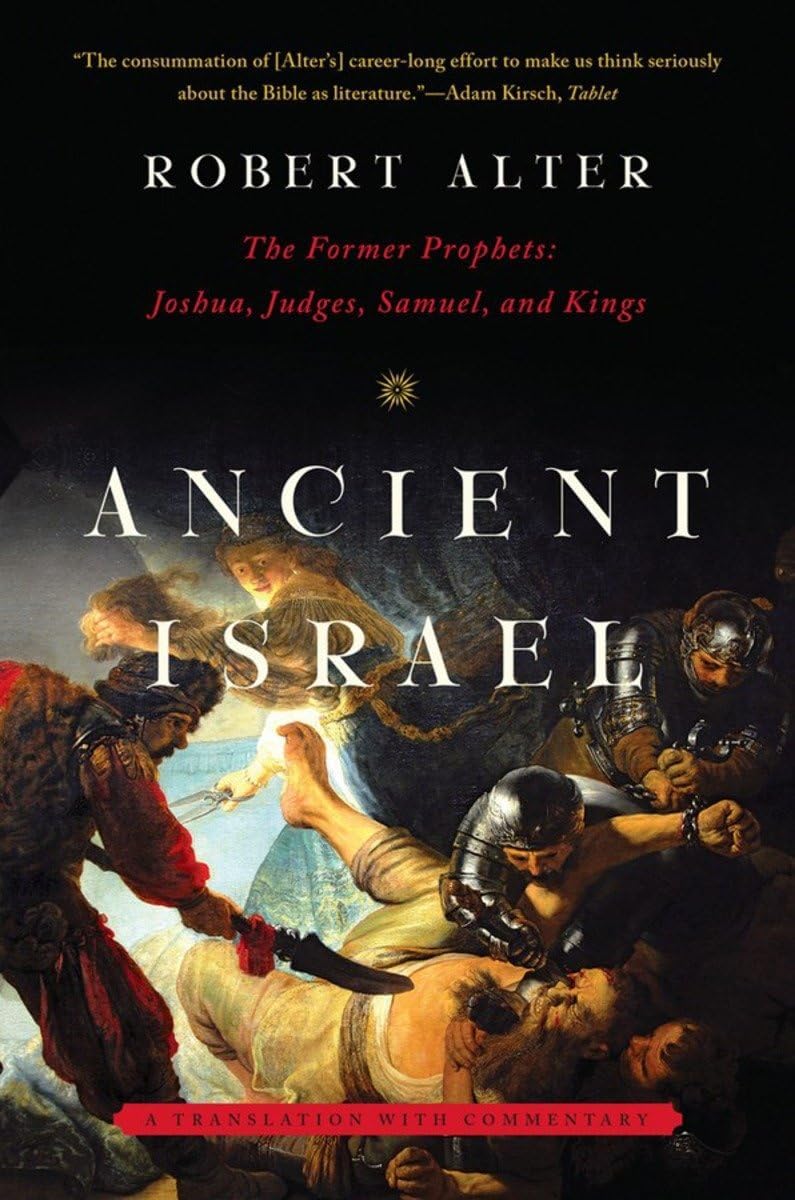
Ancient Israel: The Former Prophets: Joshua, Judges, Samuel, and Kings: A Translation with Commentary
Product ID: 1695793
Ancient Israel: The Former Prophets: Joshua, Judges, Samuel, and Kings: A Translation with Commentary [Alter, Robert] on desertcart.com. *FREE* shipping on qualifying offers. Ancient Israel: The Former Prophets: Joshua, Judges, Samuel, and Kings: A Translation with Commentary Review: Worth buying and reading - Robert Alter, an award winning author, has many skills including knowing Hebrew, understanding the Bible, and writing well. He translated and commented on many biblical books. He translates and comments upon "The Former Prophets: Joshua, Judges, Samuel, and Kings" in this volume. Ancient Judaism divided the Hebrew Bible into three parts: Torah (the Five Books of Moses), Neviim (the prophetical books - books derived by prophecy), and Ketuvim (writings - inspired books). The entire collection is called Tanach, which is an acronym made up of the names of the three parts. Later scholars divided the second section Neviim into two parts, the former and later prophets. Actually, the "former Prophets" are not books of prophecy, but historical books. Alter does not attempt to give his readers an extensive commentary on the four books. However he does introduce each with about a half dozen pages in which he explains the history and contents of the book. He also places about half a page of commentary on each page of each book. Alter's translation is much clearer than many others. For example, just a simple sentence in the Art Scroll edition of I Samuel 11:1 translates: "Then Nahash the Ammonite sent up and besieged Jabesh-gilead, and all the people of Jabesh said to Nahash, `Seal a covenant with us, and we will serve you.'" Alter has: "And Nahash the Ammonite came up and encamped against Jabesh-Gilead. And all the men of Jabesh said to Nahash, `Make a pact with us, and we shall be subject to you.'" In more than half a page under this sentence, Alter explains what the Ammonite kingdom is, its relationship to King Saul and King David, what is the settlement of Jabesh-Gilead, its relationship to Saul, what was found in Cave 4 of Qumran in the twentieth century that throws light on this episode. Review: The things that you're liable to read in the... - Does any other text have such a discrepancy between the amount of time generations have devoted to studying it and the actual understanding derived from this huge effort?? Century after century people have been told that these books were God's word, an instruction manual on how to live. Generation after generation, people have lived in houses with copies of the Bible. Family history, marriages, births and deaths were recorded in it. Dedicated missionaries spent lifetimes hard at work at their desks, just so they could translate the ancient Hebrew text into obscure languages. Just what the 19th century Hawaiians made of these brutal tales is beyond me. Did they actually read it? I have relatives who defend "Biblical marriage," -- did they actually read about all the concubines? Or was it just a sacred object? So I tried to read it, first as religious guidance, then as poetry and then as history. But I either couldn't follow it, or I just didn't believe it could be saying what I thought it was saying: all that murder, rape, genocide, pillage. As an archivist, I like to get as close to the original text as possible. Robert Alter seemed to be the most qualified guide, and I decided to make one last attempt. After reading the Five Books of Moses with Robert Alter's commentary, I was addicted and went on to read "Ancient Israel," translations and commentary on Joshua, Judges, Samuel, and Kings. only with Alter's footnotes could I make sense out of the narratives. And when the actual text itself is garbled, he points out the likely reasons. For me this time, reading the OT became something of a soap opera with lots of dramatic irony as the reader sees looming disaster, "No! Don't do that!...Oh, no, they did..." There is lots of dual causality, disaster comes because the deity is mad about the worship of idols, and also because of more mundane factors like superior forces. Alter is upfront about the overall effect of the first half of "Ancient Israel" -- ruthlessness, and the general impression made by the second half -- tedium. And " nowhere in the Bible is there a more palpable discrepancy between the values and expectations of the ancient Near Eastern era in which the book was written and those of twenty-first century readers." The story of the defeat of the Canaanites is apparently mythical, not supported by archeological evidence. According to his theory, the genocide against the Canaanites as described with great approval in the Bible, probably never actually happened. The later battles with the Assyrians and Babylonians have more of a basis in fact. Alter's notes puts all of these discrepancies and correspondences between text and extra-biblical evidence in context. The Bible's fundamental if brutal honesty however comes out in the deep moral ambiguity of nearly all the great biblical heroes, so even King David, actually especially King David, they all did pretty dastardly things, that is essentially true to human nature. With Alter's framework, the folklore elements woven into the mythical and historical narratives stand out. Elijah is simply different from any of the other prophets before him. He works wishful-thinking miracles and helps the downtrodden. He miraculously provides food in times of hunger, an early model for the loaves and fishes (like the fairy tale "Tischlein Deck Dich"). Apparently these features made him the star of Jewish folklore over the centuries. Alter convincingly concludes that Elijah provides the template for many of the Jesus stories of the New Testament. The interconnections are starting to make sense to me. I'm grateful to Alter for using both his erudition and his deep insights to help non-specialists such as myself get a sense of what the OT is all about. I'm not about to give the Bible a rating, that's rather presumptuous, but Alter's notes definitely deserve 5 stars. Worth the time and effort to work through...I'm still not about to use the Bible as a guide to living, but as a guide to human nature, it's all in there.
| ASIN | 0393348768 |
| Best Sellers Rank | #1,322,308 in Books ( See Top 100 in Books ) #202 in Christian Prophets (Books) |
| Customer Reviews | 4.7 4.7 out of 5 stars (133) |
| Dimensions | 6.2 x 1.5 x 9.2 inches |
| Edition | Reprint |
| ISBN-10 | 9780393348767 |
| ISBN-13 | 978-0393348767 |
| Item Weight | 1.95 pounds |
| Language | English |
| Print length | 880 pages |
| Publication date | April 14, 2014 |
| Publisher | W. W. Norton & Company |
I**N
Worth buying and reading
Robert Alter, an award winning author, has many skills including knowing Hebrew, understanding the Bible, and writing well. He translated and commented on many biblical books. He translates and comments upon "The Former Prophets: Joshua, Judges, Samuel, and Kings" in this volume. Ancient Judaism divided the Hebrew Bible into three parts: Torah (the Five Books of Moses), Neviim (the prophetical books - books derived by prophecy), and Ketuvim (writings - inspired books). The entire collection is called Tanach, which is an acronym made up of the names of the three parts. Later scholars divided the second section Neviim into two parts, the former and later prophets. Actually, the "former Prophets" are not books of prophecy, but historical books. Alter does not attempt to give his readers an extensive commentary on the four books. However he does introduce each with about a half dozen pages in which he explains the history and contents of the book. He also places about half a page of commentary on each page of each book. Alter's translation is much clearer than many others. For example, just a simple sentence in the Art Scroll edition of I Samuel 11:1 translates: "Then Nahash the Ammonite sent up and besieged Jabesh-gilead, and all the people of Jabesh said to Nahash, `Seal a covenant with us, and we will serve you.'" Alter has: "And Nahash the Ammonite came up and encamped against Jabesh-Gilead. And all the men of Jabesh said to Nahash, `Make a pact with us, and we shall be subject to you.'" In more than half a page under this sentence, Alter explains what the Ammonite kingdom is, its relationship to King Saul and King David, what is the settlement of Jabesh-Gilead, its relationship to Saul, what was found in Cave 4 of Qumran in the twentieth century that throws light on this episode.
E**N
The things that you're liable to read in the...
Does any other text have such a discrepancy between the amount of time generations have devoted to studying it and the actual understanding derived from this huge effort?? Century after century people have been told that these books were God's word, an instruction manual on how to live. Generation after generation, people have lived in houses with copies of the Bible. Family history, marriages, births and deaths were recorded in it. Dedicated missionaries spent lifetimes hard at work at their desks, just so they could translate the ancient Hebrew text into obscure languages. Just what the 19th century Hawaiians made of these brutal tales is beyond me. Did they actually read it? I have relatives who defend "Biblical marriage," -- did they actually read about all the concubines? Or was it just a sacred object? So I tried to read it, first as religious guidance, then as poetry and then as history. But I either couldn't follow it, or I just didn't believe it could be saying what I thought it was saying: all that murder, rape, genocide, pillage. As an archivist, I like to get as close to the original text as possible. Robert Alter seemed to be the most qualified guide, and I decided to make one last attempt. After reading the Five Books of Moses with Robert Alter's commentary, I was addicted and went on to read "Ancient Israel," translations and commentary on Joshua, Judges, Samuel, and Kings. only with Alter's footnotes could I make sense out of the narratives. And when the actual text itself is garbled, he points out the likely reasons. For me this time, reading the OT became something of a soap opera with lots of dramatic irony as the reader sees looming disaster, "No! Don't do that!...Oh, no, they did..." There is lots of dual causality, disaster comes because the deity is mad about the worship of idols, and also because of more mundane factors like superior forces. Alter is upfront about the overall effect of the first half of "Ancient Israel" -- ruthlessness, and the general impression made by the second half -- tedium. And " nowhere in the Bible is there a more palpable discrepancy between the values and expectations of the ancient Near Eastern era in which the book was written and those of twenty-first century readers." The story of the defeat of the Canaanites is apparently mythical, not supported by archeological evidence. According to his theory, the genocide against the Canaanites as described with great approval in the Bible, probably never actually happened. The later battles with the Assyrians and Babylonians have more of a basis in fact. Alter's notes puts all of these discrepancies and correspondences between text and extra-biblical evidence in context. The Bible's fundamental if brutal honesty however comes out in the deep moral ambiguity of nearly all the great biblical heroes, so even King David, actually especially King David, they all did pretty dastardly things, that is essentially true to human nature. With Alter's framework, the folklore elements woven into the mythical and historical narratives stand out. Elijah is simply different from any of the other prophets before him. He works wishful-thinking miracles and helps the downtrodden. He miraculously provides food in times of hunger, an early model for the loaves and fishes (like the fairy tale "Tischlein Deck Dich"). Apparently these features made him the star of Jewish folklore over the centuries. Alter convincingly concludes that Elijah provides the template for many of the Jesus stories of the New Testament. The interconnections are starting to make sense to me. I'm grateful to Alter for using both his erudition and his deep insights to help non-specialists such as myself get a sense of what the OT is all about. I'm not about to give the Bible a rating, that's rather presumptuous, but Alter's notes definitely deserve 5 stars. Worth the time and effort to work through...I'm still not about to use the Bible as a guide to living, but as a guide to human nature, it's all in there.
R**.
Another brilliant rendering of the Hebrew Bible
I am a newcomer to Alter's work, having been pointed his way by a friend. We recently led a Bible study on Judges, and lamented the fact that Alter's translation and commentary were not yet available. So, as soon as I saw it was available I placed my order. Ancient Israel offers helpful and concise introductions to each translation, and interesting and sometimes provocative notes throughout. Alter approaches the text as a piece of literature, and is great at revealing the artistry of the ancient compilers of these foundational narratives. If what you want is a devotional or explicitly religious perspective, I'd recommend looking elsewhere. But if you want a fresh look at some familiar texts too often taken for granted, then this book is highly recommended.
C**S
No need for me to offer another review of this excellent translation. Instead, I only want to say a few things about the quality of the book itself. The cover and paper are lower quality than the Psalms and Five Books of Moses. However, the paperback will lay open on a desk, which is handy.
T**R
This is a masterful Translation of Joshua, Judges, Samuel, and Kings. Alter seems to be motivated by a love both the hebrew and english languages for only such a dual love could produce such a work. I find that Alter is at his best when translating Prose, and in this volume his translation of the david story in the books of Samuel is second to none. If all I was getting was the translation, that alone would make me a happy man, but I find the linguistic commentary even better than the translation it is a commentary upon. His highlighting of particular or repeated use of words and phrases casts new light on entire works(his mention of the repeating motif of the cloak in samuel is but one example) and is a fresh approach to biblical exegesis. I really cannot highlight this work and biblical translations by him highly enough. All biblical translations should be thus 'Altered'
R**.
Excellent history of the Jewish people
L**Z
I am hoping that Robert Alter will eventually complete his translation of the entire Tanakh/Bible -- it is elegant, scholarly, and above all goes a long way in capturing the flavour of the original. A real translator's translation -- the commentary explores the process and problems of translating such an important text, and is always illuminating Keep 'em coming, Professor Alter -- only the Latter Prophets and a bit of Ketuvim to go....!!!
J**X
Alter really knows his stuff when it comes to the Old Testament. Most of what he writes is pure gold, but I was left wanting more...
Trustpilot
4 days ago
2 months ago