
Buy anything from 5,000+ international stores. One checkout price. No surprise fees. Join 2M+ shoppers on Desertcart.
Desertcart purchases this item on your behalf and handles shipping, customs, and support to Kyrgyzstan.
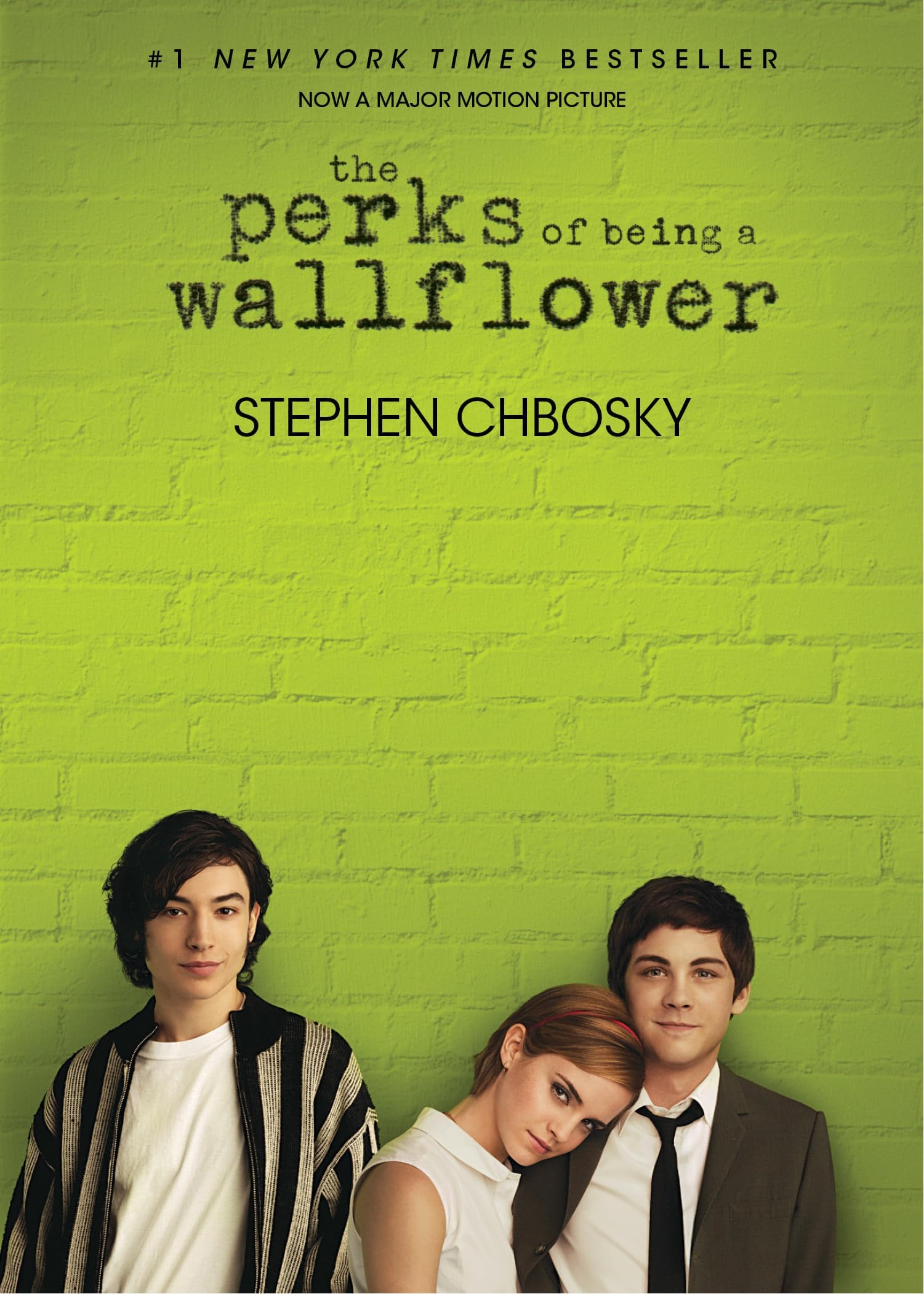
desertcart.com: The Perks of Being a Wallflower: 8601234622277: Chbosky, Stephen: Books Review: Touching and Revealing -- Seeing Our Selves and Our World "More Primarily" through Autism.... - Of course I loved the book. It's so much more than "young-adult combing-of-age". For me, it was deeply moving, an often gripping story, particularly at the end, and it opened a window not just into teenagers, but into life at all stages -- this while being extremely well-written and without calling attention to its well-written-ness. What I found most striking, was showing life through a different kind of mind, what's sometimes called Asperger's Syndrome or High-Functioning Autism. AS/HFA isn't a disease, but an important difference, important to us all. What makes AS/HFA an important difference is its talents, particularly its special "perceptiveness", though not "perceptiveness" in the usual sense. More as a deep meaning to what Robert Burns wrote, "And would some power, the Gods give us, To see ourselves as others see us!" (Know this book deals directly with many painful topics including abuse, suicide and violent bullying. It's not for "more sensitive" readers.) Reading several reviews, I'm not surprised that some reviewers found the lead character, Charlie, "too sweet" and "improbable". In this, understandably, they miss Charlie's "diffferent" mind and more, his "different" way of being. I'm a psychotherapist, specializing for several decades in people for whom therapy has failed, often people, like Charlie, who've been hospitalized. And a dozen years ago, I discovered that maybe a quarter of my clients were in the autism spectrum, almost always AS/HFA -- often highly intelligent and able to relate to the neurotypically-structured social world, though relating "differently" and needing much more conscious struggling with the basics. After working several years with AS/HFA, I found these people had remarkable powers, and the usual "unable to relate or care" descritpion of autism just wasn't true in the ordinary sense. Most were neither uninterested nor uncaring -- in fact, quite the opposite. They desperately wanted to relate and, in some ways, they were over-caring, extremely sensitive to others. They related differently, not only to others, but to themselves and their world and, in particular, to language. Often not badly, but just very differently. Writing in first person gives the author no place to hide. You MUST have an extremely interesting character, and you MUST know that character with ruthless clarity. Chbosky does, and he does so well that I suspect he may have a touch of autism himself. Or at least it runs in his family. Disclosure: after several years working with AS/HFA children, teens and adults, I noticed that I was unusually drawn to them; I could almost use that diagnostically. With that awareness, I figured out that autism runs in my family. And with that, the disease faded away and the differences began to shine through. Let me note a few points from "The Perks" to illustrate. Charlie's speech, thinking and relating, at first blush, seems to be almost child-like, more charcteristic of six years old than sixteen. He has an astonishing honesty, a naive not-understanding, and his use of words frequently has that unintended poetic feel of children. But look more carefully: Yes, there are situations he doesn't get in ways shocking for a middle-teen. But as he thinks about them and questions them, he often goes right to the heart-of-the-matter, and a heart-of-the-matter that's usually missed or forgotten by those of us, especially adults, who "just get it" and go on. Let me give an extended quote from the book's end: "Later, [my friends, Sam and Patrick,] came by in Sam's pickup truck. And we went to the Big Boy just like we always did. Sam told us about her life at school, which sounded very exciting. And I told her about my life in the hospital, which didn't. And Patrick made jokes to keep everyone honest. After we left, we got in Sam's pickup truck, and just like Sam promised, we drove to the tunnel. About half a mile from the tunnel, Sam stopped the car, and I climbed in back. Patrick played the radio really loud so I could hear it, and as we were approaching the tunnel, I listened to the music and thought about all the things that people have said to me over the past year. I thought about Bill telling me I was special. And my sister saying she loved me. And my mom, too. And even my dad and brother when I was in the hospital. I thought about Patrick calling me his friend. And I thought about Sam telling me to do things. To really be there. And I just thought how great it was to have friends and a family...." "But mostly, I was crying because I was suddenly very aware of the fact that it was me standing up in that tunnel with the wind over my face. Not caring if I saw downtown. Not even thinking about it. Because I was standing in the tunnel. And I was really there. And that was enough to make me feel infinite." Starting out, it seems almost primitively black-&-white, until "And Patrick made jokes to keep everyone honest." In the context of all that literal-ness, it's startling. Charlie doesn't just note that "Patrick is telling jokes". Humor is often a struggle for AS/HFA, and so they need to work at understanding it. Through his work, Charlie is seeing not only Patrick's style of humor, but its function. Since AS/HFA often doesn't instinctively grasp "what" to do, they approach others and their world more basically through "why it's done" and "what it means". Because Charlie struggles to see the function of so much, he remains very much in touch with a stripped-down sense of that function's truth. Again, "And Patrick made jokes to keep everyone honest." Then Charlie's "telling" returns to seemingly smple description. But read again: the description is less "simple" than "primary". And in many ways, this is the importance for us in AS/HFA relating. Attention to detail, of what simply "is", is consciously, clearly combined with an almost-primary way of relating to themselves, to others, to their world, as well as a primary relating to language. And when we see ourselves, our world, our lives through Charlie's AS/HFA "primary" lens, we not only see afresh. We see what is "primary", what goes to the heart-of-the-matter, what is the stripped down function, and so what is truly important. Not preachy, but very experiential -- "truly important" very much as-lived. And Charlie winds up poetically pointing to primary experiences, connections and always-available potentials within and around us all: "And that was enough to make me feel infinite". And he got there through self and love and family and friends. Frankly, as a therapist who works most-of-all with severe trauma -- war PTSD, attachment disorders, sexual abuse, and deep grievings -- that's a short list, in those two paragraphs, of what gets lost in trauma and of what it takes to heal. OK, I'm probably probing more than interests most potential readers. As you can see in other reviews, there are many levels to enjoy in this book. If you like, though, let yourself be touched by Charlie's "primary" description-plus-function. You may find it not only intriguging and moving, but healing. And who of us can't use a touch of healing now-and-then? P.S. I read this on Kindle and, even on my laptop, I found it an easy read. It was particularly helpful because, now over 60 years old, I can boost up the print size, making reading more relaxing. Review: If Catcher in the Rye Didn't Hurt My Brain - Today, friends, I must start with a confession: I tried to read The Perks of Being a Wallflower during high school and immediately loathed and DNFed it. As such, I’ve not tried again until 2014, at least ten years after my first attempt. I also went for a format change, because I had a vague memory of the writing being a problem, and switching formats can help with that. It’s funny, because I completely understand why my teen self loathed this book, but I can also appreciate it now and admire what it’s doing on top of enjoying the story. The writing in The Perks of Being a Wallflower probably would have been a struggle for me still, at least at the beginning. There’s a sort of Catcher in the Rye-ness to the book, but, unlike Catcher, there’s personal growth throughout the book. Perks is a full year in Charlie’s life, his freshman year of high school, and he learns a lot during that year. He grows emotionally and intellectually. For this reason, I’d say you should push through, even if you don’t like Charlie or his narration at the outset. In case you do struggle, I highly recommend this audio version narrated by Noah Galvin. Perks is one of those books written in the way that someone talks, and so it lends itself really well to the audio format. Plus, Galvin sounds like he could be 15, which is actually a really difficult thing to find in YA audiobooks. He reads with great emotion too. This was really a perfect book for the audio format. Charlie’s a really great and unique character, something which I couldn’t appreciate back when I tried to read it as a teen. At the time, I read a lot of romance, classics, and various adult fiction. YA wasn’t my thing, and I wasn’t used to reading about teen characters. Plus, Charlie’s a very unusual boy. He’s highly emotional and cries a lot, something I’ve never really done. I didn’t get him back then. Now, though, I’m so glad to see a book about a boy who cries, because our culture teaches guys to repress their feelings, and repression is not healthy. The novel’s all about learning to accept and understand yourself. There were two things I didn’t like about Perks. The first is all the drug use and smoking. Realistic, sure, but also it made me uncomfortable that smoking wasn’t shown in an unflattering light. This is one of the things that I just cannot abide personally. Then there’s Sam. She’s a full-blown Manic Pixie Dream Girl, which is a term I really don’t use often. She’s got very little personality, aside from being fascinating, gorgeous, mysterious, and sexy. I’m pretty positive John Green read this book and was greatly influenced by it. Sam’s character just isn’t interesting to me, and whenever he went on and on about her, I was rolling my eyes. The ending of The Perks of Being a Wallflower threw me for a bit of a loop. It was completely perfect and well-established by the text and at times I even wondered if something like that was coming. Still, the epilogue knocked my feet out from under me. I just am not used to epilogues containing any actual plot. Well, this one does and that plot packs a brutal punch. If you’re the sort of person who cries at books often, the epilogue should be called Sob City. It’s dark and painful, but also inspiring somehow, which is pretty damn impressive. It also brings the journey of the rest of the novel into stark relief. I’m sort of at a loss for what to say about this one without spoilers, so I guess I’ll just exhort you to give this book more of a chance than teen Christina did. This is a YA classic for a reason.
| ASIN | 1451696191 |
| Best Sellers Rank | #2,011 in Books ( See Top 100 in Books ) #1 in Teen & Young Adult Literary Fiction #1 in Teen & Young Adult Coming of Age Fiction #28 in TV, Movie & Game Tie-In Fiction |
| Customer Reviews | 4.6 4.6 out of 5 stars (45,313) |
| Dimensions | 5 x 0.7 x 7 inches |
| Edition | Media Tie-In |
| Grade level | 9 - 12 |
| ISBN-10 | 9781451696196 |
| ISBN-13 | 978-1451696196 |
| Item Weight | 7.2 ounces |
| Language | English |
| Print length | 224 pages |
| Publication date | August 14, 2012 |
| Publisher | MTV Books |
| Reading age | 14+ years, from customers |
D**G
Touching and Revealing -- Seeing Our Selves and Our World "More Primarily" through Autism....
Of course I loved the book. It's so much more than "young-adult combing-of-age". For me, it was deeply moving, an often gripping story, particularly at the end, and it opened a window not just into teenagers, but into life at all stages -- this while being extremely well-written and without calling attention to its well-written-ness. What I found most striking, was showing life through a different kind of mind, what's sometimes called Asperger's Syndrome or High-Functioning Autism. AS/HFA isn't a disease, but an important difference, important to us all. What makes AS/HFA an important difference is its talents, particularly its special "perceptiveness", though not "perceptiveness" in the usual sense. More as a deep meaning to what Robert Burns wrote, "And would some power, the Gods give us, To see ourselves as others see us!" (Know this book deals directly with many painful topics including abuse, suicide and violent bullying. It's not for "more sensitive" readers.) Reading several reviews, I'm not surprised that some reviewers found the lead character, Charlie, "too sweet" and "improbable". In this, understandably, they miss Charlie's "diffferent" mind and more, his "different" way of being. I'm a psychotherapist, specializing for several decades in people for whom therapy has failed, often people, like Charlie, who've been hospitalized. And a dozen years ago, I discovered that maybe a quarter of my clients were in the autism spectrum, almost always AS/HFA -- often highly intelligent and able to relate to the neurotypically-structured social world, though relating "differently" and needing much more conscious struggling with the basics. After working several years with AS/HFA, I found these people had remarkable powers, and the usual "unable to relate or care" descritpion of autism just wasn't true in the ordinary sense. Most were neither uninterested nor uncaring -- in fact, quite the opposite. They desperately wanted to relate and, in some ways, they were over-caring, extremely sensitive to others. They related differently, not only to others, but to themselves and their world and, in particular, to language. Often not badly, but just very differently. Writing in first person gives the author no place to hide. You MUST have an extremely interesting character, and you MUST know that character with ruthless clarity. Chbosky does, and he does so well that I suspect he may have a touch of autism himself. Or at least it runs in his family. Disclosure: after several years working with AS/HFA children, teens and adults, I noticed that I was unusually drawn to them; I could almost use that diagnostically. With that awareness, I figured out that autism runs in my family. And with that, the disease faded away and the differences began to shine through. Let me note a few points from "The Perks" to illustrate. Charlie's speech, thinking and relating, at first blush, seems to be almost child-like, more charcteristic of six years old than sixteen. He has an astonishing honesty, a naive not-understanding, and his use of words frequently has that unintended poetic feel of children. But look more carefully: Yes, there are situations he doesn't get in ways shocking for a middle-teen. But as he thinks about them and questions them, he often goes right to the heart-of-the-matter, and a heart-of-the-matter that's usually missed or forgotten by those of us, especially adults, who "just get it" and go on. Let me give an extended quote from the book's end: "Later, [my friends, Sam and Patrick,] came by in Sam's pickup truck. And we went to the Big Boy just like we always did. Sam told us about her life at school, which sounded very exciting. And I told her about my life in the hospital, which didn't. And Patrick made jokes to keep everyone honest. After we left, we got in Sam's pickup truck, and just like Sam promised, we drove to the tunnel. About half a mile from the tunnel, Sam stopped the car, and I climbed in back. Patrick played the radio really loud so I could hear it, and as we were approaching the tunnel, I listened to the music and thought about all the things that people have said to me over the past year. I thought about Bill telling me I was special. And my sister saying she loved me. And my mom, too. And even my dad and brother when I was in the hospital. I thought about Patrick calling me his friend. And I thought about Sam telling me to do things. To really be there. And I just thought how great it was to have friends and a family...." "But mostly, I was crying because I was suddenly very aware of the fact that it was me standing up in that tunnel with the wind over my face. Not caring if I saw downtown. Not even thinking about it. Because I was standing in the tunnel. And I was really there. And that was enough to make me feel infinite." Starting out, it seems almost primitively black-&-white, until "And Patrick made jokes to keep everyone honest." In the context of all that literal-ness, it's startling. Charlie doesn't just note that "Patrick is telling jokes". Humor is often a struggle for AS/HFA, and so they need to work at understanding it. Through his work, Charlie is seeing not only Patrick's style of humor, but its function. Since AS/HFA often doesn't instinctively grasp "what" to do, they approach others and their world more basically through "why it's done" and "what it means". Because Charlie struggles to see the function of so much, he remains very much in touch with a stripped-down sense of that function's truth. Again, "And Patrick made jokes to keep everyone honest." Then Charlie's "telling" returns to seemingly smple description. But read again: the description is less "simple" than "primary". And in many ways, this is the importance for us in AS/HFA relating. Attention to detail, of what simply "is", is consciously, clearly combined with an almost-primary way of relating to themselves, to others, to their world, as well as a primary relating to language. And when we see ourselves, our world, our lives through Charlie's AS/HFA "primary" lens, we not only see afresh. We see what is "primary", what goes to the heart-of-the-matter, what is the stripped down function, and so what is truly important. Not preachy, but very experiential -- "truly important" very much as-lived. And Charlie winds up poetically pointing to primary experiences, connections and always-available potentials within and around us all: "And that was enough to make me feel infinite". And he got there through self and love and family and friends. Frankly, as a therapist who works most-of-all with severe trauma -- war PTSD, attachment disorders, sexual abuse, and deep grievings -- that's a short list, in those two paragraphs, of what gets lost in trauma and of what it takes to heal. OK, I'm probably probing more than interests most potential readers. As you can see in other reviews, there are many levels to enjoy in this book. If you like, though, let yourself be touched by Charlie's "primary" description-plus-function. You may find it not only intriguging and moving, but healing. And who of us can't use a touch of healing now-and-then? P.S. I read this on Kindle and, even on my laptop, I found it an easy read. It was particularly helpful because, now over 60 years old, I can boost up the print size, making reading more relaxing.
C**)
If Catcher in the Rye Didn't Hurt My Brain
Today, friends, I must start with a confession: I tried to read The Perks of Being a Wallflower during high school and immediately loathed and DNFed it. As such, I’ve not tried again until 2014, at least ten years after my first attempt. I also went for a format change, because I had a vague memory of the writing being a problem, and switching formats can help with that. It’s funny, because I completely understand why my teen self loathed this book, but I can also appreciate it now and admire what it’s doing on top of enjoying the story. The writing in The Perks of Being a Wallflower probably would have been a struggle for me still, at least at the beginning. There’s a sort of Catcher in the Rye-ness to the book, but, unlike Catcher, there’s personal growth throughout the book. Perks is a full year in Charlie’s life, his freshman year of high school, and he learns a lot during that year. He grows emotionally and intellectually. For this reason, I’d say you should push through, even if you don’t like Charlie or his narration at the outset. In case you do struggle, I highly recommend this audio version narrated by Noah Galvin. Perks is one of those books written in the way that someone talks, and so it lends itself really well to the audio format. Plus, Galvin sounds like he could be 15, which is actually a really difficult thing to find in YA audiobooks. He reads with great emotion too. This was really a perfect book for the audio format. Charlie’s a really great and unique character, something which I couldn’t appreciate back when I tried to read it as a teen. At the time, I read a lot of romance, classics, and various adult fiction. YA wasn’t my thing, and I wasn’t used to reading about teen characters. Plus, Charlie’s a very unusual boy. He’s highly emotional and cries a lot, something I’ve never really done. I didn’t get him back then. Now, though, I’m so glad to see a book about a boy who cries, because our culture teaches guys to repress their feelings, and repression is not healthy. The novel’s all about learning to accept and understand yourself. There were two things I didn’t like about Perks. The first is all the drug use and smoking. Realistic, sure, but also it made me uncomfortable that smoking wasn’t shown in an unflattering light. This is one of the things that I just cannot abide personally. Then there’s Sam. She’s a full-blown Manic Pixie Dream Girl, which is a term I really don’t use often. She’s got very little personality, aside from being fascinating, gorgeous, mysterious, and sexy. I’m pretty positive John Green read this book and was greatly influenced by it. Sam’s character just isn’t interesting to me, and whenever he went on and on about her, I was rolling my eyes. The ending of The Perks of Being a Wallflower threw me for a bit of a loop. It was completely perfect and well-established by the text and at times I even wondered if something like that was coming. Still, the epilogue knocked my feet out from under me. I just am not used to epilogues containing any actual plot. Well, this one does and that plot packs a brutal punch. If you’re the sort of person who cries at books often, the epilogue should be called Sob City. It’s dark and painful, but also inspiring somehow, which is pretty damn impressive. It also brings the journey of the rest of the novel into stark relief. I’m sort of at a loss for what to say about this one without spoilers, so I guess I’ll just exhort you to give this book more of a chance than teen Christina did. This is a YA classic for a reason.
R**Y
It's better than the movies to be honest.
M**S
The product came in perfect condition in the estimated date. The story is short but really enjoyable and deals with taboo topics in a way that your heart will be touched really easily. Also if you have watched the movie sure you'll like much more the book.
K**T
Reread after a long time. The story of Charlie stays timeless and hope-instilling ever after. Funny, dark, emotional, sad, it has it all. Love always!
C**N
ottimo
E**O
Livro maravilhoso, e veio em ótimo estado de conservação
Trustpilot
4 days ago
1 week ago