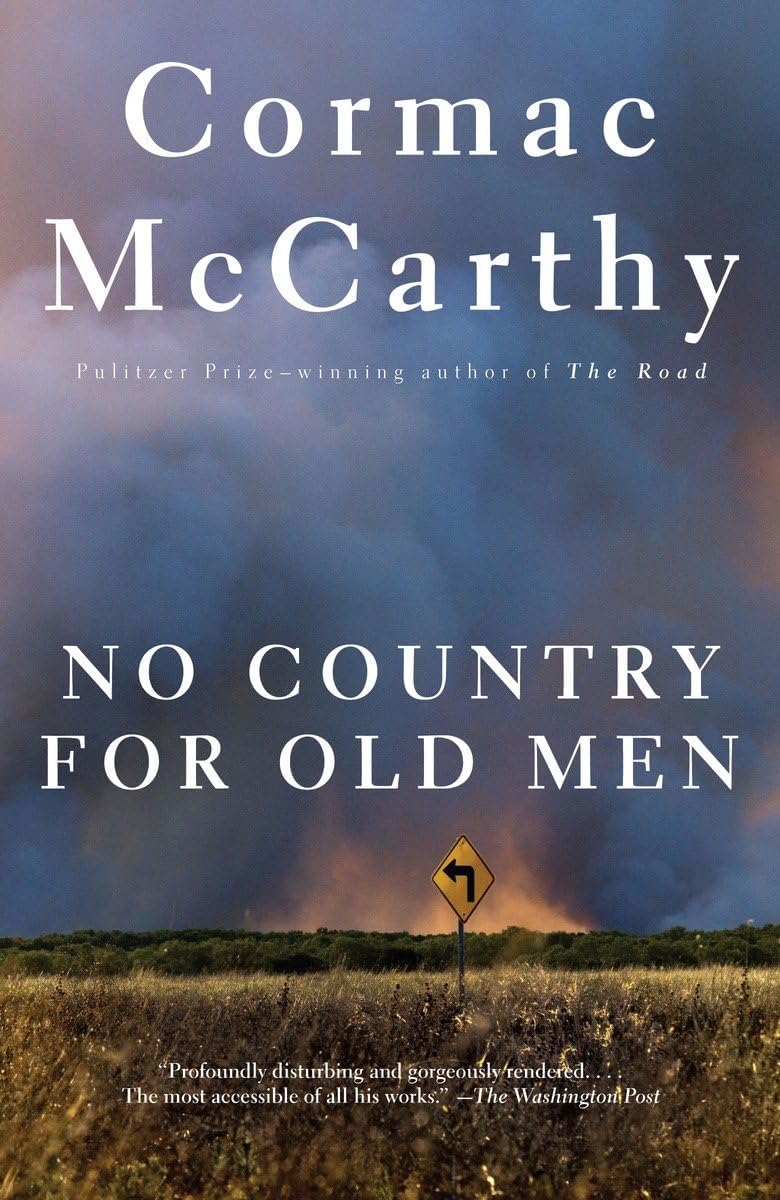
No Country for Old Men (Vintage International)
Product ID: 16813287
Buy anything from 5,000+ international stores. One checkout price. No surprise fees. Join 2M+ shoppers on Desertcart.
Desertcart purchases this item on your behalf and handles shipping, customs, and support to Kyrgyzstan.
From the bestselling author of The Passenger and the Pulitzer Prize–winning novel The Road comes a "profoundly disturbing and gorgeously rendered" novel ( The Washington Post ) that returns to the Texas-Mexico border, setting of the famed Border Trilogy . The time is our own, when rustlers have given way to drug-runners and small towns have become free-fire zones. One day, a good old boy named Llewellyn Moss finds a pickup truck surrounded by a bodyguard of dead men. A load of heroin and two million dollars in cash are still in the back. When Moss takes the money, he sets off a chain reaction of catastrophic violence that not even the law—in the person of aging, disillusioned Sheriff Bell—can contain. As Moss tries to evade his pursuers—in particular a mysterious mastermind who flips coins for human lives—McCarthy simultaneously strips down the American crime novel and broadens its concerns to encompass themes as ancient as the Bible and as bloodily contemporary as this morning’s headlines. No Country for Old Men is a triumph. Review: A Man Could Lose His Soul... - Man finds lots of money. Man runs, is pursued. Many casualties ensue. I came to McCarthy by way of The Road (Oprah's Book Club) , which was one of the most profoundly moving things I've read in fifteen years; I find myself thinking of that book and its setting, questions and issues almost daily. Through it I became aware of McCarthy's other work, and was eager to get to it. Then came the Coen brothers' brilliant No Country for Old Men , and I had to move this up in the reading queue. I did save the film until after I was done with the book, and I'm glad I did; this is better. As in The Road, there are many unanswered questions about aspects of the story off the main narrative line--who did what, where characters and events came from, where they go, what happens next, etc. They are tantalizing, an aspect I have found that keeps McCarthy's work in my head, sorting through the unexplained, wondering in which way these superfluous stories could have gone. They are a great hook, providing tangential snippets of context to a circuitous, unpredictable yet headlong single story line. This story is deceptive, beginning as a very west Texas noir tale of adventure. I was reminded of James Dickey's magnificent DELIVERANCE (BLOOMSBURY FILM CLASSICS S.) . But while Deliverance was Dickey's rumination on what exactly it means to be a man in the age of the office job, Lay Z Boy recliners and strip malls, McCarthy posits a much more simple question: are you ready to be a man when the time comes? When Life--with that capital L--comes at you and delivers unbidden the horrific, tragic or sublimely blissful, will you be ready? Can you make yourself ready; is there any way to prepare? And if you think you're ready, are you really? McCarthy asks: what have you done, and in the same breath, what have you not done? What have you overlooked, and what--this is crucial--happens to you and others depending on how ready you are? What are you prepared to do? How far will you go? Being ready means being prepared to act instantly, outside of cultural and societal norms, against your upbringing and your education, at the most basic level, not unthinkingly, but unflinchingly and uncompromisingly. Can you strip it all away, and if you do what does that make you? Can you come back? This is where a man can lose his soul. Both The Road and this work make it clear that there is a point where a man chooses to keep or forfeit his humanity, his dignity, when he chooses decency over barbarism. McCarthy's exploration shows that when the choice--made consciously--is for dignity and righteousness, ultimately it is self-destructive. McCarthy's work has a place for those who hold on to that uniquely human core of decency, who see what really needs to be done, the ugly and brutal which may need to be done for survival, and in essence condemn themselves, usually wittingly, by remaining true to decency and the care/service of others. Death is coming for us all, only a matter of time, so why not take a stand and choose your time and place, and do it with a self-determined honor, with a clean slate? There may be a reckoning--that's really as far as I see McCarthy going down that road of Good v. Evil, God v. Satan--but if there is, these decisions will tip that scale, and for those that remain behind you live on as an example of the right choice. The book's style is sparse, matching the desert and scrubland the story inhabits. McCarthy's narrative convention of not using quotations is here, but is neither a distraction nor does it lend to confusion. The narrative structure is essentially cinematic, with the sheriff-narrator providing a voiceover context, the real depth of the story, and the chapters often moving in parallel. The dialog flows as easily and effortlessly as Elmore Leonard's best, and there is no question as to what is happening in the narrative. Surprisingly, the "action," the main story, was done well before the book was. The bulk of the book and the story of money, guns and blood exists as the extended setup for one man's rumination on life's purpose, the existence of God, and what it means to be true to yourself, those you love, and those you serve. This is the last 40-odd pages of the book, and where the deepest contemplation lies. There is a lot going on here, with a lot of to my reading earnest exploration of a man's purpose, his honor, his character, and ultimately his identity. Is God out there? And if he is, and if he's the kind of guy we've all been told he is, how is it that life plays out in these ways? Bottom line: This is no happy, light and frothy, stereotypically inane TV-style read of a luckless loner who makes good after some minor tribulation. The story is stark and dark, violent and unflinching, just as life is. McCarthy poses a pessimistic vision of where we are and where we are headed, and explores whether the noble choice of decency and selflessness is tenable, even though it seems to be suicidal. Review: A haunting read that takes you in and never let's go... - When I first read `The Road' I was astounded at how much of an emotional impact it had on me. It made me think about things I never expected it to and made me care in a way I wasn't used to. It made me realize that I needed to read everything Cormac McCarthy had written and fast. Sadly, I didn't act upon that instinct quick enough. In fact I just picked up `No Country for Old Men' the other day to sit down a give it a try; but I didn't have to try. In fact `No Country for Old Men' is the easiest read I've ever encountered. I didn't put the book down, not once, and read it in one straight sitting. It's a good thing I had nothing to do Saturday because when you stay up all night to read a novel you end up useless the next day. `No Country for Old Men' has a lot going for it. McCarthy's writing style is easy to adapt to. He writes in a fashion that's easy to understand, not to wordy, not overly descriptive yet he never fails to leave the reader without a sound sense of what is taking place. One thing I fell in love with was the way he adapted his writing style to the people and places he was introducing. The novel takes place in the dusty plains of Texas and so the sentence structure is that of a Texan, incomplete and grammatically incorrect. This is not an insult; I live in Texas, I know how they talk. It's funny because I read some of this novel aloud to my daughter (not the bloody parts) and my wife noticed that I read in a deep southern accent. The wording is so absorbing you start thinking in a drawl. That, my friends, is impressive. Cormac's masterpiece follows a few characters whose lives interconnect thanks to some drug money and an unfortunate decision. Llewelyn Moss is a simple man, a war (Vietnam) vet who lives a simple life with his young wife Carla Jean. His life gets plenty complicated when he stumbles upon some dead bodies and a case full of cash. He takes the money and runs, but soon realizes that he can't stop running; he's being hunted by two parties, both after the money. Psychopathic killer Anton Chigurh is hot on Moss' tail, breathing down his neck so-to-speak, while Sheriff Bell is desperately trying to locate Moss before it is too late. Caught in the middle of it all is Moss' wife, an emotionally moving casualty of this `war'. Each chapter of `No Country for Old Men' is opened with Sheriff Bell's thoughts on the current state of affairs. As the body count rises and the reasoning behind it all fades into a dark blur he contemplates why things have gotten so bad. He reasons on the way things were growing up and how much worse they have gotten and he sheds so much light on the purpose behind these pages. He comes to the realization that he is just too old for this; that his morals are so different from the morals crowding society today and that to try and understand it will only drag you down. He realizes first hand that this is no country for old men. Each character though adds layers to McCarthy's prose, not just Bell. One profound character is that of Chigurh whose sense of justice and loyalty is tainted by his savage lust for blood. The dialog within this novel is so strong in it's subtlety that it carries his characters to levels beyond them. When Anton first explains the significance of his coin toss we are captivated by his logic; and his final, devastating scene with Moss' wife Carla Jean we are moved so deeply by the entire encounter. Scenes of these conversations permeate the novel and take on lives of their own. A particular scene with Llewelyn and a young hitchhiker bring similar feelings of warmth and sympathy. Each blood-soaked page leads us to a further understanding of Cormac's message and as the novel comes to a dramatic close we feel as though we can relate to Bell and his longer for yesteryear. Times have certainly changed and definitely not for the better. Soon, very soon, this will be no country for young men, for any man for that matter. Soon, very soon, all hope will be lost.

| Best Sellers Rank | #2,430 in Books ( See Top 100 in Books ) #23 in Westerns (Books) #27 in Contemporary Literature & Fiction #215 in Literary Fiction (Books) |
| Customer Reviews | 4.5 out of 5 stars 15,279 Reviews |
S**R
A Man Could Lose His Soul...
Man finds lots of money. Man runs, is pursued. Many casualties ensue. I came to McCarthy by way of The Road (Oprah's Book Club) , which was one of the most profoundly moving things I've read in fifteen years; I find myself thinking of that book and its setting, questions and issues almost daily. Through it I became aware of McCarthy's other work, and was eager to get to it. Then came the Coen brothers' brilliant No Country for Old Men , and I had to move this up in the reading queue. I did save the film until after I was done with the book, and I'm glad I did; this is better. As in The Road, there are many unanswered questions about aspects of the story off the main narrative line--who did what, where characters and events came from, where they go, what happens next, etc. They are tantalizing, an aspect I have found that keeps McCarthy's work in my head, sorting through the unexplained, wondering in which way these superfluous stories could have gone. They are a great hook, providing tangential snippets of context to a circuitous, unpredictable yet headlong single story line. This story is deceptive, beginning as a very west Texas noir tale of adventure. I was reminded of James Dickey's magnificent DELIVERANCE (BLOOMSBURY FILM CLASSICS S.) . But while Deliverance was Dickey's rumination on what exactly it means to be a man in the age of the office job, Lay Z Boy recliners and strip malls, McCarthy posits a much more simple question: are you ready to be a man when the time comes? When Life--with that capital L--comes at you and delivers unbidden the horrific, tragic or sublimely blissful, will you be ready? Can you make yourself ready; is there any way to prepare? And if you think you're ready, are you really? McCarthy asks: what have you done, and in the same breath, what have you not done? What have you overlooked, and what--this is crucial--happens to you and others depending on how ready you are? What are you prepared to do? How far will you go? Being ready means being prepared to act instantly, outside of cultural and societal norms, against your upbringing and your education, at the most basic level, not unthinkingly, but unflinchingly and uncompromisingly. Can you strip it all away, and if you do what does that make you? Can you come back? This is where a man can lose his soul. Both The Road and this work make it clear that there is a point where a man chooses to keep or forfeit his humanity, his dignity, when he chooses decency over barbarism. McCarthy's exploration shows that when the choice--made consciously--is for dignity and righteousness, ultimately it is self-destructive. McCarthy's work has a place for those who hold on to that uniquely human core of decency, who see what really needs to be done, the ugly and brutal which may need to be done for survival, and in essence condemn themselves, usually wittingly, by remaining true to decency and the care/service of others. Death is coming for us all, only a matter of time, so why not take a stand and choose your time and place, and do it with a self-determined honor, with a clean slate? There may be a reckoning--that's really as far as I see McCarthy going down that road of Good v. Evil, God v. Satan--but if there is, these decisions will tip that scale, and for those that remain behind you live on as an example of the right choice. The book's style is sparse, matching the desert and scrubland the story inhabits. McCarthy's narrative convention of not using quotations is here, but is neither a distraction nor does it lend to confusion. The narrative structure is essentially cinematic, with the sheriff-narrator providing a voiceover context, the real depth of the story, and the chapters often moving in parallel. The dialog flows as easily and effortlessly as Elmore Leonard's best, and there is no question as to what is happening in the narrative. Surprisingly, the "action," the main story, was done well before the book was. The bulk of the book and the story of money, guns and blood exists as the extended setup for one man's rumination on life's purpose, the existence of God, and what it means to be true to yourself, those you love, and those you serve. This is the last 40-odd pages of the book, and where the deepest contemplation lies. There is a lot going on here, with a lot of to my reading earnest exploration of a man's purpose, his honor, his character, and ultimately his identity. Is God out there? And if he is, and if he's the kind of guy we've all been told he is, how is it that life plays out in these ways? Bottom line: This is no happy, light and frothy, stereotypically inane TV-style read of a luckless loner who makes good after some minor tribulation. The story is stark and dark, violent and unflinching, just as life is. McCarthy poses a pessimistic vision of where we are and where we are headed, and explores whether the noble choice of decency and selflessness is tenable, even though it seems to be suicidal.
A**N
A haunting read that takes you in and never let's go...
When I first read `The Road' I was astounded at how much of an emotional impact it had on me. It made me think about things I never expected it to and made me care in a way I wasn't used to. It made me realize that I needed to read everything Cormac McCarthy had written and fast. Sadly, I didn't act upon that instinct quick enough. In fact I just picked up `No Country for Old Men' the other day to sit down a give it a try; but I didn't have to try. In fact `No Country for Old Men' is the easiest read I've ever encountered. I didn't put the book down, not once, and read it in one straight sitting. It's a good thing I had nothing to do Saturday because when you stay up all night to read a novel you end up useless the next day. `No Country for Old Men' has a lot going for it. McCarthy's writing style is easy to adapt to. He writes in a fashion that's easy to understand, not to wordy, not overly descriptive yet he never fails to leave the reader without a sound sense of what is taking place. One thing I fell in love with was the way he adapted his writing style to the people and places he was introducing. The novel takes place in the dusty plains of Texas and so the sentence structure is that of a Texan, incomplete and grammatically incorrect. This is not an insult; I live in Texas, I know how they talk. It's funny because I read some of this novel aloud to my daughter (not the bloody parts) and my wife noticed that I read in a deep southern accent. The wording is so absorbing you start thinking in a drawl. That, my friends, is impressive. Cormac's masterpiece follows a few characters whose lives interconnect thanks to some drug money and an unfortunate decision. Llewelyn Moss is a simple man, a war (Vietnam) vet who lives a simple life with his young wife Carla Jean. His life gets plenty complicated when he stumbles upon some dead bodies and a case full of cash. He takes the money and runs, but soon realizes that he can't stop running; he's being hunted by two parties, both after the money. Psychopathic killer Anton Chigurh is hot on Moss' tail, breathing down his neck so-to-speak, while Sheriff Bell is desperately trying to locate Moss before it is too late. Caught in the middle of it all is Moss' wife, an emotionally moving casualty of this `war'. Each chapter of `No Country for Old Men' is opened with Sheriff Bell's thoughts on the current state of affairs. As the body count rises and the reasoning behind it all fades into a dark blur he contemplates why things have gotten so bad. He reasons on the way things were growing up and how much worse they have gotten and he sheds so much light on the purpose behind these pages. He comes to the realization that he is just too old for this; that his morals are so different from the morals crowding society today and that to try and understand it will only drag you down. He realizes first hand that this is no country for old men. Each character though adds layers to McCarthy's prose, not just Bell. One profound character is that of Chigurh whose sense of justice and loyalty is tainted by his savage lust for blood. The dialog within this novel is so strong in it's subtlety that it carries his characters to levels beyond them. When Anton first explains the significance of his coin toss we are captivated by his logic; and his final, devastating scene with Moss' wife Carla Jean we are moved so deeply by the entire encounter. Scenes of these conversations permeate the novel and take on lives of their own. A particular scene with Llewelyn and a young hitchhiker bring similar feelings of warmth and sympathy. Each blood-soaked page leads us to a further understanding of Cormac's message and as the novel comes to a dramatic close we feel as though we can relate to Bell and his longer for yesteryear. Times have certainly changed and definitely not for the better. Soon, very soon, this will be no country for young men, for any man for that matter. Soon, very soon, all hope will be lost.
W**Y
Good Story If You Can Get Past the Writing Style
Story about an older sheriff, trying to solve a case of murder in the southern desert of Texas. Pretty much the title refers to how things had changed in the U.S. for the older sheriff and the older folks who comes in contact with. He deals with this unsolved case where dope money is stolen from a deal gone bad in the back desert country where several folks are dead. The other is the story of the local guy, a Vietnam Vet, who was out hunting and came upon this scene first, found everyone dead or dying, and then too the money. What ensues is a socialpath killer, Chigurh, hunting him down from as far away as Eagle Pass, Texas to near El Paso. Chigurh is what makes the book good, and more readable. The harder part of the read was the lack of quotations that McCarthy uses, which is intentional. At times, had to re-read sections to figure out who was talking. Also looked up when this was supposed to have taken place, and it was 1980. If you don't like violence, avoid this book. Every couple of chapters, Sheriff Bell, has a section italicized where is posting his own thoughts, like a diary. Had seen the movie first, and it was easier to visualize them while reading the book and hearing there voices.
D**T
No Country for Old Women Either!
This is one of McCarthy's more accessible novels and I enjoyed it immensely. It is an easy read, but don't let the facile writing fool you. While it sounds like good `ole boys in Texas exchanging relics of bygone colloquialisms, it's so much more. This is a book of great depth that needs to be read in blocks and thought about, maybe reread and then analyzed by the reader as to the true meaning of the message. At first, I found the title odd but as I completed the book, it made so much sense and I could relate so well to the way Bell was feeling. Some times in his line of work, it's just time to retire. It didn't make him a quitter, just a realist. He'd served his time and he'd done it well. But, now, it's time to move over and let a different type of soldier step to the frontline. It takes a real man to know when his time at bat is over. This is definitely a profoundly disturbing book, and one whose message will resonate with many and stay with the reader for a long time. It's a book you'll want to loan out but that you won't want to let it out of your permanent library; for the lessons are ones that we need to go back to again and again when life gets confusing and the bad guys seems to be winning. This is definitely got the devil in it, but it has many good guys, some who lose their lives because they didn't stop to consider what they are getting themselves and their families into. Is Chigurh the devil? You bet! And how many more are right there to take his place should he be eliminated? And how many stand shoulder to shoulder with him, as there is ample room for many Chugurhs'? I love the way McCarthy inhabits his characters and makes you care about them. You'll hate them, love them, try to understand them, maybe even want to kill them; but you won't come away untouched. You may wonder why some of his characters would take such outrageous chances or maybe you'd do the same, so you'll root for them to succeed, like Moss, and you'll wonder why he had to die and why the book didn't conclude with all the loose ends nicely tied in a bow and the good guys ahead. But, this book is about the way it really is, not the way we'd like it to be, so strap on your step belt, this ride is hell on wheels--riveting, and it will get you by the jugular and it won't let go even after you've finished the last page. At least that how it affected me! The sense of place was also deeply engrained in this story. I felt as though I could breath the dust and smell the blood. Its tough and violent writing and anyone who can remain untouched must not inhabit this world. And, for me the central message was that we may have come so far that (without God) we are damaged beyond repair--for there is a certain depravity in our world, whether it lurks on the horizon of the small towns, or plays a central role in the everyday life of the cities--it cannot be denied. Can't wait to read the next McCarthy. I highly recommend "No Country For Old Men." If you'd like to get your blood coursing through your body, it will not leave you unaffected.
S**S
Strong and Powerful Medicine, Almost Too Chilling to Put Down
One hundred and fifteen reviews at the time I write this one, including one written in mock-Cormac McCarthy voice, and it is clear that people either love or hate this book. Put me in the love category - this is a brilliant and unforgettable work. NO COUNTRY FOR OLD MEN breaks McCarthy's mold, moving at a fast pace with relatively little description, a lot less lyricism, and minimalist dialog whose pitch and tone creates an atmosphere all its own. In fact, McCarthy's dialog here creates the scenery. Who needs mountains and trees and rivers and hawks and wolves and horses when we have these sparse but rich voices? Those who criticize this book for its violence miss the point - America was founded and conquered by violence, leads the world in gun ownership and deaths from guns, spawns Columbines and drive-by shootings, and imposes its military might more freely on others than any other country in the world. Through his stories, McCarthy explodes the myth of a benign, peaceful and peace-loving America. We are all of us just a random coin flip away from a BTK killer or a Jeffrey Dahmer, a Columbine, or a drug deal gone sour that leaves innocent bystanders dead in its wake. The title, NO COUNTRY FOR OLD MEN, is a gorgeous double entendre about the story's contents - the setting of the book is no place for old men to live and work any more (witness Sheriff Bell's fear of the psychopathic killer, Chigurh), and it has become a place in which few old men remain alive. They are all too busy being killed off in their relative youth. As for the main characters, Anton Chigurh comes close to being one of the scariest creatures ever described in fiction. Utterly amoral, his curious breed of ethics consists of being true to his word and honest with respect to his clients' dealings. He would never take an unearned cent, yet he thinks nothing of blowing a steel bolt through the forehead of anyone who gets in his way (or who might remember him). He wreaks havoc through south Texas and yet remains virtually invisible - almost no one who could describe him is still alive. Although he appears to be named for a "chigger" - a parasitic larva found in the southwest that sucks the blood of humans - his bite is far worse. He is Death itself, minus the black hooded cloak and the long-handled scythe. Is there anyone who doesn't believe deep inside that there are more Chigurh's (or near-Chigurh's) among us? It is through his faint-hearted pursuit of Chigurh that Sheriff Bell confronts his own fears and demons. Bell's meditations, short chapters presented entirely in italics, function almost like seeing his life flash before his eyes at the moment of death. He contemplates his love and life with his wife Loretta, his cowardly behavior at his moment of truth in World War II, and his ineffectualness in protecting the citizens of his county when the time came that they truly needed him. I have read every one of McCarthy's books and loved all but the most recent of them. NO COUNTRY FOR OLD MEN is clearly not the novel many readers expected of Cormac McCarthy, but frankly, I'm happy it's not another CROSSING or CITIES OF THE PLAIN. Beside, where does it say that he has to keep rewriting BLOOD MERIDIAN or ALL THE PRETTY HORSES? This is a fascinating read, at once a bloody crime thriller, a meditation on chance and random violence in American society, and an exploration of what makes for a life well-lived. Read it for what McCarthy gives us, not for what you bring to it in the way of expectations or preconceptions. The story is strong medicine, but nothing else seems to work any more. After you finish, listen to the song "If It Were Up to Me," by Cheryl Wheeler. It offers an interesting accompaniment to this book.
J**S
A remarkable MRI of America--truth not ny times
I am one of the few of who red C.M. back in the 60's. That such a literary phenomenen could escape the radar screen of critcs and academics who were mesmerized by John Barth, T. Pynchon, Bellow etc. shows all of us that true talent, whether Beckett or Pound, is eschewed by politically correct professors et al. who have been with us for much longer than we realize. P.C. critics did not recognize his first three novels because they are, sad to say, more interested in p.c. correct authors. Sutree is a great novel, up there with The Great Gatsby and Huck Finn. I read many reviews these days who compare McCarthy with Faulkner and Hemingway. Faulkner is in a few of his novels an outstanding author: e.g. Light in August, Absalom, Absalom and to a certain extent, The Sound and the Fury( which gets A for effort but C for accomplishment). Hemingway is a good writer celebrated because he is accessible. Joyce, anyone. Has anyone read Beckett? Of course not. Updike writes well but does he have anything to say: NO. Everyone of McCarthy's novels is very good to great. But Hemingway--has any author been more overrated? He is the Southey of our time. Another factor is televison and movies--this dulled the critics'and academics' senses so that they thought Jaws and The Godfather were "great" movies---they may be, but reading critics inevitably lost all moorings, and believed that Pauline Kael was the great critic from 1950 to the present. They used her wildly erratic criteria, to analyzes novels, plays,etc. Speaking of plays: would anyone in his right mind trade any of McCarthy's novels for any of Albee's plays. Of course not. There are not Ben Jonsons in our time--we are left with critics such as Richard Eder (writing in the L.A Times) who criticized All the Pretty Horses because the Spanish was not right. His review of All the Pretty... should be studied as the way the left deals with an individual author who doesn't lionize Mexicans and makes a 16 year old white boy the unalloyed hero, who goes deep in Mexico and is able to break horses that Mexican can not. OH my god!!! As for his most recent book it, in my opininion, speaks plainly to our times. C.M. avoids illegal immigration and uses a drug deal gone awry to show us how bad people do triumph (remember Stalin or Hitler--yes they lost eventually, but what carnage they left in their wake). C.M. is saying that Sheriff Bell is only accepting REALITY. The outlaws, the miscreants, the evil ones (yes, there is evil) are not only becoming dominant, but the good ones like the Sheriff are helpless to stop them. Think 9/ll, British transport, Spanish train, Iran, N. Korea, China(flying below the radar because big business makes tons of moolah). Today we have drugs innudating our country--but what drug does C.M. choose to focus on: cheap, diluted Mexican Heroin. We live in cheapened times, where crystal meth is the fastest growing drug in America. While the Fed. government, spends billions to supposedly interdict foreign drug imports, right here in our own back yard drugs are made, sold and used. How much money does the gov't spend on cheap heroin from Mexico (almost none, because to do so would be politically incorrect or meth manufactured ubiquitously in the U.S.? virtually nil. Better to keep the sheep population of America worried about cocaine from Columbia and heroin from Afghanistan. MCarthy's book is both truth and a parable. Chirgurrah is real and we may not be in danger of gun shots in the forehead, but we are in danger of devauling life, so that murderers are celebrated (thing Dead Man Walking) and death is a celebrity (o.j., peterson etc.). Americans can't come home and read Shakespeare or Keats, because, like Meth., t.v. and dvds it is easier to addict to cheap thrills, reaching its nadir in reality t.v. The L.A. Times, the New York times couldn't thrash Old Men, but their degraded politics made it impossible for them to praise this novel which reveals so much about what we are willing to tolerate, unless the heartless killer hits us (he wont,will he?). He doesn't have to kill us physically,because our souls are already rotting and most are dead. Read the book. It's easy. Read it again and try to find a Hugh Kenner to explain it to you. "
M**D
An Absorbing Read with Compelling Characters
I got into Cormac McCarthy after having my mind blown by the movie adaptation of No Country, and it remains my favorite of his books. Perhaps it's the juxtaposition of McCarthy's preferred vintage Western setting with a new kind of evil that makes this novel work so well, and maybe it's the absolutely awesome villain that McCarthy's rugged and rowdy good ole boys have serious trouble out-thinking. Most people either love or hate McCarthy's abandonment of punctuation and his run-on sentences. I'm somewhere in the middle on it. This novel would gain a lot from breaking up some long descriptions of actions strung together by "and...and...and...", and from clearing up some pointlessly confusing pronouns (such as two male characters struggling and both being referred to only as "he", which obfuscates the action), and from adding some dialogue tags to throw readers a bone about who is talking in lengthy conversations. There's a reason we punctuate: clarity and ease of reading. I've read this novel twice, and it's one of the rare cases where I prefer the movie to the book. The movie cut out or shortened some conversations and cut out a good chunk of scenes from the book's ending, and those were solid choices that improved the narrative's momentum. In the novel, I felt like we spent a little too much time hanging around after the main story was over. Still, this novel thoroughly absorbed me into the conflict between Llewelyn Moss and Anton Chigurh, kept the tension high throughout the story, and impressed with detailed prose that is at once both simply direct and poetic. Though I have some problems with the style, I also found a lot to emulate and learn from as a writer.
G**N
Stark, Stylish, and Sometimes Stuck in Its Own Shadows
Cormac McCarthy’s No Country for Old Men is undeniably gripping, written in his trademark sparse prose and built around a tense cat-and-mouse pursuit. The atmosphere is bleak, the violence is abrupt, and the moral decay at the heart of the story is unmistakable. When the novel is firing on all cylinders, it’s as sharp and relentless as Anton Chigurh himself. But as a whole, it doesn’t quite live up to its reputation. The biggest issue is that the book often feels more like a screenplay than a novel. Scenes are cinematic but oddly hollow, with characters sketched so minimally that it’s hard to feel truly invested in them. Sheriff Bell’s reflective monologues, while thematically important, drag on and disrupt the pacing just when the action starts to build. Instead of deepening the story, they can feel repetitive—circling the same lament about a changing world without offering new insight. Additionally, McCarthy’s stylistic choices—no quotation marks, fragmented dialogue, and abrupt scene shifts—occasionally make the narrative feel murky rather than artful. It works brilliantly in some of his other books, but here it sometimes feels more like an affectation.
M**S
Modern McCarthy - Intriguing, Short and Sweet but also VERY Bitter : SUPERB
I have read many novels by Cormac McCarthy and this is the latest, after a gap of a few years since reading 'The Road'. This novel is a relatively recent work and is probably better known in it's cinematic version, adapted by the marvellous Coen brothers, which was rightly garnered with all the top Oscars in 2008 and which I saw before reading the book. This excellent novel sits in the comparatively short section of McCarthy's works, (unusually) has several clearly defined sub-plots and will be far more 'accessible' to most as whilst it has the core identifiable characteristics of McCarthy's writing style, it largely omits the use of lengthy sections of foreign language and unpunctuated sentences for which he is 'better known' in earlier works. I read this book after seeing the fantastic film 'version' (and I use that term entirely intentionally) and was struck with how markedly the tone of each differed - there is a huge opportunity to be 'distracted' by the compelling action which occurs in the story (and which, necessarily, drives the film presentation) and hence miss what I believe is the true plot behind McCarthy's prose. This difference is perfectly demonstrated when you read the (intentionally vague) story introduction printed on the back of the book and quoted in the Amazon description, repeated below : "Llewelyn Moss, hunting antelope near the Rio Grande, stumbles upon a transaction gone horribly wrong. Finding bullet-ridden bodies, several kilos of heroin, and a caseload of cash, he faces a choice - leave the scene as he found it, or cut the money and run. Choosing the latter, he knows, will change everything. And so begins a terrifying chain of events, in which each participant seems determined to answer the question that one asks another: how does a man decide in what order to abandon his life ?" It emphasises my point since it omits any mention of who I believe are the true main characters of this tale : the 'hitman' (Anton Chigurh) and Sheriff (Tom Bell) 'pursuers', with the latter being the less colourful but actually more 'dominant' of the two; this story nevertheless does have 3 important threads.... And I think my point is proven since we are first presented with some musings of an as yet unknown character, THEN introduced to the soon-to-be pursuer Chigurh - as he deals with the aftermath of his handiwork which then get Moss involved (so it is he that is actually introduced last of the 3). So, those first few pages already show us perfectly how things are on different levels, since the book is partly written in firsthand, italicised, chapters to give us the thoughts of Sheriff Bell (who is that initially unknown character) but also/predominantly in thirdhand, as events are described to us and we are let into the minds of Moss and the eventual pursuer (a VERY unpleasant place to go !); but crucially the thoughts of Moss are stated to us, whereas we can only learn about whatever thoughts the enigmatic/ruthless/weird pursuer might have through his verbal exchanges with others..... This story is clearly actually about the Sheriff, with the hugely dominant plot being something of a MacGuffin - the weighty sections of the book are given over to Bell airing his thoughts to us. So, I believe that this work has to be considered in terms of both 'what happens' (emphasised in the film) AND 'what is it about' (emphasised in the book), as the answers to those 2 questions are quite different. Both are hugely compelling and, largely, attractive considerations as much of what occurs is so gripping and the 3 main personalities so incredibly intriguing. You will try and sympathise/understand the Sheriff, root for Moss and (certainly in my case) be completely, totally and utterly captivated by the chilling nature of the odious Chigurh as each follows their path through that 'MacGuffin' series of events. It is easy to see why the Coens snapped-up the opportunity to adapt this literary masterpiece for the screen. The contrast in presentation 'emphasis' is understandable, since the film would be rather droll for many if it contained ALL the musings of Sheriff Bell which feature so prominently in the book. The reason I have included so many references to the film is not just that I don't want to reveal too much about this superb overall story written by McCarthy to spoil things for you. It's also because if you enjoy this book as much as I did, and are similarly captivated by some of the most intriguing characters you will ever read about, then experiencing them in the superb film portrayals will enhance your experience all the more.
E**O
Excelente libro
Un par de cineastas tan geniales como los hermanos Coen no pudieron encontrar cómo mejorar la narrativa y grabaron la adaptación casi cuadro por cuadro, con el diálogo casi sin alterar, eso habla mucho de la calidad de éste libro.
J**É
Imposible d soltar
Como todo lo.d Mccarthy, una joya. Esta vez con una prosa simple y diáfana. Lo más intenso, sus últimas líneas. Maravilla.
N**A
Llcer anglais
Pour les cours. Au top
M**E
Cormac McCarthy un genio
Cormac McCarthy è forse uno dei più grandi scrittori viventi! Da Premio Nobel per la letteratura!
Trustpilot
3 days ago
1 day ago