Buy anything from 5,000+ international stores. One checkout price. No surprise fees. Join 2M+ shoppers on Desertcart.
Desertcart purchases this item on your behalf and handles shipping, customs, and support to Kyrgyzstan.
📸 Capture the wild side of life with precision and style!
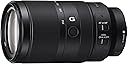
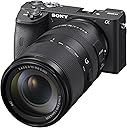
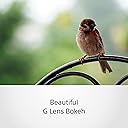
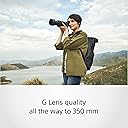
The Sony 70-350mm f/4.5-6.3 G OSS is a compact, lightweight super-telephoto zoom lens designed for APS-C E-mount cameras. Featuring advanced optics with one aspherical and three ED elements, it delivers exceptional sharpness across its zoom range. Its XD Linear Motor autofocus system offers fast, precise tracking of moving subjects, while the circular 7-blade aperture produces beautiful bokeh. Built with dust and moisture resistance, it’s ideal for outdoor photography including wildlife and sports. Optical image stabilization ensures crisp handheld shots even at maximum zoom, making it a versatile, high-performance lens for enthusiasts and professionals alike.


| ASIN | B07X5DGGMQ |
| Best Sellers Rank | 13,185 in Electronics & Photo ( See Top 100 in Electronics & Photo ) 84 in Camera Lenses |
| Box Contents | Lens |
| Brand Name | Sony |
| Camera Lens | 70 350 month |
| Colour | black |
| Compatible Camera Models | Sony A7 series, Sony A6000 series, Sony ZVE1/10 |
| Compatible Mountings | Sony E |
| Country of Origin | China |
| Customer Reviews | 4.6 4.6 out of 5 stars (1,476) |
| Exposure Control Type | Automatic, Manual |
| File Format | MP4 |
| Fixed Focal Length | 350 Millimetres |
| Focus Type | Auto Focus |
| Global Trade Identification Number | 04548736099753 |
| Has Self-Timer | No |
| Image Stabilization Type | Optical |
| Item Type Name | Lenses |
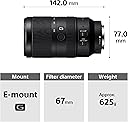
| Item Weight | 625 Grams |
| Lens Coating Description | Nano AR Coating |
| Lens Design | Zoom |
| Lens Mount | Sony E |
| Lens Type | Telephoto |
| Manufacturer | Sony |
| Manufacturer Part Number | SEL70350G.SYX |
| Maximum Aperture | 6.3 Millimetres |
| Maximum Focal Length | 350 Millimeters |
| Maximum Shutter Speed | 30 Seconds |
| Media Type | ProductImage |
| Minimum Aperture | 22 Millimetres |
| Minimum Focal Length | 70 Millimeters |
| Model Name | Sony SEL70350G E-mount APS-C 5x super-telephoto zoom G lens with up to 350mm reach (525mm equiv.) |
| Model Number | SEL70350G.SYX |
| Number of Diaphragm Blades | 7 |
| Photo Filter Size | 67 Millimeters |
| Real Angle Of View | 22 Degrees |
| Shooting Modes | Auto, Program, Aperture Priority, Shutter Priority, Manual, Movie, S&Q, Pano, Scene Selection, Night Shot, Bulb, Sweep Panorama, Multi Frame NR, 3D Sweep Panorama, High ISO NR, Continuous Shooting, Bracketing, White Balance, DRO/Auto HDR, Picture Effect, Creative Style |
| Unit Count | 1.0 count |
| Video Capture Format | 4K |
| Video Capture Resolution | 4K (3840 x 2160) |
| Viewfinder Type | Electronic viewfinder |
| Water Resistance Level | Water Resistant |
| Zoom Ratio | 5 |
U**K
An impressive long lens
A long lens was until now the only gap in my Sony system, and for a while I had my eye on one, notably this. When it came up on a lightning deal I couldn't delay any longer and took the plunge then and there and haven't looked back since. My 18-105mm has served me well as a walk around lens with an okay range, but it was limiting in situations like wildlife and sports particularly. I wanted a "proper" zoom and this is it, and with the APS-C sensor on the a6600 you're effectively getting 105-475mm, which is a bonus. It's nicely made, though heavy, and comes with a good sized hood and on-lens focus options and a focus hold. The zooming ring is quite a heavy turn I've found, though I'm used to it now. I've taken it out enough times now to get a good feel for performance and I'm impressed. Yes, a slow aperture is never ideal, but the bokeh when I choose that kind of shot is nice and you just have to get used to the lighting situations where it's performance will drop. I've found the sharpness to be very good from corner to corner and the stabilisation is a dream – where when zoomed to the max there's a huge difference when you slightly depress the shutter and witness the smoothness. The autofocus hasn't let me down either and I find the lens responds better than the 18-105. I'm getting much fewer out of focus images of birds for instance than I was getting with the 105. The bird photo I've uploaded here wasn't in great light at all but I was impressed with the results, even with it being my first time shooting at that length with subjects that quick! I was worried what the quality at 350mm was going to be like, but I'm impressed. With good lighting conditions it's excellent I'd say and there's even room to crop in further when processing. Overall I'm really pleased I took the plunge and bought this, as it completes the hole in my lens range and it performs for me brilliantly.
F**N
A must own for high IQ and portability at an affordable price for enthusiasts
Key qualities about this lens: - Portability (under 600gr, and very compact dimensions for such a telephoto 105-525 FF equivalent) which makes it easy to bring this lens along on hikes, travel, in a simple messenger bag: "The best camera is the one you carry" - Amazing Image Quality, which completely satisfies consummate pro photographers ! - Very good OSS, tremendous help at the long end - Affordability - E-mount A little bit of background which might resonate with a number of hobbyists and enthusiasts who may have found themselves in my situation, and maybe help them avoid making the 'mistake' I made. I got into photography at end of 2019 after a trip to Colombia where I realised the photos from my smartphone, GoPro and Osmo Pocket, were underwhelming compared to my friend's dslr. At the time, as a total beginner, after learning the basics about the exposure triangle and watching countless Youtube reviews about cameras, I chose a Canon M50 instead of a Sony A6400. Key reasons: ergonomics, simple menus, touchscreen, brand reputation and price. After building up a decent lineup of lenses (11-22, 22, 18-150, the sigma trio) and even upgrading to the M6 mk ii, I really enjoyed my kit and took a lot of nice photos. But now that I caught the bug and really enjoy this hobby, I found myself wanting more and more reach for wildlife, sports and even for landscape and street photography. I also noticed that most of my photos were at the longer end. I went from taking more wide angle pictures, to better subject isolation and composition, as well as really appreciating the background compression longer focal lengths create. As a result, my 150mm max focal length was starting to show its limits. I also started to be disappointed with how soft the photos were compared to my sigma 56 f1.4. So I investigated for a while the various options for telephoto lenses, with non-negotiable criterias for my use case: price, portability and IQ. Unfortunately the choice for the ef-m mount just doesn't exist, and won't since Canon has now killed this very convenient and promising system. Adapting EF glass is impractical and defeats the purpose of owning and carrying a small compact apsc setup. I quickly realised I didn't want to carry my sigma EF 18-35 f1.8 once I got the ef-m 16 f1.4. So adapting either the heavy and bulky sigma 100-400 or 150-600 was a no go. I therefore found myself realising I would need to look at other bodies and good lenses that would match them: after watching a lot of content, I landed on either going - Canon RF with the R10 + the excellent compact and light RF 100-400 - or Sony with the a6400 (or ZV-e10) + this amazing 70-350 After watching one of my favourite wildlife bird photographer notice some AF issues with the R7 and R10, and also knowing that I really wanted the sigma 18-50 f2.8 as my main mid-range lens, which only exists for the E-mount; I was already leaning Sony. Then Canon announced recently they were not going to let 3rd party lens manufacturers develop affordable good quality lenses for the RF mount. This sealed the deal for me. So here I am 3 years later, full circle. I would have saved myself quite a bit of money and frustration by getting that A6400 from the very beginning. My conclusion for any enthusiast getting into this hobby: it's ALL about the lenses ! Ignore any fanboy/partisan brand debate except for the reliability of AF (which is really important indeed). Ignore any road map, rumours of lens release: only trust the ones already available on the market for your needs. And if your budget is under £1k and you want an excellent portable APS-C telephoto, there is essentially no competition with this 70-350. It's the best in the market ! And since it's an E-mount, it will mount perfectly on a full frame body in the future if I feel the need to. This lens is an absolute keeper. Here are a few jpegs straight out of camera with no edits.
C**L
Excellent lens offering a useful telephoto range
This is an excellent lens offering a good telephoto range. Images produced are sharp. Zoom mechanism is smooth. In relation to the cameras it is designed for, the lens is quite heavy and not as balanced when fitted as a DSLR with comparable telephoto lens which I use. However, you get used to using a larger, heavier lens on the Sony a model cameras in time.
A**R
Compact, versatile, best APS-C telephoto for E-Mount.
Brilliant, compact, high reach lens. Giving you an equivalent 525mm Full Frame alternative. You have a couple of small compromises for this. Firstly, it's a variable aperture, so you will need to be okay with that. Secondly, this is an APS-C focused lens and is not compatible with the teleconverters. If you're looking for something similar in size, with a fixed aperture and teleconverter compatibility, the SEL70200G2 (F4 Macro) is a good option. Otherwise, the fast motors making focusing super easy, and a great leans for general wildlife photography too. Clean, sharp images, good colours. First picture I took was of the moon, and it's still a favourite from the lens.
A**N
GREAT PIECE OF KIT. SEE TEXT.
WOW, PURCHASED AT A VERY GOOD PRICE..... WITH SOME AND MAYBE MOST SONY APSC CAMERAS YOU CAN EVEN USE THE ZOOM FUNCTION TO EXTEND ITS REACH... AMAZING. SUGGEST YOU USE A TRIPOD AND OR A TRIPOD RING ATTACHED TO THE LENS. AT 6.3 YOU MAY NEED SOME LIGHT OR A SLOWER SHUTTER/HIGHER ISO BUT YOU WILL FIND YOU HAPPY SPOT. WELL MADE . HAVE FUN.
T**R
Great lens, super sharp.
This lens is amazing value for money, especially at the reduced price offered during the Prime promotion. It's an apsc lens and works well on my Sony A6000, very sharp and the OSS is superb, I've shot hand held at 1/50 sec with no problem. On my full-frame A7Rv this lens makes a great lightweight set up and still gives you 26MP in apsc mode but surprisingly it can be used in full-frame mode with no vignetting at the low end of the focal length, even at 350mm only modest cropping is needed to remove the corner darkening. So pleased I purchased this.
J**N
Just what I need.
A**E
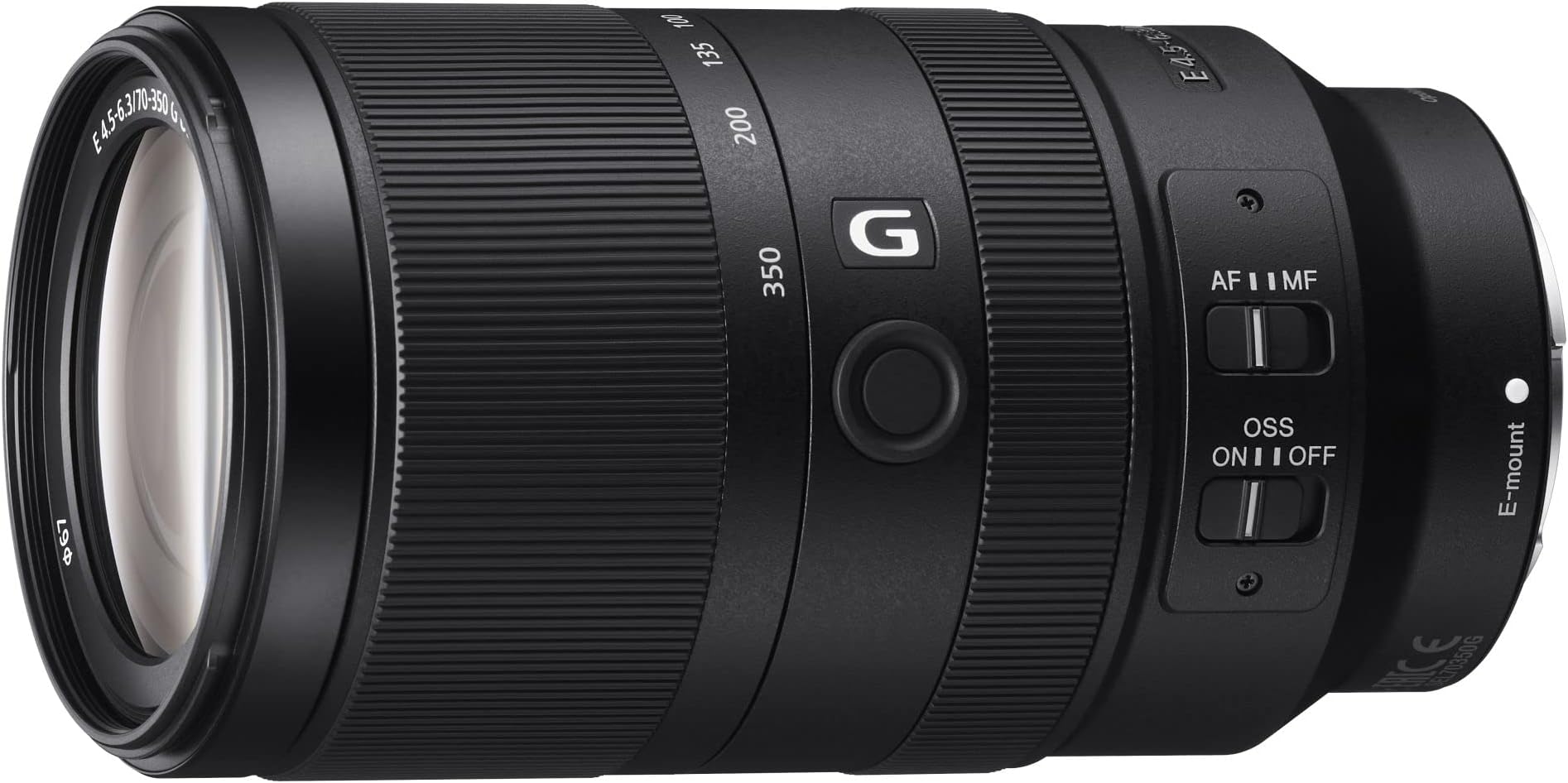
Il Sony 70-350mm G è l'ultima aggiunta al parco obiettivi della mia Sony Alpha 6600, e per quanto l'abbia utilizzato ancora poco a causa degli impegni di lavoro, posso già dire senza ombra di dubbio che insieme al Sony Zeiss 16-70mm, che ancora non ho recensito per le stesse ragioni (lavoro e pandemia), è la migliore ottica che ho avuto modo di provare finora sulla mia mirrorless. Caratteristiche fisiche: L'obiettivo è compatto e leggero (molto più leggero rispetto al Canon 70-300mm non stabilizzato che usavo con la Eos 400D), ma soprattutto è un obiettivo Sony della serie Gold, quindi è un'ottica professionale con eccellenti caratteristiche di resistenza alla polvere e all'umidità. Lo schema ottico ottimizzato per le mirrorless, inoltre, lo rende meno ingombrante anche in estensione quando viene impostato alla massima lunghezza focale. L'obiettivo è stabilizzato ma a differenza delle ottiche standard Sony, che ne sono prive, è dotato di interruttore per disabilitare l'OSS nel caso in cui ci si voglia avvalere della stabilizzazione a 5 assi (per coloro che lo usano con le a6500 e a6600), o per quando si fotografa su treppiede; l'interruttore dell'OSS è posto subito sotto quello del selettore AF-MF. La ghiera per la messa a fuoco manuale è in posizione arretrata, quindi più comoda da usare, e in prossimità della ghiera di estensione delle focali si trova anche il pulsante di blocco, molto utile per evitare l'estensione accidentale delle lenti durante il trasporto o quando la fotocamera non viene usata ma è a tracolla, e il peso la fa rivolgere verso il basso. Il pulsante di blocco può essere usato soltanto quando la ghiera delle lunghezze focali è impostata sulla distanza minima, ovviamente, e cioè sui 70 millimetri. Sulla parte laterale sinistra, quindi facilmente accessibile con il pollice, è presente il comodo pulsante per il blocco della messa a fuoco, anche se da quel poco che ho potuto vedere durante i primi test è una modalità funzionale soltanto in determinate condizioni ma sempre molto gradita su un obiettivo di categoria professionale, soprattutto dal momento che è possibile personalizzare ulteriormente la sua funzione impostando precisi parametri di messa a fuoco. Tra le caratteristiche fisiche distintive del SEL 70-350mm G c'è anche la messa a fuoco silenziosa, oltre che rapida, l'unico suono che sentirete mai uscire da questo obiettivo è il sibilo a stento percettibile che produce quando si cambia l'estensione focale. A questo punto posso concludere la parte “materiale” della recensione confermando che la confezione include il tappo protettivo anteriore, quello posteriore e il paraluce, ma non la custodia a sacchetto (e considerato il costo non penso che alla Sony avrebbe fatto male mettercelo). Prestazioni: Come ho accennato all'inizio, non ho ancora avuto modo di provare quest'obiettivo fino in fondo, anzi diciamo che non mi ci sono “divertito” come vorrei (e lo stesso vale per il Sony Zeiss 16-70mm); ma ho allegato alcune foto che sono più che adeguate per testimoniare le qualità di quest'ottica. Tutte le foto allegate, tranne due, sono state scattate alla massima estensione focale. Le foto marcate con la scritta 70mm e 350mm servono soprattutto per dare una chiara idea dell'angolo di campo effettivo di quest'obiettivo, che essendo progettato per le mirrorless con sensore APS-C è equivalente a quello di un obiettivo 105-525mm in formato 35mm; da queste due foto si può apprezzare anche la resa dei colori e la qualità delle immagini in piena luce. Da tutte le altre, invece, si può notare come l'ottica mantenga un'ottima nitidezza anche alla massima estensione focale, con solo una perdita soltanto marginale e più accentuata verso i bordi. Lo stesso discorso vale per la vignettatura, che si produce alla massima lunghezza focale, e per la distorsione ai margini, alla minima lunghezza, entrambe ridotte al minimo. In una delle foto della Luna, inoltre, ho volutamente evitato di rimuovere il rumore cromatico, per dare modo di verificare come l'aberrazione cromatica sia appena accennata e percettibile soltanto in condizioni di altissimo contrasto (in ogni caso può essere facilmente rimossa dal file ARW con il programma Sony Edit). Punti critici: La luminosità potrebbe (forse) rappresentare l'unico punto critico per questo teleobiettivo, specialmente considerando che si tratta di un'ottica Sony G, di conseguenza l'apertura da f/4,0 a f/6,3 potrebbe apparire penalizzante. In questo caso bisogna sottolineare che il 70-350mm G, pur essendo un obiettivo professionale, è un'ottica ottimizzata per le mirrorless Sony con sensore APS-C, e che per avere prestazioni superiori bisogna spendere almeno il triplo per un obiettivo G Master, ottimizzato per le fotocamere con sensore Full Frame. L'unico “limite” del 70-350mm G, quindi, è quello di dover “lavorare” con i sensori APS-C; anche così, però, se diamo un'occhiata agli altri obiettivi Sony disponibili per questa categoria di sensore, in termini di apertura massima del diaframma il 70-350mm è battuto soltanto dalle ottiche standard con lunghezze focali non superiori ai 135mm (com'è naturale che sia del resto) e dagli obiettivi Zeiss (e qui non serve nemmeno stare a precisare il perché). Già il teleobiettivo standard Sony 55-210mm E (anche questo acquistato per la mia Sony a6600 e ancora da recensire), nonostante abbia un range di lunghezze focali inferiori, ha un'apertura massima del diaframma di f/4,5 ed è meno luminoso rispetto al 70-350mm G, che un'estensione focale più elevata. Conclusioni: Ovviamente non si può pretendere di paragonare un obiettivo della serie Gold con le ottiche standard, il 70-350mm G è nettamente superiore sia per quanto riguarda la qualità delle lenti e la tecnologia sia per la resa e le prestazioni; io l'ho fatto soltanto per far capire a coloro che sono meno informati, a livello generale, che il prezzo di un obiettivo va sempre di pari passo con la sua categoria di appartenenza e con le prestazioni, soprattutto quando si parla di ottiche originali e non di obiettivi compatibili prodotti da terze parti. Il 70-350mm G è a dir poco eccezionale, soprattutto se consideriamo il fatto che si tratta di un'ottica progettata appositamente per le mirrorless Sony con sensore APS-C, quindi di categoria amatoriale. Nulla vi impedisce di adoperarlo sulle mirrorless Sony mid-range, come la a6000, a6300 e a6400, o addirittura sulle entry level a5000 e a5100, ma in questo caso non aspettatevi di poter sfruttare fino in fondo le sue reali potenzialità. Il 70-350mm G è un teleobiettivo con prestazioni professionali, ma se volete che dia il meglio di sé dovete adoperarlo per forza con una mirrorless Sony APS-C di classe avanzata, quindi la a6500, o meglio ancora la più recente a6600, dal momento che sono le uniche fotocamere amatoriali a offrire prestazioni di livello semi-professionale. Entrambi i modelli sono dotati di stabilizzatore a 5 assi, hanno un ampio range di compensazione EV, una gamma di sensibilità ISO nettamente superiore e un tetto di prestazioni nella regolazione dei parametri di scatto che è analogo a quello delle fotocamere mirrorless professionali a7 entry level di prima, seconda e terza generazione; ma sono purtroppo limitate alla categoria amatoriale a causa delle dimensioni del sensore, che è in formato APS-C.
M**E
L'objectif Sony SEL-70350G est une véritable perle pour les photographes amateurs et professionnels utilisant un appareil photo APS-C avec monture E. Avec sa plage focale impressionnante de 70-350 mm, cet objectif est parfait pour la photographie de paysage, la faune, ou même les événements sportifs, offrant une grande flexibilité sans avoir à changer constamment d'objectif. La qualité de fabrication est au rendez-vous avec un design compact et léger, ce qui le rend facile à transporter, même lors de longues sorties photo. Le piqué des images est remarquable sur toute la plage focale, et l'autofocus est rapide et précis. De plus, la stabilisation optique intégrée permet d'obtenir des images nettes même en conditions de faible luminosité ou à main levée. En termes de rapport qualité-prix, il est difficile de trouver mieux. Cet objectif offre des performances proches du niveau professionnel tout en restant abordable pour les passionnés de photographie. Je le recommande vivement à quiconque cherche un zoom polyvalent et performant sans se ruiner.
M**Y
Super lens, the zooming level was unimaginable. Great Clarity. Worth for buying.
F**∅
Es un gran objetivo. Me encanta. Vale cada céntimo de su precio. De hecho creo que es barato para lo que ofrece. Es muy nítido en casi todo su rango, es perfecto para fotografia al aire libre, exteriores, fauna animal, incluso retratos. El enfoque es rápido y el estabilizador funciona a la perfección. Se puede usar con cámaras full frame o apsc, siendo esta última donde le vas a sacar aun más partido pues se convierte en un 105-510mm más o menos. No es un objetivo muy pesado con lo cual se aguanta bien cámara en mano. Las fotos salen con muy buen color y contraste. Por último Incluye un parasol que viene muy bien. Creo que es un MustHave para casi cualquier fotógrafo.
Trustpilot
1 month ago
5 days ago