

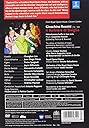
Rossini: Il Barbiere Di Siviglia
Product ID: 1535536
Details
- FormatClassical NTSC
- GenrePerforming
- LanguageItalian
- Runtime2 hours and 30
Desertcart purchases this item on your behalf and handles shipping, customs, and support to Kyrgyzstan.
The cast of this Barbiere, taken from performances in July 2009at the London s Royal Opera House, could quite simply not bebettered today: dazzling Virgin Classics artist Joyce DiDonatoin her signature role of Rosina; Juan Diego Flórez; the world sreigning bel canto tenor; Alessandro Corbelli, a buffobaritone who brings subtlety and edge to the traditional comicantics, and Ferruccio Furlanetto, who demonstrates that asupreme interpreter of Verdi s tortured King Phillip can alsohave a sense of humor. Conducting is the Royal Opera s MusicDirector, Antonio Pappano, who has led many complete operasfor EMI Classics and who though born in London literallyhas the Italian style in his blood.This DVD sees Joyce DiDonato perform her role in a wheelchair a story that has occupied international headlines. Joycebrought literal meaning to the old theatrical motto Break aleg. After she broke her fibula in an earlier show Joyce wasdetermined to finish her commitment. The good-spirited divawas re-staged into the production to allow for the additionalchallenges that come when a leading lady in a lively physicalrole must wheel around the other performers.Joyce posted the following on her blog post-performance: Well,without a doubt, last night was one of the most memorable, excitingnights in my life. I suppose that makes two in a row for me. I arrivedat the theater around 4:30 and was introduced to my new co-star: abeautiful, sleek Moonlite Breezy Wheelchair. The DVD bonus features include an interview with Joyce on herstage accident and subsequent wheelchair performances. Review: Go for the Laffs, Moshe, Go for the Laffs! - This is a "Barbiere" intended to be a 'laff-fest', staged, directed, and conducted for maximum slapstick commedia. If you want your "Barber of Seville" to retain any of the social indignation of Beaumarchais's revolutionary drama, you'd better look elsewhere. That insidious anti-aristocratic message needs to be present in Mozart's "Figaro" but it has always seemed extraneous to Rossini's. I truly doubt that Rossini gave a fig for Beaumarchais's edgy politics. I suspect old Gioachino would have been happily flabbergasted at this broad musical and uproarious dramatic interpretation of his most popular opera. In too many productions, Il Barbiere has become a stodgy 'sacred cow' aimed at traditionalists in the box seats. Rossini had only one use for sacred cattle: tournedos with black truffles. Conductor Antonio Pappano exposes his buffo nature to the camera as he conducts the overture. Watching him burble and twirl, despite the suave perfection of the orchestra in this overture one has to expect hi-jinks in the opera, and one will not be disappointed. Pappano is irrepressible. Every possible 'special effect' -- quirky rubatos, grandiose grand pauses, etc. -- will be exaggerated to the point of mannerism. But it works. It's a natural extension of Rossini's own mannerism. Likewise, every singer in this spectacular cast is irrepressible in exaggerating the both absurdity of the libretto and the comedy implicit in Rossini's music. Pietro Spagnoli is a different Figaro, not the usual sly upstart but rather a seasoned rogue with generous instincts for young lovers. Alessandro Corbelli, as Doctor Bartolo, is less the hapless old dupe of most production and more a nasty domestic tyrant, hardly a pushover for Figaro's tricks. If you'd never seen the opera before, you might think he has a chance of thwarting the elopement of his ward Rosina with the disguised Count Almaviva despite the dopey schemes concocted by Figaro. Rosina (Joyce DiDonato) is 'handicapped' dramatically; she sings from a wheel chair, having suffered a broken foot in the premiere performance. It's a brave act by DiDonato, yet I might wish we could have seen what she could do as an actress in fully functional control of her body. The most 'original' characterization is that of Count Almaviva, acted by Juan Diego Florez. He may be a Count, he may wield his privileged identity like a club when the time comes, but he's a nervous, sappy adolescent in this interpretation, hardly an accomplished Casanova. He needs Figaro to boost his confidence. Florez dominates this production, both dramatically and vocally, as I've never seen/heard any Almaviva do before. Most stagings focus on Figaro; in this one, it's Almaviva who sets the pace, gets the laughs, gets the girl, and properly triumphs in his climactic arias. Figaro is relegated to back stage, despite the robust singing and acting of Pietro Spagnoli. Rossini's "Barber", it turns out, is all about the Count. Of course, any production of any opera is really "all about" the singing, right? That's still true in this new age of operas on DVD, when we see the faces of the singers up close, when a craftier physical acting technique has become a necessity. Look closely at these singers and you'll see that they are wearing microphones in their hair. The sound you'll hear on the speakers in your home is far more balanced than it would be in an opera house; the singers and the orchestra are almost as acoustically integrated as they would be on a studio CD. To my ears, that's all the better, although I know there are people who would prefer a different sort of miking. The singing on this recording, in my opinion, is too good to be wasted; I want to hear every note fully, Florez is astonishing. Everybody knows that. Nevertheless, I didn't expect such 'historically informed' athleticism from him. He tosses off the flashiest ornaments and arpeggiated phrases of his arias as lightly as a dropped handkerchief. Possibly it was the 'presence' of Joyce DiDonato that inspired him to such virtuosity. DiDonato is a singer thoroughly imbued with the aesthetic of "historically informed performance." She approaches Rossini from the performing tradition of the 18th C baroque and rococo rather than retroactively from the 19th C of romanticism and verismo. In any case, Florez and DiDonato sing this opera in the same stylistic language, and the result is fantastically exciting. Moshe Leiser and Patrice Caurier were the stage directors of this 2009 Covent Garden production. I wish, oh I wish, I'd been there! Review: "Wheelchair" Barber of Seville on DVD - The "Wheelchair" Il Barbiere di Siviglia - London July 2009 At the beginning of this Virgin Classics DVD instead of seeing music director Antonio Pappano give the downbeat to commence the overture to Rossini's popular comedy, we see him onstage appearing before the curtain of the Royal Opera House Covent Garden to announce that Joyce DiDonato will be performing the role of Rosina in a wheelchair! Having had an accident during opening night shortly after "Una voce poco fa", and being quite the trooper, she decided not to cancel her run of performances. Considering that the staging would have to be modified in a very short time the results are nothing short of amazing... and boy can Miss DiDonato act... and spin around in a chair... and actually use the chair as a prop to the character's advantage. Plus the girl can sing as well! Now when librettist Cesare Sterbini has Rosina say that she has a cramp in her foot I am quite sure that he never ever expected the line not only to get a hearty laugh, but a warm round of applause as well! At any rate, DiDonato steals the show and that is not an easy feat considering that her Almaviva is the celebrated Juan Diego Florez... and it is normally his job to pilfer the limelight from the title character. In fact, the cast is strong from top to bottom with Pietro Spagnoli a robust Figaro, Alessandro Corbelli a conniving Bartolo, and Ferruccio Furlanetto as a slimy Basilo... with only the later considerably sacrificing vocal accuracy for dramatic effect. If anything he is the weak link in the cast from a purely vocal standpoint, but visually and histrionically he gives a tour de force performance. Even the Berta is quite good. Plus Pappano knows his way around the score which is performed in the relatively new critical edition published by Barinreiter. As for the production itself, the sets and costumes abound in bright colors with the stage riotously tilting and slanting to good effect signifying the confusion that ends the first act... with the by now infamous wheelchair effectively and energetically joining in the action as well... albeit while remaining on terra firma. If this had all been planned for months on end the final results would not have been any finer... So, heartily recommended... and destined to become a classic. In fact I transferred the audio portion not only to my iPod, but to CD as well. As such, it has become my current Barber of choice. Run... or wheel yourself to your local DVD outlet to get it!
| ASIN | B0039I1HN4 |
| Actors | Alessandro Corbelli, Ferruccio Furlanetto, Joyce DiDonato, Juan Diego Florez, Pietro Spagnoli |
| Aspect Ratio | 1.77:1 |
| Best Sellers Rank | #108,559 in Movies & TV ( See Top 100 in Movies & TV ) #1,199 in Performing Arts (Movies & TV) |
| Customer Reviews | 4.2 4.2 out of 5 stars (265) |
| Director | Antonio Pappano, Moshe Leiser, Patrice Caurier |
| Is Discontinued By Manufacturer | No |
| MPAA rating | Unrated (Not Rated) |
| Media Format | Classical, Color, Multiple Formats, NTSC |
| Number of discs | 2 |
| Product Dimensions | 11.81 x 0.39 x 11.81 inches; 3.6 ounces |
| Release date | April 20, 2010 |
| Run time | 2 hours and 30 minutes |
| Studio | Virgin Classics |
| Subtitles: | English |
G**O
Go for the Laffs, Moshe, Go for the Laffs!
This is a "Barbiere" intended to be a 'laff-fest', staged, directed, and conducted for maximum slapstick commedia. If you want your "Barber of Seville" to retain any of the social indignation of Beaumarchais's revolutionary drama, you'd better look elsewhere. That insidious anti-aristocratic message needs to be present in Mozart's "Figaro" but it has always seemed extraneous to Rossini's. I truly doubt that Rossini gave a fig for Beaumarchais's edgy politics. I suspect old Gioachino would have been happily flabbergasted at this broad musical and uproarious dramatic interpretation of his most popular opera. In too many productions, Il Barbiere has become a stodgy 'sacred cow' aimed at traditionalists in the box seats. Rossini had only one use for sacred cattle: tournedos with black truffles. Conductor Antonio Pappano exposes his buffo nature to the camera as he conducts the overture. Watching him burble and twirl, despite the suave perfection of the orchestra in this overture one has to expect hi-jinks in the opera, and one will not be disappointed. Pappano is irrepressible. Every possible 'special effect' -- quirky rubatos, grandiose grand pauses, etc. -- will be exaggerated to the point of mannerism. But it works. It's a natural extension of Rossini's own mannerism. Likewise, every singer in this spectacular cast is irrepressible in exaggerating the both absurdity of the libretto and the comedy implicit in Rossini's music. Pietro Spagnoli is a different Figaro, not the usual sly upstart but rather a seasoned rogue with generous instincts for young lovers. Alessandro Corbelli, as Doctor Bartolo, is less the hapless old dupe of most production and more a nasty domestic tyrant, hardly a pushover for Figaro's tricks. If you'd never seen the opera before, you might think he has a chance of thwarting the elopement of his ward Rosina with the disguised Count Almaviva despite the dopey schemes concocted by Figaro. Rosina (Joyce DiDonato) is 'handicapped' dramatically; she sings from a wheel chair, having suffered a broken foot in the premiere performance. It's a brave act by DiDonato, yet I might wish we could have seen what she could do as an actress in fully functional control of her body. The most 'original' characterization is that of Count Almaviva, acted by Juan Diego Florez. He may be a Count, he may wield his privileged identity like a club when the time comes, but he's a nervous, sappy adolescent in this interpretation, hardly an accomplished Casanova. He needs Figaro to boost his confidence. Florez dominates this production, both dramatically and vocally, as I've never seen/heard any Almaviva do before. Most stagings focus on Figaro; in this one, it's Almaviva who sets the pace, gets the laughs, gets the girl, and properly triumphs in his climactic arias. Figaro is relegated to back stage, despite the robust singing and acting of Pietro Spagnoli. Rossini's "Barber", it turns out, is all about the Count. Of course, any production of any opera is really "all about" the singing, right? That's still true in this new age of operas on DVD, when we see the faces of the singers up close, when a craftier physical acting technique has become a necessity. Look closely at these singers and you'll see that they are wearing microphones in their hair. The sound you'll hear on the speakers in your home is far more balanced than it would be in an opera house; the singers and the orchestra are almost as acoustically integrated as they would be on a studio CD. To my ears, that's all the better, although I know there are people who would prefer a different sort of miking. The singing on this recording, in my opinion, is too good to be wasted; I want to hear every note fully, Florez is astonishing. Everybody knows that. Nevertheless, I didn't expect such 'historically informed' athleticism from him. He tosses off the flashiest ornaments and arpeggiated phrases of his arias as lightly as a dropped handkerchief. Possibly it was the 'presence' of Joyce DiDonato that inspired him to such virtuosity. DiDonato is a singer thoroughly imbued with the aesthetic of "historically informed performance." She approaches Rossini from the performing tradition of the 18th C baroque and rococo rather than retroactively from the 19th C of romanticism and verismo. In any case, Florez and DiDonato sing this opera in the same stylistic language, and the result is fantastically exciting. Moshe Leiser and Patrice Caurier were the stage directors of this 2009 Covent Garden production. I wish, oh I wish, I'd been there!
M**B
"Wheelchair" Barber of Seville on DVD
The "Wheelchair" Il Barbiere di Siviglia - London July 2009 At the beginning of this Virgin Classics DVD instead of seeing music director Antonio Pappano give the downbeat to commence the overture to Rossini's popular comedy, we see him onstage appearing before the curtain of the Royal Opera House Covent Garden to announce that Joyce DiDonato will be performing the role of Rosina in a wheelchair! Having had an accident during opening night shortly after "Una voce poco fa", and being quite the trooper, she decided not to cancel her run of performances. Considering that the staging would have to be modified in a very short time the results are nothing short of amazing... and boy can Miss DiDonato act... and spin around in a chair... and actually use the chair as a prop to the character's advantage. Plus the girl can sing as well! Now when librettist Cesare Sterbini has Rosina say that she has a cramp in her foot I am quite sure that he never ever expected the line not only to get a hearty laugh, but a warm round of applause as well! At any rate, DiDonato steals the show and that is not an easy feat considering that her Almaviva is the celebrated Juan Diego Florez... and it is normally his job to pilfer the limelight from the title character. In fact, the cast is strong from top to bottom with Pietro Spagnoli a robust Figaro, Alessandro Corbelli a conniving Bartolo, and Ferruccio Furlanetto as a slimy Basilo... with only the later considerably sacrificing vocal accuracy for dramatic effect. If anything he is the weak link in the cast from a purely vocal standpoint, but visually and histrionically he gives a tour de force performance. Even the Berta is quite good. Plus Pappano knows his way around the score which is performed in the relatively new critical edition published by Barinreiter. As for the production itself, the sets and costumes abound in bright colors with the stage riotously tilting and slanting to good effect signifying the confusion that ends the first act... with the by now infamous wheelchair effectively and energetically joining in the action as well... albeit while remaining on terra firma. If this had all been planned for months on end the final results would not have been any finer... So, heartily recommended... and destined to become a classic. In fact I transferred the audio portion not only to my iPod, but to CD as well. As such, it has become my current Barber of choice. Run... or wheel yourself to your local DVD outlet to get it!
M**A
It doesn't get any better
I own practically every Barbiere on DVD or BD. A very few are bad, many are good, some have exceptional performers, but this one is perfect, from Weikert to the last chorus member staring motionlessly at Don Bartolo in the glorious sextet of Act I! The overture is brilliantly filmed, sound and picture in the best possible match. Leo Nucci is dominant when in scene, with his tremendous fortissimo and a beautifully sounding instrument throughout the entire range. He matches Ms Battle in everywhere, not least in "Dunque io son" which is some feat. Best Figaro I've ever seen or heard. What more can one say about Miss Battle? Her performance here strikes for the absolute beauty of her sound. Never heard that final very short solo of Rosina the way she does it. It looks deceptively easy, but everyone loses power throughout! Not Miss Battle, who just gows from strength to strength. Enough has been said about "Una voce poco fa" and the music lesson. You can believe the other guys, it is all true. Enzo Dara, whose performances I have enjoyed before, especially his Houston Don Magnifico is also fabulous. His acting is a joy to watch and his basso-baritono buffo is probably the best around. Blake does well throughout but very well in "Cessa di piu resistere". The memorable one is Juan Diego Flores in Madrid, which is obviously matchless. Furlanetto does well in "la calunia", but better in his unwanted appearance after the music lesson. If you already own any Barbiere, get this one! If you don't, get this one, then a couple more to realise what you have. If you never heard an opera in your life, get this one for starters. If you hate opera, get this one, you will be converted!
S**N
This was a real hoot. My friends and I had many laugh out loud moments. Ms Didonato's being in a wheelchair was in no way distracting and the cast worked well with it. Every singer was in fine voice.
C**A
I have so many variants of Il Barbiere that I lost count. My favourite is by far the Glyndebourne production with John Rawnsley, Maria Ewing, Claudio Desderi. I loved everybody including Ferruccio Furlanetto as Don Basilio. So, when I found this Barbiere from Met, with both Leo Nucci and Ferruccio, that was all that I needed to buy it. I was not a fan of Miss Battle, but in the end she is a nice Rosina. Rockwell Blake was a wonderful surprise, as his voice was so beautiful, powerful yet agile and it suited his majestic role. Leo Nucci is amazing in the Barber role. I alway loved him in his Verdi roles, but his Barbiere is great. Enzo Dara as Bartolo is very funny, but vocally not too good. His Un dottor della mia sorte is partly ruined by his singing voice. I don't like that they put the video on 2 DVDs, but a little "sport" does not ruin the pleasure of listening to such a great opera. The DVD has a nice video, considering it was recorded so long ago. Sound is also good. I used the 5.1 DST, and it was great.
猫**人
ボーマルシェの原作が面白いから当たり前かも知れないが、物語の骨格を担う登場人物の、バルトロ、ロジーナ、フィガロを演ずるEnzo Dara、Kathleen Battle、Leo Nicciの好演とRalf Weikert指揮のメトオケの熱気に満ちた演奏とで非常に楽しめた。取り分けバルトロを演ずるEnzo Daraが120%のサービスで、歌以外に顔の表情、所作を問わず聴衆をくすぐってくる。これはCDでは絶対に味わえないものである。家内と二人で笑いこけてしまった。フィガロの「町の何でも屋」のアリアも無難であったが、バルトロ並にもう少し遊びがあっても良かったかと思う。フィガロとバルトロには早口な歌やせりふが多いので、英語には多少自身のある筆者にも英語字幕に付いていくのに一苦労したので、サブタイトルに日本語がないのが非常に残念である。
C**N
Puissante magie des belles découvertes qui tracent le chemin de la course au trésor. Tellement amoureuse de l'impérissable version filmée du Barbier de Séville dans une mise en scène ravissante et inspirée de Jean-Pierre Ponnelle, sous la direction admirable de l'alors tout jeune Claudio Abbado, avec le merveilleux Hermann Prey en Figaro et une troupe de rêve (Teresa Berganza, Luigi Alva, Enzo Dara et Paolo Montarsolo), je peinais à me projeter dans une version actuelle sinon moderne de ce chef d'œuvre rossinien, craignant que la comparaison ne fût une déception. Mais Juan Diego Florez avait fait irruption sur le chemin de la course au trésor... C'est pour rencontrer son Almaviva que j'ai acquis ce DVD et je ne suis pas encore retombée des nues de l'éblouissement et de l'euphorie qu'un tel spectacle procure. Impossible de se livrer à une critique raisonnée de ce qui pourrait, ici ou là, susciter l'objection. La mise en scène, anachronique, simpliste, hyperbolique, poussant le burlesque jusqu'à la farce alors que le burlesque de Rossini, inspiré par Beaumarchais, n'est pas farcesque. Le choix de certaines couleurs des costumes peu flatteuses pour le teint et passablement offensantes pour notre regard en quête d'harmonie dans la douce folie rossinienne qui s'épanouit dans la rigueur de la grammaire musicale. Le parti pris - mais bien tenu -, de faire évoluer les héros, l'intrigue et les sentiments qui enfièvrent l'histoire sur un théâtre grand-guignolesque où les faux nez et les seconds rôles en forme de marionnettes stylisées plantent un décor auquel il faut adhérer comme un enfant battant des mains devant le théâtre de Guignol pour ne pas se fourvoyer dans l'inutile et vaine critique. Oui, on bat des mains et toute critique inutile et vaine se volatilise dans l'éblouissement heureux. Pour commencer, on a un sourire amusé et ému quand Antonio Pappano, merveilleux chef lyrique, ouvre le spectacle en expliquant que Joyce DiDonato sera une Ro-si-na en fauteuil roulant parce qu'elle a glissé le soir de la "première" (en français dans le texte) et s'est cassé un "os du pied", mais a entendu assumer les représentations suivantes, avec l'aide complice et solidaire de la troupe qui s'adaptera fraternellement à cette circonstance insolite, tout comme l'artiste handicapée trouvera le moyen désopilant d'adapter sa singulière posture au texte même du livret, provoquant un immense éclat de rire dans la salle. Pour suivre, on découvre des merveilles succédant aux merveilles. En poussant le burlesque jusqu'à la farce - chacun pour sa part -, les chanteurs interprètes de cette époustouflante représentation du Barbier de Séville nous offrent un volcan de beauté vocale, de puissance comique, de véracité théâtrale, d'enthousiasme effréné : on est subjugué, on rit à gorge déployée, on applaudit comme des gosses heureux. C'est dans son intégralité que la troupe nous enchante et nous transporte dans une vaste bulle de joie rieuse. Hermann Prey reste inoubliable en Figaro, on ne peut pas l'oublier, mais Pietro Spagnoli est ici son autre visage, son visage latin, Figaro méridional de rêve, astucieux, malin, roublard, charmeur, manipulateur, pour la bonne cause, celle de l'heureux dénouement et... de sa fortune. Alessandro Corbelli, après quelques hésitations au début, campe un génial Dottor Bartolo, grotesque, pitoyable et hilarant. Ferruccio Furlanetto est un impayable et magistral Don Basilio, son air de la calomnie est une pièce d'anthologie, vocale et théâtrale : quel artiste que ce chanteur capable d'être à la perfection Leporello, Sparafucile, Fiesco, Philippe II et Don Basilio ! Joyce DiDonato - sa performance extraordinaire et jubilatoire de Rosina en fauteuil roulant mise à part -, est splendide, voix, brio, maîtrise, jeu, présence. Quant à Juan Diego Florez... Que dire ?! Du commencement à la fin, il est simplement impérial, et stupéfiant. Oui, cet artiste est un seigneur du Bel Canto. Il a tout. La voix, le timbre, la virtuosité, la maîtrise, l'assurance, l'autorité, un cumul de dons qui laisse pantois. Mais aussi, et c'est le comble, la classe, le charme, l'élégance, la fierté de l'aristocrate, la drôlerie de l'amoureux usant de tous les stratagèmes pour conquérir la femme qu'il aime : déguisé en ecclésiastique venu donner une leçon de chant à la pupille cloîtrée par un barbon qu'il accable de courbettes obséquieuses, il est irrésistible. Un tel spectacle nous emmène ailleurs que dans l'admiration purement esthétique : là où nous nous sentons bien, là où la vie est belle, douce et joyeuse. Là où le bonheur d'être en vie est volcanique et indispensable.
L**S
This DG edition of The Barber of Seville is, in my opinion, the best theater production of this opera that I know of. The preference of the lovely ‘Diva’ Kathleen Battle - for the role of Rosina - seems a good choice indeed. For her brilliant vocal technique, the charming pronunciation of the italian text, the absolute precision of intonation, the radiant presence on the stage, her gestures elegant and classy. The experience and the art of the further very talented performers as Nucci, Dara, Furlanetto, Rockwell, has led to the highest level the value of the beautiful staging. For the choice of the "stellar" cast, the top performance of the interpreters, the pleasantness of the scenario, for the wise musical direction and the excellent orchestral performance, this realization has been an high pike difficult to overcome for several successive editions. The final images on the second DVD disc, with a roar of applause, clearly describe the mood and the palpable joy of the passionate audience in union with the rightful pleasure of the performers. It’s a very fascinating audio/video document. I too, if had been present, I would have been happy and really content...
Trustpilot
1 week ago
2 days ago