We remain fully operational. Our teams are working around the clock to ensure your deliveries continue safely.

DOWNLOAD THE APP


Copyright © 2025 Desertcart Holdings Limited
DOWNLOAD THE APP
Buy anything from 5,000+ international stores. One checkout price. No surprise fees. Join 2M+ shoppers on Desertcart.
Desertcart purchases this item on your behalf and handles shipping, customs, and support to Kyrgyzstan.
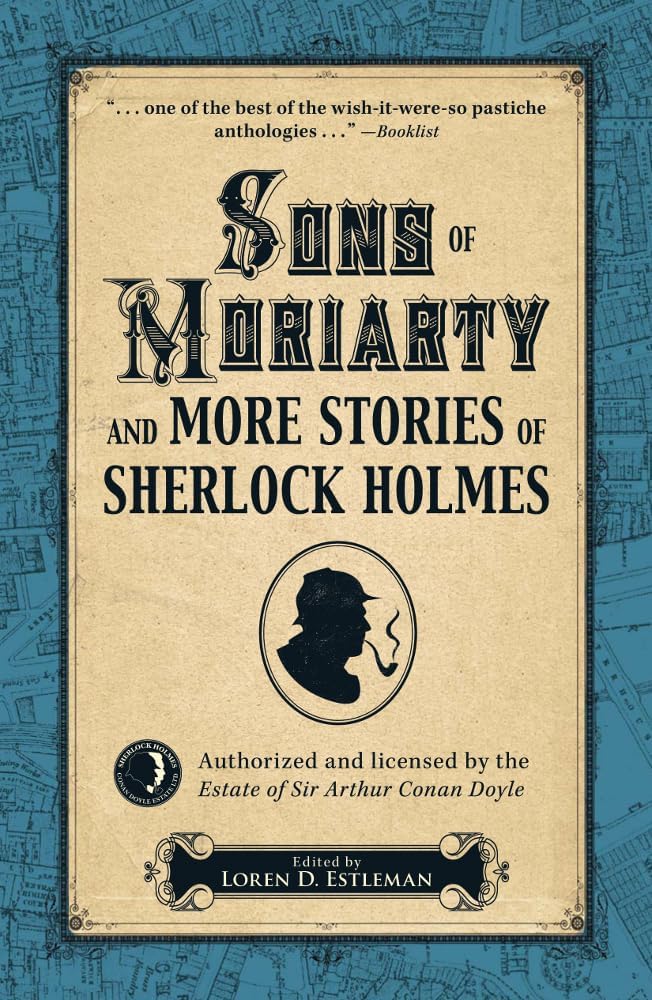
desertcart.com: Sons of Moriarty and More Stories of Sherlock Holmes: 9781440564833: Estleman, Loren D: Books Review: More Holmes for the Sherlockian - Another solid collection of Sherlock Holmes stories, with a pretty diverse cast of writers, including Anne Perry. There is an unfortunate parody story (never liked goofing on topics that are self evidently ridiculous), but the final Estleman novella "Sons of Moriarty" makes up for that flaw. The stories run a wide range of different topics, all of them better quality than most post-Doyle Holmes tales, even if they vary somewhat in greatness. The level of excellence in this book is generally lower than the previous two collections, but the final story mentioned above is a fine addition to the canon and is worth the purchase price alone. Review: A Well-Chosen, Eclectic Mixture - There is only one new entry in Estleman's newest collection, "Sons of Moriarty and More Stories of Sherlock Holmes," and it was definitely the highlight of the book. However, even the other stories, which have all been published before, are not so commonly reprinted that you would necessarily have seen them. And "Sons of Moriarty" takes up almost fifty percent of the book, so even if you had read all seven of the other stories, you still would only have read half the book! The title story is absolutely excellent AND there's a substantial introduction entitled "Sherlock Holmes: An Enduring Legacy." The book pays for itself between the foreword and the eponymous story. The first story in the book, John Lutz's "The Infernal Machine," is a traditional pastiche and starts out the book in the classic style. Holmes and Watson take on a case everyone considers to be open and shut: it appears that someone has used a prototype Gatling gun to commit murder. As there is only one Gatling gun in all of England and it is in the possession of the accused, there seems little doubt as to the guilt of their client. Next, Robert L. Fish's "The Adventure of the Double-Bogey Man" is a tale beloved to those who follow Schlock Homes and his 'remarkably inattentive' sidekick Dr. Watney. The plot involves a few rounds of golf, and the title is a pun; just one of many in the story. "The Case of the Bloodless Sock," by Anne Perry, follows the adventures of Jane Watson and her best friend, Sherlock Holmes, of Seattle, Washington, in modern times. You may have read this one before in the traditional format in another collection. Ms. Perry should have left it that way, as it was a much better story in the original format. The fourth entry, "Sherlocks," takes place in an indeterminate future. It is not at all about Holmes, but about the newly invented evidence-gathering machines, and the tension the "sherlocks" create between those who welcome automation and those who still believe in the power of the human brain. Next come stories by two different Conan Doyles. "The Field Bazaar," by Sir Arthur, is one of several little stories akin to spoofs that he wrote about his famous creation. (They are not usually reprinted nowadays but as it happens, this particular one appeared in "The Game Is Afoot," edited by Marvin Kaye, published in 1995.) Adrian Conan Doyle's "The Deptford Horror" was originally printed in "The Exploits of Sherlock Holmes" (co-written with John Dickson Carr), now long out of print but still available at desertcart marketplace. In my opinion Adrian sounds almost eerily like his father. The next-to-last story in the book, "Before The Adventures" by Lenore Carroll, offers an alternative and totally off-canon view of Holmes and Watson. Although the brief introduction to the story hints that "Holmes purists may take umbrage at the central revelation," I don't see why. It's just funny and clever, more than a little bit offbeat, and great fun. The Sons of Moriarty, the eponymous story of the collection, is novella length. In this traditional pastiche, set in the year 1903, Holmes and Watson are engaged by a young woman to locate the body of her father so that she can return it to Sicily, to be buried where he was born. In this very simple task they are blocked every step of the way. The Home Secretary has banned all excavations in the pauper's field where the body is buried. The cemetery records have been destroyed in a flood. The young woman will have to prove her relationship to the deceased, and so on. Holmes receives a veiled warning from Lestrade as to what might happen should he press on. Naturally, all these impediments in his path simply make Holmes suspicious and even more determined to persevere. And so Holmes and Watson end up going against the Mafia! The story features Holmes and Watson traveling to New York City to meet Guisseppe Petrosino, a real-life New York City detective who was a pioneer in the fight against organized crime. Highlights of this story detail many wonderful incidents of the friendship between Holmes and Watson, now in its twenty-second year.
| Best Sellers Rank | #1,021,344 in Books ( See Top 100 in Books ) #441 in Historical Fiction Short Stories (Books) #4,855 in Traditional Detective Mysteries (Books) #7,487 in Historical Mystery |
| Customer Reviews | 4.3 out of 5 stars 12 Reviews |
C**R
More Holmes for the Sherlockian
Another solid collection of Sherlock Holmes stories, with a pretty diverse cast of writers, including Anne Perry. There is an unfortunate parody story (never liked goofing on topics that are self evidently ridiculous), but the final Estleman novella "Sons of Moriarty" makes up for that flaw. The stories run a wide range of different topics, all of them better quality than most post-Doyle Holmes tales, even if they vary somewhat in greatness. The level of excellence in this book is generally lower than the previous two collections, but the final story mentioned above is a fine addition to the canon and is worth the purchase price alone.
A**R
A Well-Chosen, Eclectic Mixture
There is only one new entry in Estleman's newest collection, "Sons of Moriarty and More Stories of Sherlock Holmes," and it was definitely the highlight of the book. However, even the other stories, which have all been published before, are not so commonly reprinted that you would necessarily have seen them. And "Sons of Moriarty" takes up almost fifty percent of the book, so even if you had read all seven of the other stories, you still would only have read half the book! The title story is absolutely excellent AND there's a substantial introduction entitled "Sherlock Holmes: An Enduring Legacy." The book pays for itself between the foreword and the eponymous story. The first story in the book, John Lutz's "The Infernal Machine," is a traditional pastiche and starts out the book in the classic style. Holmes and Watson take on a case everyone considers to be open and shut: it appears that someone has used a prototype Gatling gun to commit murder. As there is only one Gatling gun in all of England and it is in the possession of the accused, there seems little doubt as to the guilt of their client. Next, Robert L. Fish's "The Adventure of the Double-Bogey Man" is a tale beloved to those who follow Schlock Homes and his 'remarkably inattentive' sidekick Dr. Watney. The plot involves a few rounds of golf, and the title is a pun; just one of many in the story. "The Case of the Bloodless Sock," by Anne Perry, follows the adventures of Jane Watson and her best friend, Sherlock Holmes, of Seattle, Washington, in modern times. You may have read this one before in the traditional format in another collection. Ms. Perry should have left it that way, as it was a much better story in the original format. The fourth entry, "Sherlocks," takes place in an indeterminate future. It is not at all about Holmes, but about the newly invented evidence-gathering machines, and the tension the "sherlocks" create between those who welcome automation and those who still believe in the power of the human brain. Next come stories by two different Conan Doyles. "The Field Bazaar," by Sir Arthur, is one of several little stories akin to spoofs that he wrote about his famous creation. (They are not usually reprinted nowadays but as it happens, this particular one appeared in "The Game Is Afoot," edited by Marvin Kaye, published in 1995.) Adrian Conan Doyle's "The Deptford Horror" was originally printed in "The Exploits of Sherlock Holmes" (co-written with John Dickson Carr), now long out of print but still available at amazon marketplace. In my opinion Adrian sounds almost eerily like his father. The next-to-last story in the book, "Before The Adventures" by Lenore Carroll, offers an alternative and totally off-canon view of Holmes and Watson. Although the brief introduction to the story hints that "Holmes purists may take umbrage at the central revelation," I don't see why. It's just funny and clever, more than a little bit offbeat, and great fun. The Sons of Moriarty, the eponymous story of the collection, is novella length. In this traditional pastiche, set in the year 1903, Holmes and Watson are engaged by a young woman to locate the body of her father so that she can return it to Sicily, to be buried where he was born. In this very simple task they are blocked every step of the way. The Home Secretary has banned all excavations in the pauper's field where the body is buried. The cemetery records have been destroyed in a flood. The young woman will have to prove her relationship to the deceased, and so on. Holmes receives a veiled warning from Lestrade as to what might happen should he press on. Naturally, all these impediments in his path simply make Holmes suspicious and even more determined to persevere. And so Holmes and Watson end up going against the Mafia! The story features Holmes and Watson traveling to New York City to meet Guisseppe Petrosino, a real-life New York City detective who was a pioneer in the fight against organized crime. Highlights of this story detail many wonderful incidents of the friendship between Holmes and Watson, now in its twenty-second year.
R**N
A grab-bag featuring short stories, a brief essay, and a novella...
This book contains the novelette Sons of Moriarty and seven short stories by various authors. Some of them have been published in many anthologies, but some I had never read before. “The Infernal Machine” by John Lutz I have read before. The infernal machine in question is a Gatling Gun. The Edgewick brothers are seeking to sell the weapon to Sir Clive Oldsbolt to manufacture the guns for the British Army. Then Sir Clive is murdered, shot seven times, and the Gatling gun was heard by the witnesses, but not seen. To make matters worse, Landen Edgewick was engaged to Sir Clive’s daughter. Her sister is engaged to a man named Robby Smythe, who is involved with one of the first combustion engine automobiles. He hopes this will be a great investment in the future. Then there is the mysterious Major Ardmont, who is visiting Sir Clive… “The Adventure of the Double-Bogey Man” by Robert L Fish was a new experience for me. Told with light-hearted fun, it is a Schlok Holmes mystery. Any more would spoil the story… “The Case of the Bloodless Sock” by Anne Perry is another I have read before. A little girl goes missing, and is later found in an alley. A note arrives from the kidnapper who says he can take the child at any time he chooses, and advises the father to sell his stock in a particular company. The girl vanishes again, and is agin returned. Holmes is on the case… “Sherlocks” by Al Sarrantonio is a new treasure for me. Taking place in an unspecified near future, machines called “Sherlocks” are taking on much of the work of CSI. PI Matheson, having had his caseload fall by 60% due to these little tentacled machines, is called into the case by notes and bank drafts. You see Matheson still believes in old time detective work… “The Field Bazaar” is a short piece by Sir Arthur Conan Doyle from 1896. “The Deptford Horror” by Adrian Conan Doyle, son of the great author, pits Holmes against something unseen. Two people have died in their rooms. They had weak hearts, but were otherwise healthy. Then there are the traces of soot scattered around the room—up the wall, across the ceiling, and down again in strange whorls… “Before the Adventures” by Lenore Carroll is—well, in this case I will just say read it! It is too good a twist to say more. “Sons of Moriarty” by Loren D Estleman takes place in 1903. An Italian beauty, Magdalena Venucci brings the case to our duo. The odd thing is that she goes to Watson’s home and surgery instead of 221B, as she has been told by someone that Holmes is there. She proves to be the daughter of Venucci the assassin killed by the mysterious Beppo in “The Six Napoleons.” She wants to take her father’s body home to Italy, but everyone from Scotland Yard to the Home Office is stonewalling her. Il Casa Negro, the Black Hand is involved and the danger cannot be more deadly—until a descendant of an old foe tries to even the score for their parent… I give the book four stars… Quoth the Raven…
R**N
Commentaries on "spin-offs" of established literature.
Since writing this yesterday,I have leaned that the name for this adaptive process is pastiche, [...] I am a reader and viewer who enjoys interpreted versions related to famous works, authors, and characters--within limits. I have enjoyed Sherlock Holmes stories since reading my first in middle school/high school? I have especially enjoyed the current American TV series in which Sherlock resides in New York City along with Joan Watson. She is a trained live-in therapist hired by Sherlock's father to get him and keep him sober. Over the years, their relationship has developed to near-equals in sleuthing but never includes romance. Both characters have major failures in their recent pasts and both gain from the other's recovery. So, Watson is a woman and Holmes is clearly an alcoholic-drug addict--whereas in the original he is a cocaine addict for 10 years ("The 7% Solution") and Watson is a wounded army medic, married, but none-too-successful. I state these examples to show how far afield I accept Sherlock-inspired-later-narratives. In contrast I find the PBS/BBC recent and current series to be offensive and stupid. Evidently I am a minority since it has been successful. When Watson's wife was discovered to be--SURPRISE!--an evil force in one episode, I gave up giving the series a chance to please me--I never did really like it. The Original Sherlock/Watson stories are never flippant and never action packed to the point of allowing action to overwhelm a good story. Thus, I also do not care for the recent Johnny Depp Sherlock movies and--by extension--am still tolerating a current remake of the beloved MacGyver series since it, too, overwhelms character and plot with action. Whatever happened to that sweet MacGyver and his ethical as well as technical journey? While it is not a take-off except in the most general terms, I am also still tolerating the mostly silly Scorpion. The trend seems obvious--tons of action and flimsy character development replace originals. Theme? forget it. So, why have I given this collection 5 stars despite a couple of very weak stories--because the other stories are so faithful the the characters of Holmes and Watson and to the Sherlock tone of the originals. As well, I really do enjoy "take-offs" of literature as long as they are true to character and tone. I intend to order another collection of Estleman stories but am not ready to attempt the very popular Sherlock Holmes vs. Dracula or Dr. Jeckyl and Mr. Holmes. I mean, surely there are limits. Well, maybe not. Amusingly, as I read a new Estelman story, I found that I was still thinking of the Holmes-creation of the last story--which did not fit at all. So, I learned to consciously read a new story for the new Holmes-clone or doppelganger. This is really a compliment to the story's author since I was so engrossed in that author's invention of Holmes. Other examples--Shakespeare adaptations. I detest Roman Polanski's Macbeth, which he created after the Helter-Skelter murders included his wife. The blood-letting is not Shakespeare, but Polanski working out his own demons. He should have written his own story and left Macbeth alone. I say this knowing full well the "sea of blood" lines in Shakespeare. Metaphor and other figurative language carries Shakespeare into our minds and to a lesser extent is portrayed on the stage or screen. In contrast, at a local Shakespeare Globe theater some years ago, a group of college students put on one of Shakespeare's comedies using an old-west cowboy, etc. setting. Fun. I was led to this collection after having read a novel in the series by Michael Kurland starring a Moriarty who is not responsible for all the evil Holmes wants to eradicate but instead uses crime to further his scientific research and his scientific research to defeat serious threats to Her Majesty and England. Moriarty is long-suffering while Holmes is a bit bumbling--but the two together are more likely to solve or prevent a crime than either separately. As well in this series, since Moriarty is an inventor-professor, I find interesting information--for example in one novel the growing impact of the hot-air balloon on war, crime, and crime prevention. Kurland has also invented a couple of not-so-minor characters who aid Moriarty--and who somewhat ameliorate Moriarty's crimes. I have already ordered more books by Estelman and Kurland.
B**L
A mixed bag of Holmes, sorta Holmes and Holmes-inspired
Don't let "The Sons of Moriarty and More Stories of Sherlock Holmes" fool you. Its definition of what constitutes a Holmesian tale is so broad as to be meaningless in this collection of seven short stories and Estleman's title novella. Let's take the traditional stories first. John Lutz's "The Infernal Machine" has Holmes and Watson investigating the murder of a nobleman. The machine in the title is a Gatling gun, which was brought over from America to sell to a nobleman with connections to the British Army. When he's found dead of multiple gunshot wounds, the weapon's owner is suspected. It is a traditional mystery, decently told, even if the solution seems a little far-fetched. The other two stories evoke the Holmesian charm but with flaws. "The Deptford Horror" by John Dickson Carr and Adrian Conan Doyle suffers from being a clone of "The Speckled Band." Estleman's "Sons of Moriarty" occupies half of the book. A follow-on to "The Six Napoleons," the Italian daughter of a Mafia assassin comes to England to take his body home. When the government denies her request, her appeal to Holmes triggers a clash with the Mafia involving opera singer Enrico Caruso, a voyage to America, several assassination attempts, and a showdown on board a ship. Estleman evokes Holmes' world and keeps the story moving, but after reading it twice, I'm still not sure why the government would care where an obscure man is buried, or why Watson lives in fear of the Mafia for the rest of his life. "The Field Bazaar" was Conan Doyle's brief contribution to a fundraiser in 1896 by his alma mater Edinburgh University. At the time, Holmes had been "dead" for three years, and there were hopes that the story would come from Dr. Watson's bulging case files. Instead, we're treated to a kind of meta-fiction. In the same way Holmes "read" Watson's thoughts in "The Cardboard Box," he deduces that his friend had been asked to contribute to the same Edinburgh fundraiser as Doyle. While not quite a parody, once can't really call it a story, either. The only true parody, "The Adventure of the Double-Bogey Man" by Robert L. Fish, is marred by the obviousness of the joke. Nothing spoils a joke like an obvious punch line. Anne Perry's "Case of the Bloodless Sock" recasts Holmes and Watson as American teenagers, changes Watson's sex as well, and has her investigating the repeated kidnapping of a girl in a Colorado town. Al Sarrantonio's "Sherlocks" uses Holmes' name for a device that is perfect at solving crimes, and asks how a private detective can make a living when he is no longer needed. Of all the stories, only Lenore Carroll's "Before the Adventures" is consistently excellent, as Watson describes in a letter to his editor at "The Strand" how he was inspired to create Holmes. Those who count Sherlock among the living will take offense, but the story is charming and inventive. So of the eight stories, there are only three in which the detective plays a starring role. Including the novella, they take up the majority of the book. The rest are parodies, sci-fi and young adult reworkings, and a alternative-universe prequel; a mixed bag in tone and intent that could disappoint readers expecting a volume in which it is always 1895.
D**Z
Another Strong Outing
One of the annoying 'quirks' if you will of ordering up Holmes/Watson pastiches is stories from previous collections have a habit of showing up in the 'Latest' ones. Guess it's one way to make the book thicker and that happened here. Fortunately, when this occurs there are usually enough original stories included that you chuckle and tell yourself you are contributing to Amazon's bottom line and making yourself popular with the stockholders. That is what happened here although the recycled stores are well done and made for enjoyable rereads. In compilations of this type often you see the phrase 'Stories inspired by the Holmes/Watson canon.' That always makes me shudder because I want stories about them not inspired by them. Spoofs, parodies and stories involving other characters I avoid whenever possible. I call them 'Throwaways' and this volume contains some of them. Fortunately Mr Estleman concluded the book with an original story that (almost) made the additional baggage worth while. Mr Estleman to my mind is on a winning streak. His name is more than enough to convince me to add his latest offering to the shopping cart even knowing I may get stiffed by some fluff taking you into realms of poetry, cutesy scenarios and (gasp) fantasy. So keep them coming Mr Estleman and I recommend your books almost reservations. For those taking the plunge for the first time you will find your money well spent.
B**R
A terrific read!
This is a delicious collection of Sherlock Holmes tales from writers past and present, and includes a satire and a futuristic tale, as well as the more traditional Baker Street stories we grew up on and still relish. This is a terrific read.
L**G
Classic Holmes
`Sons of Moriarity' is a collection of, for the most part, previously published pastiches, and concluding with the main entree, Loren D. Estleman's heretofore unpublished novella length entry. For this alone the book is well worth reading. I have been waiting for some time for a new Holmes mystery by this author, and while I cannot say this was his best effort, it certainly did surpass most others and was unquestionably worth the wait. A late era story taking place in 1903, shortly after the case Watson would eventually write up under the title of SIXN, Holmes is visited by a client whose father had ties to said affair. What seems to be a simple request from the daughter leads to would be grave digging, embroilment with the Mafia, and a journey across the ocean to New York's Little Italy district. The plot is fast paced, the story enjoyable, and the characters blessedly recognizable. I thoroughly enjoyed it and would recommend this compilation without reservation to any ardent admirer of the Great Detective.
Trustpilot
2 months ago
2 months ago