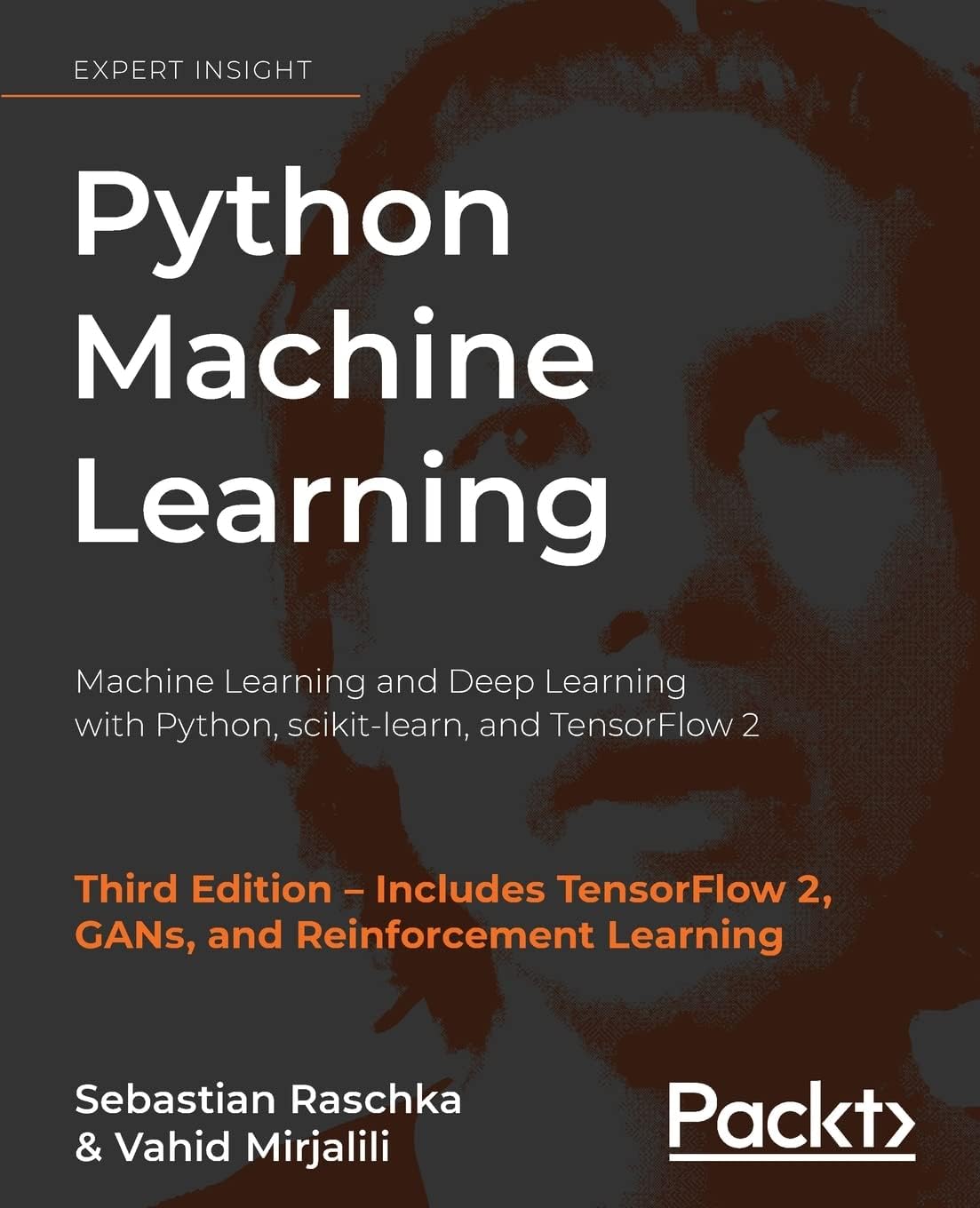
Python Machine Learning: Machine Learning and Deep Learning with Python, scikit-learn, and TensorFlow 2, 3rd Edition
Product ID: 148887041
Buy anything from 5,000+ international stores. One checkout price. No surprise fees. Join 2M+ shoppers on Desertcart.
Desertcart purchases this item on your behalf and handles shipping, customs, and support to Kyrgyzstan.
Applied machine learning with a solid foundation in theory. Revised and expanded for TensorFlow 2, GANs, and reinforcement learning. Key Features Third edition of the bestselling, widely acclaimed Python machine learning book Clear and intuitive explanations take you deep into the theory and practice of Python machine learning Fully updated and expanded to cover TensorFlow 2, Generative Adversarial Network models, reinforcement learning, and best practices Book Description Python Machine Learning, Third Edition is a comprehensive guide to machine learning and deep learning with Python. It acts as both a step-by-step tutorial, and a reference you'll keep coming back to as you build your machine learning systems. Packed with clear explanations, visualizations, and working examples, the book covers all the essential machine learning techniques in depth. While some books teach you only to follow instructions, with this machine learning book, Raschka and Mirjalili teach the principles behind machine learning, allowing you to build models and applications for yourself. Updated for TensorFlow 2.0, this new third edition introduces readers to its new Keras API features, as well as the latest additions to scikit-learn. It's also expanded to cover cutting-edge reinforcement learning techniques based on deep learning, as well as an introduction to GANs. Finally, this book also explores a subfield of natural language processing (NLP) called sentiment analysis, helping you learn how to use machine learning algorithms to classify documents. This book is your companion to machine learning with Python, whether you're a Python developer new to machine learning or want to deepen your knowledge of the latest developments. What you will learn Master the frameworks, models, and techniques that enable machines to 'learn' from data Use scikit-learn for machine learning and TensorFlow for deep learning Apply machine learning to image classification, sentiment analysis, intelligent web applications, and more Build and train neural networks, GANs, and other models Discover best practices for evaluating and tuning models Predict continuous target outcomes using regression analysis Dig deeper into textual and social media data using sentiment analysis Who This Book Is For If you know some Python and you want to use machine learning and deep learning, pick up this book. Whether you want to start from scratch or extend your machine learning knowledge, this is an essential resource. Written for developers and data scientists who want to create practical machine learning and deep learning code, this book is ideal for anyone who wants to teach computers how to learn from data. Table of Contents Giving Computers the Ability to Learn from Data Training Simple ML Algorithms for Classification ML Classifiers Using scikit-learn Building Good Training Datasets - Data Preprocessing Compressing Data via Dimensionality Reduction Best Practices for Model Evaluation and Hyperparameter Tuning Combining Different Models for Ensemble Learning Applying ML to Sentiment Analysis Embedding a ML Model into a Web Application Predicting Continuous Target Variables with Regression Analysis Working with Unlabeled Data - Clustering Analysis Implementing Multilayer Artificial Neural Networks Parallelizing Neural Network Training with TensorFlow TensorFlow Mechanics Classifying Images with Deep Convolutional Neural Networks Modeling Sequential Data Using Recurrent Neural Networks GANs for Synthesizing New Data RL for Decision Making in Complex Environments Review: Good for learning about machine learning, needs development on deep learning - I have not finished this book and I just reached chapter 16, but here are my key takeaways for this book: 1. Everything before chapter 13, before the book fully gets into deep learning and TensorFlow, are great. With already some background in python for data analysis (I have also taken the Andrew Ng's Coursera course on Machine Learning), this book supplements my knowledge greatly. The biggest highlight I would say is that it introduces you JUST ENOUGH concepts for you to understand how everything works. In addition, the contents are structured really well, too. If I were to rate this section of the book, I would give 10/10 although it would be better to have some exercises, you can always practice using Kaggle datasets. 2. Since chapter 13 when the book gets into deep learning, things get worse a little bit... The contents are still good in general, however the connections between contents might not be the case. The connections between contents are important for new learners because that helps them to understand how A leads to B and then leads to C. Here, I found the actual TensorFlow documentation a really good material to review along with the book. After reviewing those documentations, coming back to this book allows me to comprehend much more than reading the first time. In addition, if you are not careful enough, the deep learning sections also seems to have accuracy issues with its contents that could confuse people. Even though I have not finished the book, I would give 9/10 for everything I have read for deep learning. Review: Both practical and complete with theory - It is rare to find a book that covers the topic in ML to a considerable extent. Further, this books contains practical, working examples of ML that are easy to understand and related theory. Great contribution to the learning content in ML.




| Best Sellers Rank | #111,502 in Books ( See Top 100 in Books ) #42 in Computer Neural Networks #53 in Natural Language Processing (Books) #75 in Python Programming |
| Customer Reviews | 4.5 out of 5 stars 497 Reviews |
T**Y
Good for learning about machine learning, needs development on deep learning
I have not finished this book and I just reached chapter 16, but here are my key takeaways for this book: 1. Everything before chapter 13, before the book fully gets into deep learning and TensorFlow, are great. With already some background in python for data analysis (I have also taken the Andrew Ng's Coursera course on Machine Learning), this book supplements my knowledge greatly. The biggest highlight I would say is that it introduces you JUST ENOUGH concepts for you to understand how everything works. In addition, the contents are structured really well, too. If I were to rate this section of the book, I would give 10/10 although it would be better to have some exercises, you can always practice using Kaggle datasets. 2. Since chapter 13 when the book gets into deep learning, things get worse a little bit... The contents are still good in general, however the connections between contents might not be the case. The connections between contents are important for new learners because that helps them to understand how A leads to B and then leads to C. Here, I found the actual TensorFlow documentation a really good material to review along with the book. After reviewing those documentations, coming back to this book allows me to comprehend much more than reading the first time. In addition, if you are not careful enough, the deep learning sections also seems to have accuracy issues with its contents that could confuse people. Even though I have not finished the book, I would give 9/10 for everything I have read for deep learning.
C**E
Both practical and complete with theory
It is rare to find a book that covers the topic in ML to a considerable extent. Further, this books contains practical, working examples of ML that are easy to understand and related theory. Great contribution to the learning content in ML.
A**N
The python code won’t work with the wrong package versions
I have started to read the first chapter and I have found that the book code just don’t run if you don’t have the correct packages in the Python interpreter. Use the following packages versions for python 3.9.13: NumPy 1.21.2 SciPy 1.7.0 Scikit-learn 1.0 Matplotlib 3.4.3 pandas 1.3.2
J**N
Great book, quality issue fixed
I really wanted to like this book, but the printed text is unreadable. Smeared, blurry, and faded beyond legibility. Looks like a washed out photocopy of a page printed on a 1980’s ribbon dot-matrix printer.. but a printer that was partially out of ink. There’s no excuse for this. No reputable publisher would ship material this poor. Update: Was contacted by Amazon rep, and new book with corrected print was shipped free of charge. The replacement text looks great. The book itself is great.. well written, easy to follow, and contains a lot of good information.
V**Y
great book with a perfect mix of mathematical concepts and practical examples
I haven't finished reading yet. I am just about halfway through. I like the fact that this book goes into the underlying math and explains concepts very well. The author provides links to his pdf notes where the details are too much of a digression. Rather than using higher-level machine learning libraries like scikit, tensor flow and keras, the author walks through the algorithms in python and numpy. Overall, this book has the right balance between being hands-on with the code and explaining the math. I am happy I got this.
A**R
Perfect ML foundation for someone with Python experience
I blazed through this book in the runup to a new job involving ML, and it was the perfect text for the job. Not only does it include information on the code side, it also has substantial theoretical fundamentals. I feel like, for the first time, I really understand what SVMs do, or how decision trees are trained. I'd recommend this volume to anyone who, like me, had substantial experience programming in Python and would like to dive into scikit-learn.
Y**O
bad printing quality and no billing, but I received free replacement
1. The quality of printing is bad. 2. I placed the order on Jan 19 2020. When I open the last page of the book, I surprisingly saw "Made in the USA, 19 January 2020", which means they printed the book right after I placed the order. 3. I expect the billing is included with the book. I need it to request reimbursement from my company. But it is missing. Today is Feb 11: I got phone call saying that they provide replacement for free. The new book is on the road. So I am happy to give a better overall rating.
T**9
One of the Best References for Machine Learning
Raschka and Mirjalili's book is required reading for my class in Machine Learning. My students like the clear explanations and illustrations with coding. As a machine learning practitioner, their book is never far away from my computer as reference material. I would recommend that the authors introduce PyTorch and BERT models, among other elements, in their next edition.
T**9
Livraison rapide, prix , qualité de papier
C’est une livre utile !
N**N
Excellent overview of machine learning in python
If you're just starting out this book might be slightly too advanced. It's perfect for junior data scientists who want to refresh their knowledge or touch up on some areas they haven't seen before. In a similar way it would be perfect for people with technical backgrounds such as computer science and mathematics who haven't done any machine learning before but want to.
Q**.
Python Machine learning
Quite good textbook arrived in proper condition.
A**7
Best ML book for pro engineers
Best ML python book
O**E
The time of delivery
Study Business analysis
Trustpilot
3 weeks ago
3 days ago