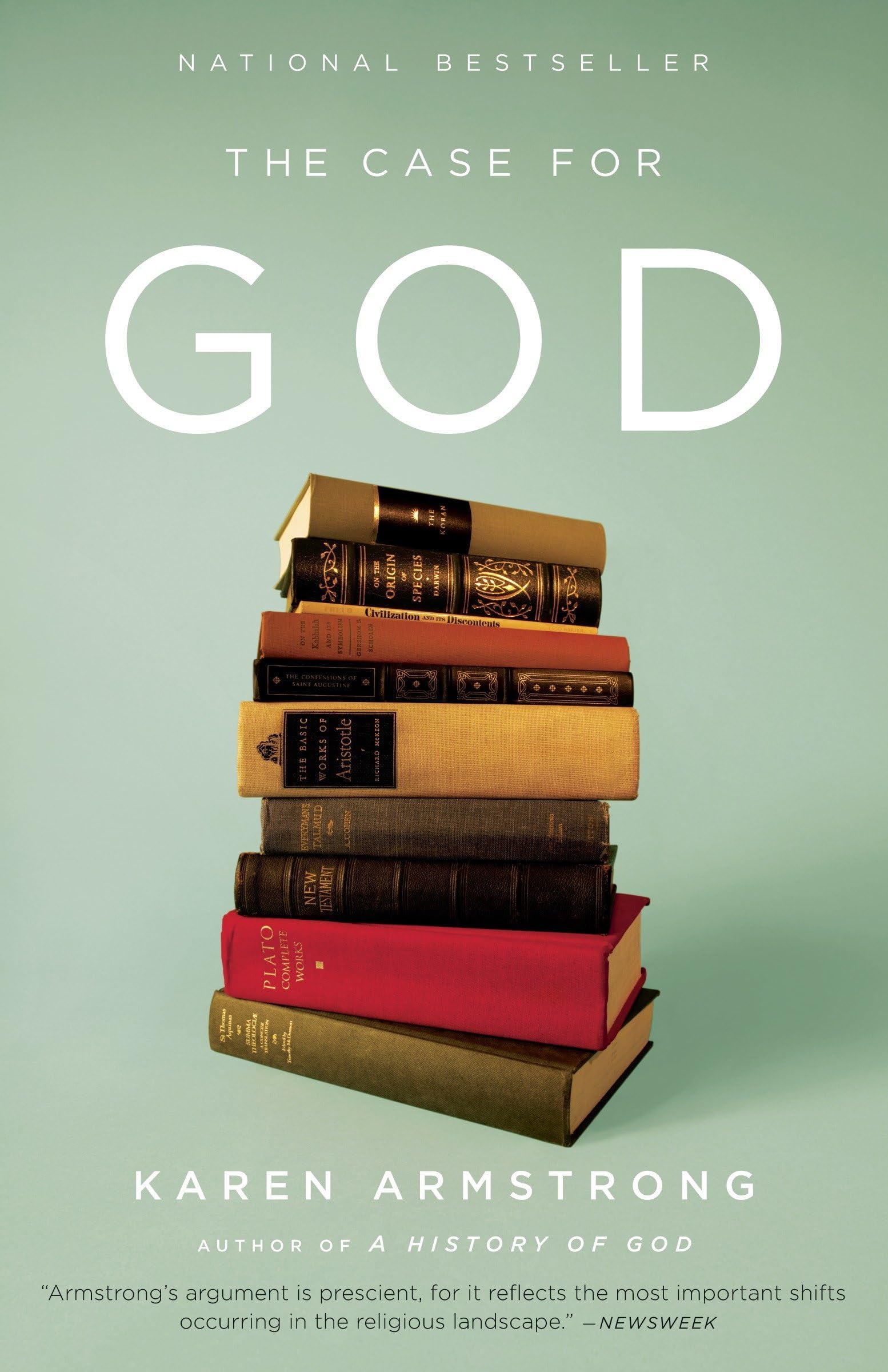
The Case for God
Product ID: 1366538
Buy anything from 5,000+ international stores. One checkout price. No surprise fees. Join 2M+ shoppers on Desertcart.
Desertcart purchases this item on your behalf and handles shipping, customs, and support to Kyrgyzstan.
NATIONAL BESTSELLER • A nuanced exploration of the role of religion in our lives, drawing on insights of the past to build a faith for our dangerously polarized age —from the New York Times bestselling author of The History of God Moving from the Paleolithic age to the present, Karen Armstrong details the great lengths to which humankind has gone in order to experience a sacred reality that it called by many names, such as God, Brahman, Nirvana, Allah, or Dao. Focusing especially on Christianity but including Judaism, Islam, Buddhism, Hinduism, and Chinese spiritualities, Armstrong examines the diminished impulse toward religion in our own time, when a significant number of people either want nothing to do with God or question the efficacy of faith. Why has God become unbelievable? Why is it that atheists and theists alike now think and speak about God in a way that veers so profoundly from the thinking of our ancestors? Answering these questions with the same depth of knowledge and profound insight that have marked all her acclaimed books, Armstrong makes clear how the changing face of the world has necessarily changed the importance of religion at both the societal and the individual level. Yet she cautions us that religion was never supposed to provide answers that lie within the competence of human reason; that, she says, is the role of logos. The task of religion is “to help us live creatively, peacefully, and even joyously with realities for which there are no easy explanations.” She emphasizes, too, that religion will not work automatically. It is, she says, a practical discipline: its insights are derived not from abstract speculation but from “dedicated intellectual endeavor” and a “compassionate lifestyle that enables us to break out of the prism of selfhood.” Review: I wish everyone would read this book - There's an awful lot of talk about God these days; and, frankly, most of it is facile. The internet in particular seems to be constantly abuzz with heated "debate" (if you can even call it that, since it tends more toward an exchange of insults than an exchange of ideas) between "ignorant" believers and "arrogant" nonbelievers who actually think that they are making devastatingly clever, irrefutable arguments when, in fact, most of what they say is so naïve, ill-informed, and poorly reasoned that even a first-year theology or philosophy student couldn't listen to it without facepalming. Sure, if you look hard enough you can find more sophisticated discussions of "the God question", even on the internet; but these can be somewhat difficult for the layperson with little or no background in the philosophy of religion to follow; and thus they tend to attract less attention than do the more puerile debates on popular online discussion forums, and similarly puerile popular books written by well-known partisans in the culture wars. So, in the face of all the nonsense that gets said on a daily basis nowadays by both sides in the God debate, it's refreshing to read this delightful book by noted religious historian (and ex-nun) Karen Armstrong, who devotes 330 pages to patiently, meticulously, and respectfully explaining exactly where both sides in this debate have gone astray, and how believers and nonbelievers alike would benefit from a little more sophistication in how they think about God, and a little more humility in how they approach the subject. Armstrong traces the history of religious thought from ancient times to the present day, to show how our understanding of God -- along with related concepts such as religion, faith, belief, myth, scripture, doctrine, etc. -- has changed over the centuries. In particular, she demonstrates how our modern conception of God is radically different from the way our pre-modern ancestors would have thought about God. The idea of God that many people have today seems overly simplistic when compared with the more sophisticated idea of God that many religious thinkers held in centuries past. In fact, the modern "God" is so simplistic, so limited, so anthropomorphic that it could be seen as idolatrous -- a false god that man has created in his own image. Armstrong argues that the current debate between believers and nonbelievers is really a fight over this false, modern "God", and has nothing to do with the God that the greatest religious minds of antiquity wrote about. I won't try to summarize the differences between the pre-modern idea of God and the modern idea of God, because it gets a bit complicated, and Armstrong explains it much better than I ever could. But, suffice it to say, the arguments you hear so often today about God apply only to the modern "God", and simply cannot be made to apply to the pre-modern God. You'll have to read the book to understand why. If we were to take Armstrong's advice and give up the modern view of God -- and, along with it, the modern understanding of what faith, religion, and scripture are all about -- in favor of an older, more sophisticated approach to these things, the debates between defensive believers and offended nonbelievers would essentially become irrelevant, and we could move forward with a more respectful, more compassionate, and more edifying dialogue between people of all faiths and of no faith. I sincerely wish that everyone -- especially those who take "the God question" seriously enough to get involved in debates over the issue -- would take the time to carefully read this book, and give serious consideration to the merits of Armstrong's argument. Sadly, I fear that the people who are most in need of this book are those who are (a) least likely to actually read it, (b) least likely to understand Armstrong's argument even if they did read it, and (c) most likely to reject Armstrong's insights out of hand simply because they don't fit neatly into their own preconceived worldviews. I am referring, of course, to the most vocal participants in the God debate, namely religious fundamentalists on the one hand, and irreligious fundamentalists (i.e. the so-called "new atheists") on the other. I refer to the new atheists as "irreligious fundamentalists" because (a) the "new atheism" is clearly a reaction against religious fundamentalism, and (b) new atheists actually have a lot more in common with religious fundamentalists than they would care to admit. Both share the same, overly simplistic, modern conception of God, along with similarly simplistic views about what it means to have religious faith. Both insist upon a literalistic interpretation of scripture, refusing to acknowledge that there can be any truth at all in "myth". Both also share the same craving for certainty, and are unwilling to admit that there are some things that are simply beyond human understanding. Therefore, both are obsessed with "proof", each trying to establish irrefutable evidence in support of its own views about God. And, most damningly, both are guilty of hubris, and the intolerance that springs from it. Each views the other with utter contempt, blaming each other for everything that's wrong with the world today. Religious fundamentalism and the new atheism are not so different after all. They are, in fact, the twin offspring of the modern conception of God; and theirs is a true sibling rivalry, which probably goes a long way toward explaining why it is so bitter. So, I will continue to refer to the new atheists as "irreligious fundamentalists", preserving the same family name as their less skeptical, but no less misguided, brethren. Both types of fundamentalists, religious and irreligious, would benefit from Armstrong's insights about God. Both are in desperate need of a more sophisticated understanding of God. Both seem to cling to the image of God they learned as small children -- an image which somehow never matured as they grew up. But if they were willing to give Karen Armstrong a chance, considering her arguments with an open mind, she could teach them a better way to think about God, which would give them a new perspective on what faith is really all about, and what religion can be at its best rather than at its worst. If one were willing, even if only for a moment, just as an experiment, to try to see things the way that Karen Armstrong sees them, one would find that both types of fundamentalism look quite absurd, because both depend on childish notions about God. If everyone who participates in the God debate were to read this book and take it to heart, the debate would still go on; but I am convinced that it would be a much more civil and more productive debate. And that would truly be a blessing from God (or possibly from Darwin -- take your pick; I'm OK with both). Review: Highlights from: “The Case for God” by Karen Armstrong, OBE, FRSL - Karen Armstrong has written an insightful summary of the historical development of the God concept from earliest time to the present. The best review of the major contributions of her case study can be found in the book’s prologue and epilogue. Her overview of the ways in which human interpretations of the transcendental “other” have appeared in history is invaluable in sorting out the objects of religious devotion (or the denials thereof) which have challenged human understanding. To convey the scope and artistry of her analyses, I have selected ideas from her book which particularly appealed to me. She presents her case in two parts; the first is The Unknown God (30,000 BCE to 1500 CE) during which ultimate reality was not a personalized God, but a profound mystery which could never be plumbed (mythos beyond logos). Reality that transcends language must be expressed symbolically, which was variously developed: in Hebrew monotheism, in Greek philosophy, in rabbinical Judaism, in early Christianity, in Eastern orthodoxy and in Islamic revelation. Central to many of these developments were the ideas that accessibility to God involved one or more of: “kenosis” (emptying oneself of selfishness), “pistis” (commitment to engagement), “ekstasis” (stepping out of habitual thought patterns), all of which required long, hard practice or ritual devotion. Attempts to prove God’s existence through logic were proposed, but those who claimed an experience of God seemed to accept the “apophatic assumption” which was that reason was incapable of encompassing what God was. The second part of the book (1500 CE to the present) covers the period in which religion and science were seen progressively to contradict each other. As the scientific method developed, observational and experimental “truths” contradicted metaphorical “truths” in scripture, which were mistakenly taken literally and suppressed for being at odds with doctrine. The philosophical enlightenment of the 18th century attempted to use logic and reason to explain transcendent experience, and this gave rise to deism and atheism but also to literal fundamentalism as a reaction to any attempt to question the veracity of scripture. But secular ideologies, such as the logical positivist’s limitation of meaningful inquiry to objective sense data, are as deadly as religious bigotry, and both represent inherently destructive idolatries. Armstrong observes that “every single fundamentalist movement, scientific as well as religious, is rooted in profound fear and is fiercely reductionistic”. Just as the monkey trial and the use of suicide bombings illustrate the weaknesses of religious fundamentalism, the holocaust as well as Hiroshima and Nagasaki illustrate the danger of science, unfettered by compassion, as a tool of militarism. If we can no longer look to an all-powerful, oriental-despot God who, if properly appeased by devotion and praise, may bless us with favors, what kind of god does this case study suggest? An answer postulated by recent German theologians seems to hark back to "that profound mystery which could never be plumbed" – a.k.a. the ground of all being. Gould has suggested that God belongs to a religious magisterium, concerned with values which is separated from a scientific magisterium which deals only with empirical sense data. Science itself is an act of faith whereas religion requires response rather than belief. In this reviewer’s opinion, Armstrong stops short of summarizing her case, perhaps because she has chosen not to include the insights that have come from analyses of those resuscitated from death or near death. There is growing evidence that consciousness, non-localized to the bodies of individuals in these and other circumstances, can expand to realms similar to, if not identical with, those experienced in mystical traditions, in order to sense that overwhelming oneness and love which is the hallmark of the perennial God experience.
| Best Sellers Rank | #161,452 in Books ( See Top 100 in Books ) #29 in Sociology & Religion #101 in General History of Religion #128 in History of Religions |
| Customer Reviews | 4.5 out of 5 stars 684 Reviews |
G**L
I wish everyone would read this book
There's an awful lot of talk about God these days; and, frankly, most of it is facile. The internet in particular seems to be constantly abuzz with heated "debate" (if you can even call it that, since it tends more toward an exchange of insults than an exchange of ideas) between "ignorant" believers and "arrogant" nonbelievers who actually think that they are making devastatingly clever, irrefutable arguments when, in fact, most of what they say is so naïve, ill-informed, and poorly reasoned that even a first-year theology or philosophy student couldn't listen to it without facepalming. Sure, if you look hard enough you can find more sophisticated discussions of "the God question", even on the internet; but these can be somewhat difficult for the layperson with little or no background in the philosophy of religion to follow; and thus they tend to attract less attention than do the more puerile debates on popular online discussion forums, and similarly puerile popular books written by well-known partisans in the culture wars. So, in the face of all the nonsense that gets said on a daily basis nowadays by both sides in the God debate, it's refreshing to read this delightful book by noted religious historian (and ex-nun) Karen Armstrong, who devotes 330 pages to patiently, meticulously, and respectfully explaining exactly where both sides in this debate have gone astray, and how believers and nonbelievers alike would benefit from a little more sophistication in how they think about God, and a little more humility in how they approach the subject. Armstrong traces the history of religious thought from ancient times to the present day, to show how our understanding of God -- along with related concepts such as religion, faith, belief, myth, scripture, doctrine, etc. -- has changed over the centuries. In particular, she demonstrates how our modern conception of God is radically different from the way our pre-modern ancestors would have thought about God. The idea of God that many people have today seems overly simplistic when compared with the more sophisticated idea of God that many religious thinkers held in centuries past. In fact, the modern "God" is so simplistic, so limited, so anthropomorphic that it could be seen as idolatrous -- a false god that man has created in his own image. Armstrong argues that the current debate between believers and nonbelievers is really a fight over this false, modern "God", and has nothing to do with the God that the greatest religious minds of antiquity wrote about. I won't try to summarize the differences between the pre-modern idea of God and the modern idea of God, because it gets a bit complicated, and Armstrong explains it much better than I ever could. But, suffice it to say, the arguments you hear so often today about God apply only to the modern "God", and simply cannot be made to apply to the pre-modern God. You'll have to read the book to understand why. If we were to take Armstrong's advice and give up the modern view of God -- and, along with it, the modern understanding of what faith, religion, and scripture are all about -- in favor of an older, more sophisticated approach to these things, the debates between defensive believers and offended nonbelievers would essentially become irrelevant, and we could move forward with a more respectful, more compassionate, and more edifying dialogue between people of all faiths and of no faith. I sincerely wish that everyone -- especially those who take "the God question" seriously enough to get involved in debates over the issue -- would take the time to carefully read this book, and give serious consideration to the merits of Armstrong's argument. Sadly, I fear that the people who are most in need of this book are those who are (a) least likely to actually read it, (b) least likely to understand Armstrong's argument even if they did read it, and (c) most likely to reject Armstrong's insights out of hand simply because they don't fit neatly into their own preconceived worldviews. I am referring, of course, to the most vocal participants in the God debate, namely religious fundamentalists on the one hand, and irreligious fundamentalists (i.e. the so-called "new atheists") on the other. I refer to the new atheists as "irreligious fundamentalists" because (a) the "new atheism" is clearly a reaction against religious fundamentalism, and (b) new atheists actually have a lot more in common with religious fundamentalists than they would care to admit. Both share the same, overly simplistic, modern conception of God, along with similarly simplistic views about what it means to have religious faith. Both insist upon a literalistic interpretation of scripture, refusing to acknowledge that there can be any truth at all in "myth". Both also share the same craving for certainty, and are unwilling to admit that there are some things that are simply beyond human understanding. Therefore, both are obsessed with "proof", each trying to establish irrefutable evidence in support of its own views about God. And, most damningly, both are guilty of hubris, and the intolerance that springs from it. Each views the other with utter contempt, blaming each other for everything that's wrong with the world today. Religious fundamentalism and the new atheism are not so different after all. They are, in fact, the twin offspring of the modern conception of God; and theirs is a true sibling rivalry, which probably goes a long way toward explaining why it is so bitter. So, I will continue to refer to the new atheists as "irreligious fundamentalists", preserving the same family name as their less skeptical, but no less misguided, brethren. Both types of fundamentalists, religious and irreligious, would benefit from Armstrong's insights about God. Both are in desperate need of a more sophisticated understanding of God. Both seem to cling to the image of God they learned as small children -- an image which somehow never matured as they grew up. But if they were willing to give Karen Armstrong a chance, considering her arguments with an open mind, she could teach them a better way to think about God, which would give them a new perspective on what faith is really all about, and what religion can be at its best rather than at its worst. If one were willing, even if only for a moment, just as an experiment, to try to see things the way that Karen Armstrong sees them, one would find that both types of fundamentalism look quite absurd, because both depend on childish notions about God. If everyone who participates in the God debate were to read this book and take it to heart, the debate would still go on; but I am convinced that it would be a much more civil and more productive debate. And that would truly be a blessing from God (or possibly from Darwin -- take your pick; I'm OK with both).
D**G
Highlights from: “The Case for God” by Karen Armstrong, OBE, FRSL
Karen Armstrong has written an insightful summary of the historical development of the God concept from earliest time to the present. The best review of the major contributions of her case study can be found in the book’s prologue and epilogue. Her overview of the ways in which human interpretations of the transcendental “other” have appeared in history is invaluable in sorting out the objects of religious devotion (or the denials thereof) which have challenged human understanding. To convey the scope and artistry of her analyses, I have selected ideas from her book which particularly appealed to me. She presents her case in two parts; the first is The Unknown God (30,000 BCE to 1500 CE) during which ultimate reality was not a personalized God, but a profound mystery which could never be plumbed (mythos beyond logos). Reality that transcends language must be expressed symbolically, which was variously developed: in Hebrew monotheism, in Greek philosophy, in rabbinical Judaism, in early Christianity, in Eastern orthodoxy and in Islamic revelation. Central to many of these developments were the ideas that accessibility to God involved one or more of: “kenosis” (emptying oneself of selfishness), “pistis” (commitment to engagement), “ekstasis” (stepping out of habitual thought patterns), all of which required long, hard practice or ritual devotion. Attempts to prove God’s existence through logic were proposed, but those who claimed an experience of God seemed to accept the “apophatic assumption” which was that reason was incapable of encompassing what God was. The second part of the book (1500 CE to the present) covers the period in which religion and science were seen progressively to contradict each other. As the scientific method developed, observational and experimental “truths” contradicted metaphorical “truths” in scripture, which were mistakenly taken literally and suppressed for being at odds with doctrine. The philosophical enlightenment of the 18th century attempted to use logic and reason to explain transcendent experience, and this gave rise to deism and atheism but also to literal fundamentalism as a reaction to any attempt to question the veracity of scripture. But secular ideologies, such as the logical positivist’s limitation of meaningful inquiry to objective sense data, are as deadly as religious bigotry, and both represent inherently destructive idolatries. Armstrong observes that “every single fundamentalist movement, scientific as well as religious, is rooted in profound fear and is fiercely reductionistic”. Just as the monkey trial and the use of suicide bombings illustrate the weaknesses of religious fundamentalism, the holocaust as well as Hiroshima and Nagasaki illustrate the danger of science, unfettered by compassion, as a tool of militarism. If we can no longer look to an all-powerful, oriental-despot God who, if properly appeased by devotion and praise, may bless us with favors, what kind of god does this case study suggest? An answer postulated by recent German theologians seems to hark back to "that profound mystery which could never be plumbed" – a.k.a. the ground of all being. Gould has suggested that God belongs to a religious magisterium, concerned with values which is separated from a scientific magisterium which deals only with empirical sense data. Science itself is an act of faith whereas religion requires response rather than belief. In this reviewer’s opinion, Armstrong stops short of summarizing her case, perhaps because she has chosen not to include the insights that have come from analyses of those resuscitated from death or near death. There is growing evidence that consciousness, non-localized to the bodies of individuals in these and other circumstances, can expand to realms similar to, if not identical with, those experienced in mystical traditions, in order to sense that overwhelming oneness and love which is the hallmark of the perennial God experience.
P**N
The Case for Yoga
In The Case for God, Karen Armstrong doesn't so much argue for God as she argues for the Socratic over the scientific method. For practice over doctrine. For much of the 330 pages, Armstrong gives us a theological history lesson, a tiresome struggle as the strand of thoughts on God and creation evolve over time in back and forth nudges. She breaks the book into two main sections: pre-modern and modern. In a nutshell, pre-modern people saw God as a transcendent and indefinable thing, only attainable through ritual and intellectual rigor. This is what gave meaning to their lives. If you think of Buddhism, Confucianism, and Daoism, Armstrong argues that this is what virtually all religion was like in pre-modern times. Key to her argument though is that pre-modern people did not take scripture literally. In fact, they seemed to revel in exegesis, or `the art of interpreting and explaining the text of scripture'. They discussed scripture and understood it as symbolism, or as myths, and by doing that, attained greater wisdom and comfort in their lives. This point is what both atheists and most religions miss today, Armstrong argues. Modern people meanwhile have been influenced by science. At first, religion used science to their advantage, primarily by claiming that only God could have created such a complex, natural world. However, as more and more things were explained (other than the origin of it all, which remains a mystery) it became harder for theologians to keep up, until eventually, science and religion stood on opposite sides. It is in this environment that the modern God was created. In a world where people needed certainty and religion came under constant fire for their seemingly outlandish beliefs, a more defined, an even more outlandish God came about: one who controlled all aspects of the world and would send you to hell if you sinned. Or, in the view of Armstrong, an idol, a being held on a pedestal to be worshipped and adored. Or, in further contrast to the pre-modern concept of God, one who deprived life of meaning rather than gave it. One was not free with the new God; their reward would be in the hereafter. It is this God that atheists now attack and Armstrong seems to agree with their arguments as it pertains to this modern God, though she thinks their antagonistic methods and lack of theological education do damage to what she thinks is an important dialogue. And in the end this is what she argues for: dialogue, in the Socratic method. She wants atheists to lay down their arms and use their intelligence to better the world. She argues that they create fundamentalism through their antagonism. Further, by arguing against scripture and ignoring the virtues of religion, they make the same mistakes fundamentalists do by taking scripture literally. She wants them to discuss theology with the religions of the world to advance the human race. She wants to go back to the old way of thinking, where people focused on practice, on activities that help us engage with God, such as civil discussion, meditation, prayer, volunteering, etc. She wants us to leave science and religion separate to deal with what they each do best. And by doing that, by giving up on using science to explain God, we will submit to the unknown and become, like the mystics, more wise and loving. I thought the strength of this book was the bookend opinion sections. The history she provided in the core was interesting, but a slog to get through, and ultimately not necessary for her argument. Much of the history she presents is interpretive anyway, which doesn't become fully evident until she discusses events of the last decade or so, when we can clearly see based on our direct experience of the events that she's presenting a large dose of opinion with her facts. But I think her broader argument is spot on. Right now the debate between religion and atheists is at a standstill, and I believe it is sucking the world dry of spirituality. Life is chaotic, and people are looking to faith of some sort to help them through. The need for spirituality will never go away. People need to be comforted when bad things happen, they need to feel they are making a difference. Science will not do that. I dont think it's a coincidence that, while modern religion is increasingly shunned these days, so many people are now studying Buddhism or taking yoga. It's these ancient elements of practice and compassion that people need to help improve their lives and feel transcendent. And it's these very things that Armstrong argues for.
W**E
historical beliefs about God
This is an excellent book. No one should find this book offensive. That said, this book is one of the best sleep aids I have ever had. It was difficult to get through the first quarter of the book. It was interesting, but it just didn't excite me. After that, the book was wonderful. And the early part was important to understanding some background for later material. The book relates many interesting historical perspectives and events. I came away with two overall perspectives. The first one is tradition. I was reminded of the musical "Fiddler on the Roof" and its song "Tradition". Why do we do these things? Tradition! Our whole lives are filled with tradition. Allegedly, Roman Senator once said, "All my great ideas have been stolen by the ancients." How true! My religious views are not necessarily new or better developed; they are just part of the historical views of religion that keep coming around. Religion is beyond our understanding; therefore, everything we think or say is inadequate. To keep from becoming idolatrous in our religion, we need to change among these views (the second perspective). The similarity I see are the various management styles in companies: none is adequate; which ever one is being used is lacking; so the next manager changes the style to something else and we just keep reusing old styles. The new style is not any better--it's just different, but it may temporarily get us out of the rut we were in. Religion changes to try to change government and society. In the same way, we need to keep changing the perspective of science, philosophy, and government because all are beyond our understanding and therefore flawed. None will ever be perfect; our desire for perfection in knowledge and understanding may continue, but we will always be unknowing and imperfect in our understanding no matter how much we (individuals, societies, and humanity) ever understand!
H**I
An excellent book for anyone interested in the history of science and religion!
I am not a religious person, though I was raised that way. Along the way I lost my faith and fell in with the "angry atheist" crowd. I've read just about every book out there decrying religion but I never thought to read any material from the other side of the fence. One day I realized how absurdly biased this stance was so I rented this book from the library. I tore through it quickly and then ordered it from Amazon. Armstrong did not convince me to return to my faith, but she did convince me to view religions and their followers in a different light. Learning the history of religions from all over the world, how they have benefitted and furthered science in the past, and how the schism between religion and science came to be gave me a much more favorable view of faith in general. Religion may not work for me personally, but I no longer feel the bitterness and anger towards faith that people have come to associate with millennials who have chosen a life without religion. If you enjoy history and philosophy, get this book. If you are interested in the history and development of religion in particular, get this book. If you are an atheist but are trying to ensure that you maintain a fair and egalitarian view of your fellow human beings (as all atheists CLAIM to do but often fail at) while being as informed as possible, get this book. If you are parents or loved ones of a person who is straying from their faith and you are trying to convince them not to, get this book. If you ARE that latter person, be aware that though you may not succeed in convincing your loved one to maintain their religiosity, you will at least encourage them not to be quite so annoying and rude about their absence of faith.
J**A
Worth savoring
The title of another book out last year excited me--The Evolution of God--but when I heard the author speak I was disappointed. (There was a lot of talk about zero sum game.) Armstrong's book is what I had hoped for from the other. It covers the changing ways people have viewed God and religion, from 30,000 BCE, when humans crawled deep into caves to cover their walls with paintings of animals and maybe shamans, to the present, when both fundamentalists and atheists insist on a strict literal interpretation of scriptures--a legacy of the modern scientific revolution that has left everyone, including the devout, looking for unambiguous, objective truth derived from some kind of logical deliberation. The modern way is simplistic; Armstrong believes religious life involves hard work, pushing finite hearts and minds to the edges of their understanding, toward the infinite. I took a long time to read this book and as soon as I finished I started reading it again. There is a lot to absorb and a lot that challenged my unexamined beliefs, a mind-blowing experience that's my drug of choice. As an an agnostic leaning toward a non-belligerent atheism, reading is almost my religion, so when Armstrong wrote convincingly about the printing press's drawback of moving learning and religion in a depersonalized and inflexible direction, leading in religion's case to ridiculous disagreements over finer and finer dogmatic distinctions, I was shocked into a speechless, apophatic state. One of many I experienced while reading her book. Which is maybe, or maybe not, ironic because that apophatic experience I got from reading is the right place, Armstrong believes, to begin transcending our everyday world and experiencing God. Religion, Armstrong writes, historically has been and should be more about practice and experience and less about blind belief in particular doctrines. Sounds great to me.
D**T
I wish the author would be more honest about her bias.
I bring a bias to this review. I am a Christian. I believe Jesus Christ is my Lord and savior. Jesus is both God and God's son and God created the universe. Armstrong sets up her case right in the beginning. There are two ways to look at the world, called "logos" and "mythos." Logos is reason and logic. Mythos, or myths, "were really focused on the more elusive, puzzling, and tragic aspects of the human predicament that lay outside the remit of logos." I don't know what this means, but then I am not a philosopher. This is probably another bias I bring to this review. I wish Armstrong would honestly reveal her bias. After reading through a summary of the history of the entire world, her argument boils down to this: God did not create us, we created God. She never says this overtly - but if I'm reading what she's trying to tell me, that's what mythos is all about - people trying to explain what they see in the world around them using made-up stories. Armstrong claims that in the old days, our ancestors knew the difference between myths and reason. It's only recently that we try to apply logic and reason to everything, even stuff our ancestors made up for which logic and reason were never meant to apply. So that's her argument. 330 pages boiled down to one paragraph. Except Armstrong is wrong. I just said I'm a Christian and now I'm going to quote the Bible. Predictable, right? Isn't that what we Christians always do? We quote the Bible to try to prove the Bible is true and then Atheists hammer us for circular reasoning. Well put the hammers away for now. We all agree the text we accept today as the New Testament portion of the Bible was written in the first century AD. Like it or not, it's a historical document. We can find out a lot about how people in that day went about their business and viewed the world. So if, as Armstrong claims, we only recently tried to force-fit myth into a system of modern reasoning and the Scriptures were never meant to be taken literally, why did Paul say this in 2 Timothy, verses 16 and 17, nearly 2000 years ago? All Scripture is God-breathed and is useful for teaching, rebuking, correcting and training in righteousness, 17 so that the servant of God[a] may be thoroughly equipped for every good work. Now I'm no Greek scholar, but today's English Bible is the work product from some of the best scholars on the planet. So we can be confident that least one opinion leader from roughly 2000 years ago was of the opinion that Scripture was more than a myth somebody made up to help his friends feel better. Armstrong is not completely in the weeds. As much as I don't like it, her description of how today's Old Testament came to be meshes with what the smartest people I can find say. The Old Testament we see today is the product of hundreds, maybe a couple thousand years of editing. One example - Moses could not possibly have written all the first 5 books of the Old Testament because the text in the last chapter of Deuteronomy describes how Moses died. The bottom line from lots of scholarship - apparently we don't know who wrote these books and much of the Old Testament. So what do we do with that? Since we don't know who wrote these original Scriptures, how can we trust what they say? Here's the part Armstrong glosses over. We trust the Old Testament because we have rock-solid evidence supporting the authenticity of the New Testament. The people in the New Testament trusted the Scriptures of their day - what we call the Old Testament today. Because they trusted their Scriptures, we trust their Scriptures because we have ample evidence to trust them. It's called a transitive trust. Greg trusts Paul, Paul trusts David, so Greg also trusts David. Granted, it's not as good as directly testable evidence, but it's much better than what Armstrong claims. Armstrong finally reveals her bias against Christians starting with this paragraph near the bottom of page 293. "Christian fundamentalists take a hard line on what they regard as moral and social decency. They campaign against the teaching of evolution in public schools, are fiercely patriotic but averse to democracy, see feminism as one of the great evils of the day, and conduct a crusade against abortion. Some extremists have even murdered doctors and nurses who work in abortion clinics. Like evolution, abortion has become symbolic of the murderous evil of modernity. Christian fundamentalists are convinced that their doctrinal "beliefs" are an accurate, final expression of sacred truth and that every word of the Bible is literally true--an attitude that is a radical departure from mainstream Christian tradition. They believe that miracles are an essential hallmark of true faith and that God will give the believer anything he asks for in prayer." Where do I even start with this diatribe? Maybe with the last sentence. Contrary to Armstrong's stereotype, Christianity does not teach that God will give us anything we ask for in prayer, nor does the Bible offer any evidence to support such nonsense. Although it's true that a few highly paid prosperity preachers lift Bible verses out of context to teach this stuff, they are wrong. In fact, all but one of Jesus's original disciples were executed and Jesus Himself endured unspeakable pain. Why would modern Christians expect anything different? It is also true that many Christians are prolife. Although we believe human life starts at conception, it is absolutely false that Christianity condones murdering doctors and nurses who work in abortion clinics. For Armstrong to suggest such a thing is offensive and sensationalist. Every group has a lunatic fringe, even Atheists, and Armstrong does herself no favors by trying to package all Christians into this fringe. Since we believe that life starts with conception, does it not make sense that we would campaign hard to change the law of the land to get rid of abortion? For those who argue that abortion represents a woman's right to choose, consider that roughly 50 percent of all unborn babies are future women. What rights are granted to these unborn babies with no voice? We believe those unborn babies who have no voice should be granted the right to live. This is not subjugating women, it is compassion for those who need it most. And as for seeing feminism as one of the great evils of the day - where do Armstrong and others come up with this stuff? Although there is no denying that men, including Christian men, have treated women badly over the generations, the real truth is, treating women like second-class citizens goes against Christian teaching. If you want equitable treatment under the law, look no further than our own sacred book in Ephesians, Chapter 5, verses 21 through 28, where Paul instructed Christians of his day in a radical new way of thinking. 21 Submit to one another out of reverence for Christ. 22 Wives, submit yourselves to your own husbands as you do to the Lord. 23 For the husband is the head of the wife as Christ is the head of the church, his body, of which he is the Savior. 24 Now as the church submits to Christ, so also wives should submit to their husbands in everything. 25 Husbands, love your wives, just as Christ loved the church and gave himself up for her 26 to make her holy, cleansing[b] her by the washing with water through the word, 27 and to present her to himself as a radiant church, without stain or wrinkle or any other blemish, but holy and blameless. 28 In this same way, husbands ought to love their wives as their own bodies. He who loves his wife loves himself. How anyone can pervert that text to make a claim that Christianity somehow advocates subjugating women is a mystery to me. Far from anti-feminist, Christians should be and often are leaders in the campaign for equal rights for women. Let's be clear here. Men and women are different. This doesn't mean one is better than the other, just that we're different. Want evidence? Does anyone reading this remember seeing a pregnant man walk down the street? Women carry babies. Men don't. We're different. Duh! Get used to it. To try to build a case that women and men are equal is ludicrous. Armstrong should build the case for equitable treatment and equal rights, not for the fiction of absolute equality. This is a mistake many feminists make and it only harms the cause. In Armstrong's defense, she is an equal opportunity critic and she destroys modern atheism starting around page 303 or so. It's amazing the mental gymnastics today's Atheists use to try to deny faith and here is one paragraph on page 305 where she demonstrates that Atheists do indeed have a faith: "As its critics have already pointed out, there is an inherent contradiction in the new atheism, especially in its emphasis on the importance of "evidence" and the claim that science always proves its theories empirically. As Popper, Kuhn, and Polyani have argued, science itself has to rely on an act of faith. Even Monod acknowledged this. Dawkins's hero Darwin admitted that he could not prove the evolutionary hypothesis but he had confidence in it nonetheless, and for decades, as we have seen, physicists were happy to have faith in Einstein's theory of relativity, even though it had not been definitively verified. Even Harris makes a large act of faith in the ability of his own intelligence to arrive at objective truth--a claim that Hume or Kant would have found questionable." So I'll give the book 3 stars. Even though her fundamental point - that we created God instead of God creating us - is wrong, she still taught me some things and I owe her credit for that. But, revealing my bias again, I hope I don't have to read any more philosophy books.
B**Y
There are no answers, only questions
If you came for answers, you will be disappointed, but if you came with an open mind, there are things to be learned here.
M**A
Fantastic book
Fantastic book, K. Armstron did unbelievable job in compiling this amount of research and writing with such clarity and passion! I realized I knew nothing of essence of any religion, and this book was an eye opener which prompted me to explore further. The paper book itself is a soft cover, and arrived not on the best condition. The font is quite small. I'd recommend buying it in a hardcover, it's easier to read and it (obviously)has greater quality.
A**C
Lasciate perdere
Un all-you-can-eat antropo-spiritual-filosofico che mischia concetti senza approfondirli mai, confondendoli in un pastone informe. Per intenderci, in poche pagine l'autrice liquida tutta la filosofia greca, dai presocratici a Aristotele, riassumendo (bontà sua) quello che questi grandi pensatori intendevano quando parlavano di Dio (o dio, a seconda dei casi). Come dire, "brevi cenni sull'universo". In molti punti traspare l'obiettivo di dimostrare che la Bibbia non può essere interpretata in senso letterale; magari la polemica ha senso nei confronti dei fondamentalisti a stelle a strisce, ma non fa che rendere ulteriormente insulso il libro. Cito una castroneria tra tante giusto per esemplificare. L'autrice sostiene che in realtà Dio non esiste, perché evade le categorie della realtà, tra cui l'esistenza. Ricordo la lezione in cui il mio prof di filosofia di liceo distinse tra essenza e esistenza; la Armstrong forse ha bigiato quando dovevano spiegarlo a lei. Per me è difficilissimo non finire i libri che inizio a leggere, ma in questo caso ho gettato la spugna a circa un quinto.
P**R
Perfecto
Tal y como esperaba. Es perfecto para lo que necesitaba. La descripción se ajusta al producto. Muy satisfecha. Muy recomendable.
M**H
Again, an awesome work by Karen Armstrong
Beautiful but little hard to understand, it requires a lot of knowledge and understanding to read it..
J**R
The Case for God
Having read Dawkins' "The God Delusion" and enjoyed it, I knew I would have to read this book at some point to get the other side of the story. I was absolutely blown away. Please excuse the lack of scholarship in my review, but I can only urge you all to read Karen Armstrong's book, and then some more by her. I have now also read "The Bible The Biography" and am currently immersed in "A History of God", which is quite terrific. Reverting to "The Case for God" for a moment, I have to say that the subtitle is quite excellent - "What Religion Really Means". I see now that this is something you won't learn from Richard Dawkins or any of his fellow horsemen of the apocalypse. I speak as an apostate from Protestant Christianity into Dawkinsite atheism. Thanks to Karen A I now realise that neither as a Christian nor as an atheist have I ever understood what it is to be religious. Key among Karen's observations are: (1) Christian, Jewish and Muslim theologians have know for the past 6 centuries that God doesn't exist. (2) God is hard work. If you examine the root of the word believe (Latin credo), it has nothing to do with an intellectual assent to a set of doctrines, but a disciplined struggle to achieve wholeness and wisdom. (3) Karen A is quite happy to learn from thoughtful atheists such as Julian Baggini, but R Dawkins and others have such a primitive grasp of theology that their contributions are of little merit. Dawkins and his critics are arguing about the same very limited version of religion and so are indistinguishable to a scholar like Karen. Sorry, I am going on about Richard Dawkins all the time, when the whole point is to wean myself off popular atheism for a bit. Karen starts her book talking about "logos" and "mythos" as two distinct paths to truth. As post 18th Century Enlightenment human beings in the scientific age we are used to "logos" or, loosely speaking, reason. We take it for granted that the scientific method yields truth. The idea that "mythos", which encompasses story telling and an artistic/ritualised re-enactment of important moral experience, should also lead to truth is an initially very strange idea. As is the idea that such truth can only be grasped intuitively. Words and pictures can point the way, but they are not the thing itself. If we want to get something out of religious texts, then we need to approach them as did pre 18th Century Enlightenment Christians, that is we need to discover and create our own meanings. Religion changes and adapts and that's how it manages to keep going. The premise of religion is surely right, that human experience can be unbearable and needs healing. I'd better stop before I reveal too many shortcomings as a new theologian. Suffice it to say that you should read this book, from whatever persuasion you come, if you want to find out new things about religious experience. You are in safe hands. Karen Armstrong is a wonderful scholar, at once knowledgeable and profound, but also witty and generous hearted. A few years ago at Amman airport I noticed that one English writer had four books in the bookshop. The author was Karen Armstrong. That was an earlier inking that her books might just be worth reading. I understand that, among her other achievements, she is the only theologian coming from a Christian perspective who is well liked and trusted in the scholarly Jewish and Muslim communities.
Trustpilot
4 days ago
1 month ago