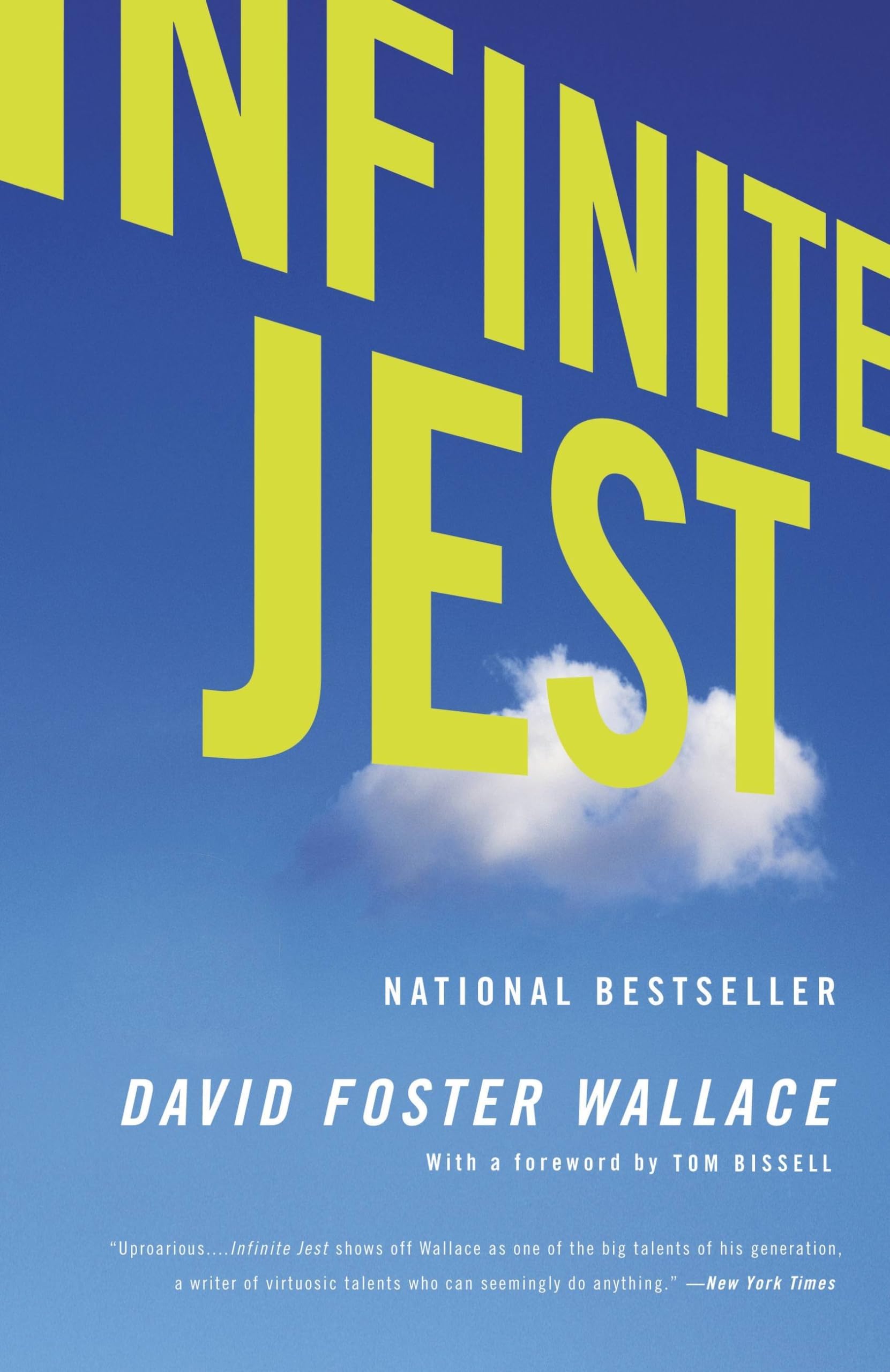

Infinite Jest
Product ID: 1365034
A gargantuan, mind-altering comedy about the pursuit of happiness in America. Set in an addicts' halfway house and a tennis academy, and featuring the most endearingly screwed-up family to come along in recent fiction, Infinite Jest explores essential questions about what entertainment is and why it has come to so dominate our lives; about how our desire for entertainment affects our need to connect with other people; and about what the pleasures we choose say about who we are. Equal parts philosophical quest and screwball comedy, Infinite Jest bends every rule of fiction without sacrificing for a moment its own entertainment value. It is an exuberant, uniquely American exploration of the passions that make us human - and one of those rare books that renew the idea of what a novel can do. Review: A working vacation - INFINTE JEST. (1996) David Foster Wallace. Everything you have heard, read, and that has been said about Infinite Jest is true. Should YOU read it? Is the only relevant question. This book is work--it's going into the gym and the classroom. (It is 1079 pages and holding it requires strength and strategy. And Kindle, iPod, or cd isn't a remedy because of the classroom aspect--you will want to highlight, and write in the margins; and it requires two bookmarks--one for the body and one for the endnotes.) This book, though a novel, is a journey into the mind of David Foster Wallace and is one long suicide (Wallace hung himself 12 years after publication at age 46) note. But it is not grim and dour. It is, at times, gruesome and frightening, yes, and also funny, and always insightful into the human condition and especially the American pursuit of happiness and pleasure along with the concurrent escape from discomfort and pain. And mostly about the inherent and ironic conflict between pleasure and pain--how the relief of pain into pleasure ultimately creates more pain, which causes one to seek more relief/pleasure, i.e. a psychological and physiological trap--a cage with no way out ... except maybe through a Twelve-step program which is SO boring so as to be not worth the effort. And then, there is reincarnation--which DFW never calls by name (something he does with the Psychoanalytic Reaction Formation, also) but which plays a huge part in the story. Both. Should YOU read it? I rank it as one of the four best books of all time. I lived with it for three weeks pretty much not doing anything else but reading and thinking about what Wallace was saying. I stopped drinking (One theme is addiction) and didn't bother to go out or watch any entertainment or do any work of my own (writing). It, the book, moved into my mind--took up residence in my apartment, became my roommate. Of course that is ironic also because the book's first name was "A FAILED ENTERTAINMENT," and the book is the most entertaining thing I've ever experienced - passively; but then it is work so it's not completely passive, as say watching something - "spectation" Wallace calls it. What the book is is inside the brain of a particular personality who happens to be a genius with a photographic memory (which again he doesn't name but describes: "Hal [a central character] can summon a kind of mental Xerox of anything he'd ever read and basically read it all over again, at will, ... ." (Pg. 797) I think parts of Wallace surface in all of the characters (there are scores of them) and what he does is to debate through interior and exterior dialogue, btw & w/in characters. Ideas/thoughts/philosophy (and of course this is discussed. He also critiques his own writing style via this, his technique,) Wallace's personality is, if categorized by the trait theory of The Big Five (OCEAN) [I think]: Extremely high O (open) slightly less but still very high C (conscientiousness), somewhat low E (extraversion, i.e Introverted), somewhat low A (agreeableness) and somewhat above average N (neuroticism). Add to that an extremely high I.Q. with that memory thing, a large physical presence (6'2, 200lbs.) and a cute and interesting face and you've got the man. If you think you can relate to those characteristics--you'll probably be taken by, and drawn into the novel as I was. [About being high O. Highly Open persons tend to be bored by people below them on the continuum, which looks like arrogance, elitism, snobbery, creative showoffishness, etc. Openness is the trait most associated with creativity. They also tend to be low in A (a `pussified' trait) for obvious reasons.] That by way of introduction. Briefly now, a look at Infinite Jest by way of the six elements of a story. Title: Perfect, either one. Defines the book. Plot: There is only a very almost inconsequential one. It is sometimes a distraction. It is about the relationship btwn the USA and Canada and the use and disposal/reuse of energy and territory. In an interesting way - it is woven into the pleasure/pain conundrum and so therefore worth some consideration. The personal and political intersect with, I think, some very bizarre drug enhanced imaginative thoughts and ideas. Free association. Characterization: There are three main protagonists. Hal Incandenza, a 17 yr.old, privileged white boy, at an elite youth tennis academy in Massachusetts; founded by his father (alcoholic) and run by his mother (OCD). Hal is addicted to marijuana and nicotine and a gifted and highly rated tennis prospect. He has younger residents/students/players he mentors, as well as two brothers who play prominent roles. Don Gately, a 29 yr. old, staff resident of a halfway house for recovering substance abusers, located adjacent to the tennis academy. Don is 9 months sober and oversees other recovering addicts. He is recovering from addiction to downers and a life of crime. Remy Marathe, (of unknown age) a legless Canadian, and member of a group of wheel chair assassins involved with the USA v. Canada's political/environmental/territorial mess. There are numerous sub-characters within these three facets of the story - the tennis academy, the halfway house, and the governments of the two countries. There is a prominent female character, Joelle van Dyne. She is involved with Orin Incandenza (Hal's older brother); James Incandenza (Hal's father); Mario Incandenza (Hal's younger, deformed, brother); and Don. She is also a person of interest i/r/t Remy's work. She is addicted to crack cocaine and a girl of exceptional beauty--the P.G.O.A.T.--the Prettiest Girl On The Planet. To me, none of the characters were all that likable. Setting: The story takes place mostly in and around Boston, Mass. USA in the near future [The book being written in the mid 90's.] year of 2007. It is spring through fall and there is rain, humid heat, and snow. The "action" is mostly in and around the tennis academy, the halfway house and the seedy underbelly of Boston. There is also the desert SW around Tucson. Wallace is the best I've ever read of painting landscape and cityscape with words. He is also the best at the littlest details of people behavior. [Reading him is in some ways like opening your eyes to the world for the first time.] The zeitgeist is a future that revolves around telecommunications and entertainment, both voice and video. It is eerily accurate i/r/t where we are today. [It was written pre Internet & wireless explosion.] Style: This is maybe where most people simply go batty and throw the book against the wall. There is no consistent POV or voice save for Wallace's. He breaks every rule (for writing) there is ... and yet he pulls it off. All the characters pretty much talk the same, with the same idiosyncrasies, i.e. Wallace's. He uses conjoined conjunctions up the wazoo: "And so but... That thus this is why... So and but that night's next ..." etc. He repeats words: "Then he considered that this was the only dream he could recall where even in the dream he knew that it was a dream, much less lay there considering the fact that he was considering the up-front dream quality of the dream he was dreaming." [then he adds, mocking himself] "It quickly got so multileveled and confusing that his eyes rolled back in his head." (pg. 830) Events are not lineal. Sometimes events and persons don't become clear for 100s of pages. He makes up words. He uses obscure words. He uses acronyms up the wazoo. He uses endnotes that are stories in and of themselves. The endnotes sometimes explain the main story. There can be page upon page w/o a paragraph break. His segues sometimes are just barely, and then ... the sidebar has next to nothing to do with anything except - the central theme(s). This is the where the personality factor of Openness factors in--if you're not of a like mind/brain--it'll drive you nuts. The story has no ending, the book ends. Theme: The strongest case for reading this book. DFW says the book is about: Tennis; Addiction; & Entertainment. It is that, and more. Some readers struggle with the minutiae of tennis. But the game of tennis and the discipline required is a metaphor for life, in Wallace's mind. This is what is taught at the academy, and also all the AA stuff, characters and references. Delay of gratification and effort and struggle are their own rewards ... blah,blah, blah and yada, yada. Life is a GAME and it is not about you or who wins that matters. Ironically--nothing matters. Addiction is covered from head to toe, from its genesis to its usually horrific conclusion. You think you're not, addicted, maybe you should read this book for that reason. Entertainment and the individual and that relationship- ship's- ships' (Wallace's style is infectious) exploitation by design and by fate (Never named.). Then there is the issue of control, choice, and self-determination, which is the underpinning of The Game, Addictions, & Entertainment. Is it (control) really just a delusion? So why not - seek pleasure and submit to ecstasy? And running beneath the underpinning is all the unnamed Freudian stuff (Also, never named.)--that childhood decides. That even the best of intentions can have disastrous consequences, and not even here to get into all the horror of the ubiquitous neglectful, abusive, and incestuous parenting stuff that Wallace explores. And finally [not really possible] Wallace's take on reincarnation--that YOU will be killed by a woman, and that that woman will be your mother in your next life. Got time? Time to explore who you are and why you do what you do--to step outside your cage and study yourself as subject? Take a vacation ... haha. Review: What Drives a Great Writer? - David Foster Wallace's Infinite Jest (1996) and Don DeLillo's Underworld (1996) are each a great writer's take on the state of American culture at the end of the 20th Century, and can be read together to form the kind of comprehensive picture of our social universe that only great novelists can provide. One (DeLillo's Underworld) looks backward from the point in time of the end of the cold war to its earliest days and traces its key characters through their formative years into maturity, with its narrative center of gravity the October 1962 nuclear crisis over the USSR's nuclear-armed missiles in Cuba as told by the stand-up comic Lenny Bruce, its cathetic object a baseball, and its aesthetic fulcrum the middle-aged Klara's massive project in the early 1990's to paint in bright colors an entire fleet of B-52 bombers mothballed in the Arizona desert. The other (DFW's Infinite Jest) looks forward from about the turn of the 21st century to the main narrative action of the novel that takes place in about 2010 (which DFW denominates as the "Year of the Depend Adult Undergarment"), with its cathetic object a tennis ball, and its aesthetic fulcrum the highly sought-after video film "Infinite Jest" that had culminated the film-directorial career of one James O. Incandenza, who commits (spectacular) suicide shortly after producing the film. Infinite Jest follows the three children of J.O. Incandenza (Oren - age 23, Mario - 19, and Hal - 17) during the latter part of the Y.D.A.U., the last two of whom are living at the tennis academy in suburban Boston founded by J.O. and now managed by his wife Avril and her new husband. (This is not the narrative structure of that great chronicler of the American pater familias, Joyce Carol Oates. The J.O. of DFW's Infinite Jest never appears as himself in the novel - although he is spoken about often, and he even appears early on in disguise to a ten-year old Hal.) Infinite Jest also follows the travails of a wacky group of residential inmates at a drug-and-alcohol recovery halfway house that is next door to the tennis academy and just down the hill from it. (Big Don Gately is the head night-duty resident, and one of his tasks is to keep a log of the inmates' activities and compliance with the house's rules, and to be available to provide a sympathetic ear to any insomniac in the early stages of withdrawal from substance abuse -- check out the early a.m. discussion between Gately and the new resident Joelle over why she wears a veil). These two groups have interlocking narratives that are both surprising and revealing, and form the bulk of the novel's attention, including as a key theme the question "What drives such high suicide rates in substance abusers?" But wait, there's more. In a dystopia reminiscent of Phillip K. Dick's masterpiece The Simulacra, America circa 2010 has morphed into an EU-like organization of the U.S., Canada, and Mexico, with a bland crooner for a President who seems much less than a real person, and with a knee-jerk response to the (inevitable) environmental crisis from toxic pollution that entailed cutting off most of Vermont, New Hampshire, and Maine and forcibly making it part of Quebec (which DFW calls 'experialism'), building a giant plexiglass wall along the new border with giant fans the size of power plants to blow the Boston area's toxic air into the 'Concavity' now formed by the rejected part of the Northeast U.S., and using huge catapults to launch large bundles of garbage from Boston (nearby the tennis academy) into the Concavity. Needless to say, this has caused a group of disaffected Quebecois known as the 'Wheelchair Assassins' to plot revenge (they are legless, and like so much of the story, the etiology of their disability is explained in the extensive notes located at the end of the novel), and their weapon is the - reputedly - profoundly compelling last film by J.O. Incandenza, so compelling to watch that anyone who sees it can't stop watching it, to the point of dying of thirst, hunger, or whatever pathology is the result of constant repetitive viewing of a video film. (Yes, DFW is obviously a big fan of Monty Python.) The Wheelchair Assassins have set about locating the master copy (the extant copies are copy-protected, and anyway they can't view them for themselves since they would perish), which has taken them to the doorsteps of the children of J.O., and, mostly unknown to each of them, they are in mortal danger. OK, those are the main narrative threads. But there's so much more. Metafictional elements are brought out - among other things - by an academic-sounding narrator (who seems mainly to be the author of the endnotes) whose primary interest is cataloguing the J.O. Incandenza film oeuvre, mostly by listing them in chronological order and identifying actors, film type, camera type and techniques, etc. DFW travesties the self-important cant of the academic film-criticism industry throughout the novel - see especially the 9-page endnote 24, titled "J.O. Incandenza: A Filmography," referencing such erudite studies as Comstock, Posner, and Duquette, 'The Laughing Pathologists: Exemplary Works of the Anticonfluential Apres Garde: Some Analyses of the Movement Toward Stasis in North American Conceptual Film;' the listing in the endnote for the J.O. film 'Homo Duplex' - a "[p]arody of Woititz and Shulgin's 'poststructural antidocumentaries,' interviews with fourteen Americans who are named John Wayne but are not the legendary 20th-Century film actor John Wayne;" and the discussions at various places in the novel's text of J.O.'s 'The American Century as Seen Through a Brick,' and 'The Medusa v. The Odalisque.' Just listing a director's films and categorizing them according to some academics' notions of an artist's 'period' shows no depth, provides no insight into the human condition. But lucidly presenting the give-and-take of dialogue (often hilarious!) between DFW's key characters reveals insights into the big issues we typically try to cover over in the quotidian of our daily life: What is true freedom of action? What is best for us and how do we balance your interests with mine? How do we live a moral life while subjected to the compromises of our crass consumer culture? Check out the lengthy dialogue (middle of the novel) of the huge U.S. government covert operative Hugh Steeply (in character as 'Helen Steeply,' in drag, in heels, and after full-body electrolysis) with the Wheelchair Assassin 'Marathe' (all the time holding a machine pistol under the blanket covering his lap) on the subject of the utilitarian politics underlying every government's implied promise of fairness to its citizens. So what does drive a great writer like DFW (or Oates, or DeLillo, or Pynchon, or the other great late 20th-Century authors)? Well, DFW loves his damaged, mixed-up characters, and he lovingly tolerates their dingbat antics (the unattractive characters are mostly the political ones). He loves their stories, he loves their words, and he loves writing. It's love. (For TD.)
| Best Sellers Rank | #56,729 in Books ( See Top 100 in Books ) #42 in Classic Literature & Fiction #113 in Contemporary Literature & Fiction #179 in Literary Fiction (Books) |
| Customer Reviews | 4.4 out of 5 stars 6,348 Reviews |
M**R
A working vacation
INFINTE JEST. (1996) David Foster Wallace. Everything you have heard, read, and that has been said about Infinite Jest is true. Should YOU read it? Is the only relevant question. This book is work--it's going into the gym and the classroom. (It is 1079 pages and holding it requires strength and strategy. And Kindle, iPod, or cd isn't a remedy because of the classroom aspect--you will want to highlight, and write in the margins; and it requires two bookmarks--one for the body and one for the endnotes.) This book, though a novel, is a journey into the mind of David Foster Wallace and is one long suicide (Wallace hung himself 12 years after publication at age 46) note. But it is not grim and dour. It is, at times, gruesome and frightening, yes, and also funny, and always insightful into the human condition and especially the American pursuit of happiness and pleasure along with the concurrent escape from discomfort and pain. And mostly about the inherent and ironic conflict between pleasure and pain--how the relief of pain into pleasure ultimately creates more pain, which causes one to seek more relief/pleasure, i.e. a psychological and physiological trap--a cage with no way out ... except maybe through a Twelve-step program which is SO boring so as to be not worth the effort. And then, there is reincarnation--which DFW never calls by name (something he does with the Psychoanalytic Reaction Formation, also) but which plays a huge part in the story. Both. Should YOU read it? I rank it as one of the four best books of all time. I lived with it for three weeks pretty much not doing anything else but reading and thinking about what Wallace was saying. I stopped drinking (One theme is addiction) and didn't bother to go out or watch any entertainment or do any work of my own (writing). It, the book, moved into my mind--took up residence in my apartment, became my roommate. Of course that is ironic also because the book's first name was "A FAILED ENTERTAINMENT," and the book is the most entertaining thing I've ever experienced - passively; but then it is work so it's not completely passive, as say watching something - "spectation" Wallace calls it. What the book is is inside the brain of a particular personality who happens to be a genius with a photographic memory (which again he doesn't name but describes: "Hal [a central character] can summon a kind of mental Xerox of anything he'd ever read and basically read it all over again, at will, ... ." (Pg. 797) I think parts of Wallace surface in all of the characters (there are scores of them) and what he does is to debate through interior and exterior dialogue, btw & w/in characters. Ideas/thoughts/philosophy (and of course this is discussed. He also critiques his own writing style via this, his technique,) Wallace's personality is, if categorized by the trait theory of The Big Five (OCEAN) [I think]: Extremely high O (open) slightly less but still very high C (conscientiousness), somewhat low E (extraversion, i.e Introverted), somewhat low A (agreeableness) and somewhat above average N (neuroticism). Add to that an extremely high I.Q. with that memory thing, a large physical presence (6'2, 200lbs.) and a cute and interesting face and you've got the man. If you think you can relate to those characteristics--you'll probably be taken by, and drawn into the novel as I was. [About being high O. Highly Open persons tend to be bored by people below them on the continuum, which looks like arrogance, elitism, snobbery, creative showoffishness, etc. Openness is the trait most associated with creativity. They also tend to be low in A (a `pussified' trait) for obvious reasons.] That by way of introduction. Briefly now, a look at Infinite Jest by way of the six elements of a story. Title: Perfect, either one. Defines the book. Plot: There is only a very almost inconsequential one. It is sometimes a distraction. It is about the relationship btwn the USA and Canada and the use and disposal/reuse of energy and territory. In an interesting way - it is woven into the pleasure/pain conundrum and so therefore worth some consideration. The personal and political intersect with, I think, some very bizarre drug enhanced imaginative thoughts and ideas. Free association. Characterization: There are three main protagonists. Hal Incandenza, a 17 yr.old, privileged white boy, at an elite youth tennis academy in Massachusetts; founded by his father (alcoholic) and run by his mother (OCD). Hal is addicted to marijuana and nicotine and a gifted and highly rated tennis prospect. He has younger residents/students/players he mentors, as well as two brothers who play prominent roles. Don Gately, a 29 yr. old, staff resident of a halfway house for recovering substance abusers, located adjacent to the tennis academy. Don is 9 months sober and oversees other recovering addicts. He is recovering from addiction to downers and a life of crime. Remy Marathe, (of unknown age) a legless Canadian, and member of a group of wheel chair assassins involved with the USA v. Canada's political/environmental/territorial mess. There are numerous sub-characters within these three facets of the story - the tennis academy, the halfway house, and the governments of the two countries. There is a prominent female character, Joelle van Dyne. She is involved with Orin Incandenza (Hal's older brother); James Incandenza (Hal's father); Mario Incandenza (Hal's younger, deformed, brother); and Don. She is also a person of interest i/r/t Remy's work. She is addicted to crack cocaine and a girl of exceptional beauty--the P.G.O.A.T.--the Prettiest Girl On The Planet. To me, none of the characters were all that likable. Setting: The story takes place mostly in and around Boston, Mass. USA in the near future [The book being written in the mid 90's.] year of 2007. It is spring through fall and there is rain, humid heat, and snow. The "action" is mostly in and around the tennis academy, the halfway house and the seedy underbelly of Boston. There is also the desert SW around Tucson. Wallace is the best I've ever read of painting landscape and cityscape with words. He is also the best at the littlest details of people behavior. [Reading him is in some ways like opening your eyes to the world for the first time.] The zeitgeist is a future that revolves around telecommunications and entertainment, both voice and video. It is eerily accurate i/r/t where we are today. [It was written pre Internet & wireless explosion.] Style: This is maybe where most people simply go batty and throw the book against the wall. There is no consistent POV or voice save for Wallace's. He breaks every rule (for writing) there is ... and yet he pulls it off. All the characters pretty much talk the same, with the same idiosyncrasies, i.e. Wallace's. He uses conjoined conjunctions up the wazoo: "And so but... That thus this is why... So and but that night's next ..." etc. He repeats words: "Then he considered that this was the only dream he could recall where even in the dream he knew that it was a dream, much less lay there considering the fact that he was considering the up-front dream quality of the dream he was dreaming." [then he adds, mocking himself] "It quickly got so multileveled and confusing that his eyes rolled back in his head." (pg. 830) Events are not lineal. Sometimes events and persons don't become clear for 100s of pages. He makes up words. He uses obscure words. He uses acronyms up the wazoo. He uses endnotes that are stories in and of themselves. The endnotes sometimes explain the main story. There can be page upon page w/o a paragraph break. His segues sometimes are just barely, and then ... the sidebar has next to nothing to do with anything except - the central theme(s). This is the where the personality factor of Openness factors in--if you're not of a like mind/brain--it'll drive you nuts. The story has no ending, the book ends. Theme: The strongest case for reading this book. DFW says the book is about: Tennis; Addiction; & Entertainment. It is that, and more. Some readers struggle with the minutiae of tennis. But the game of tennis and the discipline required is a metaphor for life, in Wallace's mind. This is what is taught at the academy, and also all the AA stuff, characters and references. Delay of gratification and effort and struggle are their own rewards ... blah,blah, blah and yada, yada. Life is a GAME and it is not about you or who wins that matters. Ironically--nothing matters. Addiction is covered from head to toe, from its genesis to its usually horrific conclusion. You think you're not, addicted, maybe you should read this book for that reason. Entertainment and the individual and that relationship- ship's- ships' (Wallace's style is infectious) exploitation by design and by fate (Never named.). Then there is the issue of control, choice, and self-determination, which is the underpinning of The Game, Addictions, & Entertainment. Is it (control) really just a delusion? So why not - seek pleasure and submit to ecstasy? And running beneath the underpinning is all the unnamed Freudian stuff (Also, never named.)--that childhood decides. That even the best of intentions can have disastrous consequences, and not even here to get into all the horror of the ubiquitous neglectful, abusive, and incestuous parenting stuff that Wallace explores. And finally [not really possible] Wallace's take on reincarnation--that YOU will be killed by a woman, and that that woman will be your mother in your next life. Got time? Time to explore who you are and why you do what you do--to step outside your cage and study yourself as subject? Take a vacation ... haha.
J**S
What Drives a Great Writer?
David Foster Wallace's Infinite Jest (1996) and Don DeLillo's Underworld (1996) are each a great writer's take on the state of American culture at the end of the 20th Century, and can be read together to form the kind of comprehensive picture of our social universe that only great novelists can provide. One (DeLillo's Underworld) looks backward from the point in time of the end of the cold war to its earliest days and traces its key characters through their formative years into maturity, with its narrative center of gravity the October 1962 nuclear crisis over the USSR's nuclear-armed missiles in Cuba as told by the stand-up comic Lenny Bruce, its cathetic object a baseball, and its aesthetic fulcrum the middle-aged Klara's massive project in the early 1990's to paint in bright colors an entire fleet of B-52 bombers mothballed in the Arizona desert. The other (DFW's Infinite Jest) looks forward from about the turn of the 21st century to the main narrative action of the novel that takes place in about 2010 (which DFW denominates as the "Year of the Depend Adult Undergarment"), with its cathetic object a tennis ball, and its aesthetic fulcrum the highly sought-after video film "Infinite Jest" that had culminated the film-directorial career of one James O. Incandenza, who commits (spectacular) suicide shortly after producing the film. Infinite Jest follows the three children of J.O. Incandenza (Oren - age 23, Mario - 19, and Hal - 17) during the latter part of the Y.D.A.U., the last two of whom are living at the tennis academy in suburban Boston founded by J.O. and now managed by his wife Avril and her new husband. (This is not the narrative structure of that great chronicler of the American pater familias, Joyce Carol Oates. The J.O. of DFW's Infinite Jest never appears as himself in the novel - although he is spoken about often, and he even appears early on in disguise to a ten-year old Hal.) Infinite Jest also follows the travails of a wacky group of residential inmates at a drug-and-alcohol recovery halfway house that is next door to the tennis academy and just down the hill from it. (Big Don Gately is the head night-duty resident, and one of his tasks is to keep a log of the inmates' activities and compliance with the house's rules, and to be available to provide a sympathetic ear to any insomniac in the early stages of withdrawal from substance abuse -- check out the early a.m. discussion between Gately and the new resident Joelle over why she wears a veil). These two groups have interlocking narratives that are both surprising and revealing, and form the bulk of the novel's attention, including as a key theme the question "What drives such high suicide rates in substance abusers?" But wait, there's more. In a dystopia reminiscent of Phillip K. Dick's masterpiece The Simulacra, America circa 2010 has morphed into an EU-like organization of the U.S., Canada, and Mexico, with a bland crooner for a President who seems much less than a real person, and with a knee-jerk response to the (inevitable) environmental crisis from toxic pollution that entailed cutting off most of Vermont, New Hampshire, and Maine and forcibly making it part of Quebec (which DFW calls 'experialism'), building a giant plexiglass wall along the new border with giant fans the size of power plants to blow the Boston area's toxic air into the 'Concavity' now formed by the rejected part of the Northeast U.S., and using huge catapults to launch large bundles of garbage from Boston (nearby the tennis academy) into the Concavity. Needless to say, this has caused a group of disaffected Quebecois known as the 'Wheelchair Assassins' to plot revenge (they are legless, and like so much of the story, the etiology of their disability is explained in the extensive notes located at the end of the novel), and their weapon is the - reputedly - profoundly compelling last film by J.O. Incandenza, so compelling to watch that anyone who sees it can't stop watching it, to the point of dying of thirst, hunger, or whatever pathology is the result of constant repetitive viewing of a video film. (Yes, DFW is obviously a big fan of Monty Python.) The Wheelchair Assassins have set about locating the master copy (the extant copies are copy-protected, and anyway they can't view them for themselves since they would perish), which has taken them to the doorsteps of the children of J.O., and, mostly unknown to each of them, they are in mortal danger. OK, those are the main narrative threads. But there's so much more. Metafictional elements are brought out - among other things - by an academic-sounding narrator (who seems mainly to be the author of the endnotes) whose primary interest is cataloguing the J.O. Incandenza film oeuvre, mostly by listing them in chronological order and identifying actors, film type, camera type and techniques, etc. DFW travesties the self-important cant of the academic film-criticism industry throughout the novel - see especially the 9-page endnote 24, titled "J.O. Incandenza: A Filmography," referencing such erudite studies as Comstock, Posner, and Duquette, 'The Laughing Pathologists: Exemplary Works of the Anticonfluential Apres Garde: Some Analyses of the Movement Toward Stasis in North American Conceptual Film;' the listing in the endnote for the J.O. film 'Homo Duplex' - a "[p]arody of Woititz and Shulgin's 'poststructural antidocumentaries,' interviews with fourteen Americans who are named John Wayne but are not the legendary 20th-Century film actor John Wayne;" and the discussions at various places in the novel's text of J.O.'s 'The American Century as Seen Through a Brick,' and 'The Medusa v. The Odalisque.' Just listing a director's films and categorizing them according to some academics' notions of an artist's 'period' shows no depth, provides no insight into the human condition. But lucidly presenting the give-and-take of dialogue (often hilarious!) between DFW's key characters reveals insights into the big issues we typically try to cover over in the quotidian of our daily life: What is true freedom of action? What is best for us and how do we balance your interests with mine? How do we live a moral life while subjected to the compromises of our crass consumer culture? Check out the lengthy dialogue (middle of the novel) of the huge U.S. government covert operative Hugh Steeply (in character as 'Helen Steeply,' in drag, in heels, and after full-body electrolysis) with the Wheelchair Assassin 'Marathe' (all the time holding a machine pistol under the blanket covering his lap) on the subject of the utilitarian politics underlying every government's implied promise of fairness to its citizens. So what does drive a great writer like DFW (or Oates, or DeLillo, or Pynchon, or the other great late 20th-Century authors)? Well, DFW loves his damaged, mixed-up characters, and he lovingly tolerates their dingbat antics (the unattractive characters are mostly the political ones). He loves their stories, he loves their words, and he loves writing. It's love. (For TD.)
M**P
A Profound, Intense Experience.
Everything about Infinite Jest is intimidating. Its size, its depth, the end notes (which, unlike regular end notes, are not just optional citations but critical movers of the plot) - everything about this book says, "You can't read me." And a significant part of David Foster Wallace's genius is that this intimidation was chosen for effect - it was essentially done on purpose, and it's what makes this book not just a story, but an experience. And not infrequently a life-changing experience. One of the first things you notice about Infinite Jest - one of the first unmistakable facts about this book that you will encounter - is that it is not a linear narrative. There is some academic speculation about exactly how non-linear the book really is (is it circular? fragmented? a mobius strip?) but suffice it to say it will skip around a great deal at first before giving you enough freebie background information to give the reader a firm footing and propel the story forward. While this may sound very tedious, by the time you get your bearings - say, around pages 90-130 - you will begin to appreciate that Wallace has put you through that fragmented beginning for a reason. This is not drug-induced moon-howling stream of consciousness. This is not structured chaos. It is not beautiful by accident, or despite itself. It is beautiful on purpose. It is somewhat pointless and beside the point to summarize the plot of Infinite Jest, but one piece is critical to understanding what I think Wallace was going for with this, his masterpiece of fiction. The plot centers around a movie - called "the samizdat," or Infinite Jest - which, if viewed, turns the viewer into a crazed addict who wants nothing more but to watch it again, and again, and again and again, until they die of starvation/dehydration/exhaustion. Conceptually, Wallace seems to have put a great deal of thought into whether something like that would be physically possible - some kind of filming technique, lens, subject or equipment that could have such an immediate, irreversible and profound effect on anyone who saw it. I don't know this for a fact, but I suspect Wallace also wondered what could be possible to achieve with a novel - what techniques, subjects lenses or equipment could he employ to have an equally, if not identically, profound influence on those who experienced it. I think the heft of the book is a deliberate choice. You are supposed to be a little aware that this thing you're holding weighs three pounds or whatever. I think the disintegrated nature of the plot structure is a deliberate choice, because his nonfiction is straightforward and entertaining. I think the footnotes are meant to piss you off, and you are supposed to be occasionally frustrated with the book. But he does this because it gets you emotionally invested in the book as a mental exercise but also as a physical artifact. It's his way of breaking through that barrier of time and space and making you physically feel something. Another arresting feature of Infinite Jest is the sheer density of ideas that he packs into it. A single page will hatch three or four ideas that you've never thought of before - enough ideas to satisfy an entire chapter of a John Updike novel. And none of them are frivolous, or overwrought, or showing off. They're just new, interesting ideas that would take a normal person about a week to have thought of on their own. It's almost like alien intelligence - it's hard to believe sometimes that this book was composed on yellow legal pads in a one-room studio apartment in Syracuse, NY. But it was. The book is not without flaws, and not everyone will appreciate it. One of the most obvious shortcomings is that Wallace doesn't really write any empathetic female characters. In fact, for all the ideas and thoughts and insight and hyper-intelligence, the characters in Infinite Jest seem to be emotionally transactional with one another in a way that seems unrealistic - like it takes place not on earth but on the planet Vulcan. The book also tends to deliver what emotional payload it does have through exploration of the depths of addiction, madness and despair. Not that it's a book of total sadness - and unlike some addiction-themed works of fiction James Frey, it isn't meant to shock or to sell books, I don't think. Instead, this is a profound intellectual explosion that obviously came from the hands of a 30-year old man, and to some extent that's who is going to be able to identify with this book the most. I read Infinite Jest over the course of about three months, which from what I can tell is just little slower than average among those who actually complete the book. That was about a year ago. Many people have said Infinite Jest was a life-changing experience for them - so many that for me to say it now would be a cliché. So I won't. But I will say that in the year since I completed the book, I have felt on the one hand like I have joined some kind of weird international brotherhood of book-nerd dudes who read and loved Infinite Jest, and on the other very isolated by my inability to fully digest what it had to say. By all means, read (or at least attempt to read) this book. It might not change your life.
T**L
Here's What You Need to Know...
I feel like there's been so much written about this book, that it almost seems impossible to try to add anything new to this discussion. However, I will try to lay out reasons to buy/not buy this book as well as a few things people might want to know before jumping into this kind of commitment. INFINITE JEST isn't for everyone, and I don't mean that in a condescending or patronizing way: it will certainly appeal to some people's sensibilities much more than others. ###Here's What You Need to Know### David Foster Wallace's INFINITE JEST is a postmodern novel with a premodern message. Wallace, who railed against irony, wanted to be sincere in his writing. So while this book does contain many postmodern conventions, its ideas about humanity aren't postmodern at all. I think many people were disappointed that the book is "about addiction, and that's all you need to know," but there is much more to this book, and there's much more that Wallace has to say. Some of these messages are delivered with a heavy hand, and that's fine: Wallace wanted to be sincere, and he wouldn't want to dull his insights by distancing himself from them via irony or whatever else. This book is indeed incredibly long. INFINITE JEST is notoriously known for being a long book - it's just shy of 1100 pages. Stephen King's THE STAND (uncut edition) and George R.R. Martin's STORM OF SWORDS are longer this, but I was able to clear those books much quicker than David Foster Wallace's second novel. I'm a very slow reader, and I was able to read INFINITE JEST in about two months, without taking into account the time I spent reading two shorter novels by different authors. This book is indeed incredibly verbose. As a way to rage against the rising popularity of minimalist writing in the 1980's, Wallace found himself moving towards a brand of writing that captured everything: every thought, every action, every detail. His maximalist writing can be hard to get through at time: there's an extended passage detailing a tennis academy's design that seems to go on forever. The discussion of an invented game that involves intermediate calculus to keep score reaches across dozens of pages. Wallace sought to capture everything. Everything you heard about the endnotes is true. The narration of the book is frequented interrupted with endnotes (different from footnotes), some of which span a dozen pages and contain their own endnotes. These asides are not optional: plot details are frequently hinted at or exposed in these interludes. READ THIS ON KINDLE IF YOU CAN. I want to stress this point: reading INFINITE JEST is much easier on an eReader for a few reasons. With Kindle, the hassle of flipping back to the endnotes is a burden made much lighter. Each note is hyperlinked to its corresponding section to the back. It's also really easy to highlight, bookmark, make notes of certain areas to revisit if you need. Some important plot elements are given only once in passing, so marking these areas is helpful, and Kindle makes the task really simple. The weight of this mammoth book is also erased with the electronic copy. There are two complaints about the Kindle version however: 1) it's not a real book, and I prefer handling most books (I think we all kind of do, right?) and 2) if you close the eReader while you are in the endnotes, your Kindle will recognize that page as being the further point you've read to. Remedying this situation isn't hard; you'll just need to log onto Amazon and clear your furthest-page-read, but it is a bit annoying. ###Here's Why You Should Buy This Book### Some of the passages in this novel rank among my favorite all-time sections of writing. While Wallace can be verbose, it can lead to some of the most inventive and poetic turns of phrase. I found myself going back and re-reading many moments as soon as I finished them and highlighting them for later use (I rarely ever do this). This book is funny, sad, smart, and silly. INFINITE JEST really runs the gamut in terms of emotions that it evokes. I've seen many readers talk about how funny it is, and others that focus on how tragic it is. There are moments in this book that I still reflect on and laugh out loud. There are moments that, when I think about them, make me want to cry. There are even moments in this that give me the goosebumps imagining how horrifying they would be. INFINITE JEST is filled with tons of ideas and tons of characters. Readers will spend a lot of time with the characters here, and almost all of them are interesting. Some of them are fun, and some of them are despicable. Mario Incandenza ranks among one of my favorite characters in literature. Additionally, this book is full of ideas about addiction, entertainment, society, family, imperialism, Quebec separatism, and tennis. There's a lot of great insight spread out across the novel's length. There's not a ton of plotting to INFINITE JEST, but it's alright: these characters are often compelling enough that readers will want to spend their time with them. It seems that half of the reason to read INFINITE JEST lies merely in the act of doing it. Most people bail on the book midway through, so finishing the novel is seen as a sort of accomplishment in some circles. ###Here's Why You Should Pass on This Book### This book is too long. It surprised me to learn that INFINITE JEST had an editor and that sections of the book were excised. There are some stretches where not much seems to happen and no new insights are made. Most books leave me wanting the ending to go on and on forever, but there were times where I was just ready for this novel to be over (strangely enough, not at the ending though). INFINITE JEST is wildly inconsistent. It probably comes with the territory of maximalist writing, but while some passages of writing are fantastic, some passages are equally dull. While I loved the book, I think it would be hard to argue that this novel is a solid, consistent work. Additionally, the novel frequently jumps (apropos of nothing) to different characters and different times and different settings. The narrative might be dealing with Hal Incandenza at a Boston tennis academy in the future only to suddenly (with, granted a line break) focus on a glimpse of his father in the 1970's. Even more additionally, the writing style changes frequently. The use of styles can be jarring. I ended up liking this point, but I feel that I may be in the minority on this. Early in the book, an essay written by one of the characters (in high school) is recounted in full. Later, we are treated to stream-of-consciousness via a character we are not familiar with. Later, there are dozens of pages with nothing but dialog (literally, not figuratively), and some passages that are completely without dialog. There's not much plot here. I haven't talked much about the plot in the above content because there's just not that much to talk about. The premise is: a filmmaker created a video that is so enjoyable, people can't turn away from it or think about anything else. Most of this book focuses in on its settings and characters to make its points. ###Overall... ### Overall, I gotta say, even for all of its flaws, I really enjoyed INFINITE JEST. Some of the reviewers that rated this book poorly have good points to make, and I would recommend reading these reviews before making the plunge on buying this book. At the end of the day though, if you enjoy postmodern fiction, INFINITE JEST is definitely an experience worth trying.
A**N
Fascinating and deeply compelling. Don't let anyone tell you it's not well-plotted
**This review will contain (minor) spoilers. It is designed as a resource for potential readers who fear Infinite Jest is plotless.** David Foster Wallace's magnum opus is definitely one of the most polarizing popular novels in recent memory. It is rare to find a reader who is lukewarm about this book -- one tends to either love it or loathe it enormously. The main problem the loathers seem to have with IJ is that, to them, there is either no plot or the plot is too hard to follow. I disagree as it actually has a very tightly constructed narrative that opens with a series of vignettes that orient the reader to the universe (in dystopias I believe this is called "universe"-or-"world building") through the perspective of various characters, some more consequential than others. The seemingly scattered opening does not, however, mean that Infinite Jest is another one of those somewhat plotless postmodern academic tomes... the category that "Gravity's Rainbow" or "The Recognitions" could fit into, which is not a knock on those works. On the contrary IJ contains a wonderful (and obviously allegorical) narrative that carries the reader through a not so distant North America completely consumed by its relentless desire to entertain itself... and corporations' eagerness to provide avenues to fulfill those desires. Yes, this is an idea-heavy novel with many strong philosophical, technical, intellectual, and meditative passages -- many of which are dazzlingly well written, such as the AA meetings, Hal's depression battle, the nature of celebrity envy, etc. etc. -- but they are woven into a fun and tragic plot that with a little trust and patience with the author are not hard to follow. If you are thinking about buying and reading this novel, don't be afraid you won't be able to "get it"... that's so overblown by its reputation as a classic literary masterpiece... ironically a label Wallace himself hated because it changes how readers approach books. Here's a loose outline of the plot, in the order it's presented narratologically. -- 17 y/o tennis star and lexical genius Hal Incandenza (Protagonist A) has a nervous breakdown during a college interview at Arizona. This is in first person and is the "last" event in the book's chronology. -- Switch to third person and back to an earlier times. The years can be tricky because they're named after corporate products rather than numbered. There is a reference key early on. Other characters are introduced, including a white collar pot addict (who doesn't return till far later), Hal's older brothers Orin and Mario and their mother Avril, an unnamed black girl from Boston, Hal's late-father James, and Hal's friends and tennis teammates from his athletic boarding school, Enfield Tennis Academy in Massachusetts. Certain chapters are entirely dialogue or entirely inside the mind and voice of a character. Others are more conventionally narrated in Wallace's patented tragicomic style. -- Oral narcotics addict Don Gatley (protagonist B) is introduced. He is at rock bottom and kills a man on accident who turns out to be a Canadian terrorist leader stationed in Brookline. -- We learn more about ETA. Hal's father James founded it and his mother and uncle now run it together. -- Remy Marathe and Hugh/Helen Steeply are introduced. They are secret agents on opposing sides (Canada/US) in a convoluted triple-cross, ultimately trying to locate "Infinite Jest" (aka The Entertainment), a film cartridge so entertaining that one cannot stop watching it and dies. Quebecois assassins want it as a weapon. Hal's dad was the filmmaker, and he wanted to be buried with the master copy after his suicide. Many of the details surrounding the film itself, including how it leaked, are open to speculation. The search for this film is what winds the two narrative halves together... even if they don't meet exactly in the text itself. :) -- We learn about Ennet House Drug and Alcohol Recovery House [sic], just across the street from ETA, where Don is now a live in staffer and on 400-something days of full sobriety. Many characters are introduced here. -- We meet Joelle (aka Madam Psychosis), a radio host who tries killing herself with a crack OD. She ends up at Ennet House. -- Now that the new world (its technologies, its politics, its culture, its characters from the 3 main settings) have been introduced, the narrative motion takes a backseat to Wallace's at times indulgent but always brilliant and entertaining scenes in which the characters really come alive and interact. We get some great tennis writing as well as the best addiction/sobriety writing in modern fiction. -- The plot picks back up after a major catalyst event I won't spoil here. But the chances are if you made it through all the foregoing anchor points (which only scratch the surface and are strictly to prove the point that this novel is well plotted), there's a good chance you're not putting IJ down till the end.
C**J
Best book I have ever and will ever read
Best book I have ever and will ever read! Changed my view of the world made me want to be a more open and thoughtful person, brought me laughter and made me cry for days. This was a reading experience I have never had before and sadly think I will never have again. It made me hopeful and also more accepting. I don't know how to describe the emotional mark it left on me, The size can be intimidating and at first you can get frustrated because of the many jumps and characters but once you reach a certain point you cant put it down. I don't describe myself as well read, educated or smart and I know many people think Wallace is only for the scholarly or English majors but i don't think this is true. If I can read it anyone can (if this is the sort of thing you like). You get lost in the world of jest and forget about yourself instead you become so immersed in these people and the world they know. It's crazy that much of what this book touches on is so relevant in culture today, with extremists, nationalists, depression, streaming video, addiction, advertising, escahton, success and the way our culture merits what success is by what you do, how we think cynicism is smart and cool, our obsession with looks, complicated relationships with family. I'm sure people have put it way better… But everything about this book is beautiful nothing comes out as pretentious or judgmental it just presents itself as it is. Yes it is a deeply sad book I cried for three days probably. I took away so much from it and for about a year following I saw everything through infinite jest, it was a weird experience and I still do think about it daily. I've stopped being so cynical and less alienating through kindness, to the best of my ability it's not always easy but for some reason I just wanted to be better. I can't really articulate why well but it was a moving experience maybe how people feel when they find religion or god, not sure. I'm not saying he is god or anything like that but it was a thing that profoundly changed me, like how people describe something they believe in. I feel like now I'm chasing the dragon trying to find another book that has the same effect but I think I have to just leave it in it's own place and not compare because it would be unfair to other books and writers. Although i have tried endlessly to find books that captivate and move me to the extent that IJ has through; if you like this read that and Howling fantods, and so on…. Subsidized time from corporate sponsors is amazing, you can go back to this book and always find surprises and new meanings, its never dull or predictable, the ways to view things are endless so it never becomes old. I suggest reading a short story of his if your not sure this book is for you, called Good Old Neon. That was how I decided to try IJ after reading Good Old Neon and loving it! It's not a quick read it requires time and thought you cant just plow through it, It took me about 6 months to read the first half and than two weeks to read the second because once i got to that point I needed to know what happens I became very invested. I'm sure everyones experience is different and maybe some people will take a week and some a year . But no matter the time it takes it is incredible! The Endnotes are extremely important and can be very helpful and funny, his attention to detail adds depth to the places and characters inerworkings like nothing I've read before. Hope this was helpful if not I appologize I'm not very good at describing things but I liked it so much I felt I should try to influence anyone who is unsure of buying that it is worth a try.
F**Y
The Joke Was On Me, A Vast, Abstruse, Post Modern Literary Endurance Contest
Golly, where do I begin? I could write a book about this book. “Infinite Jest” is a very lengthy, complicated, post modern novel, published in 1996, about life in a near future North America. Some of the writing is brilliant and emotive. Some of the writing is crude and boorish. Many of the characters are dysfunctional. There is a LOT of narrative about substance abuse. I would never recommend this novel to a novice reader. There were times I could barely continue reading this work. I took approximately six months to finish it. I felt relieved when it was finally over. I started out reading a new hard copy. In short order I could barely continue, and I purchased an audiobook narrated by Sean Pratt. Mister Pratt’s performance was masterful. It made the reading experience tolerable… barely. While I have read thousands of books, I am uncredentialed in regard to literature. This novel is “post modern”. There are numerous rambling paragraphs of “stream of consciousness” narratives. Some paragraphs are literally pages long. One example is sentence after sentence detailing the flow of intermingling urine on the floor after drug abusers wallow in their own waste. A fairly famous modernist, NOT post modernist novel that I have read that reminds me of “Infinite Jest” is “Ulysses” by James Joyce. I did not particularly care for “Ulysses” and I needed study aides to really digest it. But I found it somewhat easier to read that Infinite Jest. Also, “Ulysses” may prepare you for a post modernist version of scatology. Another work that was published at the end of the Modernist Period is “Murphy” by Samuel Beckett. Samuel Beckett received a Nobel Prize for Literature. “Murphy” reminds me a little bit of both “Ulysses” and “Infinite Jest” and is much shorter than either. This novel is might assist one into the world of post modernist literature. If one wishes to prepare for the stream of consciousness of Infinite Jest, one might consider “Absalom Absalom” by William Faulkner. I do feel obligated to say that earlier Faulkner is much more readable and one might consider easing into “Absalom Absalom” by reading earlier, simpler Faulkner. None of this is light fiction. Another post modern novel that is considerably shorter and, I think, much more readable than Infinite Jest is “The Crying of Lot 49” by Thomas Pynchon. If one has never read any modernist or post modernist literature, one might consider reading those novels for the purpose of orientation. If one cannot stand Lot 49, I can’t imagine enjoying “Infinite Jest”. And I emphasize it is much shorter. Thank You for taking the time to read this review…
B**D
of the whirling wraith who said death was just everything outside you getting really slow.
What to even say? First of all, it is undeniable that writing a review that even comes close to representing what I just read is impossible. It is too multi-faceted, too many-layered, too all-encompassing. It doesn't even really feel like a book in some ways. It feels more like some bizarre mixture of stage-play and highly-experimental art film that someone decided to describe via text. Infinite Jest is a famous book. Or perhaps notorious for its infamy. It's dense, difficult, and beyond all descriptions of enormity. It holds this reputation, and these things are true. But that's not nearly all that it is. It's outrageous and hilarious and horrifying and deep. It's specific. It's witty. It's incredibly detailed and extremely descriptive. It's intense. It's confusing. It's observational in the most hyper-focused way. It's structurally insane. It's ironic. It's metaphysical, and meticulous. It's science fiction. It's disturbing. It's a freakish tragedy, and a paranormal thriller. It's enlightening, and uplifting. It's annular! It is oh so many things. And it has time to be all of these things and more. David Foster Wallace's magnum opus lives up to its reputation in every way, and if you put in the time that it asks for I believe you find an ultimately rewarding reading experience. I'd been waiting to embark on the journey de Jest for literally years, and stumbled onto the perfect time to do so when a friend lent me a little sliver of The Pale King and decided it was time. Without doubt it's the longest book I've ever read. One sees 1,100 pages and thinks, "Oh, I've done that before.". No. No. It is unspeakably lengthy. You earn every page. But in spite of the effort required, it's so much fun. I've never laughed more frequently at a book; that's a fact. I may also never have recoiled so frequently at a book. D.F.W. here encompasses the phrase "write what you know". Everything contained within these pages comes off as being the utmost truth; the product of years of real human experience. Tennis and drugs and family and pain and stress and addiction and obsession and optics and wheelchair assassins and feral infants and militant grammarians and ... entertainment. People ask you what it's about and after your mind reels from the sheer absurdity of trying to condense such a work into a handful of meaningful sentences, you settle on this thematic fact: it's about entertainment. A critique, an observation. A big joke played on the reader; he takes the ridiculousness of entertainment and our addiction to it and pushes it to the absolute consumptive maximum. And he does so expertly. D.F.W. is a keen observer. The type of person that notices the little things about human behavior, and is able to so accurately portray them on the page that you wonder, "Why didn't I notice that?" He brings the subconscious forth. He reminds you to laugh at the dark side of life. And to remember that when you take life seriously it just isn't funny. He writes in a way that serves to make you think, and I did plenty of that over the last two months. It must be highlighted that this is not some shtick book. It's not different for the sake of being different, or long for the sake of being long (though it might be, and you may see that as part of the joke), it's a labor of many years by a master of the craft taking all the liberties he feels like. The type of writer that reminds you that some of them just stand above. The type of mind that reminds you that hyper-intelligence is a burden as often as it is a gift; and a heavy one to bear.
G**U
Difficult to carry on
Couldnt hold my interest.
P**.
Consigliato
Ottimo libro
I**A
Excelente libro en excelentes condiciones
Totalmente bueno, una buena crítica a una plétora de temas... e incluso a la típica estructura de una novela.
S**E
Binding and font are good 💯
The physical state of the book is quite good.The binding is good given this book has 1000+ pages The font is also decent and is NOT as small as other reviews have stated. It is quite readable.
G**O
The best post-modern American novel since Gravitys Rainbow
Having spent the last 6 years reading every single thing that DFW had written in a prolific and varied career, this remains, by far my favourite book of all time. I have read a number of books of a similar length, so upwards of 500k words or 1300 pages, namely, Gravitys Rainbow by Pynchon (laugh out loud funny!), Ulysses by Joyce (awful and felt like a torture, took almost a year to read I hated it so much!), War and Peace (deep and profound and philosophical, I feel I was too young, at 16, to truly understand its real themes), Atlas Shrugged by Rand (read most recently in just 6 weeks and my god was it preachy and needed an editor, desperately!) and it was Infinite Jest (a direct quote from Hamlet, 'a fellow of infinite jest') which I read in 5 months which I enjoyed the most. This is a thoroughly post-modern novel and books being a form of entertainment, is going full meta by being about the nature of entertainment itself. It present a world of a tennis academy, the nature of addiction, a dystopian future in which Mexico and the States and Canada united together into what DFW calls ONAN (Organisation of North American Nations). Canada, in this vision of the future, is a nuclear wasteland, where there prowl giant feral mutant rats, while Quebecois separatists are assassinating their enemies via a very unique style - by giving them a copy of a film on a VHS tape called, appropriately, 'The Entertainment' which the person puts into their VCR player and watches on loop until they die of malnutrition/exhaustion imposed on them by their inability to stop watching such a compellingly, addictively, entertaining film. DFW riffs on this theme in an earlier essay called 'De Unibus Pluram' (which you can find online for free) which was written on the back of the statistics, at the back-end of the 1980s, that the average American household spends 6 hours a day watching TV (it's probably considerably longer, 3 decades on!) So if you like the essay, I'd suggest you get the book. It is incredibly fresh and laugh out loud funny in an enormous amount of places. Once thing that will probably annoy people who buy the physical books are the endless footnotes and endnotes (some running for 10 pages and often having footnotes to the footnotes!) which are integral to the plot and for which you will probably require a separate bookmark at the back of the book to refer to. I read this book digitally and it very helpfully has hyperlinks allowing you to jump to the footnotes/endnotes and back to the main text at will. I suspect this book is a lot harder to read in physical form and there are some reviews that say they had to break the spice of the book to separate the final 150 pages - which is the footnotes, as otherwise, it is very difficult to read this novel. This novel is broadly about the nature of modern entertainment, addiction, tennis, drugs and a whole lot else. It is hilariously funny and self-aware. DFW is possibly the greatest fiction writer (and definitely THE greatest non-fiction writer) of his generation and he was a person who was both exceptionally smart and talented (at Amherst he was doing 2 dissertations simultaneously, one on philosophy and one on creative writing, the latter being published as The Broom of The System, his first novel, when most of his peers were struggling with just 1). He has written extensively on all sorts of topics, from AVN awards to lobsters in Maine, to tennis, Terminator 2, philosophy and mathematics (see his book Everything and More) and I am sure I am not doing justice to the sheer breadth of the things that he writes about with refreshing candour and incredible humour. He was also a tragic figure, hanging himself when changing anti-depressants in 2008. He did though, leave behind a hugely impressive body of work and Infinite Jest, in my opinion, having read everything he has written over the years, is his crowning glory. It is the most fun book of this length that I have ever read. As somebody who had to give up alcohol through recovery, the sections of the book concerning itself with AA is absolutely 200% accurate and my understanding is that DFW in fact spent many hours/days sitting through AA meetings and absorbing the fellowship's take on addiction and its trigger factors. It really reads like he knows exactly what goes on there - as he really did, in real life. DFW was a complex figure and there is a strong argument to be made that his best work, is, in fact, his NON-fiction (a supposedly funny thing I'll never do again, aboard a luxury cruise liner, will always remain the funniest bit of non-fiction I have ever read!). But in this humble reviewer's opinion, Infinite Jest, for its sheer scope, refreshing honestly, spot on observations and dialogue and just satire and humour - will push it close. DFW is one of the greatest minds of his generation, yet he writes in such an accessible manner in all his work so as to become something much, much more than just another crusty intellectual, speaking down to us to, plebs, from his high horse. I believe what he really is - he is a voice of his generation (80s and 90s) - and Infinite Jest is a testament to that. Of all the long, classic books, that people read (or more often take selfies with to show off their nauseating 'intellectualism' on Instagram - rather than actually read), think War and Peace, Atlas Shrugged, Capital In the 21st Century, The Brothers Karamazov, Anna Karenina, Finnegan's Wake, Ulysses etc and so forth, this is BY FAR the most fun book of its length and type. Infinite Jest is both sad, depressed and funny and even 25 years after it was published (in 1994) remains relevant to the modern age. In fact, its take on the very nature of entertainment itself perhaps foresaw the age of vanity and social media, as seen through the prisms of Tinder, Facebook, Twitter and Instagram. The end result is a triumph for a tragic figure who left us far too soon. His legacy, as both an acute observer and reader of people in his non fiction as he is in his fiction - is absolutely secure, and will remain so for a long time to come. I don't know to what extent DFW can pass for 'one of us, a man of the people' given his fairly privileged upbringing of being the son of 2 university professors (one in philosophy, one in English, and hence being exposed to both subjects from birth, pretty much) but the way he writes certainly speaks to his audience in a way that few writers (fiction, non-fiction and every shade in between) every succeed in doing.
Trustpilot
5 days ago
1 day ago