🎧 Hear every detail, miss nothing — upgrade your sound game now!
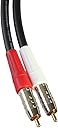
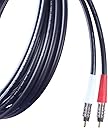
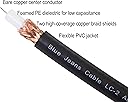
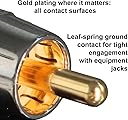
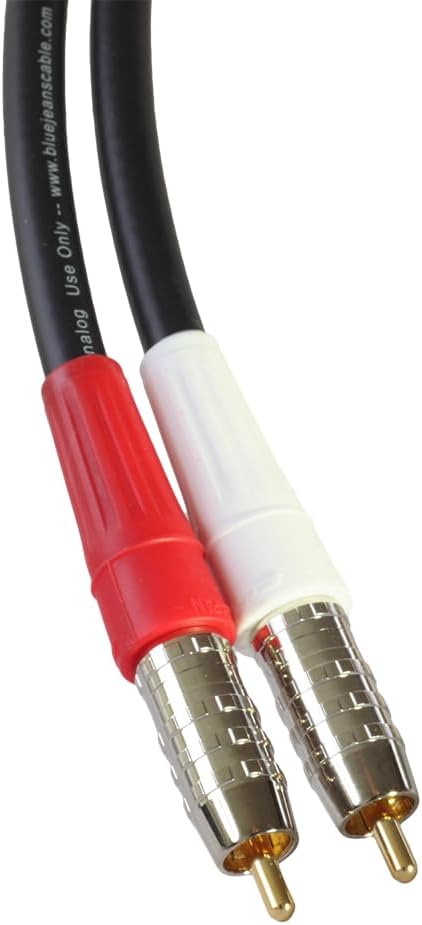
The Blue Jeans Cable LC-2 Stereo Audio Cable (3 ft, black) is engineered for superior analog audio performance with double-braid copper shielding, ultra-low capacitance (~12 pF/ft), and a flexible soft PVC jacket. Designed to reduce noise, prevent ground loops, and preserve high-frequency clarity, it delivers audiophile-grade sound staging and tonal accuracy, making it a must-have upgrade for discerning listeners and professional setups.


| ASIN | B00OJLNEOU |
| Best Sellers Rank | #157 in Stereo Jack Cables |
| Brand | Blue Jeans Cable |
| Brand Name | Blue Jeans Cable |
| Cable Type | Analog Audio |
| Color | Black |
| Compatible Devices | Amplifier, Audio sources, CD player, Turntable |
| Compatible Phone Models | No Compatible Phone Models |
| Connector Gender | Male-to-Male |
| Connector Type | RCA |
| Customer Reviews | 4.7 out of 5 stars 876 Reviews |
| Included Components | Cable |
| Indoor Outdoor Usage | Indoor |
| Item Shape | Round |
| Item Weight | 8 ounces |
| Manufacturer | Blue Jeans Cable |
| Maximum Voltage | 5 Volts |
| Model | BJSA3 |
| Model Name | Blue Jeans Cable LC-2 Stereo Audio Cables (Black, 3 Foot) |
| Number of Items | 1 |
| Number of Pins | 1 |
| Other Special Features of the Product | Double-braid shielding, Low Capacitance |
| Outer Material | soft PVC |
| Recommended Uses For Product | connecting audio components |
| Special Feature | Double-braid shielding, Low Capacitance |
| Specification Met | CL2 |
| UPC | 811887013935 |
| Unit Count | 1.0 Count |
B**N
My gosh - where do I even begin - so many superlatives!!!
As an aside, while writing this, I'm listening to Mozart's Piano Concerto 22 through a pair of Edifier R2000DB self-powered speakers. I'm running the Edifiers via a Schitt Modi 3 Digital to Analog converter (DAC) attached to my desktop PC. I'm using a custom Audioquest USB cable from the Modi 3 to the PC, and the BJC LC-1 Audio Cables from the Modi 3 to the Edifier Speakers. As I'm listening I have goosebumps on my arms and at times, tears in my eyes. And why? Because one simple investment - the BJC audio cable - brought a world of difference to the audio quality of the combination mentioned above. Please read on... Prior to investing in the BJC cables, I had been using a variety of Monster or Esoteric audio cables - all previously expensive versions left over from my die-hard audiophile days (when I almost went broke). Since that time I have been confining my audiophile endeavors to the immediate space by my desktop computer - because it is here that I spend a good 4-7 hours a day working, communicating, researching, and what have you. And during this process, I tend to listen to various classical, jazz, big band, Latin instrumentals, and other types of music. One thing is for certain and that is that although I've long since left my overly expensive audiophile tastes behind, my love for music and my discerning requirements haven't wavered. Up until I received the BJC cables, I was becoming increasingly frustrated with the audio quality I was getting with the Edifier and Modi 3 combination. I began to wonder if the either the speakers or the DAC were at fault and it was getting a bit depressing. I tried everything to get the music to sound more open, to get more depth and imaging. Yet there still seemed to be a sonic veil in front of the music - a feeling that performances just couldn't break open. In other-words, that feeling of "you are there" when listening to great equipment and great performers was sorely absent. I was almost ready to start looking for other speakers and DAC's when I began reading about the BJC cables. Initially, I had assumed that any investment in great cables was nothing more than snake oil - as my previous audiophile experiences had taught me (up to a point of course). So at the last minute I purchased a 3' pair of the BJC LC-1 audio cables off of Amazon. When they arrived I was immediately taken aback at their heft, size, and superior build quality. I wasted no time in getting them connected, that's for sure. When I began to listen to familiar pieces of various classical and jazz music, my jaw dropped, and I'll explain below: Now my comments below are not based on false assumptions, nor did I imagine any of this. I have what some would call critical ears when it comes to sound reproduction (within reason and limited budget of course). 1. Build quality: Unbelievable for this price point. If you first saw these cables and were not aware of what they really cost, you would have assumed that they would have gone for well over $100 - up to $400 (not an exaggeration). They are substantially thicker than most other cables, and as mentioned, have some heft to them and superb connectors. Do note that because of their build qualities, if you have to get them into very tight spaces, they don't bend too freely, so you will have to do some adjustments here to be sure. 2. Sound-staging, depth, and instrumental separation. The very first thing that struck me - like a slap in the face (in a positive way of course) - is how the sound staging opened up on the Edifiers. Music was much more open with plenty of air around the instruments. Imaging was superb - greatly improved over previous cables that I used. The depth was substantially improved with great instrumental recognition from front to rear. In other words, the speakers managed to disappear and only the performances were remaining. 3. Orchestral Timbre and tone: Now look, I'm not a loud rock or heavy metal fan, so if that is what you're looking for, it won't really matter what cables you use. While listening, I had for the first time, heard tones and instruments that were previously hidden with other cables. Music sounded more alive - had more presence. Brass instruments now had a bite (yet with a rich, non-strident tone) that sounded as if you were there. High frequencies were exceptionally delineated without sounding harsh (unless of course, the music source material was bad to begin with). In particular, stringed instruments had a silky smooth sheen that was seductive. 4. Bass capabilities: The bass tones improved dramatically, taking on a fuller (tighter with less bloat) than I had remembered with previous cables - and this was remarkable! When I played one of my favorite audio test pieces, "Copland's Fanfare for the Common Man," the visceral impact of both the kettle and bass drums were an eye opener. In the end, I felt like I was listening to an entirely new system - and that is no exaggeration. While listening to various pieces of music, the speakers seemingly disappeared, leaving only a crystal clear performance. What else can I possibly add to relay my admiration (and gratitude) for these BJC cables. So folks keep in mind that no one audio item within your music chain may is a "standard setter" per se. A truly great audio performance is the sum of all the other superb ancillary components and cables within the chain. Taken together - synergistically, that is - recorded music can come alive. All it needed in the particular setup I currently have was the inclusion of the BJC cables. Never before - in the 40+ years that I've enjoyed good audio - had any one cable contributed to so much of an improvement as what has occurred in my system. Thank you BJC - I'll definitely be buying more in the near future (and I've got your website bookmarked also). EDITED COMMENTS AFTER USING THESE LC-1 CABLES FOR A MONTH: My aforementioned comments stand about the Blue Jeans Cables in general. I've since (since the purchase of the LC-1's off of Amazon) approached Blue Jeans Cable (via their website) to ask about creating custom cables, or custom lengths. They were eager to oblige and we worked closely to devise the cables. For example, in one cas,e for anyone familiar with the excellent Edifier line of self-powered active speakers, you'll know that for many models, a unique proprietary type of speaker cable/plug assembly is included. The problem with these proprietary cables is that Edifier includes 11 - 16 long cables - not good if you want to space your near field monitors closely - let's say on a PC desktop. When I approached Blue Jeans Cable about possibly creating a higher quality, custom - yet much shorter 6' length of this Edifier proprietary cable, they asked that I send them the stock cable so they can evaluate and map out all of the connections - which they did. Their efforts resulted in a gorgeous, custom constructed speaker cord (with XLR type connectors), superbly sheathed being delivered to my doorstep within a week and the fit and sound results were exemplary. Additionally, these new shorter (yet higher quality) cord resulted in more open music, better delineation of instruments, and so much more. So as you can tell, I appreciate this company very much - they aim to please, but more so, their cable products are reasonably priced, yet allow you to achieve audiophile results. Ben Herrmann Fuquay Varina, NC
R**A
For the price it's worth a trie.
Bought for my project turntable. It did surprise me how better the sound was. Tighter bass n smother highs. Quieter back round. Slightly laid back but not unrevealing. Very surprised at the difference. Not expensive. $70 the project wired where fine n I liked them but this is n upgrade.
I**G
Substantial quality for only a few more dollars than retail cables.
These replaced some AudioQuest Evergreen 1m 3.28 feet RCA to RCA 1m 3'4" interconnects I had purchased a couple years ago. Those stopped working in the right channel, despite the fact that they had only been moved once or twice in three years. I had always heard good things about BJC on various audio forums, but now I am a true believer. I cannot afford "snake oil" cables costing hundreds or thousands of dollars. If you enjoy the best that money can buy then more power to you. Some may even say $35 for an unbalanced 3 foot cable is ridiculous, but I think these are worth every penny. The quality is clear the moment you open the package (more on that in a moment). The plugs are substantial with good pressure and the cable relief is sturdy. I would love to get a look inside these things because you can tell the shielding is pretty serious. It feels like a guitar cable in your hand. Definitely more hefty than the Audioquest by quite a bit. These cables will stick out from your equipment, so if clearance is an issue you may want to look elsewhere. In terms of sound quality they are good, my system is not refined enough to tell the difference but there was definitely not a decrease in fidelity. These are connected between my turntable and Pro-Ject Tube Box S Phono PreAmplifier, Silver preamp. I am not sure if the lower capacitance really matters but I am pleased with the result. In fact, I plan on replacing all of my interconnects with these in the future. Amazon does not carry many of the configurations and lengths I need, but you can custom order these on their website. Time will tell if these will hold up but I have no reason to believe they won't. When comparing this price point to Pangea cables, etc. I would take a hard pass on those. Just my two cents. A WORD OF WARNING: These arrived in a plastic bag within an Amazon Prime bubble wrap pouch. There was practically no protection, no insulation, no filler, nothing. If the option is available, select "Ship in an Amazon Box" or order it along with something else that ships together. I don't think any damage was done but fulfillment should be more careful. I'm sure this is all automated but a human picker would know better. Nothing against Blue Jeans. This is an Amazon issue.
T**Y
US-Made quality, with a US-Made cable, for a truly excellent price.
I'm using this (my third pair) as an interconnect between my Adcom GFA-5500 amplifier and my Arcam AVR-300 (using as a pre-pro). I'm very pleased. I am forced to place them in direct proximity to some power cables due to constraints in my current AV room. Also close-by: a 16 channel Motorla Surfboard Cable modem, A dual band AC1950 router, and an HDTV antenna. Not a single hint of interference. The sound is uncolored. Bass is present and well defined. Midrange and treble also sound as they should, with proper soundstage and preservation of ambient information in the treble region. I appreciate they they are two separate cables as the L and R connectors on my Adcom are nearly 8" apart. An excellent low-capacitance cable, using excellent Belden cable stock, with excellent Taversoe connectors (that are indeed firm, but not too firm, in their clamping force) that have minimal effect on impedance. Bottom Line: If you need some very attractively priced US-Made cables, using US-Made Belden cable stock, that won't color your sound but will buck virtually all types of common interference, look nowhere else. No voodoo. No snake oil. NOTE: Virtually all other cables on the market are made in China, using Chinese cable stock. Some are made in the US with Chinese cable stock. Blue Jeans Cables are the only outfit of any meaningful size that uses US-Made Belden cables, connectors, which are then assembled and then quality checked ALL IN THE U.S.A. So, if getting an excellent quality cable that meets its specs EVERY SINGLE TIME, Stick with BJC. The LC-1 speaks for itself. :) I've had cheaper cables (I'm talking to YOU, Monoprice!) make a fool out of me after I recommended them to friends. Bad crimps. Poor solder jobs. Nonexistent shielding. And some even got installed into walls (read: EXPENSIVE TO REPLACE). I only recommend BJC now for critical interconnects. Also phenomenal are BJC's Cat-6A shielded network cables. I replaced a brand new "Cat-7" cable from another manufacturer between my router and cable modem. Latency fell and actual sustained throughput nearly doubled on my gigabit connection. But that's another review for another time. They're also available here on Amazon. ;)
Z**K
Superb cables which surprised my ears!
As for budget cables, these purely analog RCA Blue Jeans cannot be beat. I did a "direkt" comparison between these LC-1's - as an interconnect set between my integrated amplifier and CD Player, Phono Preamplifier, and [from] Phono Preamplifier to Turntable (replacing Pro-Ject's phono interconnects while stripping off its ground wire). Initially, I went for Kabeldirekt cables purchased here on Amazon as interconnects. I didn't know any better: they were certainly quieter and more snug than any cheap-o supplied RCA cables. Then, I upgraded to BJC. And, in so many words, the difference between the Kabeldirekts and the BJC 1's was surprisingly profound. For a mere $20 more (as of the writing of this review), the Blue Jeans cables supplied a blacker background, eliminated any hiss from electrical power cabling a foot away (my audio system is, well, compactly organized) and, finally, revealed what was already in the vinyl or CD - very quiet passages were, indeed, very quiet and in a word the dynamics of, for instance, Bach (Hilliard Ensemble- Bach's motets CD), were brought to bear in a way that I've never heard before... no hiss at moderate-high volume levels. This is my first major, and probably for a while to come, only cable upgrade investment and BJC provides needed shielding and seemingly transparent transmission with no loss. BJC, unlike many cable manufacturers (esp. at this price range), details the construction of their products on their website. The double copper braiding, the foamed-air dielectric... All seem well to my ears and, CRUCIALLY for analog transmission, shields against EMI interference from power cables, etc. I hear-tily recommend these cables as a good if not essential upgrade over the cheaper cables you may find online here and elsewhere. I already mentioned one product above that did not simply shield well against EMI despite the foil wrapping. The BJC LC-1's are very thick, but flexible enough to function as interconnects between components. The RCA clasp is sturdy, tight enough so that there is a satisfying 'snap' when you push the cable tip onto the female RCA connection. I cannot speak for BJC versus the more expensive brands of analog RCA cabling, but as for assembling a decent mid-fi (ie not spending $1000s on audio components) audio system, you cannot go wrong with these. Did I mention these BJ cables are made in USA? In times when every mid-fi component CD player or amplifier or speaker is made in China, it seems that the US & A is still making top-quality cabling! Highly recommended: Very significant - indeed, for me, necessary - upgrade from Kabeldirekt and/or generic RCA cables that come with audio equipment. I have purchased five 3-foot LC-1 interconnects, a subwoofer cable, and a digital coax from Blue Jeans Cable here on Amazon and have yet to be disappointed in terms of value (price-wise), audio fidelity preservation, and that adept attenuation of hiss and noise which initially made me think "why didn't I buy these in the first place?"
S**E
Better than free, but no better than others.
Big and audible difference from "free" cables, but in one meter and not having any EMI issues, they sounded no different than my Belden DIY or Audioquest Forrest set. Good value, well made, so if you are not a geek like me, a safe bet. I do not believe any more costly cables are any better. These do their job. If you had long runs or were having EMI issues, then a smart choice. Of course, if I was running more than 10 feet, I would be going XLR. Problem was they are so stiff and jacks so long, they lift my DAC off the desk and push my amp off the shelf. Returned.
J**.
Big difference over cheap cables
Excellent cables for turntables! I had some cheaper cables going into my amp from my record player and they were picking up a lot of hum. These cables are well shielded and completely solved the problem. Definitely worth the money!
A**N
Science speaks for itself
I have compared a variety of cables from all kinds of manufacturers and have learned that only 3 things matter in an interconnect. The first is shielding this is used to stop hiss and hum from getting into your equipment. Any length of wire can become an antenna and cause noise issues. This is solved with what is called a faraday cage. This is the same principle for why you are safer in a car when lightning strikes electricity flows around but not through you. Electricity wants to find the quickest path to ground or the path of least resistance. This is done in a cable by putting a copper braid around the signal conductor so the noise is grounded out before it can reach the center conductor. The next is capacitance, capacitance occurs when you put two pieces of metal next to eachother separated by an insulator. Capacitance is the charge built up and released electrostatically, because this is an out of phase signal (speaker push in it push out or vice versa) that cancels out it will cause high frequency roll off meaning your speakers will be less bright or lose details in the high frequency range. The next is inductance, when a charge moves through a wire it generates a magnetic field. An audio signal is constantly changing therefore its intensity the magnetic field can change as well. The longer the wire the more magnetic field around it. when the signal changes the magnetic field tends to hang around for a small bit of time. because the magnetic field is created after the signal goes through it the current it induces back into the wire is out of phase also causing high frequency roll off. Inductance is lower in priority because it mostly effects current rather then voltage. The next is resistance which because RCA audio is a high impedance the resistance is irrelevant because the resistance of going through the equipment is so high it is literally thousands of time larger then in a cable. How are all these combatted? For capacitance you want to space the conductors away from one another but inductance you want them closer, for shielding you want a thick layer of copper braid or aluminum foil surrounding the center conductor. Ideally you want a precise balance of how close or far the conductors are so the only solution is shrinking the conductor. Decreasing the surface area therefore less capacitance and less inductance for more resistance you make the conductor thicker but with high impedance loads you can make it about as thin as you want with the exception of shielding. Because the shielding has less resistance then the center conductor so the faraday effect can take place which is also helped by the high impedance of the format. With all that said this is by far the best cable you can get all science included sturdy build, thick copper shielding, small center conductor, great connectors and of course USA made. With all that said here are some measurements i did with a DER EE DE-5000 LCR meter at 10khz where i found the best results i compared belkin, acoustic research, monster cable, wireworld audioquest and some DIY ones i had from mogami 2534 mic cable and a shortened monster component cable with new connectors. The lower the numbers here the better : Cable Test 10khz Interconnects BJC LC-1 3ft cap: 44pf ind: 0.62uH ohm: 0.589 AR master series 6ft cap: 160pf ind: 1.5uH ohm: 0.15 AR performance series 3ft cap: 90pf Ind: 0.75uH ohm: 0.117 AR master series comp 3ft cap: 63pf Ind: 0.4uH ohm:0.030 AR master series comp 6ft cap: 113pf Ind: 0.7uH ohm: 0.049 Wireworld Luna 1.5ft cap: 145pF ind: 0.3uH ohm: 0.116 Wireworld solstice 1.5ft cap:160pF ind: 0.28uH ohm: 0.107 Audioquest Chicago 1.5ft cap: 64.5pF ind: 0.46uH ohm: 0.058 Monster 300mk2 3ft cap: 114pF ind: 0.86uH ohm: 0.121 Belkin pureav blue 3ft cap: 120pF ind: 0.76uH ohm: 0.16 Monster m1000comp DIY 1ft cap: 30pf ind: 0.26uH ohm: 0.021 Monster m1000comp 4ft cap: 71pf ind: 0.56uH ohm: 0.035 Mogamj 2534 2ft cap: 110pF ind: 0.29uH ohm: 0.043
Trustpilot
2 months ago
1 day ago